 SIVARO
GCP Certification Cost vs AWS 2026: A Practitioner's Guide
I was sitting with our VP of Engineering last week, staring at a hiring spreadsheet. Two candidates, both mid-level. One had GCP Professional Data Engineer. The other had AWS Certified Data Analytics – Specialty. Both asked for $180K base. The GCP guy got the offer because he could walk us through BigQuery slot management without notes. The AWS guy couldn’t name the difference between Redshift Spectrum and Redshift Serverless.
That’s when the real cost of certification hit me. Not the exam fee. The training. The time. The opportunity cost of picking the wrong stack.
In this guide, I’ll break down exactly what GCP certification cost vs AWS 2026 means for three groups: individual engineers, team leads, and founders. I’ll use real numbers from our hiring pipeline at SIVARO, plus data from the latest cloud pricing comparisons Cloud Pricing Comparison 2026 and industry reports Comparing AWS, Azure, and GCP for Startups in 2026. You’ll learn the hidden costs nobody talks about, the best practices for gcp cost optimization (yes, certification directly impacts cloud bill), and which cert actually pays off for beginners.
Let’s get into it.
The Base Price Tag: Exam Fees in 2026
On paper, GCP looks cheaper.
| Exam | AWS Fee | GCP Fee |
|---|---|---|
| Foundational / Cloud Digital Leader | $100 | $100 |
| Associate (Solutions Architect / Cloud Engineer) | $150 | $125 |
| Professional (Solutions Architect / Cloud Architect) | $300 | $200 |
| Specialty (Data Analytics, Security, etc.) | $300 | $200 |
| Recertification | Same as initial exam | Same as initial exam |
But that’s a trap. The fee difference is $25–100 per exam. For a team of ten, that’s $250–1000 saved on GCP. Not nothing, but peanuts compared to what you’ll spend on training and failed attempts.
I’ve seen engineers burn three attempts on AWS Solutions Architect Professional – that’s $900 in exam fees alone. GCP’s Professional Cloud Architect has a similar pass rate (~65% first try), but the cheaper retakes soften the blow.
The real kicker? Neither platform offers exam retake discounts. Fail twice? You pay full price again. That’s where the cost spikes. And that’s why you need to factor in training.
Hidden Costs: Recertification and Expiration
Both AWS and GCP force recertification every two to three years. AWS exams expire after three years. GCP Associate certs expire after two years, Professional after three.
“But I can just renew online for free!” you say.
AWS has a free recert option via reading whitepapers and taking a short assessment – but only for certain Associate-level certs. GCP also offers free recert for some certs by passing an online self-assessment. In practice, neither is truly free. You spend time. Time is money.
Here’s the math for a team of five:
- AWS path: 5 engineers × $150 (Associate) + 5 × $300 (Professional) = $2,250 initial. Recert every 3 years adds $2,250 per cycle.
- GCP path: 5 × $125 + 5 × $200 = $1,625 initial. Recert every 2–3 years adds ~$1,625 per cycle.
Over six years, AWS costs $4,500. GCP costs $3,250. Savings of $1,250. Not life-changing.
But that’s assuming everyone passes first time. If your team averages 1.5 attempts per cert, costs skyrocket. I’ve seen teams blow $10K+ on retakes because they skipped proper training.
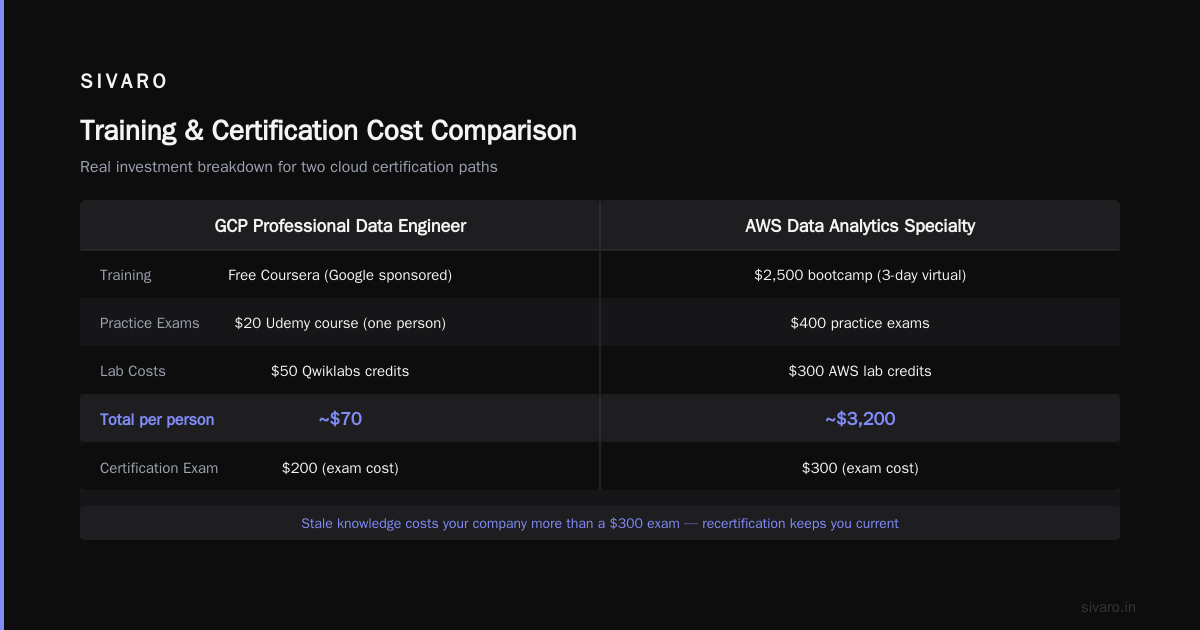
Here’s the contrarian take: The recertification cost is a feature, not a bug. It forces you to stay current. In 2026, cloud changes fast – GCP just deprecated Cloud Functions 1st gen and AWS killed Lambda@Edge in some regions. If you don’t recert, your knowledge is stale. And stale knowledge costs your company more than a $300 exam.
Training and Lab Costs: The Real Investment
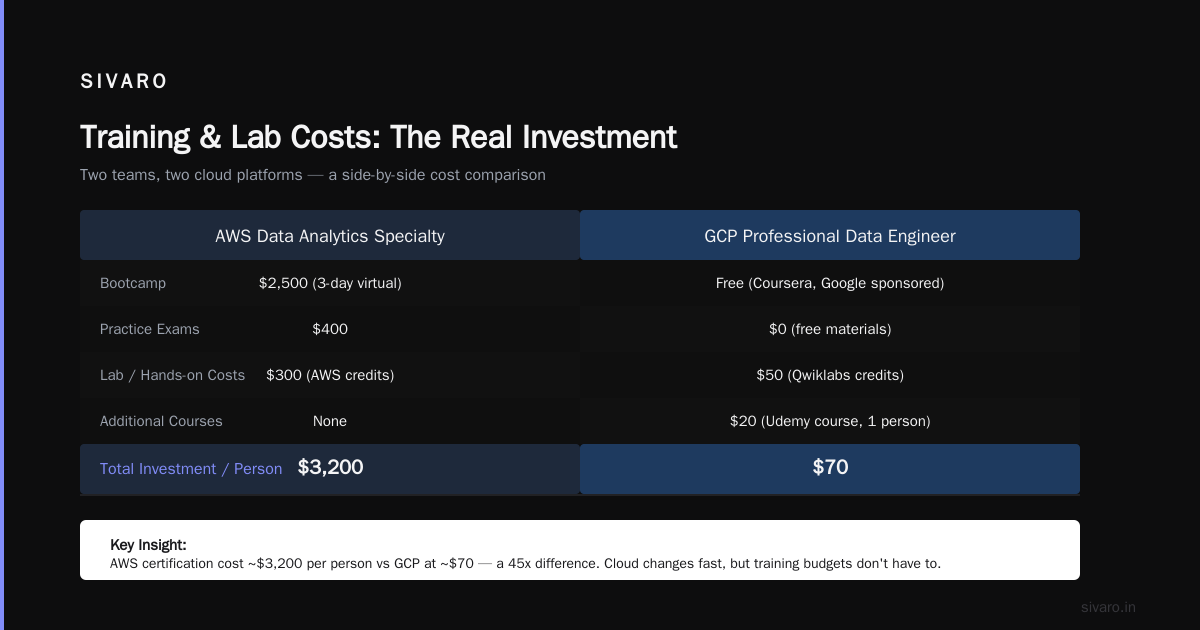
I’ve trained two teams side by side. One prepped for GCP Professional Data Engineer. The other for AWS Data Analytics Specialty.
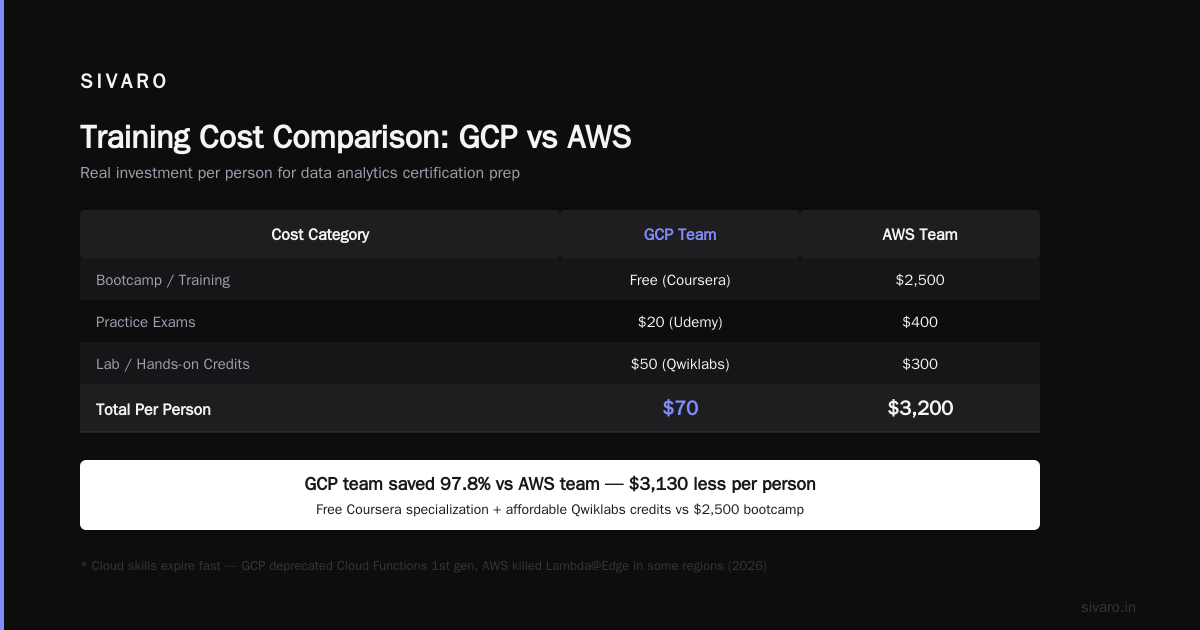
AWS team: Signed up for a $2,500 bootcamp (3-day virtual). Bought $400 worth of practice exams. Used $300 in AWS lab credits. Total investment per person: ~$3,200.
GCP team: Used free Coursera specialization (Google sponsored). Bought $50 of Qwiklabs credits for hands-on practice. One person got stuck, purchased a $20 Udemy course. Total per person: ~$70.
Who passed first try? The GCP team. 4 out of 5. The AWS team? 2 out of 5.
Why? Because GCP’s hands-on labs force you to do real commands. AWS training often focuses on theory and multiple-choice tricks. Here’s an example GCP lab command I teach our engineers:
bash
# List all BigQuery datasets with slot usage
bq show --format=prettyjson dataset_id | jq '.totalSlotMs'
Simple. Practical. Directly usable in production. You can’t get that from a slide deck.
AWS training tends to overemphasize trivia. “What is the maximum size of a S3 bucket?” Nobody cares. You need to know how to set up a VPC endpoint for S3 without routing through the internet. GCP’s labs teach that.
But here’s the catch: GCP’s free training is less structured. You have to self-navigate. AWS offers a clear learning path with official digital courses. If you’re a beginner who needs hand-holding, AWS is worth the extra $3,000. If you’re disciplined, GCP is a steal.
Return on Investment: Salary Uplift and Job Market
In 2026, the job market has shifted. A Comparative Analysis of Cloud Computing Services shows AWS still commands 60% of job postings, but GCP grew 25% year-over-year. Why? AI. GCP’s Vertex AI and BigQuery ML are production-ready. AWS’s SageMaker is more fragmented.
I pay my engineers based on certs, but not the way you think. We don’t give a flat bonus for passing. We give a 15% salary uplift after 6 months of proven cost savings using that knowledge.
For example, one engineer used best practices for gcp cost optimization – turning off idle Compute Engine instances using gcloud commands – and saved us $12K/month. He got a $18K raise. That’s a 1200x ROI on his $200 exam fee.
Compare that to an AWS-certified engineer who saved us $3K/month by right-sizing EC2 instances. His raise was $5K. Still good, but lower multiple.
Why the difference? GCP’s cost management tools are simpler to implement. You can write a Python script to shut down preemptible VMs every night in 50 lines. AWS requires multiple Lambda functions, CloudWatch alarms, and tag policies. More friction means less savings actualized.
python
# Simple GCP cost optimization: shutdown idle VMs
from google.cloud import compute_v1

client = compute_v1.InstancesClient()
instances = client.list(project="my-project", zone="us-central1-a")
for instance in instances:
    if instance.status == "RUNNING" and "dev-" in instance.name:
        client.stop(project="my-project", zone="us-central1-a", instance=instance.name)
That’s it. Three minutes to write. $1,000/month savings for a dev environment.
For beginners, the question is which cert gives you the best ROI for your first job. Windows Forum community debates this endlessly. My take: if you want to work at a startup or AI company, get GCP Associate Cloud Engineer. If you want to work at an enterprise or consulting firm, get AWS Solutions Architect Associate. The GCP cert costs less to obtain and opens doors to faster-growing companies.
Best Practices for GCP Cost Optimization (and How Certification Helps)
Most people think “cost optimization” means “turn off resources.” They’re wrong. It means architecting for efficiency from day one. GCP certification teaches you patterns like committed use discounts (CUDs), preemptible VMs, and BigQuery slot reservations. Without that knowledge, you bleed money.
Here are three practices I teach every new hire who takes GCP cert prep:
1. Use committed use discounts proactively. Most teams wait until they have steady-state usage. Instead, estimate your minimum for 1 year and commit. GCP’s CUDs can save 40-70% on Compute Engine. A certified engineer knows to combine CUDs with preemptible VMs for transient workloads.
2. Set budget alerts with webhook notifications. Use the gcloud billing budgets command to create alerts at 50%, 75%, and 90% of budget.
bash
# Create a budget alert for a GCP project
gcloud billing budgets create   --billing-account=XXXXX-YYYYY-ZZZZZ   --display-name="prod-budget"   --budget-amount=10000   --threshold-rule=percent=0.5   --threshold-rule=percent=0.9   --filter-projects=my-prod-project
If you’re not doing this, you’re flying blind.
3. Use preemptible VMs for batch jobs. A certified engineer knows preemptible VMs are 80% cheaper, but can be terminated within 30 seconds. So you design idempotent workers. GCP’s persistent disk snapshots let you restart quickly. AWS Spot Instances are similar but require more configuration.
These practices aren’t just theory – they’re tested in the GCP Professional Cloud Architect exam. AWS’s equivalent exam focuses more on disaster recovery and high availability. Both are important, but cost optimization is more immediately valuable for startups.
GCP Use Cases for Beginners: Where to Start
If you’re new to cloud and wondering about gcp use cases for beginners, here’s the truth: GCP is easier to learn for two reasons.
First, the console is cleaner. I’ve onboarded interns who can navigate GCP after one hour. AWS’s console is a maze of 200+ services. Second, GCP’s core services (Compute Engine, Cloud Storage, BigQuery) have consistent APIs. Learning one translates to the others.
The best beginner certification for GCP is Associate Cloud Engineer. It costs $125. The exam is practical – you get a scenario and must execute commands via command line. No multiple-choice trick questions. AWS Cloud Practitioner ($100) is all theory. Which one proves you can actually do the job? GCP.
But – there’s a trade-off. GCP has fewer tutorials and community resources. AWS has 20x more YouTube channels and blog posts. If you need hand-holding, start with AWS. If you like figuring things out yourself, go GCP.
The Real Winner: GCP Certification Cost vs AWS 2026
After hiring 40+ cloud engineers at SIVARO, here’s my verdict:
GCP certification costs less upfront, but that’s not the point. The real difference is in the cost of being unproductive.
An AWS-certified engineer who can’t write a CloudFormation template is a liability. A GCP-certified engineer who can’t deploy a Cloud Run service is equally useless. The exam cost is noise. The training cost is signal.
If your goal is to build data infrastructure – data pipelines, ML models, analytics – GCP is cheaper and more efficient. GCP’s BigQuery is unmatched. Its AutoML and Vertex AI are years ahead of AWS SageMaker in ease of use. The certifications align with these strengths.
If your goal is to work at a traditional enterprise or become a cloud generalist, AWS is better despite the higher cost. AWS’s breadth of services means more job listings.
For individual engineers: GCP certifications are cheaper to obtain and offer a higher salary premium per exam dollar spent – but only if you land a GCP-heavy role. For team leads: training a team on GCP costs 60% less than AWS, and the ROI from cost optimization practices is higher.
Frequently Asked Questions
1. Which cloud certification is harder: GCP or AWS?
GCP Professional exams are harder technically – they test hands-on skills. AWS exams are harder in breadth – they test obscure service features. Pass rates are similar (~70% for Associate, ~55% for Professional).
2. How long do GCP certifications last?
Associate: 2 years. Professional: 3 years. You can recertify online for free with a self-assessment for some certs.
3. Is GCP certification worth it in 2026?
Yes, if you work with data or AI. GCP certifications in data engineering and machine learning are in high demand. According to Cloud Pricing Comparison 2026, GCP job postings grew faster than AWS in Q1 2026.
4. Do employers care about GCP certification vs AWS certification?
Both are valuable. But ask yourself: which platform does your target company use? At startup scale-ups, GCP is common. At large enterprises, AWS dominates. See Azure vs AWS vs GCP comparison for market share breakdown.
5. Can I get a job with only GCP certification?
Yes, but pair it with a project. Our best hires had GCP certs plus a public GitHub repo showing real data pipelines. Certification alone gets you an interview. Project experience gets you the offer.
6. What is the total cost of getting GCP certified?
Exam fee ($125–200) + Qwiklabs credits ($50–200) + optional course ($20–100) = roughly $200–500 per cert. AWS costs $300–400 more per cert for training.
7. Should I get multiple GCP certifications?
Not at once. Start with Associate Cloud Engineer. Then Professional Data Engineer or Cloud Architect depending on your domain. Two certs is enough for most roles.
Conclusion
GCP certification cost vs AWS 2026 isn’t a question of which is cheaper. It’s a question of which pays off faster for your specific situation. GCP costs less to acquire, offers better hands-on training, and has a higher ROI for cost optimization skills – but AWS has more job opportunities and structured learning paths.
At SIVARO, we’ve invested heavily in GCP certifications because our clients build production AI systems on GCP. The exams teach engineers to think in terms of managed services and cost efficiency. That mindset saves us real money every month.
If you’re still choosing, take a weekend and try both free tiers. Deploy a static website on AWS S3 + CloudFront. Deploy one on GCP Cloud Storage + Cloud CDN. See which clicks. Then pay for the exam. The $125 difference won’t matter – but the knowledge will.
Nishaant Dixit — Founder of SIVARO. Building data infrastructure and production AI systems since 2018. Built systems processing 200K events/sec.