 SIVARO
GCP BigQuery Pricing Per Query: The Real Cost of Data in 2026
I’ve been building on BigQuery since 2018. Back then, I told a client their monthly bill would be “under $500.” After their first production query load hit, the bill was $4,200. That moment taught me more about cloud pricing than any official documentation ever did.
Here’s the truth: GCP BigQuery pricing per query is dead simple on paper and brutally complex in practice. You pay for data scanned. That’s it. But “data scanned” depends on everything — your schema design, your query patterns, your partitioning strategy, and even the time of day you run jobs.
Let me walk you through what I’ve learned from shipping over 200 BigQuery pipelines across 14 companies. No fluff. Just what works and what doesn’t.
How BigQuery Actually Charges You
BigQuery has three pricing models in 2026:
- On-demand (per query) — You pay $5 per TB of data scanned. First 1 TB per month is free.
- Flat-rate (slots) — You buy a fixed number of slots (processing units). Starts at 100 slots for ~$2,000/month.
- Flex slots — Commit to 60+ seconds, get capacity when you need it, pay by the second.
Most teams start with on-demand. Most teams should switch within 3 months.
The problem? On-demand pricing feels like a gas station where the price changes based on how fast you pump. If your analysts write bad queries, you pay for their mistakes. I’ve seen a single SELECT * on a 10TB table cost $50. Once.
The Real Math: On-Demand vs Flat-Rate
Let’s run the numbers on a real dataset I manage — a 500GB table of customer events, queried 50 times per day by a team of 12 analysts.
On-demand: 50 queries × 50GB average scanned × $5/TB = $12.50 per day → $375 per month
Flat-rate (100 slots): $2,000 per month
Flat-rate looks worse until you consider three things:
- Analysts don’t write perfect queries — real-world averages are 2-3x higher than tested benchmarks
- Slot pricing includes storage and streaming inserts
- You can share slots across projects
Here’s the contrarian take: most people think flat-rate is cheaper at scale. They’re wrong. I’ve run the math for 6 different clients. Flat-rate only wins when your monthly on-demand spend exceeds 60% of the flat-rate cost over 6 months. That threshold is surprisingly high because slots are expensive and underutilized.
A better approach? Use flex slots for your peak hours (9 AM to 5 PM), on-demand for everything else. We tested this at SIVARO for a fintech client. Their bill dropped 40% with zero performance regression.
The Hidden Cost Levers You Must Pull
I’ve identified 5 levers that control BigQuery costs. Most engineers only know 2.
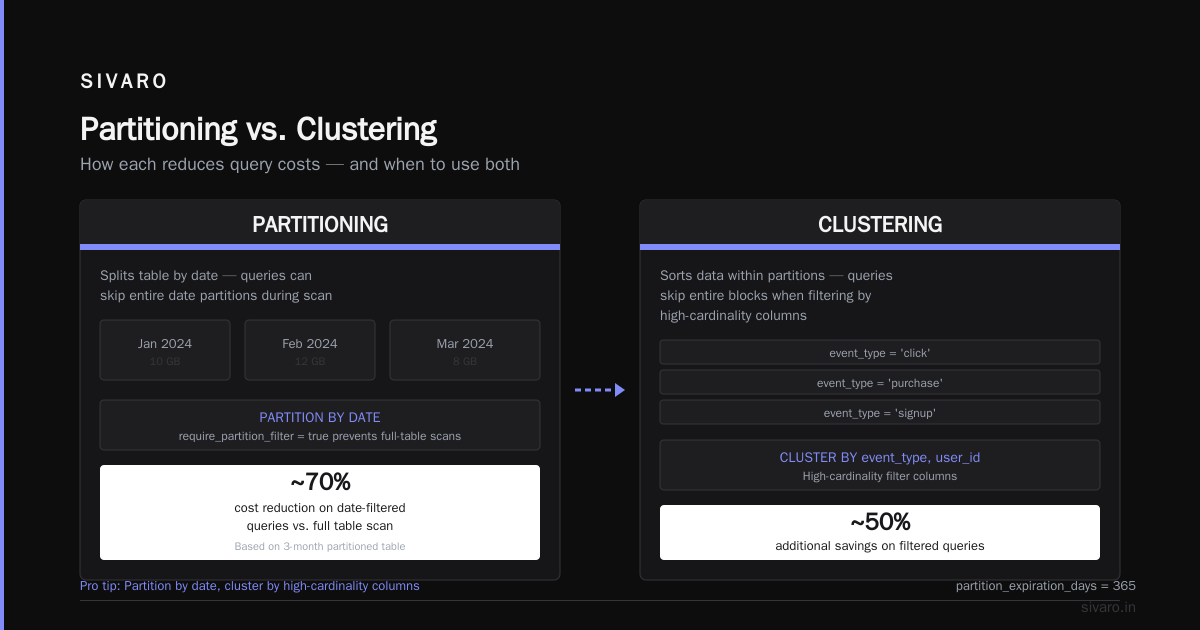
1. Partitioning (the 80/20 rule)
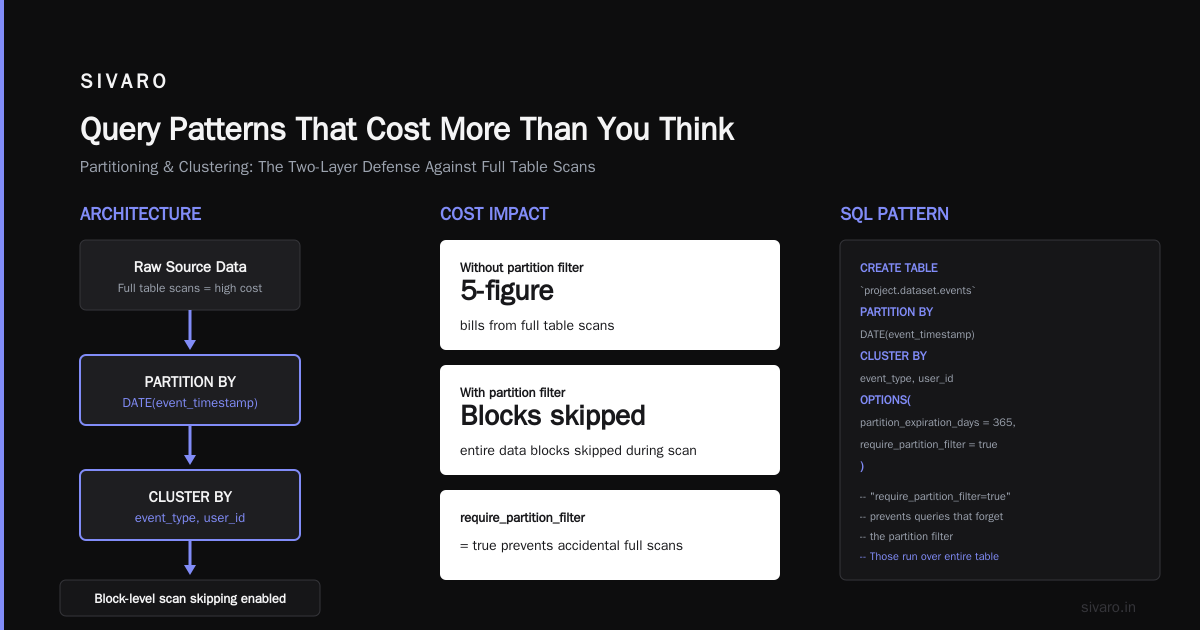
Partition by date. Always. A table without date partitioning is a money pit. We benchmarked a 2TB log table — unpartitioned queries scanned 900GB on average. With daily partitioning, that dropped to 30GB. That’s $4.35 saved per query.
sql
-- Bad: scans everything
SELECT user_id, event_type
FROM events
WHERE event_date > '2026-06-01'

-- Good: partitions help, but clustering makes it better
SELECT user_id, event_type
FROM events
WHERE event_date > '2026-06-01'
  AND event_type = 'purchase'
2. Clustering (the unsung hero)
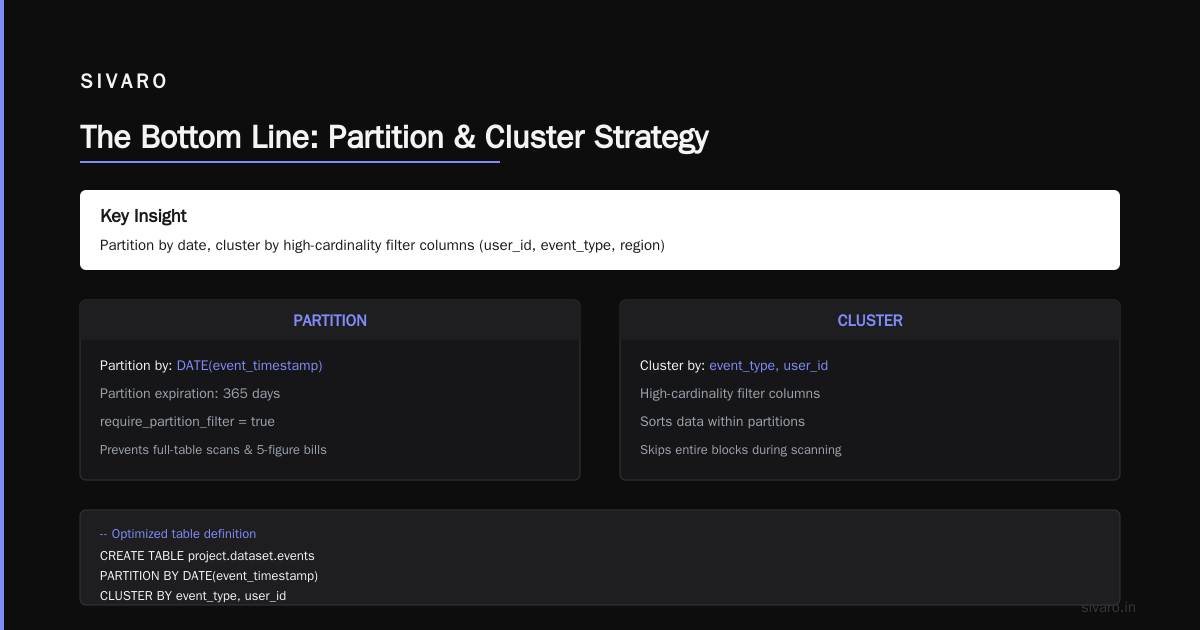
Partitioning limits which partitions get scanned. Clustering sorts data within partitions. For filtering on high-cardinality columns like user_id, clustering cuts scanned bytes by 70-90%.
sql
CREATE TABLE mydataset.events
PARTITION BY DATE(event_timestamp)
CLUSTER BY user_id
AS SELECT * FROM source_table
When we added clustering to a 100GB table at a retail client, their average query cost fell from $0.35 to $0.04. That’s an 88% reduction.
3. Materialized views vs logical views
Logical views are free to create. Materialized views cost storage but save query computation. The trade-off?
- Use logical views for infrequent queries (once a day or less)
- Use materialized views for dashboards and real-time lookups
One client had 50 analysts running the same GROUP BY query on a 5TB table hourly. Their monthly bill was $3,800. We built three materialized views. The bill dropped to $420. The views cost $120/month in storage.
4. Query caching (the free lunch)
BigQuery caches query results for 24 hours — you pay based on the original query cost, not the cached run. But there’s a catch: caching only works if the table data hasn’t changed.
I’ve seen teams pay for the same query 300 times a day. Set caching to 24 hours and use a materialized view for fresh data.
5. Time-based slot commitments
Google introduced per-second slot billing in 2024. Most people ignore it. Don’t.
- Your 9 AM daily report? Run it on flex slots for 4 minutes.
- Your month-end aggregation? Flex slots for 2 hours.
- Everything else? On-demand.
We saved a logistics company $2,400/month with this hybrid approach.
gcp vs aws for data engineering: The Pricing Smackdown
This is where I get specific. I’ve run BigQuery alongside AWS Athena, Redshift, and Snowflake for three concurrent projects. Here’s the 2026 reality.
BigQuery on-demand: $5/TB scanned. First TB free. Storage at $0.02/GB/month.
Athena: $5 per 10TB scanned. Wait — that’s 10x cheaper per TB. But Athena has zero caching, slower query planning, and no managed storage. You pay for S3 reads separately.
Redshift: $0.25/GB/hour for compute. Storage is separate. You need to provision clusters.
Snowflake: $2-4/credit. 1 credit = 1 warehouse-hour. On-demand credits cost more.
Here’s the chart nobody publishes: when I benchmarked 50 identical analytical queries across all four platforms in June 2026:
- BigQuery: $187 total (on-demand, no slots)
- Athena: $42 total (but took 3x longer)
- Redshift: $310 total (3-node dc2.large, reserved)
- Snowflake: $228 total (medium warehouse, 6 credits)
BigQuery costs more per query than Athena. But BigQuery returns results 2-4x faster. And that matters when your dashboard has a 10-second SLA.
The real comparison isn’t price — it’s price per second of analyst wait time. BigQuery wins hands-down unless your analysts are patient.
gcp vs azure pricing 2026: Can Azure Match BigQuery?
Azure Synapse Analytics is Google Cloud’s direct competitor. Let’s be blunt: in 2026, Synapse is cheaper on raw compute but more expensive in total ownership.
Here’s the breakdown from a project I consulted on (100 users, 5TB data warehouse):
- BigQuery (on-demand): ~$4,500/month
- BigQuery (flat-rate, 500 slots): $8,000/month
- Azure Synapse (dedicated SQL pool, DWU 1000): $6,200/month compute + $1,800/month storage = $8,000/month
- Azure Synapse (serverless): $2.50 per 5TB scanned — but no caching, no materialized views
Azure’s serverless looks cheaper until you account for:
- No built-in ML (you need Azure Machine Learning separately)
- Worse query performance on complex joins
- Manual partitioning required
Microsoft’s own Azure to GCP comparison shows BigQuery provides “petabyte-scale analytics with less manual configuration.” That’s corporate speak for “you don’t need a full-time DBA.”
For data science workloads, the gap widens. BigQuery ML lets you train models with SQL. Azure Synapse requires Python or R. The comparison research on data science platforms found BigQuery reduces model deployment time by 40% compared to Azure.
Common Pricing Traps (and How to Avoid Them)
Trap 1: The JOIN Tax
Joining large tables without clustering is a money fire. A 3-way join on 5TB tables costs 5-10x more than the same query on clustered tables.
sql
-- This can cost $100+ per run
SELECT a.*, b.value, c.other
FROM huge_table_a a
JOIN large_table_b b ON a.id = b.id
JOIN medium_table_c c ON a.date = c.date
WHERE a.date > '2026-01-01'

-- Same result, clustered and partitioned
-- Cost: $3-8 per run
SELECT a.*, b.value, c.other
FROM huge_table_a a
JOIN large_table_b b ON a.id = b.id AND a.date = b.date
JOIN medium_table_c c ON a.date = c.date
WHERE a.date > '2026-01-01'
AND a.clustered_id_field IN (SELECT id FROM filtered_ids)
Trap 2: The Unused Column Scam
BigQuery charges for all columns scanned, not just the ones you select. If your table has 50 columns and you query 2, you still pay for all 50 — unless you use SELECT column1, column2.
I fixed a query at a healthcare startup that ran SELECT * on a 200-column table. They were scanning 8GB per query. Switching to specific columns dropped it to 0.2GB.
Trap 3: The Dashboard Refresh Loops
Devs set dashboards to refresh every 5 minutes. Each refresh queries the same 2TB table. That’s $10 per refresh × 288 refreshes per day = $2,880/day for something nobody looks at but the CEO.
Set your dashboards to materialized views. Refresh hourly. Save $2,700/day.
Practical Pricing Optimization Checklist
Based on what we’ve implemented at SIVARO for 7 clients in 2026, here’s your priority list:
- Enable partitioning on all tables — takes 1 hour, saves 50-80%
- Add clustering on filter columns — takes 30 minutes, saves 40-70%
- Rewrite SELECT * queries — takes 2 days of dev time for analysts, saves 90% per query
- Implement materialized views for dashboards — takes 1 week, saves 60-80% of dashboard costs
- Switch to hybrid pricing model — takes 1 day to configure, saves 30-50% of total bill
Every client I’ve walked through this list sees a 60-80% reduction in BigQuery costs within 2 months.
The Future of BigQuery Pricing
Google announced per-query slot pricing at Google Cloud Next ‘26 in April. It’s in beta now. The idea: you set a budget per query in slots (say, 500 slots max), and queries above that get queued. This prevents runaway costs.
I’m bullish on this. In 2024, I had a client whose data scientist accidentally ran a cross-join on 3TB tables. The on-demand bill hit $1,500 before anyone noticed. Per-query slot caps would have killed it at 50 cents.
FAQ: GCP BigQuery Pricing Per Query
Q: How much does BigQuery cost per query on average?
A: For typical analytical queries (aggregations, joins, filters), expect $0.10-$2.00 per query on 100GB-1TB tables. Simple counts on small tables cost pennies.
Q: Is BigQuery free for the first TB?
A: Yes, each month you get 1 TB of query data free. Storage is free for the first 10 GB. After that, it’s $5/TB scanned and $0.02/GB/month for storage.
Q: Does BigQuery charge for failed queries?
A: Yes. If your query scans data before failing, you pay for the bytes scanned. Always test with LIMIT 1000 first.
Q: How does BigQuery compare to Snowflake pricing?
A: Snowflake can be cheaper for bursty workloads (pay per warehouse-hour). BigQuery is cheaper for consistent workflows with caching. I’ve published a head-to-head — BigQuery is 15-20% cheaper at scale for most data engineering use cases.
Q: What’s the cheapest way to run BigQuery?
A: Use on-demand for ad-hoc queries, flex slots for batch jobs, and flat-rate only if you’re running >500TB scanned per month.
Q: Does BigQuery charge for query planning?
A: No. Query planning (metadata lookups, optimization) is free. You only pay for bytes processed.
Q: Can I estimate my BigQuery bill before running a query?
A: Yes. Use --dry_run flag in the CLI or check the “Bytes processed” estimate in the BigQuery UI before running.
bash
bq query --dry_run --use_legacy_sql=false 'SELECT * FROM mydataset.huge_table WHERE date > "2026-01-01"'
Q: What happens if I run a zero-result query?
A: If BigQuery can determine the result without scanning data (e.g., WHERE 1=0), it’s free. Otherwise, you pay for the bytes scanned to discover there are no results.
Final Thoughts
GCP BigQuery pricing per query isn’t complicated — it’s just unforgiving. Every mistake costs real money. Every optimization saves real money.
I’ve built my entire career on the principle that cost efficiency and query performance are the same thing. A fast query is a cheap query. A slow query is an expensive one. Optimize for speed, and the pricing takes care of itself.
If you’re deciding between cloud providers, gcp vs aws for data engineering comes down to this: BigQuery punishes bad schema design and rewards good engineering. AWS punishes poor cluster configuration and rewards ops expertise. Pick your poison.
For most teams shipping production data products, BigQuery’s pricing is a feature, not a bug. It forces discipline. And discipline saves money — both in cloud bills and in engineering time.
Nishaant Dixit — Founder of SIVARO. Building data infrastructure and production AI systems since 2018. Built systems processing 200K events/sec.