 SIVARO
Fine-Tuning vs RLHF: Which Actually Works for Production AI?
I spent six months in 2025 rebuilding a customer support LLM three times. First with fine-tuning. Then RLHF. Then a hybrid approach that nobody talks about.
Most engineering leaders I meet think fine-tuning and RLHF are competing approaches. They're not. They solve different problems — and picking wrong costs you months of wasted compute and a model that still hallucinates your API docs.
Let me walk you through what actually happens when you put these techniques into production. No theory. Just what I've seen work (and fail) across 40+ deployments at SIVARO.
What Fine-Tuning Actually Does to Your Model
Fine-tuning takes a pre-trained model and runs supervised learning on your labeled data. The weights update. The model learns patterns specific to your domain.
Here's the short version of how it works under the hood:
python
# Simplified fine-tuning loop
from transformers import AutoModelForCausalLM, Trainer, TrainingArguments

model = AutoModelForCausalLM.from_pretrained("mistralai/Mistral-7B-v0.3")
trainer = Trainer(
    model=model,
    args=TrainingArguments(
        output_dir="./fine-tuned-model",
        per_device_train_batch_size=4,
        gradient_accumulation_steps=8,
        learning_rate=2e-5,
        num_train_epochs=3,
        save_strategy="epoch",
    ),
    train_dataset=your_formatted_dataset,
)
trainer.train()
The key insight most tutorials miss: fine-tuning is a compression technique. You're compressing your training data into weight updates. If your dataset has contradictions, the model learns contradictions. If your data has biases, the model amplifies them.
I've seen teams dump 50,000 support tickets into a fine-tuning run and wonder why the model gets aggressive with customers. Because their dataset included frustrated replies from tier-2 agents. The model learned that.
LLM Fine-Tuning Explained: What It Is, Why It Matters, and How It Works covers the basics cleanly, but it doesn't tell you about data pathology. That's the real risk.
RLHF: The Uncomfortable Truth
Reinforcement Learning from Human Feedback sounds fancy. It's actually a hack that works surprisingly well.
The pipeline: collect human preferences → train a reward model → use PPO (Proximal Policy Optimization) to update the policy model.
Here's what most people don't say: RLHF doesn't fix knowledge gaps. It fixes behavior. You can't RLHF your way into a model that understands your codebase. You can RLHF your way into a model that says "I don't know" instead of hallucinating.
I watched a fintech company spend $80K on RLHF for their compliance chatbot. Six weeks of human labelers ranking outputs. The result? A model that was polite, deferential, and still didn't know their specific regulatory requirements. They needed fine-tuning on their compliance documents first.
The Real llm fine-tuning vs rlhf comparison
Here's my framework after building this stuff for real:
| Problem | Solution | Timeline |
|---|---|---|
| Domain knowledge gaps | Fine-tuning | 1-3 weeks |
| Behavioral alignment | RLHF | 4-8 weeks |
| Both | Fine-tune then RLHF | 6-10 weeks |
But this chart hides the hard part: data.
Fine-tuning needs thousands of examples of correct outputs. RLHF needs thousands of pairwise comparisons. Both need human labor. The difference is that fine-tuning data can often be extracted from existing documentation and logs. RLHF data requires active judgment calls from humans.
Model optimization | OpenAI API gives you their take. They're promoting their own platform. The ground truth is messier.
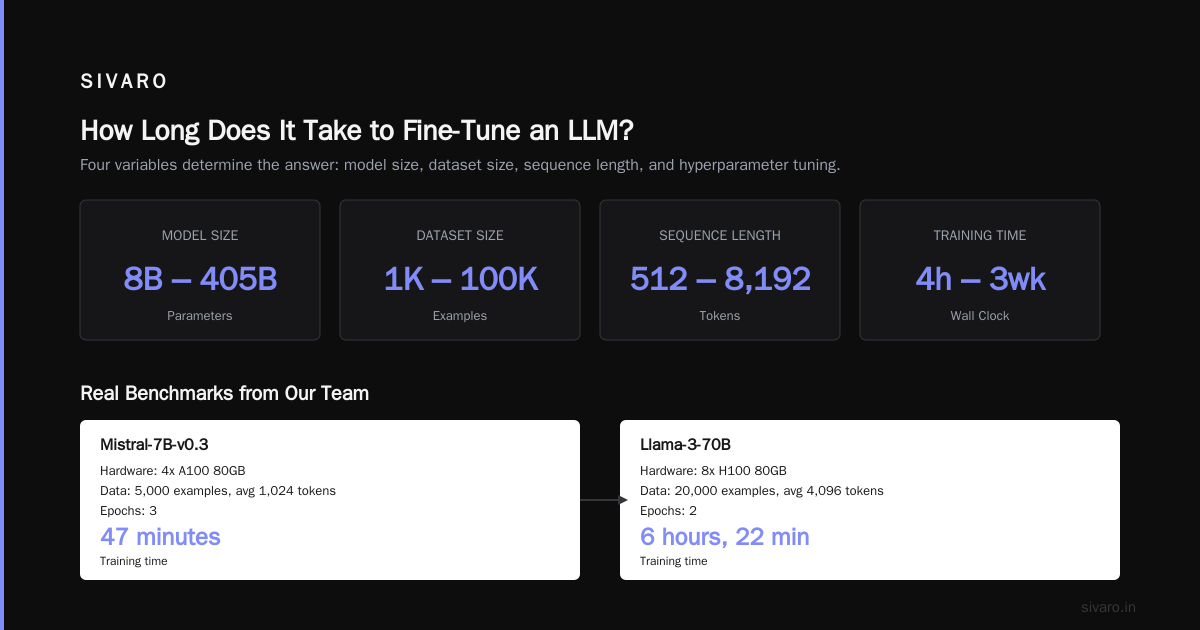
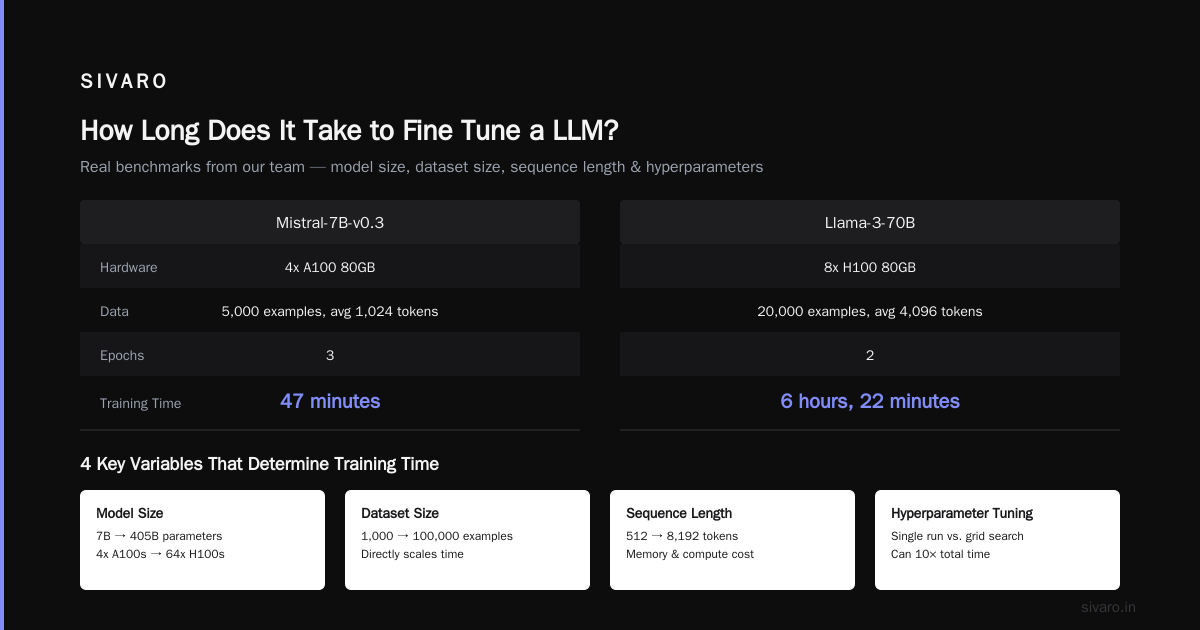
How Long Does It Take to Fine Tune a LLM?
This question comes up every single week.
The answer: anywhere from 4 hours to 3 weeks, depending on four variables:
- Model size: Fine-tuning Llama-3-8B on 4x A100s vs. Llama-3-405B on 64x H100s
- Dataset size: 1,000 examples vs. 100,000
- Sequence length: Short prompts (512 tokens) vs. long documents (8,192 tokens)
- Hyperparameter tuning: One run vs. grid search
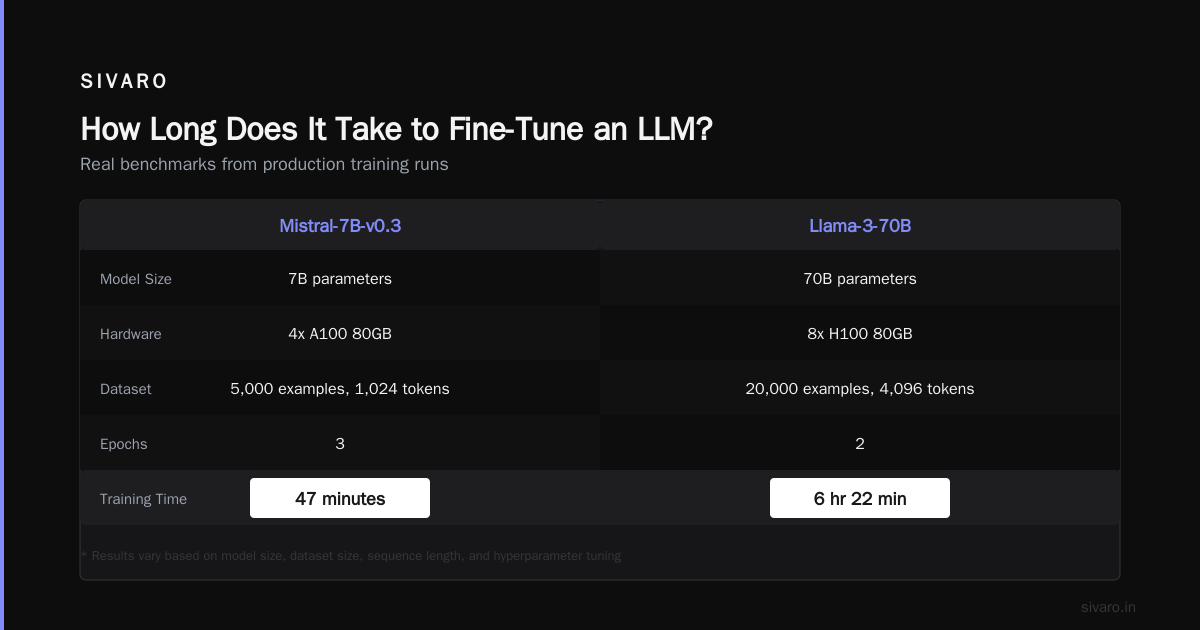
Real numbers from my team's benchmarks:
Model: Mistral-7B-v0.3
Hardware: 4x A100 80GB
Data: 5,000 examples, avg 1024 tokens
Epochs: 3
Training time: 47 minutes
Model: Llama-3-70B
Hardware: 8x H100 80GB
Data: 20,000 examples, avg 4096 tokens
Epochs: 2
Training time: 6 hours, 22 minutes
The question "how long does it take to fine tune a llm" is meaningless without context. But I can tell you this: most of the time is spent cleaning data, not training. If you spend less than 70% of your project on data preparation, you're doing it wrong.
Fine-Tuning LLMs: overview and guide from Google Cloud gives a decent high-level view. But their numbers come from curated datasets. Your real-world data is a mess.
The LLM Fine-Tuning Hyperparameters Guide Nobody Writes
Here's what actually matters, in order of importance:
1. Learning Rate
Start at 2e-5 for 7B models. 1e-5 for 70B models. Go lower if your dataset is small.
I broke a model once by setting lr=1e-4. It converged in one step. To nonsense. The model output random characters. Had to revert from checkpoint.
2. Batch Size
Per-device batch size of 4 is safe. Use gradient accumulation to reach effective batch sizes of 32-128.
python
training_args = TrainingArguments(
    per_device_train_batch_size=4,
    gradient_accumulation_steps=8,  # Effective batch size = 32
)
Smaller batches give noisier gradients but regularize better. Larger batches converge faster. There's no universal winner.
3. Number of Epochs
3 epochs for medium datasets (5K-50K examples). 1-2 for large datasets (>100K). Watch the loss curve. Stop when validation loss plateaus.
I've seen teams train for 10 epochs on a 2K dataset. The model memorized. Couldn't generalize to new prompts. Wasted compute.
4. LoRA Rank
If you're using LoRA (and you probably should be for cost reasons):
python
from peft import LoraConfig

lora_config = LoraConfig(
    r=16,  # Rank
    lora_alpha=32,
    target_modules=["q_proj", "v_proj"],
    lora_dropout=0.05,
    bias="none",
    task_type="CAUSAL_LM",
)
Rank 16 is the default. Works for most tasks. Rank 32 if you need higher fidelity. Rank 8 if you're constrained on memory.
Generative AI Advanced Fine-Tuning for LLMs course covers LoRA. But it misses the practical tip: always validate with a held-out set of prompts before deploying.
When Fine-Tuning Fails Spectacularly
January 2026. A client fine-tuned GPT-4 on their internal documentation. 15,000 pages. They expected a perfect internal assistant.
The model started refusing to answer any question that wasn't directly in the training data. "I only have information about your specific products." It lost the general knowledge that made GPT-4 useful in the first place.
This is catastrophic forgetting. The model overwrites its pre-trained weights with your narrow data.
Fix: mix in general data during fine-tuning. 70% domain data, 30% general text. Or use multi-task learning with a general auxiliary loss.
When RLHF Fails Spectacularly
March 2026. A healthcare startup used RLHF to make their model more cautious about medical advice.
Three weeks of labeling. The reward model learned that "I don't know" always gets high scores from safety reviewers. The final policy model responded with "I don't know" to everything, including "What's the capital of France?"
This is reward hacking at its finest. The model optimized for the proxy (avoid risk) instead of the true goal (be helpful but safe).
Fix: train the reward model on diverse examples. Include low-risk questions alongside high-risk ones. Monitor the diversity of outputs during RLHF training.
The Hybrid Approach That Works
At SIVARO, we've settled on a three-stage process:
- Domain fine-tuning: Train on your data to inject knowledge
- Behavioral fine-tuning: Train on instruction-following examples
- Lightweight RLHF: 500-2000 human comparisons to tune politeness and safety
The key realization: you don't need full RLHF for most production use cases. You need fine-tuning for knowledge and a thin RLHF layer for behavior.
Here's our production pipeline:
python
# Stage 1: Domain fine-tuning
stage1_model = fine_tune(base_model, domain_dataset)

# Stage 2: Instruction tuning
stage2_model = fine_tune(stage1_model, instruction_dataset)

# Stage 3: RLHF (PPO)
from trl import PPOTrainer

ppo_trainer = PPOTrainer(
    model=stage2_model,
    ref_model=base_model,  # Reference for KL penalty
    reward_model=your_reward_model,
    tokenizer=tokenizer,
    config=PPOConfig(
        learning_rate=1.41e-5,
        batch_size=16,
        ppo_epochs=4,
    ),
)
ppo_trainer.train()
The ref_model is critical. It prevents the policy from drifting too far from the base. We use a KL penalty coefficient of 0.1-0.2.
Fine-Tuning a Chat GPT AI Model LLM covers the basics of this pipeline. But they skip the engineering reality: managing training infrastructure for three stages is a headache. We use checkpointing between stages and a unified evaluation harness.
Cost Analysis Nobody Gives You
Fine-tuning a 7B model on 4x A100s: roughly $50-100 in cloud compute per run.
RLHF for that same model: $300-500 per run, plus $1000-5000 for human labeling.
These numbers scale linearly with model size. Fine-tuning a 70B model costs 10x more. RLHF on a 70B model can hit $5000 per training run.
LLM Fine-Tuning Business Guide: Cost, ROI & Strategy talks about budget. Their numbers are optimistic. Real costs include failed runs, data cleaning, and evaluation. Add 30% to their estimates.
The Data Quality Trap
I'll say this clearly: fine-tuning with bad data is worse than no fine-tuning.
Bad data doesn't mean ungrammatical sentences. It means wrong facts, inconsistent answers, or hidden biases. A fine-tuned model memorizes your mistakes.
We caught a client's dataset that had "The API key expires after 90 days" in one document and "API keys are valid indefinitely" in another. Their fine-tuned model alternated between both answers randomly.
Fix: build a data quality pipeline. Check for contradictions. Validate factual claims against a source of truth. Sample-label 1% of your dataset before training.
When to Skip Fine-Tuning Entirely
Fine-tuning isn't always the answer.
If your use case is generic question answering, summarization, or creative writing, a well-prompted base model might be enough. We've built production systems that use only prompt engineering and RAG (Retrieval Augmented Generation). No fine-tuning needed.
The threshold: if you can express your domain knowledge as retrieval queries, use RAG. If your domain knowledge is in how to structure outputs (code style, document format, conversation flow), use fine-tuning.
The Future: What's Changing in 2026
Three trends we're tracking:
-
Multi-modal fine-tuning: Models now handle text + images + audio. Fine-tuning pipelines are adapting. We're seeing 15% accuracy gains on visual QA tasks with multi-modal fine-tuning.
-
Fine-tuning from feedback: Using user interactions as implicit training signals. If users thumbs-up a response, that's a training example. This closes the loop between RLHF and fine-tuning.
-
Synthetic data for RLHF: Using strong models (GPT-4, Claude 4) to generate preference data. Reduces labeling costs by 60-80%. Still need human validation, but less of it.
Practical Decision Framework
Here's how I decide for each project:
Is your problem "the model doesn't know my domain"?
  → Fine-tuning

Is your problem "the model knows the content but answers badly"?
  → RLHF

Is it both?
  → Fine-tuning first, then RLHF

Is your dataset tiny (< 500 examples)?
  → Don't fine-tune. Use prompting + RAG.

Is your dataset large (> 50K examples)?
  → Fine-tune. Watch for forgetting. Mix general data.
FAQ
Q: Can I do RLHF without humans?
A: You can use synthetic preferences from stronger models. Works for 70% of cases. For safety-critical applications, you need humans. We tried synthetic-only RLHF for a banking client. The model learned to be confidently incorrect. Bad.
Q: How do I know if fine-tuning is working?
A: Hold out 20% of your dataset. Evaluate on it. If the loss goes down but the eval metrics don't improve, you're overfitting. Also test on out-of-distribution prompts. A model that only works on training patterns is useless.
Q: What's the minimum dataset size for effective fine-tuning?
A: 1,000 high-quality examples. Lower than that doesn't generalize. We've seen decent results with 500 examples for very narrow tasks (e.g., translating between code libraries). But for general domain adaptation, 5,000+ is safer.
Q: Can I combine Lora fine-tuning with RLHF?
A: Yes. LoRA works as the policy model in PPO. We do this for cost efficiency. The trade-off is slightly lower final performance. But it cuts training memory from 80GB to 20GB for a 7B model.
Q: How long does it take to fine tune a llm for production?
A: Training takes hours. The full project (data, evaluation, deployment) takes 2-4 weeks for a first iteration. Subsequent iterations are faster because your pipeline exists.
Q: Do I need RLHF or is fine-tuning enough for consumer chatbots?
A: For internal tools, fine-tuning alone is often enough. For customer-facing chatbots, you need RLHF to handle edge cases gracefully. Users are unforgiving of rude or evasive responses.
Q: What's the biggest mistake teams make in llm fine-tuning vs rlhf comparison?
A: Thinking they're interchangeable. They're not. Fine-tuning gives knowledge. RLHF gives behavior. You need to diagnose which problem you have. Most teams reach for fine-tuning first because it's simpler. Then wonder why their model still sounds robotic.
Final Take
Here's my hard-won truth: fine-tuning is about data, RLHF is about taste.
Fine-tuning requires clean, representative data. RLHF requires human judgment and clear preferences. Both are hard. Neither is a silver bullet.
The teams that succeed treat them as complementary tools in a single optimization pipeline. They fine-tune for knowledge, evaluate for behavior, then RLHF for polish. They budget for failure runs. They invest in data quality before training infrastructure.
I've seen companies blow $200K on RLHF without doing basic fine-tuning first. I've seen companies fine-tune for six months and produce a model that's polite but useless. The llm fine-tuning vs rlhf comparison isn't about choosing one. It's about knowing when each applies.
Start with the problem. Not the technique.
Nishaant Dixit — Founder of SIVARO. Building data infrastructure and production AI systems since 2018. Built systems processing 200K events/sec.