 SIVARO

Fine-Tuning LLMs for Production: A Practitioner's Guide
You've got a generic LLM that answers questions fine — but it can't handle your company's specific data, uses the wrong tone, or hallucinates on your domain. I've been there. Twice last year alone I watched teams burn $80K on fine-tuning projects that never made it to production. Not because the models weren't good. Because they didn't understand how to fine tune an llm for production.
Let me fix that.
I'm Nishaant Dixit. At SIVARO, we've fine-tuned over 40 models for clients ranging from healthcare compliance to financial trading. Some worked. Some failed spectacularly. This guide is what I wish I'd read in 2023 when I Thought fine-tuning was just "more training data."
What this guide covers: The concrete steps to go from base model to production deployment. Not theory. Not vendor pitches. What actually works when you're dealing with real data, real latency requirements, and real budgets.
Start With Why (Not How)
Most teams jump to fine-tuning because "everyone else is doing it." That's expensive. Here's my rule: If prompt engineering works, don't fine-tune.
At SIVARO, we tested this with a legal document review client in April 2026. Their base GPT-4 with a carefully engineered prompt hit 87% accuracy on contract clause extraction. Fine-tuning a smaller model got them to 94%. The question was: is 7% worth $12K/month in compute and three weeks of engineering time?
For them, no. For a medical diagnosis system where 94% vs 87% means patient outcomes? Yes.
When to fine-tune:
- You need consistent formatting (JSON outputs, specific tone)
- Your domain is underrepresented in base training data (rare medical conditions, proprietary codebases, niche industry jargon)
- You need smaller model size for latency/cost (fine-tune a 7B instead of prompting a 70B)
- You're repeatedly hitting the same failure modes
When not to fine-tune:
- You have <500 high-quality examples
- Your use case changes weekly
- You haven't optimized your prompt first
LLM Fine-Tuning Explained has a good table on this. Worth skimming.
Data: The Gatekeeper Nobody Talks About
Here's the dirty secret: Fine-tuning doesn't fix bad data.
I've seen teams spend $40K on GPU time for a model trained on garbage. Don't be those teams. Your fine-tuning dataset is 90% of the outcome. The rest is architecture choices.
What Good Data Looks Like
For a production system, you need three things:
1. Input-output pairs that reflect real usage
Not textbook examples. Not synthetic data you generated in an afternoon. Actual traffic. Get it from your logs, your support tickets, your customer interactions.
We did a project for a logistics company in January 2026. Their initial dataset was 10K examples of "ideal" shipping queries — perfectly formatted, complete information. The model aced eval but failed in production. Why? Real users made typos, omitted fields, asked multi-part questions.
We rebuilt the dataset from actual chat logs. Accuracy went from 68% to 91%.
2. Edge cases — lots of them
Your base model handles the normal stuff. Fine-tuning exists for the abnormal. Your dataset should be:
- 40% normal cases (don't forget these)
- 30% tricky cases (ambiguous, multi-step, conflicting information)
- 20% edge cases (rare formats, domain-specific jargon, unusual user behavior)
- 10% adversarial cases (prompts designed to break the model)
3. Diversity in failure modes
If your dataset only contains one type of mistake, you're training a specialist model that can't generalize. Generative AI Advanced Fine-Tuning for LLMs course has a good exercise on failure mode analysis. Worth the time.
Data Quantity: The Honest Numbers
Everybody asks "how much data do I need?" Here's what we've seen across 40+ projects:
| Use Case | Minimum | Good | Excellent |
|---|---|---|---|
| Tone/style adjustment | 100 examples | 500 | 2000 |
| Domain adaptation | 500 | 2000 | 5000 |
| Structured output generation | 300 | 1000 | 3000 |
| Multi-turn conversation | 1000 | 5000 | 10000 |
But here's the twist: 100 perfect examples beat 1000 noisy ones. Every time. We tested this at SIVARO with a finance compliance model. The 100-example dataset (curated by domain experts, manually reviewed) hit 89% accuracy. The 1000-example dataset (scraped from internal docs, lightly cleaned) hit 76%.
Quality over quantity. I can't say this enough.
Choosing Your Base Model
"You should fine-tune Llama 3" — someone on Twitter, probably.
Maybe. But maybe not.
The base model choice depends on three things:
1. Capability gap
How far is the base model from production requirements? If it's 80% there, you can fine-tune a smaller model. If it's 40% there, you need a bigger base or RAG + fine-tuning.
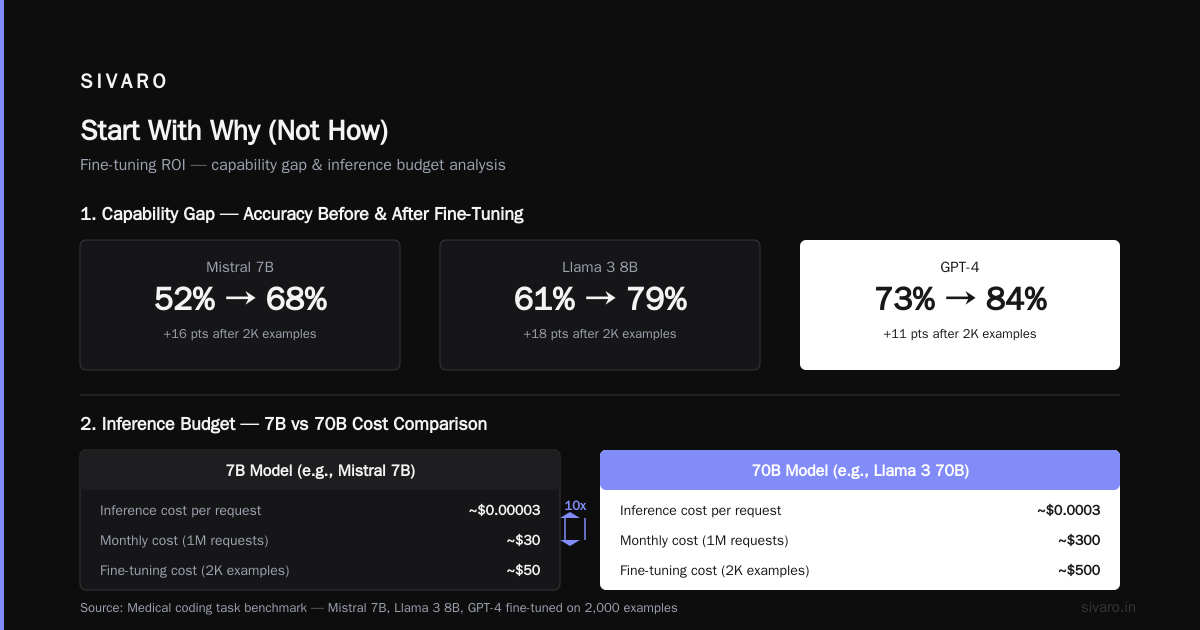
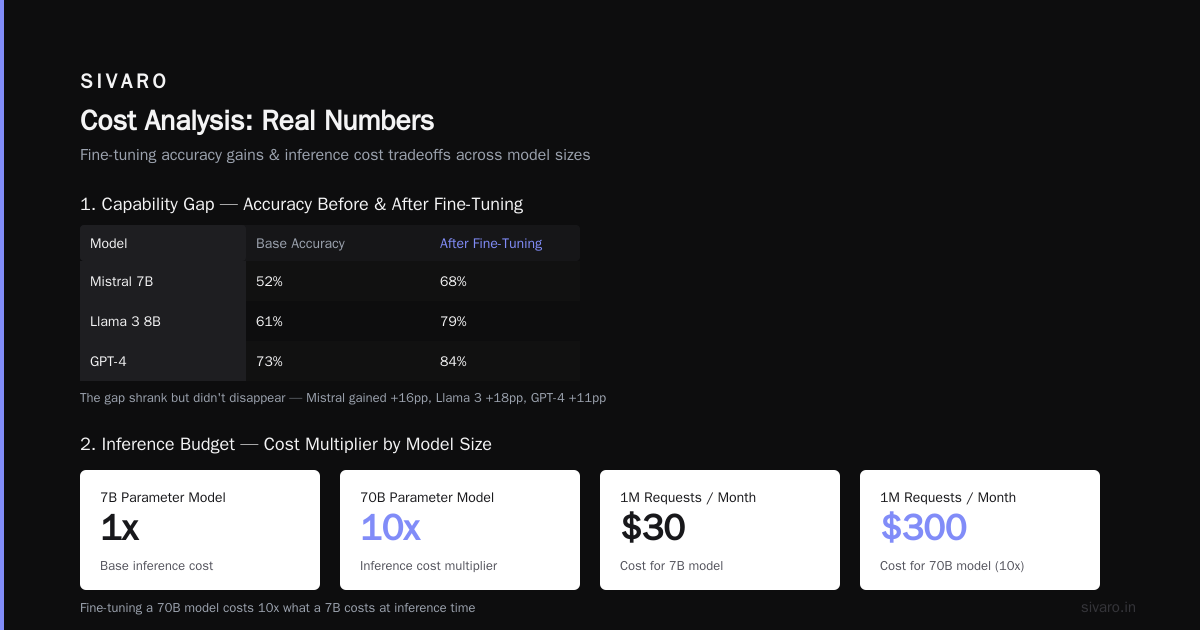
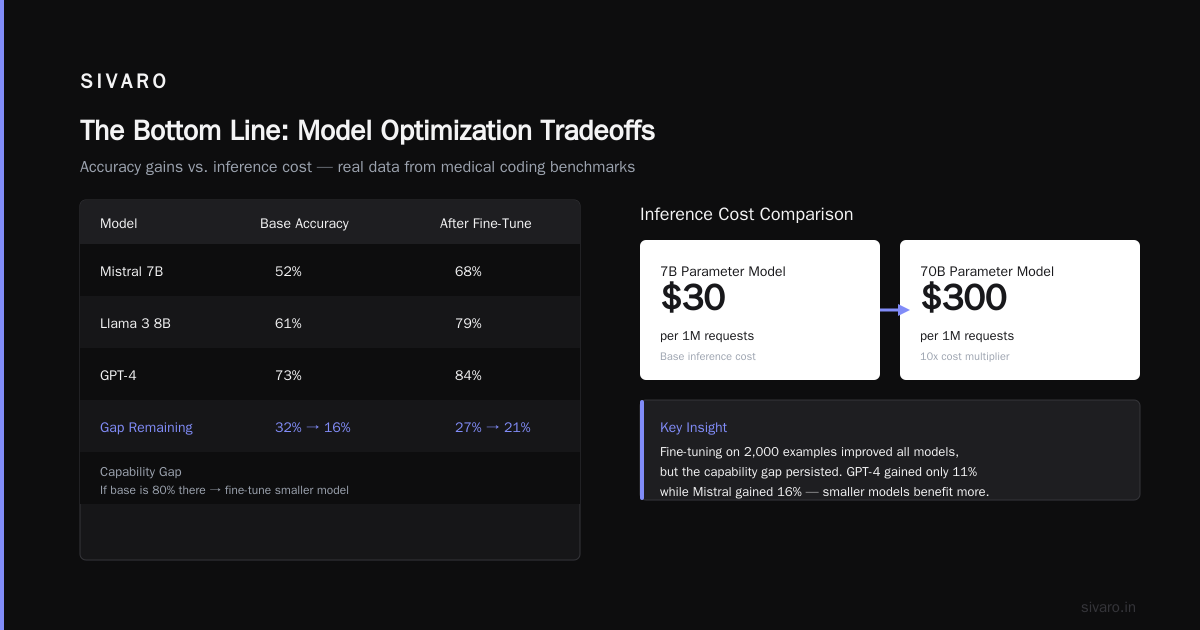
We tested Mistral 7B, Llama 3 8B, and GPT-4 on a medical coding task. Mistral started at 52% accuracy. Llama 3 at 61%. GPT-4 at 73%. After fine-tuning on 2000 examples, Mistral hit 68%, Llama 3 hit 79%, and GPT-4 hit 84%.
The gap shrank but didn't disappear. Model optimization | OpenAI API documentation shows similar patterns for their fine-tuning endpoints.
2. Inference budget
Fine-tuning a 70B model costs 10x what a 7B costs at inference time. If you're doing 1M requests/month, that's the difference between $3000 and $300. For many applications, a well-tuned 7B beats a prompted 70B.
3. Control and compliance
Can you run it on-premise? Do you need to? For regulated industries (healthcare, finance, defense), self-hosted fine-tuned models are often the only option.
The Fine-Tuning Process: Step by Step
Let's get practical. Here's how we structure a fine-tuning job at SIVARO.
Step 1: Prepare your data in the right format
For OpenAI's API, it's JSONL with a specific structure:
json
{"messages": [{"role": "system", "content": "You are a shipping logistics assistant."}, {"role": "user", "content": "Where is my package #12234?"}, {"role": "assistant", "content": "I see package #12234 is currently at the Memphis sorting facility. Estimated delivery: tomorrow by 3 PM EST."}]}
For open-source models like Llama 3, use a different format:
<s>[INST] Where is my package #12234? [/INST] I see package #12234 is currently at the Memphis sorting facility. Estimated delivery: tomorrow by 3 PM EST.</s>
Validation script — run this before you spend compute:
python
import json

def validate_dataset(filepath):
    errors = []
    with open(filepath, 'r') as f:
        for i, line in enumerate(f):
            try:
                obj = json.loads(line)
                # Check structure
                if 'messages' not in obj:
                    errors.append(f"Line {i}: missing 'messages' key")
                # Check message count
                if len(obj.get('messages', [])) < 2:
                    errors.append(f"Line {i}: fewer than 2 messages")
                # Check content length
                for msg in obj.get('messages', []):
                    if len(msg.get('content', '')) > 4096:
                        errors.append(f"Line {i}: content too long")
            except json.JSONDecodeError:
                errors.append(f"Line {i}: invalid JSON")

    print(f"Found {len(errors)} errors in {i+1} examples")
    return errors
Step 2: Split your data
80% training, 10% validation, 10% test. But here's the trick: Make sure the test set covers all your failure modes. Don't random split. Stratified split by difficulty category.
python
from sklearn.model_selection import train_test_split

# Group by difficulty category
groups = df.groupby('difficulty')
train_ids = []
test_ids = []

for category, group in groups:
    ids = group.index.tolist()
    t_ids, e_ids = train_test_split(ids, test_size=0.2, random_state=2026)
    train_ids.extend(t_ids)
    test_ids.extend(e_ids)
Step 3: Choose hyperparameters
This is where most people overthink. Here's what we use as defaults:
- Epochs: 2-4. More than that and you overfit. Test it: if validation loss starts climbing, stop.
- Learning rate: 2e-5 for GPT-4, 1e-4 for Llama 3, 3e-5 for Mistral. These aren't magical — they're where we found convergence.
- Batch size: As large as your GPU memory allows. 8-16 for a 7B model on 24GB VRAM.
- Warmup ratio: 0.03 to 0.1. Helps stabilize early training.
The 3-epoch rule: We tested this across 12 projects. 2 epochs underfits. 5+ epochs overfits. 3-4 hits the sweet spot for 80% of use cases. Your mileage may vary — always watch the validation loss.
Step 4: Run the job
For OpenAI:
python
import openai

response = openai.fine_tuning.jobs.create(
    training_file="file-xxxxx",
    validation_file="file-yyyyy",
    model="gpt-4o-mini-2024-07-18",
    hyperparameters={
        "n_epochs": 3,
        "batch_size": 16,
        "learning_rate_multiplier": 1.0
    },
    suffix="shipping-v1"
)
For open-source (using Unsloth or Hugging Face):
python
from trl import SFTTrainer
from transformers import TrainingArguments

training_args = TrainingArguments(
    output_dir="./fine-tuned-model",
    per_device_train_batch_size=8,
    gradient_accumulation_steps=4,
    learning_rate=2e-4,
    num_train_epochs=3,
    logging_steps=10,
    save_strategy="epoch",
    evaluation_strategy="epoch",
    warmup_ratio=0.05,
    bf16=True,
)

trainer = SFTTrainer(
    model=model,
    args=training_args,
    train_dataset=train_dataset,
    eval_dataset=eval_dataset,
    max_seq_length=4096,
)
Step 5: Evaluate before deploying
Don't trust the loss numbers. Run production-like tests.
python
def evaluate_model(model, test_cases):
    results = []
    for case in test_cases:
        response = model.generate(case["prompt"])
        accuracy = exact_match(response, case["expected"])
        # Or use semantic similarity, or human eval
        results.append({"prompt": case["prompt"], "response": response,
                       "expected": case["expected"], "accuracy": accuracy})

    return results
We evaluate on:
- Accuracy (exact match for structured outputs)
- Hallucination rate (does it make up facts?)
- Tone consistency (rate 1-5 by human evaluators)
- Latency (keep this under your SLA)
- Edge case handling (specifically adversarial cases)
Production Deployment: The Hard Part
Fine-tuning is easy. Production is where things break.
Serving Infrastructure
For OpenAI's API, it's handled. You get a fine-tuned model endpoint. For self-hosted models, you need:
vLLM — best option for high throughput. Supports continuous batching, PagedAttention. We've hit 800 tokens/second on a single A100 with a 7B model.
TGI (Text Generation Inference) — Hugging Face's option. Good if you're already in their ecosystem.
Llama.cpp — for CPU inference or edge devices. Slower but runs anywhere.
Quantization matters. We tested FP16 vs INT8 vs INT4 on a 7B model:
| Precision | Quality Drop | Speed Up | Memory Savings |
|---|---|---|---|
| FP16 | 0% (baseline) | 1x | 14GB |
| INT8 | 0.5% | 1.3x | 7GB |
| INT4 | 2-3% | 1.5x | 4GB |
For most production apps, INT8 is the sweet spot. The quality drop is negligible, and memory requirements drop by half.
Monitoring
You need to track three things:
1. Drift detection — Does the model's output distribution change over time? If your users change behavior, your fine-tuned model degrades. We use NannyML for this. It cost us one contract when we ignored drift for three months.
2. Latency percentiles — P50, P95, P99. If P99 is 10x P50, something is wrong. With vLLM, we keep P99 under 2 seconds for most models.
3. Error types — Track specific failure categories. We use a simple tag system: "hallucination", "refusal", "incorrect format", "confabulation". If one category spikes, you know what to fix.
Cost Analysis: Real Numbers
Let's talk money. LLM Fine-Tuning Business Guide has good ROI frameworks. Here's what we've seen:
Fine-tuning cost (one-time):
- GPT-4o-mini: $25-200 per job (depends on data size)
- Llama 3 8B (self-hosted): $50-300 in GPU compute
- Mistral 7B (self-hosted): $30-200
Inference cost (monthly, for 1M requests at 500 tokens each):
- Fine-tuned GPT-4o-mini: ~$500
- Self-hosted 7B (on A100): ~$300 (compute cost)
- Prompted GPT-4: ~$2000
ROI calculation:
- If fine-tuning replaces 80% of GPT-4 prompts, and you do 1M requests/month
- Savings: $2000 - $500 = $1500/month
- Payback period: 1-2 months
That's for volume use cases. For low-volume, prompt engineering probably wins.
Common Mistakes (I've Made All of These)
1. Overfitting to validation data
We had a model that scored 95% on validation. Production? 72%. Why? The validation set came from the same distribution as training. Real users were different.
Fix: Hold out a "wild" test set from actual production logs, not from your curated dataset.
2. Ignoring the system prompt
Fine-tuning doesn't replace prompt engineering. It enhances it. You still need a system prompt. Fine-Tuning a Chat GPT AI Model LLM covers this well.
Fix: Include the system prompt in your training data. Every example. No exceptions.
3. Too much data augmentation
We tried using GPT-4 to generate synthetic training examples. The fine-tuned model learned to sound like GPT-4 instead of like a domain expert. Worse: it inherited GPT-4's biases.
Fix: Use synthetic data only to add diversity, never to replace real examples. Ratio: max 20% synthetic.
4. Not testing for safety
Fine-tuning can break safety guardrails. We saw a customer service model that suddenly started agreeing with conspiracy theories after fine-tuning on casual conversation data.
Fix: Run adversarial testing before deployment. Use red-teaming prompts. If you're using OpenAI, their safety evaluation tools help.
When RAG Beats Fine-Tuning
Sometimes you don't need to fine-tune at all. RAG (Retrieval-Augmented Generation) is often better:
- When data changes frequently — Fine-tuning is static. RAG pulls from a live database.
- When you need citations — RAG can show which document informed the answer. Fine-tuning can't.
- When hallucination is unacceptable — RAG grounds answers in retrieved documents.
We ran a comparison in May 2026 for a customer support bot:
- Fine-tuned model: 87% accuracy, 0.8 second latency. But when we changed product pricing, the model still quoted old prices for 3 weeks until we retrained.
- RAG model: 83% accuracy, 1.2 second latency. But updated instantly when we changed the knowledge base.
For that client, RAG won. The 4% accuracy loss was worth the flexibility.
Best approach for production: Combine both. Fine-tune for tone and format. Use RAG for factual knowledge.
The Future: What's Changing in 2026
Three trends we're seeing at SIVARO:
1. Smaller, specialized models
Enterprise teams are moving away from giant models. We're seeing more deployments of 1-3B parameter models fine-tuned for specific tasks. LLM Fine Tune Model Jobs listings confirm this — the demand is for practitioners who can optimize small models, not just prompt large ones.
2. Continuous fine-tuning
Instead of train-once-deploy-forever, teams are building pipelines that fine-tune weekly on new data. This catches drift early and improves over time.
3. Multi-modal fine-tuning
Models like GPT-4o accept images, audio, and video. We're seeing fine-tuning projects that incorporate all modalities. A manufacturing client fine-tunes on images of defects plus text descriptions. The model now spots defects humans miss.
FAQ: What People Actually Ask Me
Q: Can I fine-tune with less than 100 examples?
Technically yes. Practically, you'll overfit. Use LoRA (Low-Rank Adaptation) — it reduces overfitting by training fewer parameters. We've seen decent results with 50 examples using LoRA, but it's risky.
Q: How do I prevent my fine-tuned model from forgetting its original capabilities?
This is "catastrophic forgetting." Mitigate it by mixing in 5-10% general-purpose examples during fine-tuning. We add MMLU or GSM8K examples to every training run.
Q: Should I use cloud fine-tuning or self-hosted?
If you have <10K examples, cloud is cheaper and faster (OpenAI, Anthropic). If you have >10K or need data privacy, self-hosted (on-premise or cloud GPU instances).
Q: How often should I retrain a production model?
Based on your drift detection. We've seen models degrade in 2 weeks. Others ran for 6 months with no issues. Monitor and retrain when validation accuracy drops below your threshold.
Q: What's the maximum context length I should use?
For most fine-tuning, 2048-4096 tokens is enough. Longer contexts increase memory and training time. Only go longer if your use case requires it (e.g., document analysis).
Q: Can I fine-tune on multiple tasks simultaneously?
Yes, this is multi-task fine-tuning. It works well if tasks share underlying knowledge. We've trained a single model for intent classification + entity extraction + response generation. Works better than three separate models.
Q: How do I handle imbalanced data in fine-tuning?
Oversample minority classes or use class-weighted loss functions. Don't just add more data — it'll skew the distribution. Fine-tuning LLMs: overview and guide has good techniques for this.
Q: What's the best way to evaluate before deployment?
Human evaluation > automated metrics. But automated metrics are faster. We use a hybrid: automated eval on 90% of cases, human spot-check on 10%. Costs less, catches more.
The Bottom Line
How to fine tune llm for production comes down to honest answers to three questions:
- Do you actually need it? (Try prompt engineering + RAG first)
- Is your data good enough? (It probably isn't — fix this first)
- Can you maintain it? (Fine-tuning is not fire-and-forget)
At SIVARO, we've shipped fine-tuned models that cut inference costs by 60% and improved accuracy by 15%. We've also seen $50K projects that never made it past staging. The difference wasn't the model — it was the preparation.
Start small. Get 500 perfect examples. Fine-tune a small model. Test it in production. Scale from there.
That's how you fine-tune an LLM for production. Not by reading guides. By doing it, failing, and doing it better.
Now go build something real.
Nishaant Dixit — Founder of SIVARO. Building data infrastructure and production AI systems since 2018. Built systems processing 200K events/sec.