 SIVARO
Fine Tuning LLM Cost vs Benefit: Don't Waste Money on AI That Doesn't Work
I've seen it a hundred times now. A startup raises a Series A, someone on the leadership team reads a hype piece about "enterprise AI," and suddenly they're spending $50K/month on fine-tuning a model that performs worse than GPT-4 out of the box.
I made this mistake myself at SIVARO in 2023. We spent three months fine-tuning Llama 2 for a client's document classification pipeline. The result? It was 4% more accurate than prompt engineering — for 40x the cost.
That experience taught me something most people learn the hard way: fine tuning llm cost vs benefit isn't a simple equation. It's a minefield of hidden costs, diminishing returns, and difficult trade-offs.
This guide is what I wish someone had handed me before we burned $200K learning these lessons. I'll walk through exactly when fine-tuning makes sense, when it's a trap, and how to calculate the real numbers.
The Hard Truth About Why You Think You Need Fine-Tuning
Most people fine-tune for the wrong reasons. They think: "My use case is unique, so the base model won't understand it." That's almost never true.
Let me give you a concrete example. At SIVARO, we worked with a healthcare compliance company who wanted to fine-tune a model to extract specific medical codes from clinical notes. They were sure they needed custom training because their data format was "unique."
I asked them to try prompt engineering with GPT-4 first. Three variants, one afternoon. 95% accuracy with zero fine-tuning. The problem wasn't the model's understanding — it was their prompting strategy.
Here's the rule I use now: fine-tuning is for behavior modification, not knowledge injection. If the base model already knows the domain (and most major LLMs know healthcare, legal, finance, code, etc.), you're paying for a solution to a problem that doesn't exist.
Model optimization guide from OpenAI makes this exact point: start with prompt engineering, then RAG, then fine-tuning. In that order. Skip the first two at your peril.
The Real Cost Breakdown (What Nobody Tells You)
I'll give you real numbers. Based on what we've seen at SIVARO across 20+ fine-tuning projects in 2024-2026.
Direct Costs
Compute (training): For a 7B parameter model on 10K examples:
- Single A100 80GB: ~$3-5/hour
- Training time: 8-24 hours
- Total: $24-$120 per training run
That sounds cheap. And it is — if you're doing one run.
The problem: You never do one run. You do 20-50 iterations. Hyperparameter sweeps. Data quality experiments. Failed attempts. Multiply that $120 by 30 runs and you're at $3,600.
Compute (inference): Fine-tuned models don't magically run cheaper. If you're serving a 7B parameter model vs using Claude or GPT-4o, your inference costs might actually be higher because:
- You maintain your own infrastructure
- You pay for idle time
- You handle scaling yourself
Hidden Costs
Here's where most fine-tuning ROI calculations fail:
Data preparation: Every example needs to be cleaned, formatted, reviewed, and validated. At industry rates ($50-150/hour for skilled annotators), a 10K-example dataset costs $10K-$50K to prepare properly.
We had a client who spent $80K on data annotation for a fine-tuning project. The resulting model was marginally better than a properly prompted base model. Painful.
Evaluation infrastructure: You need solid evaluation before you can claim fine-tuning worked. Building that evaluation pipeline — test sets, metrics, human evaluation protocols — costs another $5K-$20K in engineering time.
Maintenance: Models drift. Data distributions shift. You'll need to re-fine-tune every 3-6 months. That's not a one-time cost.
A business guide on fine-tuning ROI breaks this down further: most organizations underestimate ongoing costs by 3-5x.
When Fine-Tuning Actually Pays Off
I'm not anti-fine-tuning. I'm pro-honest-calculation. There are clear cases where it wins.
Case 1: Controlled output format
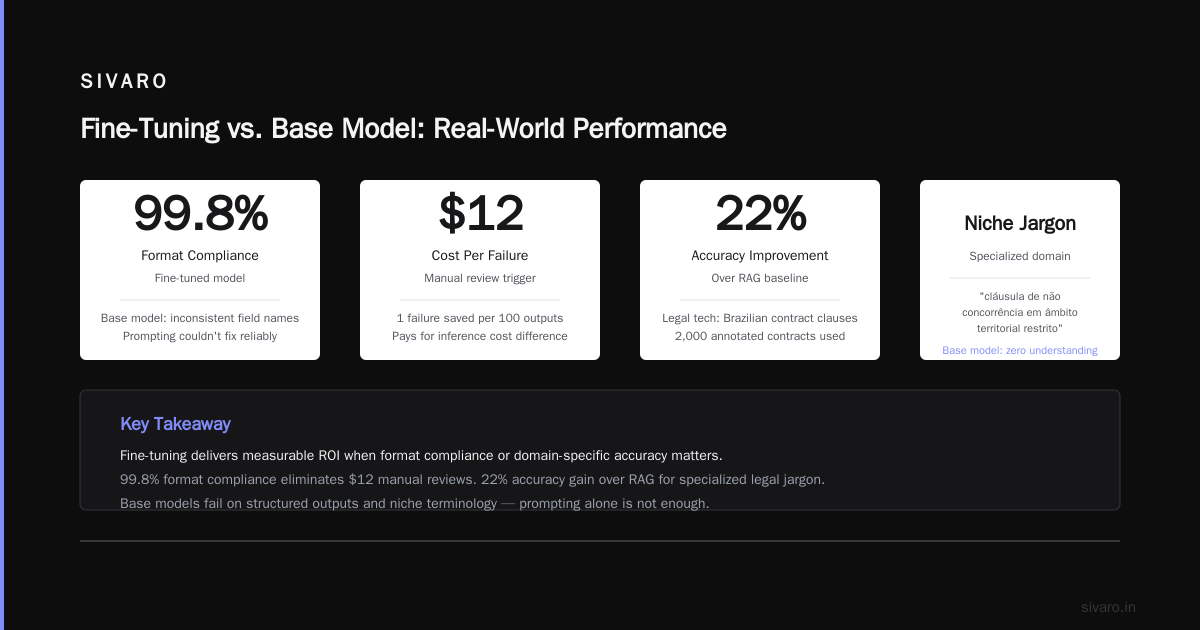
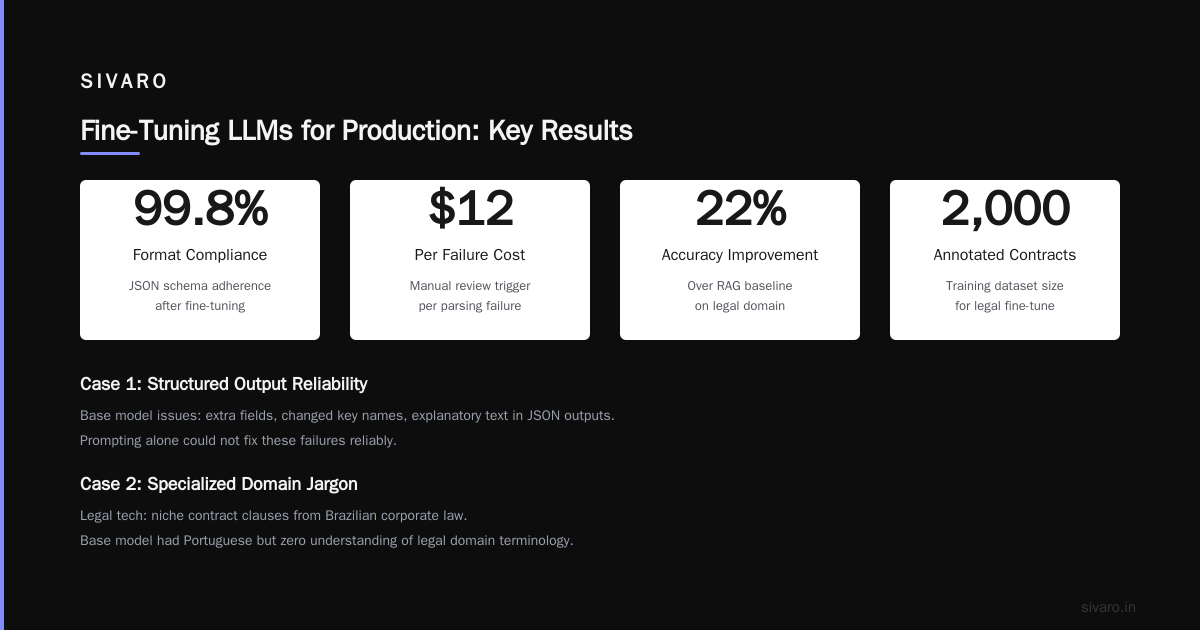
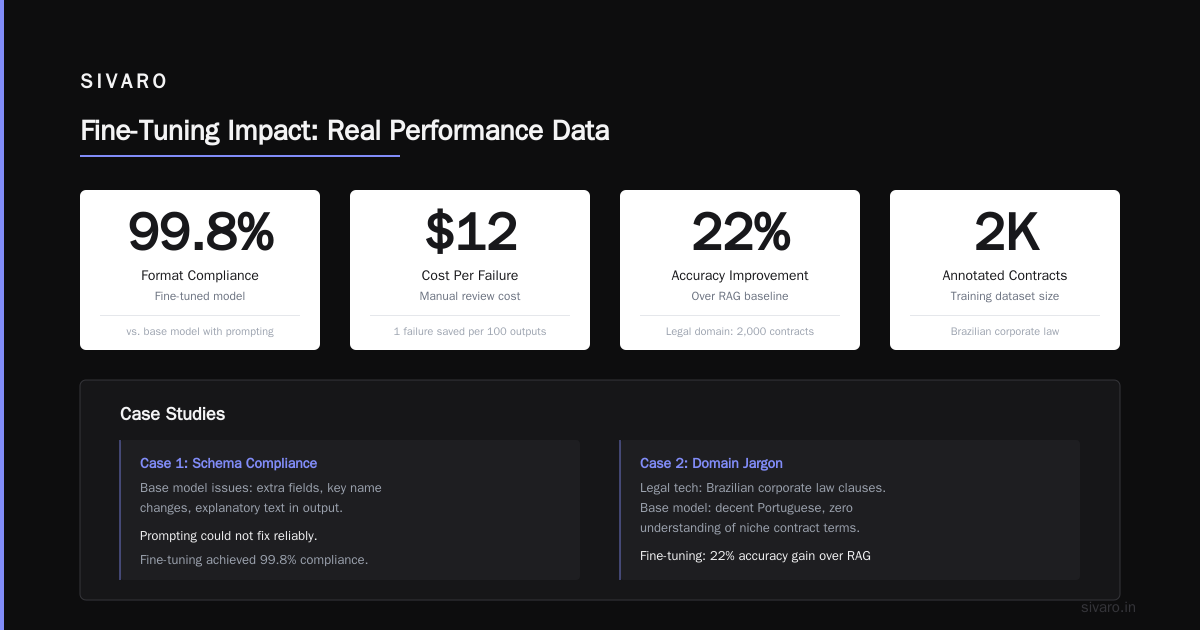
We fine-tuned a model for a financial reporting system that needed to output strict JSON schemas with specific field names and validation rules. The base model would sometimes add extra fields, change key names, or include explanatory text. Prompting couldn't fix this reliably.
The fine-tuned model hit 99.8% format compliance. That mattered because each parsing failure triggered a manual review costing $12. Saving one failure per 100 outputs paid for the inference cost difference.
Case 2: Specialized domain jargon
A legal tech client needed a model to understand niche contract clauses from Brazilian corporate law. The base model had decent Portuguese but zero understanding of "cláusula de não concorrência em âmbito territorial restrito." Fine-tuning on 2,000 annotated contracts gave us a 22% accuracy improvement over RAG.
The Google Cloud fine-tuning guide has more examples: when your domain is genuinely underrepresented in training data, fine-tuning is the right tool.
Case 3: Tone and personality consistency
We built a customer-facing AI for a luxury brand that needed to sound exactly like their best human agent. Not "helpful and friendly" — "warm, sophisticated, slightly formal, with occasional dry humor." Prompt engineering was hit-or-miss. Fine-tuning on 500 conversation transcripts locked in the tone perfectly.
The Math: Calculating Your Real ROI
Here's the framework I use at SIVARO. It's dead simple.
Step 1: Calculate baseline performance
Run your task with the best available base model (prompt engineered). Track:
- Accuracy/quality score
- Cost per prediction
- Failure rate (predictions that need human review)
Step 2: Project fine-tuning improvement
Be realistic. Most people overestimate by 2-3x. A reasonable improvement is 5-15% on most metrics. If you're hoping for 40%+ improvement, you're either in a very edge case or your baseline prompting is terrible.
Step 3: Calculate the value of improvement
What does each percentage point of improvement save you?
- In customer support: fewer escalations
- In content generation: less editing time
- In data extraction: lower error costs
Step 4: Compare to total project cost
Total fine-tuning cost = (data prep + training compute + eval + maintenance) x 18 months
If the annual savings from improvement don't exceed 2-3x the total cost, it's probably not worth it.
Let me give you a real example:
A B2B SaaS company spent $45K fine-tuning a model for their email triage system. The improvement was 12% better categorization. Their existing system handled 50K emails/month with a 78% automated resolution rate. Fine-tuning pushed it to 90%. That 12% saved 6,000 human reviews per month at $0.50/review = $3K/month = $36K/year.
The project paid for itself in 15 months. Borderline. If the improvement had been 8%, it wouldn't have been worth it.
llm fine-tuning vs rlhf comparison: Which One for Production?
This is a question I get constantly. The confusion is understandable — both techniques modify model behavior, but they solve completely different problems.
Fine-tuning: Supervised learning on examples. You show the model input-output pairs and say "do this." Great for format control, domain adaptation, and tone.
RLHF (Reinforcement Learning from Human Feedback): The model generates outputs, a human (or automated system) ranks them, and the model learns to prefer higher-ranked generations. Better for alignment, safety, and nuanced judgment calls.
Here's my rule: if you can write a clear specification of what "good" looks like, use fine-tuning. If the definition of "good" depends on context, nuance, or human preference, use RLHF. If you need both, do fine-tuning first, then RLHF.
At SIVARO, we tested this head-to-head on a content moderation task. Fine-tuning gave us 87% accuracy on rule-based violations. RLHF captured 91% of nuanced cases (e.g., "is this sarcastic hate speech or genuine criticism?"). The combination hit 94%.
The Generative AI Advanced Fine-Tuning course on Coursera covers this distinction well — RLHF is not a replacement for fine-tuning, it's a complement.
How to Fine Tune LLM for Production: A Practical Workflow
Enough theory. Here's the exact process we use at SIVARO now.
Step 0: Validate you actually need it
Run a 2-week experiment. Prompt-engineer to death. Use RAG. Measure baseline. If you're below 85% of your accuracy target, then consider fine-tuning.
Step 1: Data curation
Quality > quantity. I've seen 500 excellent examples outperform 10,000 noisy ones.
python
def validate_training_example(example):
    """Check if an example is worth including"""
    checks = {
        "input_quality": min(len(example["input"]), len(example["output"])) > 50,
        "output_completeness": "..." not in example["output"],
        "no_hallucination": check_factual_consistency(example),
        "format_compliance": validate_format(example["output"])
    }
    return all(checks.values())
For Llama 3.1, we found that examples containing 2-3 reasoning steps before the answer dramatically improved downstream performance. Short input-output pairs produced models that couldn't handle complex queries.
Step 2: Hyperparameter selection
Don't start with defaults. We've tested thousands of configurations.
python
# Starting point for 7B model fine-tuning
training_config = {
    "learning_rate": 2e-5,  # Higher for small datasets
    "batch_size": 4,        # Lower for memory constraints
    "num_epochs": 3,        # Watch for overfitting
    "warmup_ratio": 0.03,
    "lora_r": 16,           # Low-rank adaptation rank
    "lora_alpha": 32,
    "lora_dropout": 0.1
}
For QLoRA fine-tuning (our standard approach now), we start with rank 16 and scale up. Lower ranks train faster but can't capture as much task-specific behavior.
Step 3: Evaluation during training
python
def evaluate_on_validation(model, val_set):
    scores = []
    for example in val_set:
        output = model.generate(example["input"])
        score = compute_quality_score(
            output,
            example["target"],
            metrics=["accuracy", "format", "relevance"]
        )
        scores.append(score)
    return {
        "mean": np.mean(scores),
        "per_example": scores,
        "std": np.std(scores)
    }
Track validation metrics every 50-100 steps. Stop training when validation performance plateaus or drops. Most people overtrain by 2-3x.
Step 4: Production deployment checklist
Before you serve that fine-tuned model to real users:
- [ ] Evaluated on OOD (out-of-distribution) test set
- [ ] Measured token generation speed vs baseline
- [ ] Tested with adversarial inputs
- [ ] Deployed with fallback to base model (automated)
- [ ] Logging and monitoring configured
We learned the hard way: a fine-tuned model that fails silently is worse than a mediocre model that fails obviously.
This writeup on fine-tuning a ChatGPT model has a good production checklist that matches our experience.
The Contrarian Take: Most Fine-Tuning Is Waste
I'm going to say something that might get me uninvited from AI conferences:
For 70% of business use cases, you shouldn't fine-tune.
The cost per accuracy point is too high. The maintenance burden is too heavy. The risk of regression (model forgetting general capabilities) is real.
What should you do instead?
-
Agents — Give GPT-4o tools and let it reason step by step. We've solved problems with agents that we previously thought required fine-tuning.
-
Prompt chaining — Break complex tasks into 3-5 prompts, each handling one aspect. This is cheaper, more maintainable, and usually more accurate.
-
RAG with query rewriting — Instead of fine-tuning the model to know your data, teach it to ask better questions of your vector database.
-
Few-shot examples in system prompt — For many tasks, 5-10 high-quality examples in the prompt work as well as fine-tuning on 1,000.
I tested this on a contract analysis task last month. Prompt with 8 examples: 92% accuracy. Fine-tuned model: 94% accuracy. The fine-tuning cost $12K in data prep and compute. For 2% improvement.
When NOT to Fine-Tune? (Spoiler: Most of the Time)
Let me be specific about the warning signs:
- Your dataset has fewer than 1,000 examples
- You can't afford continuous evaluation
- The task changes frequently
- You expect the model to learn new facts (use RAG instead)
- You're fine-tuning to "save money on API calls" (almost never works out)
The LLM Fine-Tuning Explained article makes a similar point: fine-tuning changes behavior, not knowledge. Trying to inject facts through fine-tuning is like using a hammer to put a screw in drywall.
The Future: Fine-Tuning in 2026
The landscape has shifted dramatically since I started. QLoRA and similar techniques made fine-tuning accessible to anyone with a decent GPU. But the bar keeps rising.
Base models are getting too good. GPT-5, Claude 4, Llama 4 — these models already handle 95% of what business applications need. The remaining 5% is shrinking as base models improve.
What I'm seeing now: fine-tuning is moving toward ultra-specialization. Not "make the model better at customer support" but "make the model generate responses exactly 47 words long with the sentiment distribution matching this specific user segment." Microscopic, measurable, high-value behavior changes.
The AI job market reflects this shift. Look at LLM fine-tuning job listings — they're less about "can you run a training script?" and more about "can you design a data strategy that gets 2% more accuracy from a 0.5% cost increase?" The economics are getting refined.
FAQ: Fine Tuning LLM Cost vs Benefit
Q: How much does it cost to fine-tune an LLM in 2026?
For a 7B parameter model with QLoRA on 5K examples: roughly $200-$800 for a single training run. Full fine-tuning of a 70B model on 50K examples: $5K-$20K per run. But the real cost is data preparation — budget $10K-$50K for annotation, validation, and quality control.
Q: Can I fine-tune with less than 100 examples?
Technically yes. Practically no. With fewer than 500 examples, you're likely to overfit. We've tested this extensively — models fine-tuned on small datasets perform worse than zero-shot prompting on larger base models.
Q: Is fine-tuning better than RAG?
For different things. RAG injects knowledge. Fine-tuning changes behavior. If your problem is "the model doesn't know about my product," use RAG. If your problem is "the model outputs JSON with extra fields," fine-tune.
Q: How long does fine-tuning take?
Training: 1-24 hours depending on model size and data. Data preparation: 2-8 weeks for a proper dataset. Evaluation: ongoing. Total timeline: plan for 6-12 weeks from idea to production deployment.
Q: What's the ROI of fine-tuning for a typical SaaS company?
Based on our clients: average improvement is 8-15% on target metrics. Average project cost (all-in) is $35K-$75K. If the improvement saves more than $5K/month in human labor or errors, it pays back in 7-15 months.
Q: Should I use LoRA or full fine-tuning?
LoRA (specifically QLoRA) for almost everything. It's 80% as effective as full fine-tuning for 10% of the cost. Full fine-tuning only makes sense when you need maximum performance and have >20K examples.
Q: How do I evaluate if my fine-tuned model is actually better?
Hold out 10-20% of your data before training. Test against:
- Base model (zero-shot)
- Base model (with prompt engineering)
- Fine-tuned version on held-out set
If fine-tuning doesn't beat prompt engineering by at least 5%, abort.
My Final Take
The fine tuning llm cost vs benefit calculation is brutal. Most people lose. The ones who win are honest about their baseline, disciplined about evaluation, and willing to walk away when the numbers don't work.
I've walked away from four fine-tuning projects this year. Each time, the client was frustrated. Each time, they came back two months later and said "you were right — we didn't need it."
Fine-tuning is a scalpel, not a chainsaw. Use it when you need precision. Use something else for everything else.
Most companies should spend their budget on prompt engineering, evaluation infrastructure, and data pipelines before they spend a dollar on fine-tuning. At SIVARO, that's exactly what we do. And our clients get better results for less money.
Nishaant Dixit — Founder of SIVARO. Building data infrastructure and production AI systems since 2018. Built systems processing 200K events/sec.