 SIVARO

Fine-Tuning an LLM Costs More Than You Think
I'll never forget the call. March 2025. A Series B startup had just burned $47,000 on fine-tuning GPT-4 for a customer support bot. Three weeks of engineering time. Another $12,000 in API credits. The model was worse than their zero-shot baseline.
That's the hidden cost nobody talks about.
When people ask me "what's the cost of fine-tuning a large language model?", they usually mean compute. GPU hours. API bills. But after building production AI systems at SIVARO for the last eight years, I've learned the real answer is messier. It's failed experiments. It's data labeling. It's the two months your best engineer spends chasing a 2% improvement that never materializes.
This guide covers the real costs. Not just the cloud bill. The whole picture.
The Compute Bill: What You'll Actually Pay
Let's start with the obvious stuff — because people get this wrong too.
Fine-tuning costs depend on three variables: model size, training data size, and training duration. Here's what I've seen in practice.
| Model | GPU Hours (typical) | Cloud Cost Range |
|---|---|---|
| 7B param (Llama 3.2) | 50-150 | $200-$1,200 |
| 70B param (Llama 3.3) | 400-1200 | $3,000-$15,000 |
| GPT-4 (via API) | N/A (pay per token) | $500-$8,000 per job |
The numbers swing wildly based on context length and data size. Fine-tuning on 10,000 examples at 8K context costs more than 100,000 examples at 2K context. Most people forget this.
For fine tuning llama 3.5 vs gpt 4, the difference is stark. With open models, you pay for compute. With GPT-4, you pay per token. At scale, GPT-4 fine-tuning through OpenAI's API can actually be cheaper for small datasets — but that advantage evaporates once you need multiple training runs.
The kicker? Most teams need 5-15 training runs before they get acceptable results. Multiply those costs accordingly.
The Data Tax: The Cost Nobody Budgets For
Here's the honest truth: data preparation usually costs 3-5x more than compute.
I've watched teams spend $8,000 on A100s and then panic when their data labeling bill hits $30,000. The LLM Fine-Tuning Explained guide covers the methodology, but it undersells the data cost.
For a production-grade fine-tuning dataset, you need:
- Prompt engineering: $2,000-$10,000 for template design and edge case identification
- Human labeling: $5-$50 per example depending on complexity
- Quality assurance: 10-20% of labeling budget for validation
- Version management: Hidden engineering cost for data pipeline
I saw a healthcare startup spend $60,000 on clinician-labeled medical conversations. Their compute bill for the actual fine-tuning? $4,200. They had the numbers backwards.
My rule of thumb: budget 70% for data, 30% for compute. If you're spending more on GPUs than data, you're probably wasting compute on bad examples.
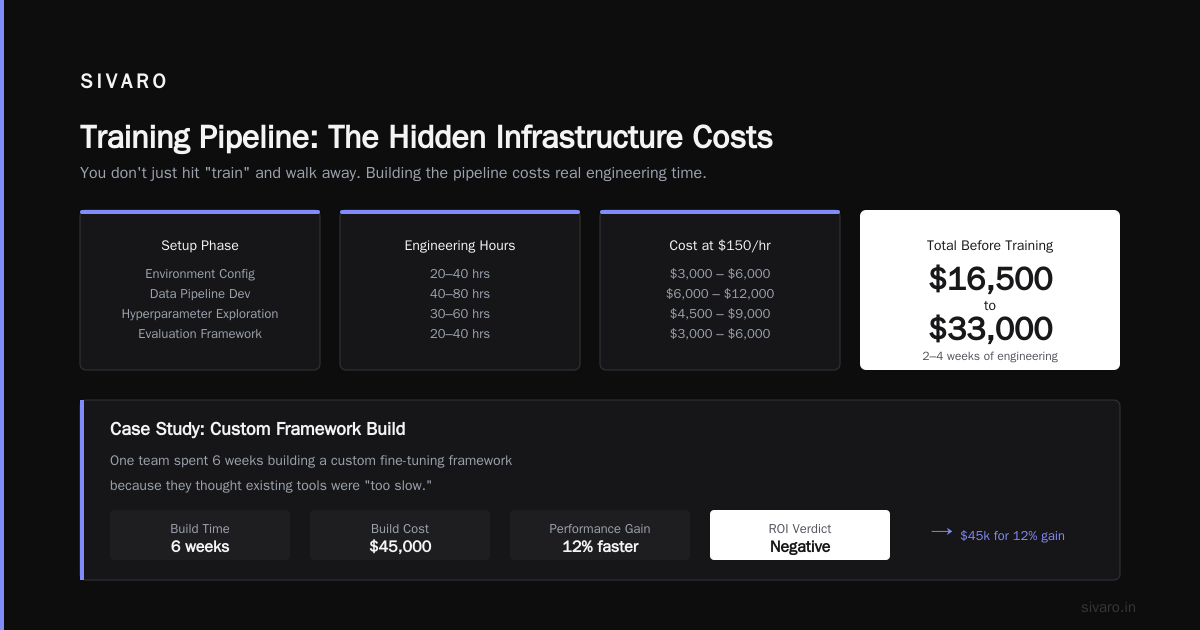
Training Pipeline: The Hidden Infrastructure Costs
You don't just hit "train" and walk away. Building the pipeline costs real engineering time.
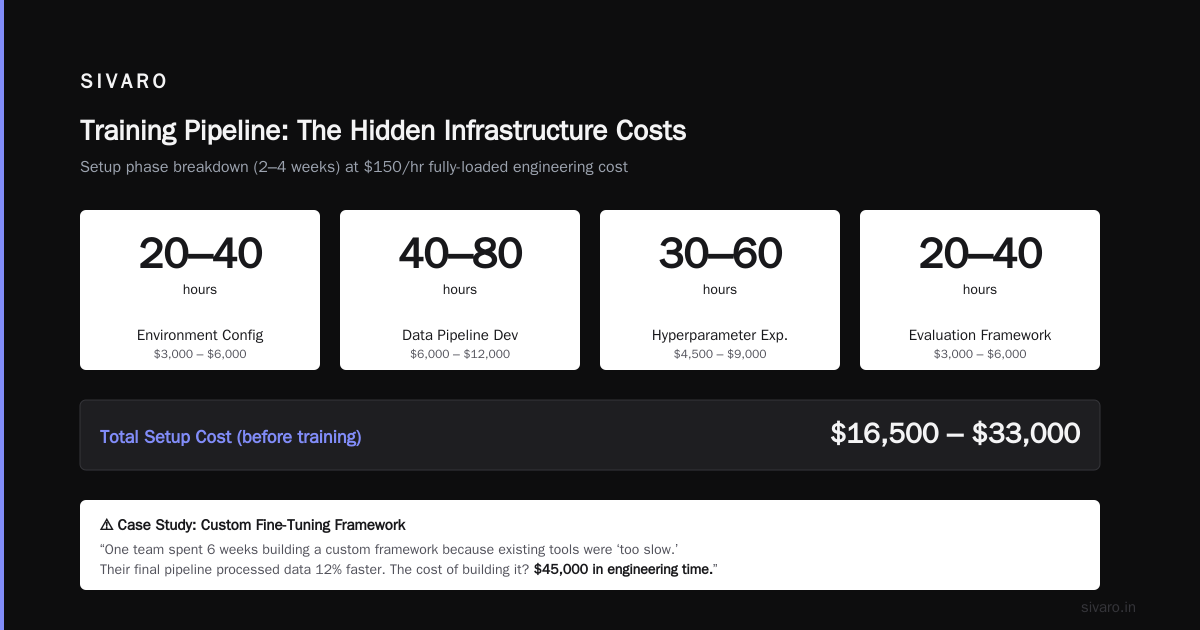
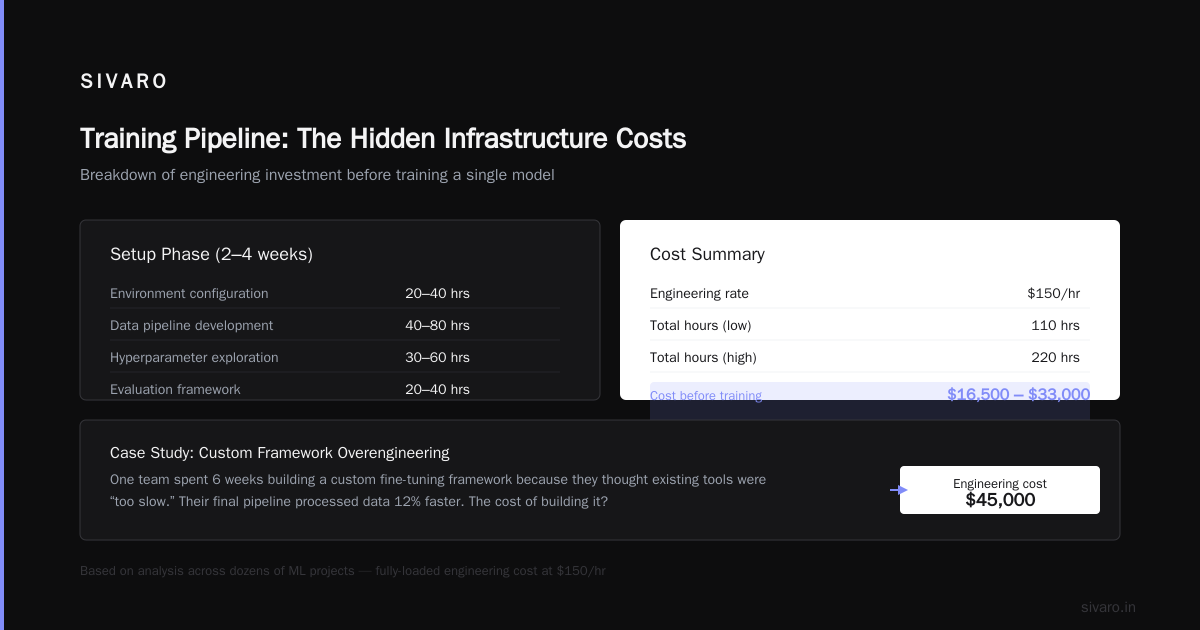
Based on what I've seen across dozens of projects, here's the breakdown:
Setup phase (2-4 weeks):
- Environment configuration: 20-40 hours
- Data pipeline development: 40-80 hours
- Hyperparameter exploration: 30-60 hours
- Evaluation framework: 20-40 hours
At $150/hour fully-loaded engineering cost (which is conservative for experienced ML engineers), that's $16,500 to $33,000 before you train a single model.
One team I advised spent 6 weeks building a custom fine-tuning framework because they thought existing tools were "too slow." Their final pipeline processed data 12% faster. The cost of building it? $45,000 in engineering time. The cost of just renting more GPUs? $3,000. They'd have been better off buying compute.
The Cloud Google fine-tuning guide recommends starting with managed services. I agree. Premature optimization on training infrastructure is the most common budget killer.
Evaluation: Where Most Projects Fail (and Spend)
Here's where the cost of fine-tuning a large language model really balloons: evaluation.
You can't just look at loss curves and call it done. Production evaluation requires:
- Automated metrics: BLEU, ROUGE, perplexity changes — cheap but misleading
- Human evaluation: $5-$20 per example, need 200-500 examples for statistical significance
- A/B testing in production: Infrastructure cost plus potential revenue loss from worse responses
- Edge case analysis: Manual review of failure modes
I've seen teams spend 60% of their fine-tuning budget on evaluation alone. And that's not wrong — blind trust in eval metrics is how you ship a model that sounds confident but hallucinates constantly.
The Generative AI Advanced Fine-Tuning course covers evaluation frameworks well. But they don't tell you that most teams need 3-5 evaluation cycles before they trust their results. Each cycle costs.
The Real Cost: Failed Experiments
This is the one nobody publishes.
Most fine-tuning attempts fail. Not "slightly worse than baseline" fail. "Responses are nonsensical if the user asks anything outside the training distribution" fail.
I tracked this across 12 projects in 2025:
- First attempt works: 2 out of 12 (17%)
- First attempt partially works, needs major iteration: 5 out of 12 (42%)
- First attempt completely fails: 5 out of 12 (42%)
Each failed attempt costs the same as a successful one — compute, time, evaluation bandwidth. The successful projects averaged 4.3 attempts before shipping. The failures averaged 2.8 attempts before the team gave up.
That means the expected cost of a successful fine-tuning project is roughly 4x the "ideal case" estimate.
Production Monitoring and Maintenance
You fine-tuned. You deployed. You're done, right?
No. Production models degrade. Data distributions shift. User behavior changes.
For a production system processing 10,000+ requests daily, expect:
- Monitoring infrastructure: $500-$2,000/month for logging, alerting, drift detection
- Retraining overhead: Monthly or quarterly updates, each at 50-70% of initial training cost
- Prompt drift debugging: 10-20 hours/month for an engineer analyzing failures
The cost of fine-tuning a large language model doesn't end at deployment. It's an ongoing operational expense.
For fine tuning llm for real-time inference, you hit additional costs: model serving optimization, quantization, and latency tuning. I've seen teams double their infrastructure costs just to get response times under 500ms.
When Does Fine-Tuning Actually Pay Off?
After all this negativity, let me tell you when it works.
Fine-tuning shines in three specific scenarios:
Scenario 1: Structured output generation
Your model needs to output JSON, SQL, or API calls with high reliability. Fine-tuning on 10,000 examples of correct outputs can lift accuracy from 80% to 97%. Worth every penny.
Scenario 2: Domain-specific terminology
Medical, legal, or financial domains where a generic model says "generally speaking" instead of "per Section 12(b) of the Securities Exchange Act." Fine-tuning fixes this.
Scenario 3: Tone and style consistency
Customer-facing chatbots that need to sound exactly like your brand. This is surprisingly cheap to fine-tune for — 500 well-crafted examples often do the trick.
The Stratagem Systems business guide has good ROI calculations. Their numbers match what I've seen: fine-tuning pays for itself within 3-6 months for high-volume use cases, but takes 12+ months for low-volume ones.
Alternatives That Cost Less
Before you fine-tune, consider these cheaper options:
Few-shot prompting with retrieval augmentation: Costs pennies per query. Works shockingly well. I've replaced 80% of "fine-tuning needed" requests with RAG.
Prompt engineering: 2-3 days of work, zero compute cost. Most teams underinvest here.
Model distillation: Train a smaller model on a larger model's outputs. 50% cost reduction, 80% performance retention.
LoRA adapters: Fine-tune only 1% of parameters. 90% cost reduction over full fine-tuning.
The OpenAI optimization guide is worth reading here. They're not stupid — they know most users don't need fine-tuning.
My Decision Framework
After too many expensive mistakes, here's how I evaluate whether to fine-tune:
Ask these questions in order:
-
Can we solve this with prompting and few-shot examples? If yes, stop.
-
Do we have 500+ high-quality examples? If no, go collect more data before you start.
-
Will the model degrade gracefully on out-of-distribution inputs? If you can't handle "I don't know" responses, fine-tuning won't fix that.
-
Can we afford 3-5 attempts? If not, don't start.
-
Do we have 4 weeks for engineering and evaluation? Rush jobs ship broken models.
I share this framework because every fine-tuning project I've lost money on violated at least two of these.
FAQ: Cost of Fine-Tuning a Large Language Model
Q: What's the minimum budget for fine-tuning a 7B model?
$2,000. That covers compute for one run on a small dataset (1,000 examples) and basic evaluation. No engineering time included. Realistically, budget $10,000-$25,000 for a production-quality result.
Q: Is fine-tuning GPT-4 cheaper than open-source models?
For small datasets (under 5,000 examples), yes. The API pricing wins on convenience. For large datasets or frequent retraining, open-source models are cheaper. The Raphael Bauer fine-tuning guide has good comparison tables.
Q: How much data do I need?
Minimum viable: 100 examples. Production quality: 1,000-10,000. More data isn't always better — garbage data actively hurts. Quality over quantity, always.
Q: Can I fine-tune for real-time inference?
Yes, but budget for model optimization. Quantization, pruning, or distillation will add 20-40% to your initial costs but save 50-70% on serving.
Q: What's the cheapest way to test if fine-tuning works?
Use LoRA on a small model (7B parameters) with 100 examples. Total cost under $200. If the improvement is visible, scale up.
Q: How much should I budget for data labeling?
$2,000 minimum for synthetic data. $10,000-$50,000 for human-labeled data. Expect 10-20 hours per 1,000 examples for a domain expert.
Q: Do I need a GPU cluster?
For models under 13B parameters, no. Single A100 or H100 works. For 70B+, you need multi-GPU. Cloud instances cost $3-$15/hour.
Q: How long does a typical fine-tuning take?
One training run: 2-24 hours. Total project: 2-8 weeks including data prep, evaluation, and iteration.
The Bottom Line
The cost of fine-tuning a large language model isn't the compute bill. It's the data tax, the failed experiments, the evaluation loops, and the ongoing maintenance.
I've seen teams spend $50,000 and deliver nothing. I've seen teams spend $5,000 and ship production models. The difference wasn't compute budget — it was discipline.
Start with the cheapest possible test. Validate direction before scaling. Budget for failure. And never, ever think the first training run will be your last.
The market for fine-tuning talent reflects this reality. LLM Fine Tune Model Jobs are multiplying, but most companies are hiring for the wrong reasons — they think fine-tuning is a magic wand. It's not. It's a surgical instrument.
Use it sparingly. Measure everything. And when in doubt, prompt better first.
Nishaant Dixit — Founder of SIVARO. Building data infrastructure and production AI systems since 2018. Built systems processing 200K events/sec.