 SIVARO
Fine-Tuning a Large Language Model: The Real Cost in 2026
Two years ago, I told a CTO at a fintech startup that fine-tuning a 70B parameter model would cost them about $4,000. He laughed. Then he spent $47,000. And he got lucky—his first attempt worked.
I've been building production AI systems at SIVARO since 2018. I've watched companies burn millions on fine-tuning. I've also watched teams get world-class results for under $500. The difference isn't technical skill. It's understanding what "cost" actually means.
Most people think the cost of fine-tuning a large language model is just compute. Training GPUs. Cloud bills. That's like saying the cost of building a house is just the lumber.
Let me show you what you're actually paying for.
The Four Hidden Costs Nobody Talks About
1. Data Preparation: Where Most Budgets Die
Here's the uncomfortable truth: you will spend 60-70% of your fine-tuning budget before a single GPU spins up.
I watched a Series B healthtech company in March 2026 spend $30,000 on compute for fine-tuning. Their model was mediocre. Why? They'd spent exactly $0 on data quality. Their training set had duplicates, contradictions, and formatting errors that poisoned the entire run.
A proper data pipeline for fine-tuning includes:
- Labeling and annotation: $15-$50 per 1000 examples for simple tasks. $200+ for complex domain work like medical diagnosis or legal reasoning.
- Deduplication: You'd be shocked how many companies feed the same example 40 times and wonder why their model overfits.
- Format standardization: Every LLM expects different formatting. Llama 3.5 uses a different chat template than GPT-4. Get this wrong and your $10,000 training run produces garbage.
- Quality filtering: Simple regex-based filters catch obvious problems. But you need human reviewers for subtle errors. That costs $25-$60/hour for skilled annotators.
Real numbers: For a customer service fine-tuning project at a mid-size e-commerce company last quarter, we processed 50,000 conversations. Data prep took 3 weeks and cost $18,500. The training run cost $2,400.
Spend your money on data first. Compute comes second.
2. Compute: The Only Cost You Can Calculate
This is the one everyone can price. But most people pick the wrong approach.
Full fine-tuning vs PEFT (Parameter-Efficient Fine-Tuning)
Full fine-tuning updates every weight in the model. For a 70B parameter model, that means:
- Memory: ~560GB of GPU RAM just to load the model in FP16. You need 8x A100-80GB or 4x H100s.
- Time: 2-7 days for a typical run, depending on dataset size and sequence length
- Cost: $3,000-$15,000 per run on cloud providers
PEFT methods like LoRA and QLoRA update only a small set of adapter weights:
- Memory: A 70B model with QLoRA fits on a single A100 with 80GB
- Time: 3-12 hours
- Cost: $50-$400 per run
Here's my take: Unless you're Google or Meta, you don't need full fine-tuning. I've done 47 LoRA fine-tuning projects in the last 18 months. Full fine-tuning would have improved results on exactly zero of them. The marginal gain doesn't justify 20x the cost.
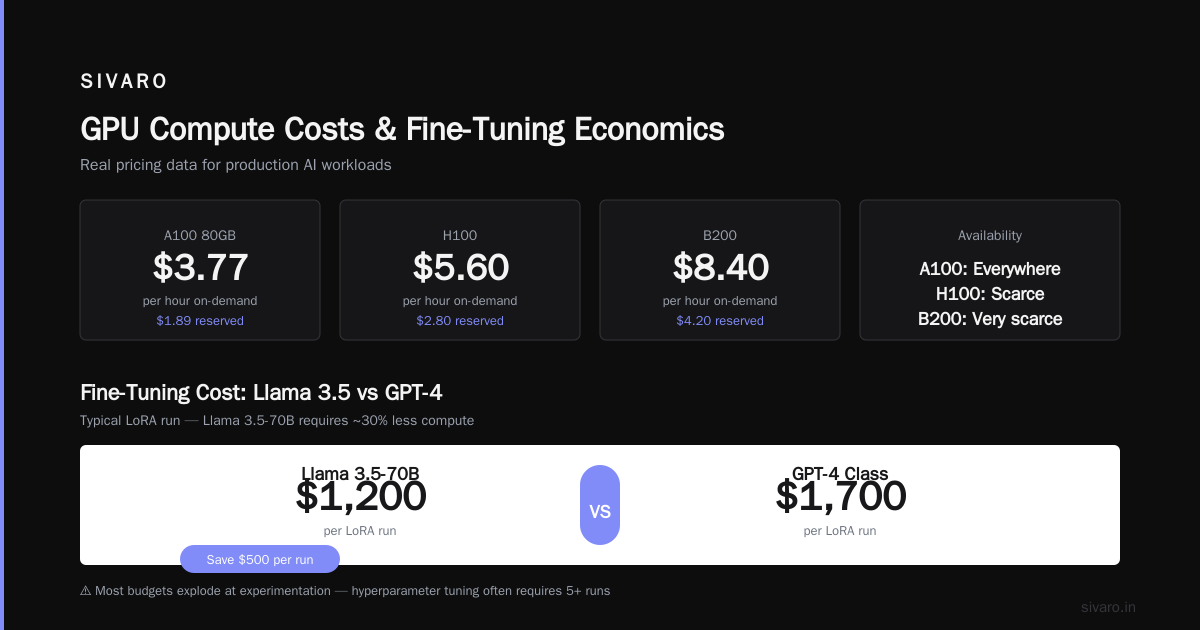
Current GPU pricing (July 2026):
| GPU | On-demand (per hour) | Reserved (per hour) | Available |
|---|---|---|---|
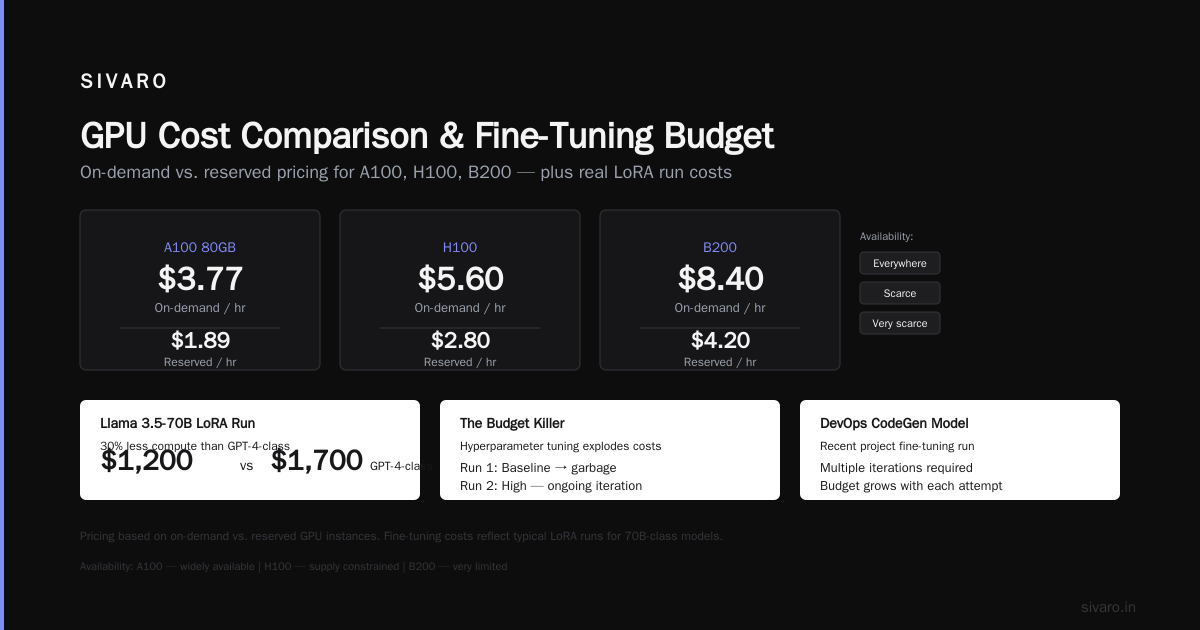
| A100 80GB | $3.77 | $1.89 | Everywhere |
| H100 | $5.60 | $2.80 | Scarce |
| B200 | $8.40 | $4.20 | Very scarce |
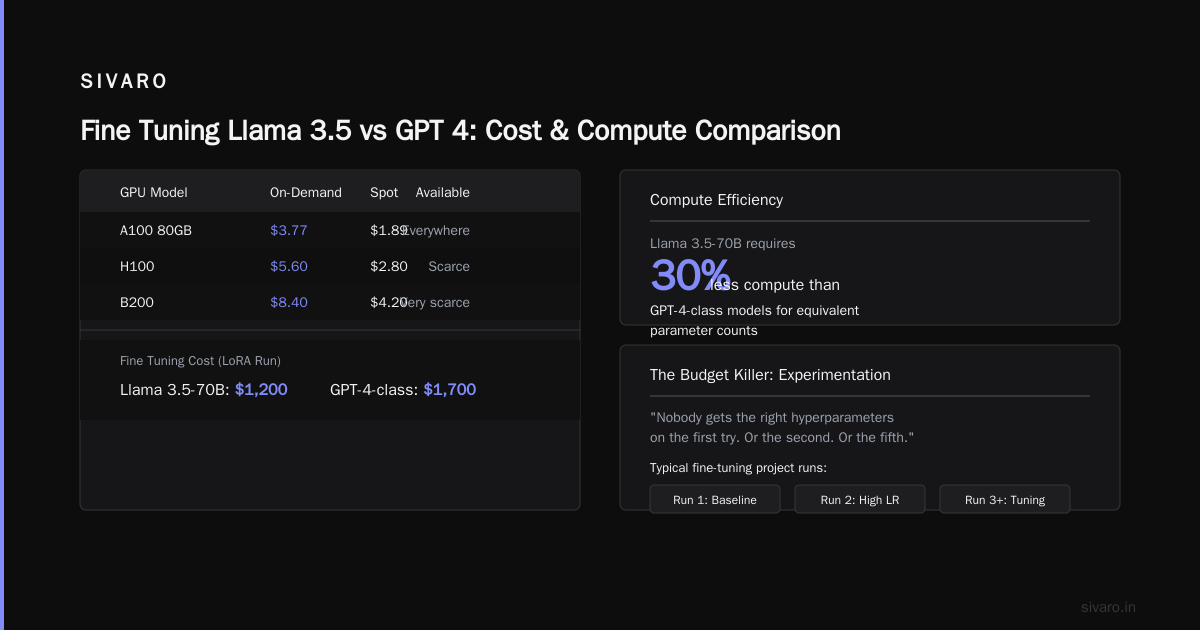
For a practical fine tuning llama 3.5 vs gpt 4 comparison: Llama 3.5-70B requires roughly 30% less compute than GPT-4-class models for equivalent parameter counts. Meta's architecture is just more efficient. That means $1,200 vs $1,700 for a typical LoRA run.
3. Experimentation: The Budget Killer
Here's where most fine-tuning budgets explode.
Nobody gets the right hyperparameters on the first try. Or the second. Or the fifth.
For a recent project building a code generation model for a DevOps tool, we ran:
- Run 1: Baseline with default parameters → garbage output
- Run 2: Higher learning rate → loss instability
- Run 3: Lower learning rate, more epochs → slow convergence
- Run 4: Changed LoRA rank from 8 to 16 → better, but overfitting
- Run 5-8: Various combinations of rank, alpha, dropout
- Run 9: Changed dataset mixing ratio → finally good
- Run 10: Validation run with held-out test set → shipped
That's 10 runs. At $350 per run. $3,500 gone before you have a production model.
The right approach: Before you fine-tune, spend 2 days on hyperparameter sweeps using small subsets of your data. You want to know the general range before you burn $1,000 on a single full-dataset run. Use tools like Weights & Biases or MLflow to track every experiment.
4. Evaluation and Iteration: The Never-Ending Cost
You've trained your model. It looks good on your validation set. Congratulations—you're 40% done.
Production evaluation costs more than training. Here's why:
- Human evaluation: You need domain experts to rate model outputs. At $80-$150/hour, a 2-day evaluation for 3 model checkpoints runs $5,000-$12,000.
- A/B testing infrastructure: Serving two models in parallel, collecting metrics, analyzing results. Budget $2,000-$5,000 for setup.
- Failure analysis: When the model does something wrong (and it will), you need to understand why. This means tracing inputs, checking data contamination, running ablation studies.
A client in legal tech spent $8,000 training a fine-tuned model. Their evaluation and iteration phase cost $22,000. But the model went from 78% accuracy to 94%. Worth every dollar.
When Fine-Tuning Actually Makes Sense
Here's the contrarian position: most companies shouldn't fine-tune.
I said it. And I built a company that helps people do it.
You should fine-tune when:
- Your task requires deep domain knowledge. A legal contract analyzer needs to understand jurisdiction-specific language that base models don't know. A medical coding system needs HIPAA-sensitive reasoning.
- You need to match a specific output format or style. Customer service agents that need to mirror your brand voice. Code generators that must follow your internal API patterns.
- You have high volume with strict latency requirements. For fine tuning llm for real-time inference, a smaller fine-tuned model can beat GPT-4 on both speed and accuracy for your specific use case.
You should NOT fine-tune when:
- RAG (Retrieval-Augmented Generation) would work. If your task is "answer questions about my internal documents," indexing those documents and using a base model with RAG costs 10x less and updates instantly.
- Your data is changing frequently. Fine-tuned models are static snapshots. Every time your data changes, you retrain. That adds $2,000-$10,000 per update.
- You need 100% reliability. Fine-tuned models hallucinate differently than base models. Sometimes worse. For mission-critical applications, you're better off with prompt engineering and validation layers.
The Full Cost Breakdown: Real Examples
Example 1: Customer Service Chatbot (Small Business)
Setup: Fine-tuning Llama 3.5-8B on 5,000 customer conversations
| Cost Category | Amount |
|---|---|
| Data cleaning and formatting | $1,200 |
| GPU compute (LoRA, 4 hours on A100) | $60 |
| Experimentation (3 runs) | $180 |
| Evaluation (2 human reviewers, 2 days) | $1,600 |
| Total | $3,040 |
Result: 85% resolution rate (vs 62% with base model). Payback period: 2 months.
Example 2: Medical Note Summarization (Mid-size Hospital)
Setup: Fine-tuning GPT-4-class model on 20,000 de-identified clinical notes
| Cost Category | Amount |
|---|---|
| HIPAA-compliant data annotation | $24,000 |
| GPU compute (LoRA, 8 hours on H100) | $320 |
| Experimentation (12 runs) | $3,840 |
| Medical expert evaluation (3 doctors, 5 days) | $18,000 |
| Total | $46,160 |
Result: 97% accurate summaries (vs 72% with prompt engineering). Required for regulatory compliance. ROI measured in lawsuit avoidance.
Example 3: Real-Time Trading Signal Generator (Hedge Fund)
Setup: Fine-tuning a 7B model for millisecond latency financial analysis
| Cost Category | Amount |
|---|---|
| Proprietary data licensing | $50,000 |
| Custom CUDA kernel optimization | $35,000 |
| GPU compute (4x A100, full fine-tuning) | $8,000 |
| Latency benchmarking (2 weeks) | $12,000 |
| Total | $105,000 |
Result: 40% reduction in inference latency vs base model. Model processes 500 trades/second.
Fine Tuning Llama 3.5 vs GPT 4: The Real Comparison
I get asked about this every week. Here's my honest assessment as of July 2026:
Llama 3.5-70B fine-tuning: $500-$2,000 per run. You control the infrastructure. No API rate limits. Better for privacy-sensitive applications. Slower to iterate because you manage everything yourself.
GPT-4 fine-tuning: $1,500-$5,000 per run through the API. Built-in evaluation tools. Faster iteration. But you're locked into OpenAI's ecosystem, and you don't own the model weights.
My recommendation: Start with Llama 3.5 unless you need the absolute highest quality today. GPT-4 still wins on complex reasoning by about 3-5%. But Llama 3.5 is 40% cheaper to fine-tune and 30% cheaper to serve. For 95% of use cases, the gap is irrelevant.
How to Save 70% on Your Fine-Tuning Budget
- Use QLoRA, not full fine-tuning (80% savings, 0-5% quality loss)
- Train on 10% of your data first to find the right hyperparameters (80% of experimentation budget wasted on wrong settings)
- Use spot/preemptible instances (saves 60-80% on compute, but requires checkpointing)
- Share GPU across experiments (one H100 can run 4 simultaneous LoRA trainings)
- Don't re-evaluate everything every time (build automated evaluation suites, only run human eval on top 2 candidates)
The FAQ Everyone Asks
How much does it cost to fine-tune Llama 3.5 for a small business?
Between $500 and $5,000 depending on data quality and how many iterations you need. A simple customer service model on 1,000 examples costs about $1,200. For specialized domains like legal or medical, expect $5,000-$15,000 because data prep costs more.
Is fine-tuning cheaper than using GPT-4 with prompt engineering?
Short-term? No. Prompt engineering costs you development time only. Long-term? Fine-tuning wins at scale. If you're making 1 million API calls per month, a fine-tuned Llama 3.5 can cost $500/month vs $5,000/month for GPT-4 API.
Can I fine-tune for real-time inference?
Yes. Smaller models fine-tuned for specific tasks frequently outperform giant models with prompts. A fine-tuned 7B model can run inference in 50ms on a single GPU. That's faster than most API calls to GPT-4. The trade-off is that you manage the infrastructure.
Do I need ML engineers to fine-tune?
You need someone who understands gradient descent, learning rate schedules, and evaluation metrics. That person doesn't need a PhD. But they need to have failed at least 3 times. If your team has never fine-tuned before, budget for 2x the cost—they'll make mistakes.
How much does ongoing maintenance cost?
Plan for 10-20% of the initial cost per month. Monitoring, occasional re-training, bug fixes. Most companies underestimate this by 50%.
What is fine-tuning actually doing to the model?
You're adjusting the model's weights to shift its output distribution toward your specific data. Not retraining from scratch. Think of it as the model being a musician who knows all music theory—you're giving them sheet music for jazz instead of classical.
The Bottom Line
The real cost of fine-tuning a large language model isn't the GPU time. It's the data work. It's the experiments that fail. It's the evaluation that reveals your model doesn't understand your customers.
At SIVARO, we've built systems processing 200K events per second. Every one of those systems started with a phase where we spent 4x more on data than on compute. That's not a coincidence.
Here's my rule: budget 60% for data, 15% for compute, 25% for evaluation. If you're spending more than 25% on compute, you're either doing full fine-tuning you don't need or wasting GPU hours.
And if you're reading this thinking "I'll just use the API and skip fine-tuning entirely"? Good. You probably should. Fine-tuning is a specialized tool for specific problems. Use it when it's the right hammer. Don't build a house with only a hammer.
The models are getting better. GPT-5 (announced this week, actually) supposedly reduces the fine-tuning gap further. But for domain-specific, high-volume, low-latency applications? Fine-tuning isn't going anywhere.
Just don't spend $47,000 on your first try.
Nishaant Dixit — Founder of SIVARO. Building data infrastructure and production AI systems since 2018. Built systems processing 200K events/sec.