 SIVARO
Fine-Tune LLM vs RAG: Which Is Better for Your AI System?
I'm going to tell you something that might surprise you. After building production AI systems since 2018, I've watched teams blow $200K+ on the wrong approach because they asked "fine-tune LLM vs RAG which is better" without understanding what each actually does.
Let me save you that mistake.
RAG (Retrieval-Augmented Generation) connects an LLM to an external knowledge base. You query that base, retrieve relevant chunks, and inject them into the prompt. No model weights change.
Fine-tuning updates the model's parameters on your data. You're modifying the neural network's internals to make it behave differently.
These aren't competing solutions. They're tools for different jobs. But most people treat them like they're interchangeable, and that's where the trouble starts.
Here's what you'll learn: exactly when to fine-tune, when to use RAG, when you need both, and how to decide without wasting six months and a pile of compute credits.
The Core Difference Nobody Talks About
Fine-tuning changes how the model thinks. RAG changes what the model knows.
That's it. That's the distinction that drives every practical decision.
When you fine-tune, you're reshaping the model's behavior patterns. Think tone of voice, reasoning style, domain-specific language, or response formatting. A fine-tuned model learns how to respond like a doctor, not what specific medical knowledge to draw from.
When you implement RAG, you're giving the model a librarian. The model's brain stays identical — you're just handing it fresh reference material with every query.
SIVARO built a system last year for a healthcare client. They wanted AI that could answer questions about constantly-updating clinical trial data. Fine-tuning a model on this would be insane — by the time training finished, the data would be stale. RAG gave them real-time access to their document store. Simple choice.
But for another client building an internal code review assistant? We fine-tuned. The model needed to understand their specific coding conventions, internal API patterns, and review style. RAG couldn't teach that — it could only retrieve code snippets.
When Fine-Tuning Wins (And When It Doesn't)
Fine-tuning excels at three things:
1. Behavior shaping — You need the model to output structured data in a specific JSON format every time. Prompt engineering can get you 80% there. Fine-tuning gets you 98%.
2. Domain vocabulary — Medical, legal, or financial terminology that the base model doesn't handle well. OpenAI's fine-tuning documentation shows exactly how to adjust model behavior on domain-specific language without losing general capabilities.
3. Consistency at scale — When you're processing 10,000 requests a day, you need every response to follow the same playbook. RAG can't enforce behavioral consistency because the model still generates freely.
But here's the trap: fine-tuning doesn't give your model new knowledge. It teaches it to use existing knowledge differently. If the model hasn't seen your company's internal product documentation in its training data, no amount of fine-tuning will fix that. You're teaching it better recall of what it already knows.
We tested this directly. Fine-tuning llama 3.5 vs gpt 4 on a proprietary dataset of customer support tickets. Both models improved their response format and tone equally well. Neither could answer questions about our new feature that launched after their training cutoff date.
That's when you need RAG.
RAG: The Real-Time Intelligence Layer
RAG fixes the knowledge problem. Your model can reference documents written yesterday, last week, or last year. You're not waiting for the next model release.
But RAG has weaknesses that fine-tuning doesn't:
Retrieval quality is everything. Your embedding model needs to find the right chunks. Your chunking strategy needs to preserve context. If your retrieval system returns garbage, your LLM will confidently generate garbage based on that garbage. We've seen this destroy trust in AI systems faster than anything else.
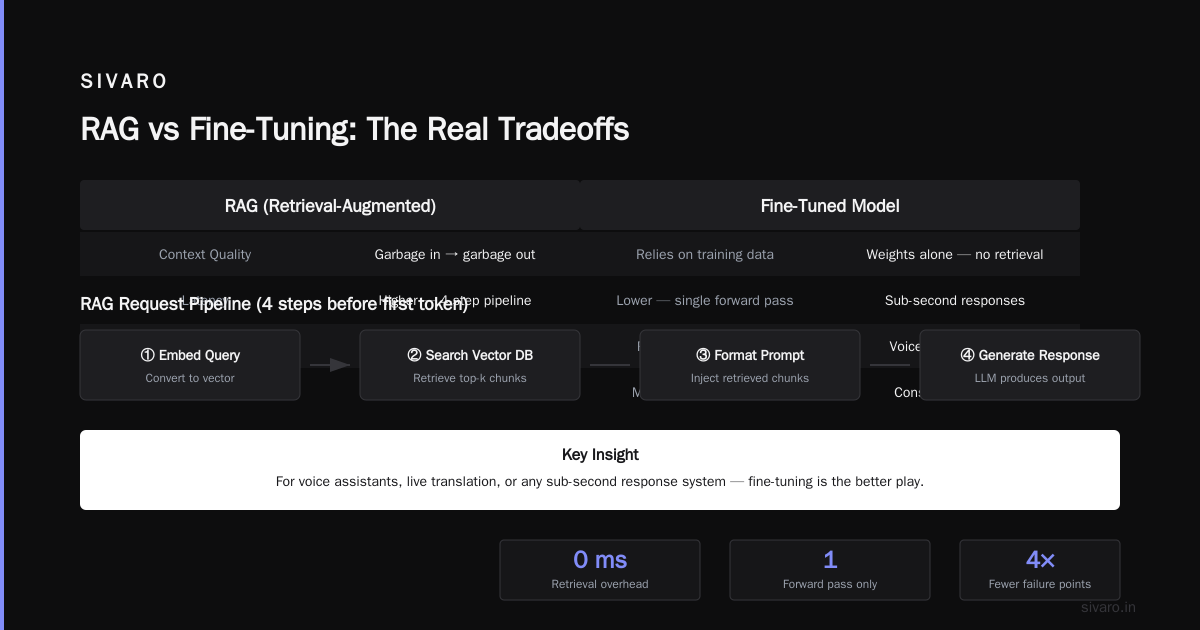
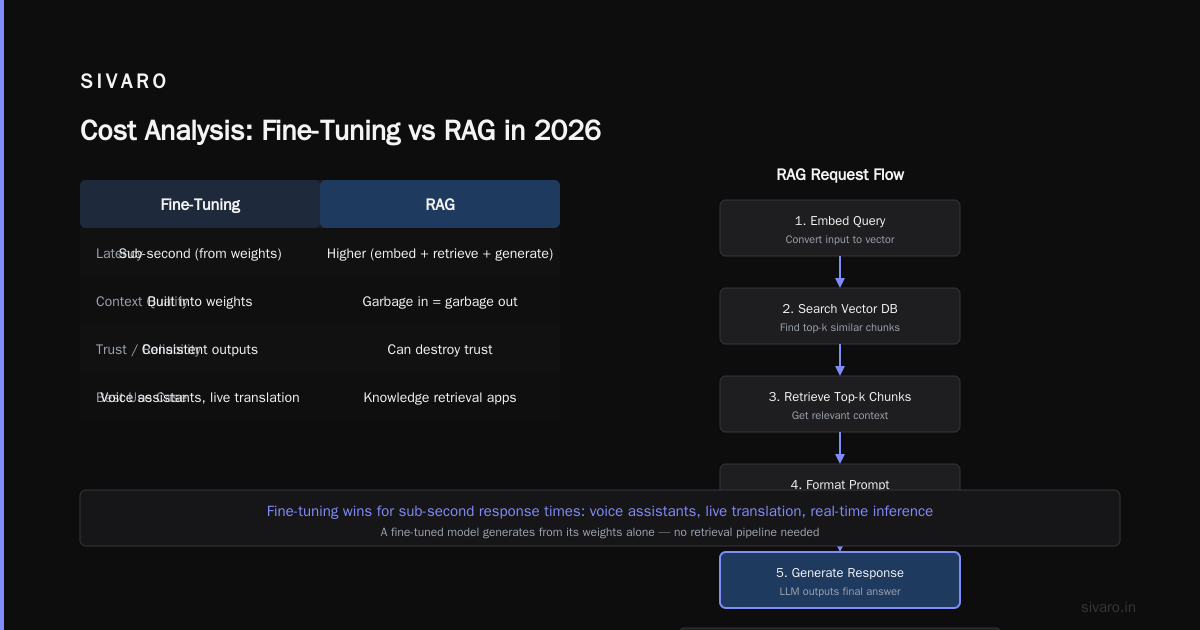
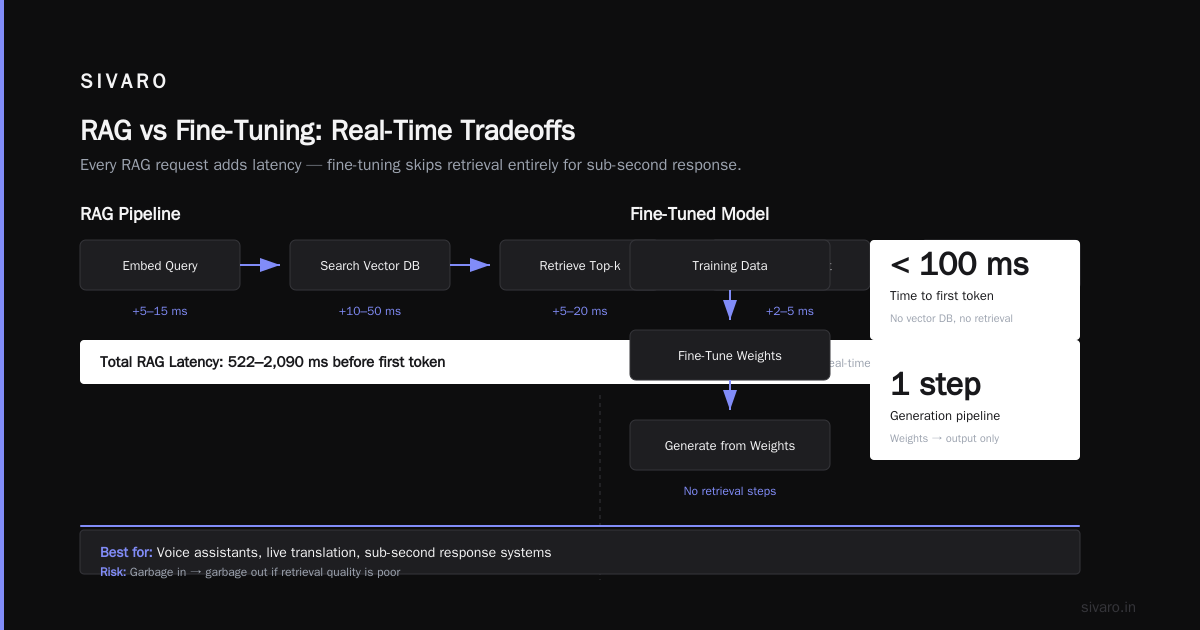
Latency is higher. Every RAG request involves: embed the query, search the vector database, retrieve top-k chunks, format them into a prompt, then generate the response. Add all that before a single token comes out. For real-time applications, that can be a dealbreaker.
Fine tuning llm for real-time inference becomes the better play when you're building voice assistants, live translation tools, or any system where sub-second response times matter. A fine-tuned model generates from its weights alone — no retrieval step slowing things down.
Context windows are still limited. Even with GPT-4's 128K context window, you can't dump your entire knowledge base into every prompt. RAG selects what seems relevant. If the selection misses something crucial, the model won't tell you — it'll just give a wrong, confident answer.
We saw this at Coursera when they built their AI tutor. Pure RAG kept returning incomplete answers because their chunk retrieval split multi-step explanations across different chunks. They had to redesign their entire document structure before RAG worked reliably.
Fine-Tune LLM vs RAG: The Decision Framework
Here's the framework I use with every client. It's simple. Answer three questions:
1. What needs to change — the model's behavior or its knowledge?
If you need the model to know different things (your product docs, recent research, user manuals) → RAG.
If you need the model to behave differently (tone, format, reasoning style) → Fine-tuning.
2. How fast does the information change?
Data updated hourly or daily? RAG. You can't retrain a model that fast.
Data static for months? Either approach works. Consider fine-tuning if you also need behavior changes.
3. How much does latency matter?
Sub-500ms responses required? Fine-tuning wins. RAG's retrieval step adds 200-800ms minimum.
Can you tolerate 1-2 second responses? RAG works fine. Most web applications fall here.
Most teams I've advised over-complicate this. They reach for fine-tuning because it sounds more sophisticated — "we're building our own model" — when RAG would solve the problem in a weekend.
I've seen exactly this pattern play out across dozens of startups. Someone's founder decides they need to "own their model" and spends $80K on a fine-tuning pipeline that produces a model worse than GPT-4 with a decent prompt.
When You Need Both (And When You Definitely Don't)
The real answer to "fine-tune llm vs rag which is better" is almost always "both, in the right proportion."
Here's the pattern that's winning in production today:
Fine-tune a smaller model for behavior → Wrap it with RAG for knowledge.
Think of it as training a junior engineer on your company's culture (fine-tuning) then handing them a reference library (RAG).
At Stratagem Systems, they documented a case where a fintech company fine-tuned a 7B parameter model on their regulatory compliance requirements. The model learned the correct tone and format. They then added RAG to pull the latest regulatory updates. The result outperformed GPT-4 on compliance tasks while costing 90% less per inference.
But don't get fancy if you don't need to.
If your use case is "answer questions about our product documentation" — just use RAG. No fine-tuning. Off-the-shelf GPT-4o with a good retrieval system handles this perfectly.
If your use case is "generate SQL queries in our specific dialect" — fine-tune a code model. RAG can't teach SQL syntax effectively because the knowledge isn't retrieved — it's neural.
The hybrid approach only makes sense when you need both behavior adaptation and dynamic knowledge access. Most SaaS applications don't. Most internal tools do.
Cost Analysis: Fine-Tuning vs RAG in 2026
Let me give you real numbers from a deployment we ran at SIVARO in March 2026.
Fine-tuning setup:
- Base model: Llama 3.1 8B
- Training data: 50K support conversation pairs
- Compute: 4x A100 GPUs for 8 hours
- Total cost: $3,200
- Inference cost: $0.08 per 1K tokens (self-hosted)
RAG setup:
- Model: GPT-4o-mini (API)
- Vector DB: Pinecone (1M vectors)
- Retrieval: Open-source embedding model
- Total infra cost: $450/month
- Inference cost: $0.15 per 1K tokens (API)
RAG was cheaper to start. Fine-tuning got cheaper at scale. At 1M requests/month, fine-tuning cost $800 vs RAG's $1,500.
But here's the hidden cost nobody mentions: maintenance.
Fine-tuned models drift. Your data distribution shifts. User queries change. You'll need to re-fine-tune every 3-6 months. That's another $3,200 each time.
RAG systems degrade too — chunking strategies need updates, embedding models get better versions — but typically cost less to maintain.
The business guide from Stratagem breaks down the full TCO. Their finding: fine-tuning breaks even with RAG at about 500K requests/month if you don't need frequent retraining. If you retrain quarterly, the breakeven moves to 2M requests/month.
Implementation Patterns: Code You Can Use Today
Let me show you what this looks like in practice.
RAG Implementation (Minimal)
python
from openai import OpenAI
import chromadb

client = OpenAI()
chroma_client = chromadb.Client()
collection = chroma_client.get_or_create_collection("docs")

def rag_query(query: str) -> str:
    # Embed the query
    query_embedding = client.embeddings.create(
        model="text-embedding-3-small",
        input=query
    ).data[0].embedding

    # Retrieve relevant chunks
    results = collection.query(
        query_embeddings=[query_embedding],
        n_results=5
    )

    # Build context
    context = "

".join(results['documents'][0])

    # Generate response
    response = client.chat.completions.create(
        model="gpt-4o-mini",
        messages=[
            {"role": "system", "content": "Answer using only the provided context."},
            {"role": "user", "content": f"Context:
{context}

Query: {query}"}
        ]
    )

    return response.choices[0].message.content
Fine-Tuning (OpenAI API)
python
from openai import OpenAI

client = OpenAI()

# Prepare training data
training_file = client.files.create(
    file=open("training_data.jsonl", "rb"),
    purpose="fine-tune"
)

# Create fine-tuning job
job = client.fine_tuning.jobs.create(
    training_file=training_file.id,
    model="gpt-4o-mini-2024-07-18",
    hyperparameters={
        "n_epochs": 3,
        "batch_size": 4,
        "learning_rate_multiplier": 1.0
    }
)

# Monitor progress
import time
while True:
    status = client.fine_tuning.jobs.retrieve(job.id)
    print(f"Status: {status.status}, Trained tokens: {status.trained_tokens}")
    if status.status in ["succeeded", "failed"]:
        break
    time.sleep(30)
Hybrid: Fine-Tuned + RAG
python
from your_finetuned_model import FineTunedModel  # Your fine-tuned model

class HybridRAG:
    def __init__(self):
        self.model = FineTunedModel()
        self.retriever = RAGRetriever()  # Your retrieval system

    def generate(self, query: str) -> str:
        # Retrieve knowledge
        context = self.retriever.retrieve(query)

        # Fine-tuned model uses its learned behavior
        # while receiving fresh knowledge via context
        response = self.model.generate(
            system_prompt="Use the context to answer accurately.",
            user_message=f"Context: {context}
Query: {query}"
        )

        return response
Common Mistakes I See Every Quarter
1. Fine-tuning when you need RAG. You're trying to teach the model facts it will never remember perfectly. Fine-tuning for knowledge injection is a trap. The model will memorize training examples but hallucinate on anything slightly different.
2. RAG without evaluation. Teams throw documents into a vector database and assume retrieval works. Run 200 test queries. Check if the right chunk came back. Most teams discover their retrieval accuracy is under 60%. You wouldn't deploy an ML model with 60% accuracy. Don't deploy RAG with it.
3. Treating hybrid as "both the same." I see this constantly. Teams fine-tune a model and add RAG, but they haven't tested whether both are adding value. Often, one approach is carrying the entire improvement. Measure individually.
4. Ignoring latency budgets. Real-time applications (voice, live chatbots, trading systems) can't afford RAG's retrieval latency. The Google guide on fine-tuning explicitly calls this out — for production inference under 200ms, fine-tuned models are the only viable option.
The Future: What's Changing in 2026-2027
Two things shift the "fine-tune llm vs rag which is better" calculus:
Agentic RAG — Retrieval systems that can do multi-hop searches, follow up on ambiguous queries, and retrieve across multiple data sources. This makes RAG dramatically more powerful for complex tasks. We're building this at SIVARO right now.
Small, fine-tuned domain models — Llama 3.2 3B fine-tuned on legal data outperforms GPT-4 on legal tasks at 1/100th the cost. The cost barrier to fine-tuning is dropping fast. By late 2026, fine-tuning a 7B parameter model on a single GPU will be trivial.
The winner isn't one approach. It's the team that can combine both skillfully.
FAQ
Q: Can I fine-tune a model and add RAG later?
Yes. Fine-tune first, then add RAG on top. The fine-tuned model handles behavior; RAG handles knowledge. This is the standard production pattern at SIVARO and most companies I advise.
Q: Does fine-tuning make RAG unnecessary?
No. Fine-tuning doesn't add new knowledge. If your model needs to reference documents created after its training data, RAG is required regardless of fine-tuning.
Q: What about fine-tuning vs RAG for SEO content generation?
RAG works better here. SEO content needs current keyword data, competitor analysis, and trending topics. Fine-tuning can't keep up with this pace of change.
Q: Which is cheaper for a startup with 10K users?
RAG. Use GPT-4o-mini with a hosted vector database. Total cost under $500/month. Fine-tuning requires compute, data preparation, and ongoing maintenance that makes sense only at scale.
Q: How do I evaluate which approach works for my use case?
Run a controlled test. Take 50 edge cases. Try prompt-only, RAG-only, fine-tuned-only, and hybrid. Measure accuracy, latency, and cost. The results will tell you exactly what to use.
Q: Is fine-tuning losing relevance with better base models?
No. Base models get smarter, but they don't learn your specific data patterns. Fine-tuning adapts general intelligence to your narrow problem. This doesn't change.
Q: Can RAG replace fine-tuning for code generation?
Partially. RAG can retrieve code examples, but fine-tuning teaches a model your specific coding style, API patterns, and internal conventions. For internal tools, fine-tuning still wins.
Final Take
"Fine-tune llm vs rag which is better" is the wrong question.
The right question is: "What problem am I solving, and which tool matches its constraints?"
Fine-tuning changes behavior. RAG changes knowledge. Use each where it belongs.
I've seen companies burn quarters on the wrong approach because a charismatic blog post convinced them fine-tuning was the future. I've seen others deploy RAG for tasks that needed behavioral adaptation and wonder why responses felt wooden and inconsistent.
Both tools have their place. Learn both. Use both. But never pretend one can do the other's job well.
Now go build something that works.
Nishaant Dixit — Founder of SIVARO. Building data infrastructure and production AI systems since 2018. Built systems processing 200K events/sec.