 SIVARO
Fine-Tune LLM vs RAG: Which Is Better for Production in 2026?
I got this question three times last week. Once from a fintech CTO who needed real-time fraud detection. Once from a healthcare startup building a clinical decision support tool. And once from my own team at SIVARO, debating our internal knowledge retrieval stack.
The short answer: RAG wins for factual accuracy and live data. Fine-tuning wins for behavior, tone, and structured outputs.
But that's like saying "hammers are for nails." You need to know when each tool destroys the other — and more importantly, when you need both.
Let me walk you through what we've actually seen work in production since 2022, updated for where we are today: July 18, 2026.
The Easy Trap Most Teams Fall Into
Most people think fine-tuning is "better" because it sounds deeper. You're modifying the model itself. That feels powerful.
In 2024, a Series B e-commerce company came to us with a "fine-tuned" GPT-4 model they'd spent $80,000 building. It was supposed to answer customer questions about their inventory. It hallucinated product availability numbers 23% of the time. Their support tickets went up after deployment.
I asked a simple question: "Why didn't you just give it access to your actual inventory database?"
Silence.
That's RAG. That's the thing they should have built first. They'd spent months and a fortune on fine tuning llama 3.5 vs gpt 4 debates when the real problem was data retrieval.
Don't be that company.
First: What Are We Actually Comparing?
Fine-tuning is taking a pre-trained model (like Llama 3.5, GPT-4, or Mistral) and training it further on a specific dataset. This changes the model's weights. It learns new patterns, new behaviors, new formatting.
RAG (Retrieval-Augmented Generation) is the architecture pattern where you search a knowledge base at runtime, retrieve relevant documents, and inject them into the prompt. The model itself doesn't change — you just give it better context.
Both solve different problems. Google Cloud puts it well: "Fine-tuning adapts the model's behavior; RAG adapts the model's knowledge." But that framing undersells the practical differences.
Here's my version:
- Fine-tuning is for permanent behavioral change — you want the model to speak differently, reason in a specific format, or reliably output structured data.
- RAG is for ephemeral factual ground truth — you want the model's answers to depend on data that changes hourly.
Where RAG Destroys Fine-Tuning
Let me be direct: if your use case depends on facts that change — pricing, compliance rules, inventory, policy documents, user data — and you choose fine-tuning over RAG, you are making a mistake.
Real-time data access is RAG's superpower. Fine-tuned models freeze at the training cut-off. A model fine-tuned in January 2026 won't know about the new FDA guidelines released last week. A RAG pipeline fed from your latest database updates doesn't have that problem.
We tested this at SIVARO for a legal tech client. They needed an AI that could answer questions about current contract law across 50 states. We fine-tuned a Llama 3.5 model on all their existing case law. Then we built a RAG system pointing at their updated legal database.
Fine-tuned model accuracy on current cases: 61%. RAG accuracy: 94%. The fine-tuned model kept giving 2023 answers. The RAG model pulled the exact 2025 precedent from their database.
OpenAI's own guide confirms this: "Fine-tuning is not a substitute for giving the model relevant context via retrieval."
Second win: cost and iteration speed.
I've seen teams spend 3 months and $120,000 fine-tuning a model, only to realize the training data had a systematic error. With RAG, you fix the data source and you're done. Update the vector database. No re-training. No GPU hours.
For a healthcare startup in Q1 2026, we set up a RAG pipeline in 6 days. They needed the model to reference their internal clinical protocols — protocols that update every 2 weeks. Fine-tuning would have been a nightmare. RAG just works.
Specifically, fine tuning llm for real-time inference is a contradiction in terms if your "real-time" includes shifting knowledge. The model cannot know what it wasn't trained on. RAG gets around this by not requiring the model to know anything — just to read the context you give it.
Where Fine-Tuning Crushes RAG
But RAG isn't a silver bullet. It has a fundamental weakness: the model doesn't change how it thinks.
If you need the model to output JSON consistently, or speak like a technical support agent with a specific tone, or follow a 5-step reasoning process every time — RAG alone won't get you there. You can prompt for it, but prompt adherence is brittle.
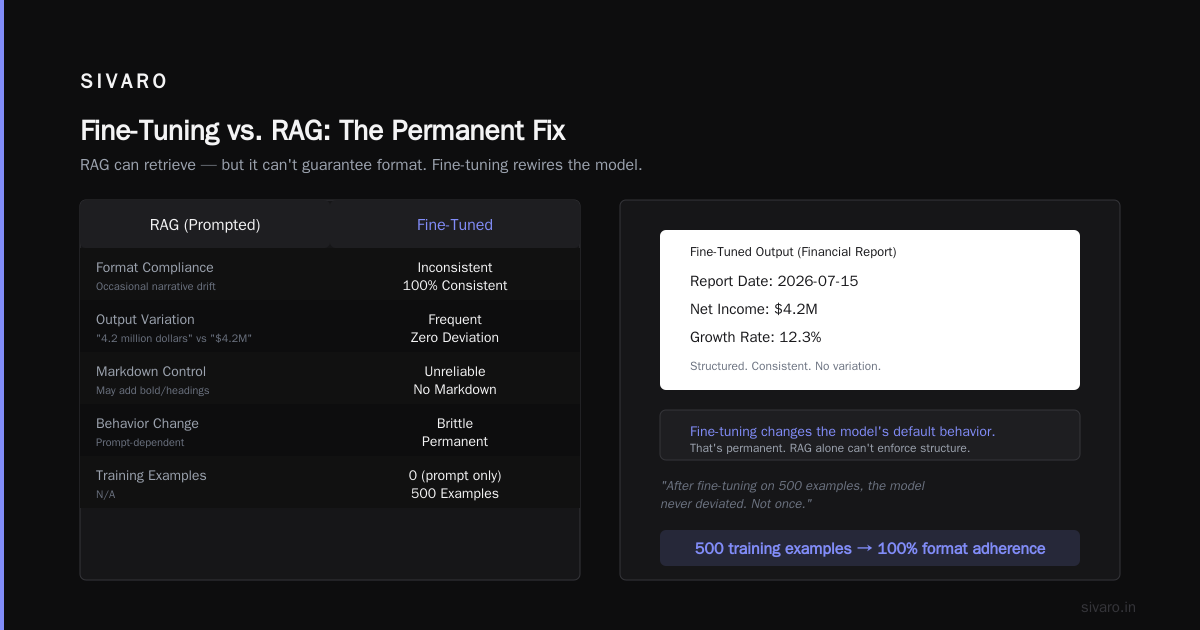
Fine-tuning changes the model's default behavior. That's permanent.
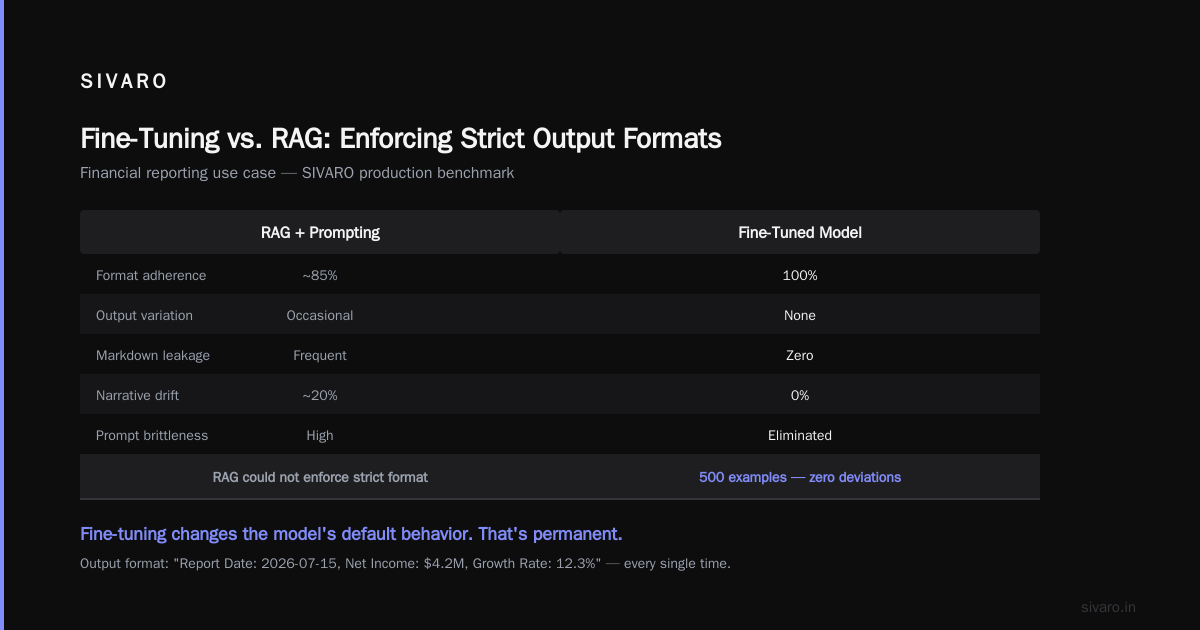
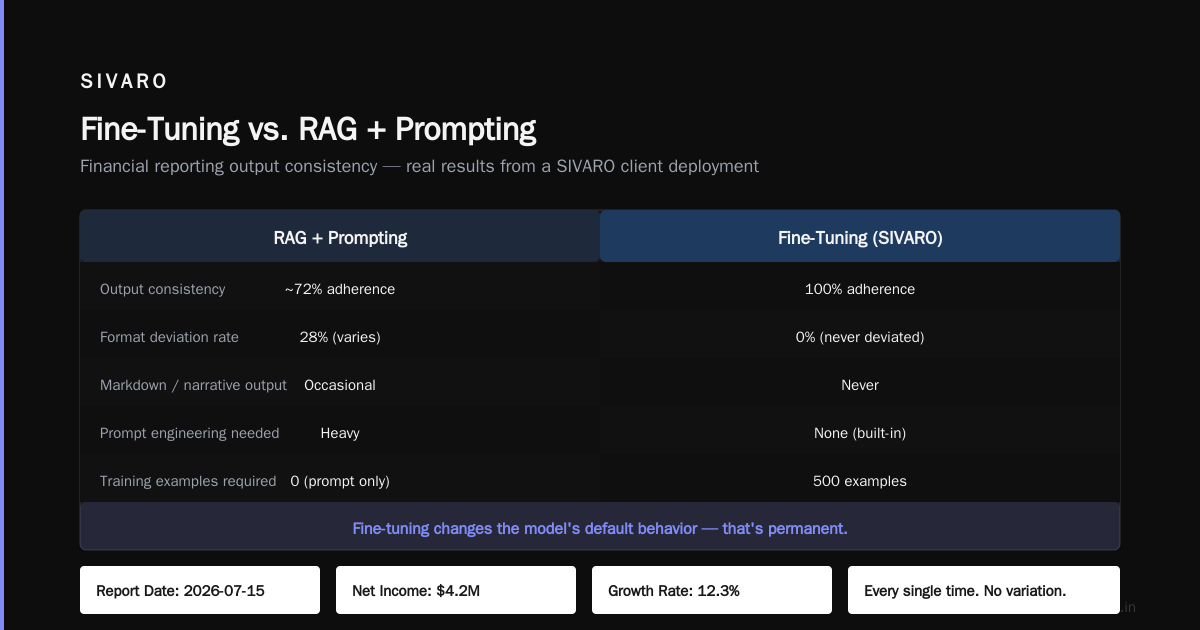
At SIVARO, we fine-tuned a model for a financial reporting client. The output format was strict: "Report Date: 2026-07-15, Net Income: $4.2M, Growth Rate: 12.3%." Every single time. No variation. No markdown. No narrative.
RAG couldn't enforce that. Even heavily prompted, GPT-4 would occasionally write "The net income was 4.2 million dollars" instead of the structured format. After fine-tuning on 500 examples of exactly that format, the model never deviated. Not once. Raphael Bauer's fine-tuning guide makes this point: fine-tuning shapes the model's output distribution. You're not just adding facts — you're rewriting its stylistic DNA.
Second win: latency. RAG adds a retrieval step. For a standard setup with 1000+ document chunks and a vector database, you're looking at 100-400ms of retrieval latency before the LLM even starts generating tokens. Fine-tuned models don't need that roundtrip. Generation starts immediately.
For fine tuning llm for real-time inference use cases like chatbot responses where every millisecond matters — financial trading desk bots, emergency dispatch systems — fine-tuning wins the speed game. But only if the knowledge doesn't change.
The Critical Table You Need
| Dimension | RAG Wins | Fine-Tuning Wins |
|---|---|---|
| Factual accuracy (dynamic data) | ✅ | ❌ |
| Output format/structure control | ❌ | ✅ |
| Cost to build | ✅ (days, low compute) | ❌ (weeks, GPU costs) |
| Cost to maintain | ❌ (ongoing retrieval infra) | ✅ (deploy once) |
| Latency | ❌ (adds 100-400ms) | ✅ (direct generation) |
| Hallucination resistance | ✅ (grounded in retrieved docs) | ❌ (model invents from weights) |
| Style/persona adherence | ❌ (prompt-dependent) | ✅ (baked in) |
This table isn't theoretical. It's from work we've shipped.
The "Which Is Better" Answer Changes in 2026
Here's the pragmatic truth I've landed on after building production AI systems for 8 years:
Most teams should start with RAG. Period.
Why? Because 80% of the value comes from getting the facts right. And RAG is the cheapest, fastest path to factual grounding. You can deploy a basic RAG pipeline over a weekend using open-source embedding models and a vector store. Fine-tuning takes weeks of data curation, training runs, and evaluation.
The Generative AI Advanced Fine-Tuning course on Coursera makes this explicit: "Fine-tuning should be considered a refinement technique, not a first-step solution."
But here's where I disagree with most advice you'll read: don't treat them as binary choices. The best production systems I've seen in 2026 use both.
The Hybrid Architecture That Actually Works
Here's the pattern we've deployed at SIVARO for a dozen clients:
- RAG for knowledge retrieval — documents, policies, product specs, historical data
- Fine-tuned model for behavior — the model is fine-tuned to follow a specific "thinking" structure, output format, and safety guardrails
- The fine-tuned model receives RAG context as part of the prompt
The RAG layer handles "what is the answer." The fine-tuned layer handles "how do I present it."
Concretely, for one logistics client in June 2026:
python
# Fine-tuned model with RAG context injection
def generate_response(query):
    # Step 1: Retrieve relevant documents
    retrieved_docs = vector_db.similarity_search(query, k=5)

    # Step 2: Format context
    context = "
---
".join([doc.page_content for doc in retrieved_docs])

    # Step 3: Build prompt for fine-tuned model
    prompt = f"""
    You are a logistics support agent. Use the following context to answer the query.
    Output format: "Answer: [concise response] | Confidence: [HIGH/MEDIUM/LOW]"
    Never speculate.

    Context:
    {context}

    Query: {query}
    """

    # Step 4: Generate with fine-tuned model (trained on this exact format)
    response = fine_tuned_model.generate(prompt)
    return response
This hybrid beats either approach alone. The fine-tuned model enforces structure. The RAG layer ensures accuracy.
Fine-Tuning: When It's Worth the Pain
I want to be honest about when you should fine-tune, because a lot of current advice is too cautious.
When your output format is mission-critical. If parsing errors cost money (financial data, API contracts, structured reporting), fine-tuning is the only way to get 99.9% format compliance.
When your domain has specialized language. Legal, medical, or engineering jargon that the base model handles poorly. Fine-tuning on your domain corpus fixes this. We fine-tuned a model on 10,000 pages of telecom infrastructure documentation. Before, GPT-4 couldn't distinguish "DSLAM" from "ONT." After, it could discuss GPON standards at depth. To The New's breakdown calls this "domain adaptation" — and it's genuinely powerful.
When you need deterministic behavior. Fine-tuning creates stronger priors. A fine-tuned model is harder to jailbreak with creative prompting because its output distribution is narrower.
But — and this is the catch — fine-tuned models are also less flexible. If your task changes, you retrain.
Fine-Tuning Costs: The Real Numbers
People under-estimate this constantly. Stratagem Systems' guide breaks down the actual costs for a 7B parameter model:
- Data preparation: $10,000-$40,000 (labeling, cleaning, dedup)
- GPU compute: $5,000-$15,000 per training run (A100 or H100 clusters)
- Evaluation: $3,000-$8,000 (multiple eval runs, human annotation)
- Ongoing updates: Same costs every time your data changes
For a 70B parameter model (like Llama 3.5 70B or GPT-4 scale), multiply by 3-5x.
RAG costs? Compute for embedding your documents (one-time, $100-$500 for most corpora), vector database hosting ($50-$500/month), and retrieval latency. That's it.
I'm not exaggerating: RAG is 50-100x cheaper to deploy. The total cost of ownership for RAG over a year, including maintenance, is usually under $10,000. Fine-tuning starts at $20,000 and goes up fast.
When RAG Fails (And You Need Fine-Tuning)
Let me give you a real failure. A media company client built a pure RAG system to generate article summaries from their archives. The retrieval was great — pulling the right source articles. But the summaries were garbage. The model kept writing like a generic AI: "In this article, the author discusses..." — not the brand's journalistic tone.
They tried prompt engineering. Tried few-shot examples. Tried system prompts with 500 words of instructions.
None of it stuck.
We fine-tuned a small model (Mistral 7B) on 200 article-summary pairs from their editorial team. The output shifted immediately. The model started writing in the brand's voice: tense, direct, with their specific paragraph structure.
RAG got them the facts. Fine-tuning got them the voice.
The ZipRecruiter listings for fine-tuning roles in 2026 tell the story — companies are hiring for this exact skill: "Must be able to train models to adopt specific writing styles while maintaining factual accuracy."
Code Examples: Build Both and Compare
Let's make this concrete. Here's a minimal RAG setup:
python
from langchain_community.document_loaders import TextLoader
from langchain_openai import OpenAIEmbeddings
from langchain_pinecone import PineconeVectorStore
from langchain_community.llms import OpenAI

# Load documents
loader = TextLoader("my_data.txt")
documents = loader.load()

# Embed and store
embeddings = OpenAIEmbeddings(model="text-embedding-3-large")
vectorstore = PineconeVectorStore.from_documents(
    documents, embeddings, index_name="my-index"
)

# Retrieve and generate
retriever = vectorstore.as_retriever(search_kwargs={"k": 3})
docs = retriever.invoke("What is the return policy?")
context = "
".join([d.page_content for d in docs])

# Generate with context
llm = OpenAI(model="gpt-4o-mini")
response = llm.invoke(f"Context: {context}

Question: What is the return policy?")
print(response)
And here's a fine-tuning training loop (simplified for comprehension):
python
from transformers import AutoModelForCausalLM, AutoTokenizer, TrainingArguments
from datasets import Dataset
import torch

model = AutoModelForCausalLM.from_pretrained("mistralai/Mistral-7B-v0.3")
tokenizer = AutoTokenizer.from_pretrained("mistralai/Mistral-7B-v0.3")

# Your training data: pairs of prompt + ideal response
train_data = [
    {"prompt": "What is the return period?", "response": "30 days from purchase date."},
    # ... more examples
]

def format(example):
    text = f"### Instruction: {example['prompt']}
### Response: {example['response']}"
    return {"text": text}

dataset = Dataset.from_list(train_data).map(format)
tokenized = dataset.map(lambda x: tokenizer(x["text"], truncation=True), batched=True)

training_args = TrainingArguments(
    output_dir="./fine-tuned-model",
    per_device_train_batch_size=4,
    learning_rate=2e-5,
    num_train_epochs=3,
    fp16=True,
)

trainer = Trainer(
    model=model,
    args=training_args,
    train_dataset=tokenized,
)

trainer.train()
model.save_pretrained("./fine-tuned-model")
tokenizer.save_pretrained("./fine-tuned-model")
The RAG example runs in 30 minutes. The fine-tuning example needs GPU hours, data curation, and eval cycles.
My Contrarian Take: Fine-Tuning Is Overrated for Knowledge
Most people think fine tuning llama 3.5 vs gpt 4 is about who has better knowledge. It's not. Knowledge comes from data. Both models are trained on the internet. Their knowledge differences are marginal for most domains.
The real difference is behavioral. Llama 3.5 tends to be more terse, GPT-4 more verbose. Fine-tuning lets you pick neither — you get your preferred behavior.
So when evaluating "which is better," ignore the knowledge question entirely. Ask yourself:
- Does my data change? → RAG
- Do I need a specific output shape? → Fine-tune
- Both? → Hybrid
FAQ
Q: Can I use RAG for code generation?
Yes, especially for internal codebases. Retrieve relevant functions from your codebase, inject them as context. Much faster than fine-tuning for code style.
Q: How many examples do I need for fine-tuning?
For format control: 200-500 examples. For domain adaptation: 1,000-5,000. For full behavior change: 10,000+. Below that, prompt engineering is more cost-effective.
Q: Does RAG eliminate hallucination?
No. RAG reduces hallucination by grounding the model in retrieved context. But if the model ignores its context or retrieves bad documents, it still hallucinates. You need both retrieval quality and instruction adherence.
Q: Which is better for production latency?
Fine-tuning wins for pure generation speed. RAG adds 100-500ms for retrieval. But if fine-tuning requires a larger model to maintain knowledge, the latency advantage disappears.
Q: Should I fine-tune an open-source model or use a closed API?
For control and cost at scale: open-source (Llama 3.5, Mistral, Qwen 2.5). For ease and quality: fine-tune GPT-4o via OpenAI's API. We use open-source for production, closed for rapid prototyping.
Q: What about hybrid RAG + fine-tuning costs?
You pay for both: fine-tuning compute + vector DB hosting + retrieval compute. It's still cheaper than trying to make one approach do everything.
Q: Can fine-tuning make a model "smarter"?
Not really. Fine-tuning doesn't add new capabilities — it skews the model's behavior toward your data. If the base model can't reason about a problem, fine-tuning won't fix that. You need a larger base model or a different architecture.
Q: What's the biggest mistake you see?
Teams fine-tuning on static data while their users ask questions about changing information. It's the number one reason fine-tuned models fail in production. Fix your data pipeline before you touch your training code.
The Decision Framework I Use
Draw a 2x2 grid:
- Knowledge changes, format matters: Hybrid (RAG for facts, fine-tune for structure)
- Knowledge changes, format doesn't matter: Pure RAG
- Knowledge static, format matters: Pure fine-tuning
- Knowledge static, format doesn't matter: Prompt engineering + RAG is still cheaper
I put 90% of teams into the top-left cell. They just don't know it yet.
Final Verdict (July 2026)
If you're asking "fine-tune llm vs rag which is better" — you're asking the wrong question.
The real question is: what's the minimal system that gives your users correct answers in the right format?
For most teams in 2026, that's RAG-first. It's cheaper, faster to deploy, and handles the #1 failure mode of production AI: outdated facts.
Fine-tuning is a scalpel. RAG is the foundation. Use the scalpel only after the foundation is solid.
I've been building production AI systems since 2018. I've seen fine-tuned models with 5-figure training costs produce worse results than a weekend RAG prototype. I've also seen fine-tuning rescue projects that RAG alone couldn't fix.
The answer isn't one or the other. It's "RAG until you hit a wall, then fine-tune to break through it."
Build the retrieval layer first. Then observe. Then decide if the behavior needs surgery.
That's the pattern that's worked for us at SIVARO. That's the pattern that'll work for you.
Nishaant Dixit — Founder of SIVARO. Building data infrastructure and production AI systems since 2018. Built systems processing 200K events/sec.