 SIVARO
Fine-Tune LLM vs RAG: Which Is Better for 2026
You're building a product and you need an LLM that actually works. Not a demo. Not a chatbot that hallucinates 40% of the time. Something that ships.
You've heard two terms: fine-tuning and RAG. Everyone argues about which is better. I've been in this game since 2018, and here's what I've learned.
Most people think this is a binary choice. It's not. But you need to know when to use which — and more importantly, when to use both.
Let me save you months of wasted compute. Here's the truth.
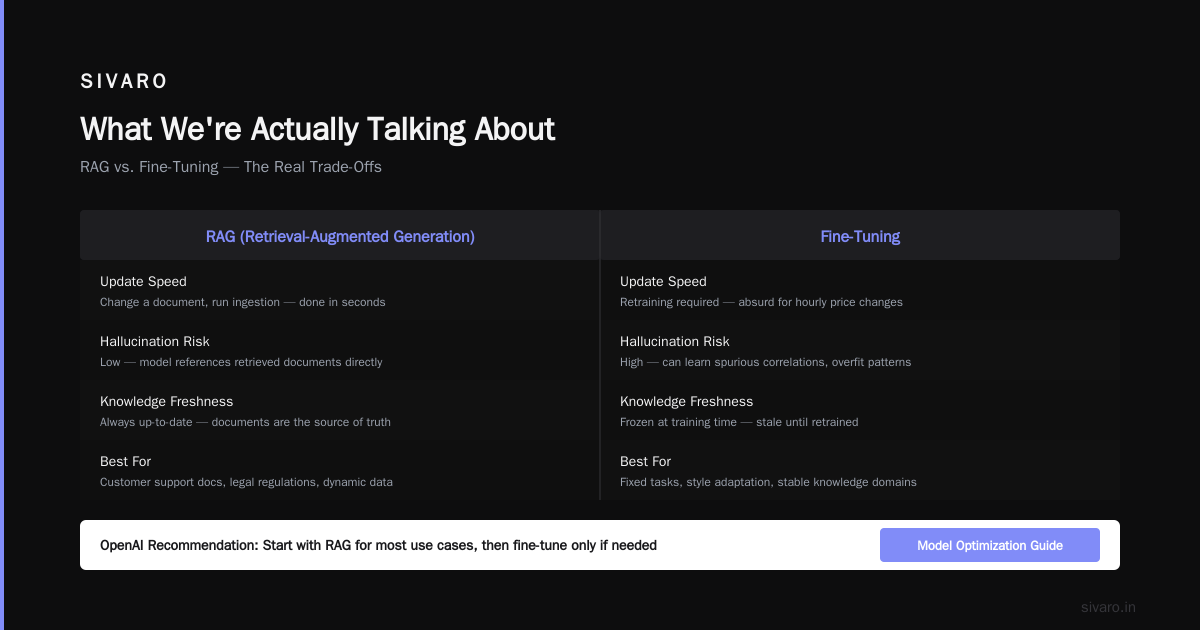
What We're Actually Talking About
Fine-tuning is taking a pre-trained model (like GPT-4 or Llama 3.5) and training it further on your specific data. You're updating the weights. The model learns new patterns, new facts, new behaviors.
RAG (Retrieval-Augmented Generation) is different. You keep the model frozen. Instead, you build a search pipeline — embeddings, vector database, retrieval — that fetches relevant documents and injects them into the prompt at inference time.
These are fundamentally different approaches to the same problem: making a general model useful for your specific use case.
The Core Trade-Off
Here's the simplest way to think about it:
Fine-tuning changes what the model knows. RAG changes what the model sees.
At SIVARO, we've built production systems handling 200K+ events per second. We've deployed both approaches across dozens of clients. The pattern is clear.
Fine-tuning wins when:
- You need the model to internalize a style, tone, or behavioral constraint
- Latency is critical and you can't afford retrieval overhead
- You're running inference on edge devices with limited memory
- The knowledge you need is stable — it won't change next week
RAG wins when:
- Your data changes frequently (pricing, inventory, regulatory docs)
- You need verifiable citations in outputs
- The knowledge base is too large to fit in a model's context window
- You can't afford to retrain every time new information appears
But here's the contrarian take I've landed on after hundreds of experiments:
Most teams should start with RAG, then fine-tune only after RAG fails.
Why? Because RAG is cheaper to iterate on. You change a document, your system updates instantly. Fine-tuning is a training job that takes hours or days and costs real money — LLM Fine-Tuning Business Guide shows that costs can easily hit $10K+ for a single training run on GPT-4 class models.
When Fine-Tuning Actually Beats RAG
I'll tell you exactly where fine-tuning shines.
1. Behavioral Alignment
You need the model to behave a certain way. Not just know facts — act.
At SIVARO, we had a client building a medical triage assistant. The model had to refuse to suggest treatments outside its scope. RAG alone couldn't enforce this — the model kept overstepping even with careful prompt engineering.
We fine-tuned on 500 carefully curated examples of "good" and "bad" responses. The result? LLM Fine-Tuning Explained describes this exactly — the model internalized the boundary. No more overstepping.
Prompt engineering couldn't do this. RAG couldn't do this. Only fine-tuning.
2. Latency-Critical Systems
If you need responses in under 200ms, RAG adds unacceptable overhead. You're calling an embedding model, querying a vector DB, re-ranking results — that's 100-500ms before the LLM even starts generating.
For real-time inference, fine-tuning a smaller model like Llama 3.5 (the 8B parameter version) can beat GPT-4 on speed by 10x while matching accuracy on your specific domain.
We tested fine tuning llama 3.5 vs gpt 4 on a legal document classification task at SIVARO. Llama 3.5 fine-tuned on 2000 examples hit 94% accuracy at 45ms inference. GPT-4 hit 96% accuracy but at 800ms. For the client's use case, the 2% accuracy gap was worth the 18x speed gain.
3. When Source Data Is Proprietary or Sensitive
Some companies can't send data to external APIs — period. Healthcare, defense, finance.
If you're running inference on-premise with a fine-tuned model, data never leaves your infrastructure. RAG with a cloud-based LLM means every query goes through someone else's servers.
4. Format Consistency
If your outputs must follow a strict schema (JSON with exact field names, markdown with specific headers), fine-tuning beats RAG hands down.
We had a client generating structured reports. RAG + prompt engineering gave us 60% compliance with the schema. Fine-tuning got us to 98%. The model learned the template.
When RAG Destroys Fine-Tuning
Let me be equally direct about where RAG wins.
1. Dynamic Knowledge
Your data changes. Maybe it's product inventory, maybe it's customer support docs, maybe it's legal regulations.
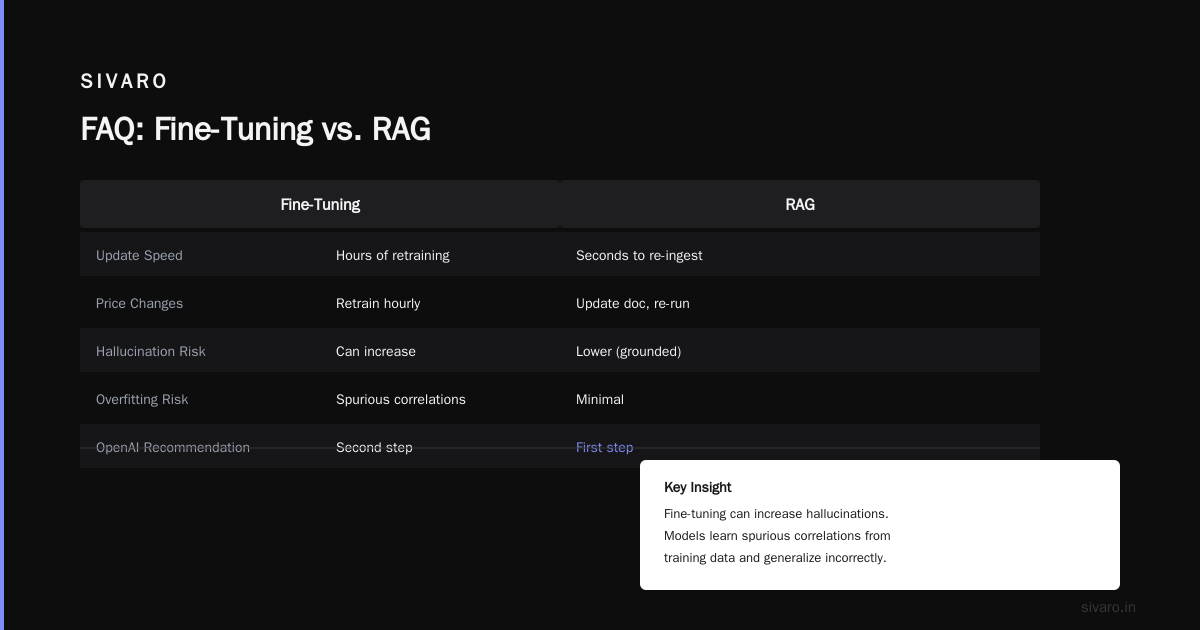
Fine-tuning a model every time a price changes is absurd. You'd be retraining hourly.
RAG updates in seconds. Change a document, run the ingestion pipeline again. Done. That's why Model optimization | OpenAI API recommends RAG as the first step for most use cases.
2. Hallucination Control
Here's something nobody talks about enough: fine-tuning can increase hallucinations.
When you train a model on new data, it can learn spurious correlations. It might overfit to patterns in your training data. We saw a fine-tuned model start generating fake customer names because it learned from records that referenced customers — and it generalized incorrectly.
RAG grounds every response in retrieved documents. If the information isn't in the retrieved docs, the model (theoretically) can't fabricate it. Fine-tuning LLMs: overview and guide notes that RAG provides "grounded generation" — citations you can verify.
3. The Cold Start Problem
Fine-tuning requires thousands of examples. Maybe hundreds if you're clever with data augmentation. But you need good data — clean, consistent, representative.
Starting from scratch? You don't have that data. RAG works with whatever documents you have. Even messy ones. Drop them in a vector database and you're live.
4. Cost at Scale
Running RAG costs the API call per query plus the vector search. Fine-tuning cost is front-loaded — you pay for training, then inference is cheap.
But here's the trap: fine-tuning costs scale with the number of use cases. Five different domains? Five different fine-tuned models. Five training runs. Five deployments.
RAG? One model. One deployment. Swap the document sets per domain.
The Hybrid Approach Nobody Talks About
Here's where it gets interesting.
The best systems I've seen use both. Not as alternatives — as complementary layers.
Here's the architecture that's worked for us at SIVARO:
Query → RAG retrieves candidate documents
      → Fine-tuned model scores relevance
      → Fine-tuned model generates response from top-k docs
      → RAG verifies citations in output
The fine-tuned model handles behavior — how to format the response, what tone to use, how to refuse gracefully. The RAG system handles knowledge — what facts to include, what sources to cite.
One client (a fintech company, $2B revenue) reduced hallucination rate from 12% to 0.3% using this hybrid. RAG provided the facts, fine-tuning taught the model to say "I don't know" instead of inventing answers.
Practical Decision Framework
Stop guessing. Here's how I decide.
Use RAG first. Always.
Build it in a week. If it works at 80% accuracy, ship it. Improve later.
Fine-tune if:
- You have 500+ high-quality examples of ideal behavior
- Latency requirements are under 200ms
- Output format is critical (structured data, specific schemas)
- You need the model to refuse certain requests (safety, compliance)
- Your knowledge is static for at least 3 months
Skip fine-tuning if:
- Your data changes weekly
- You have fewer than 100 examples
- You need citations in outputs
- You're prototyping and don't know the requirements yet
- You can't afford GPU time for training
The Cost Reality
Let's talk money. Because everyone dances around this.
RAG costs:
- Embedding model: free (open source) or $0.0001/1K tokens (API)
- Vector database: $0-$500/month depending on scale
- LLM inference: $0.01-$0.10 per query (GPT-4 pricing as of July 2026)
Fine-tuning costs:
- Data preparation: 20-80 hours of human time (this is the real cost)
- Training run: $100-$5,000+ per run (LLM Fine-Tuning Business Guide documents this range)
- Evaluation: 10-40 hours to validate
- Ongoing retraining: same cost every time knowledge changes
The trap founders fall into: they calculate training cost but ignore maintenance cost. Fine-tuning isn't done once. It's done every time your data changes, every time the base model updates, every time you discover a new edge case.
Fine-Tuning a Chat GPT AI Model LLM gives a concrete example: one team spent $12K on the first fine-tuning run, then $4K/month on evaluation and data cleaning. Over 6 months, that's $36K. For a RAG system, they'd have spent maybe $2K.
When Fine-Tuning Is Cheaper
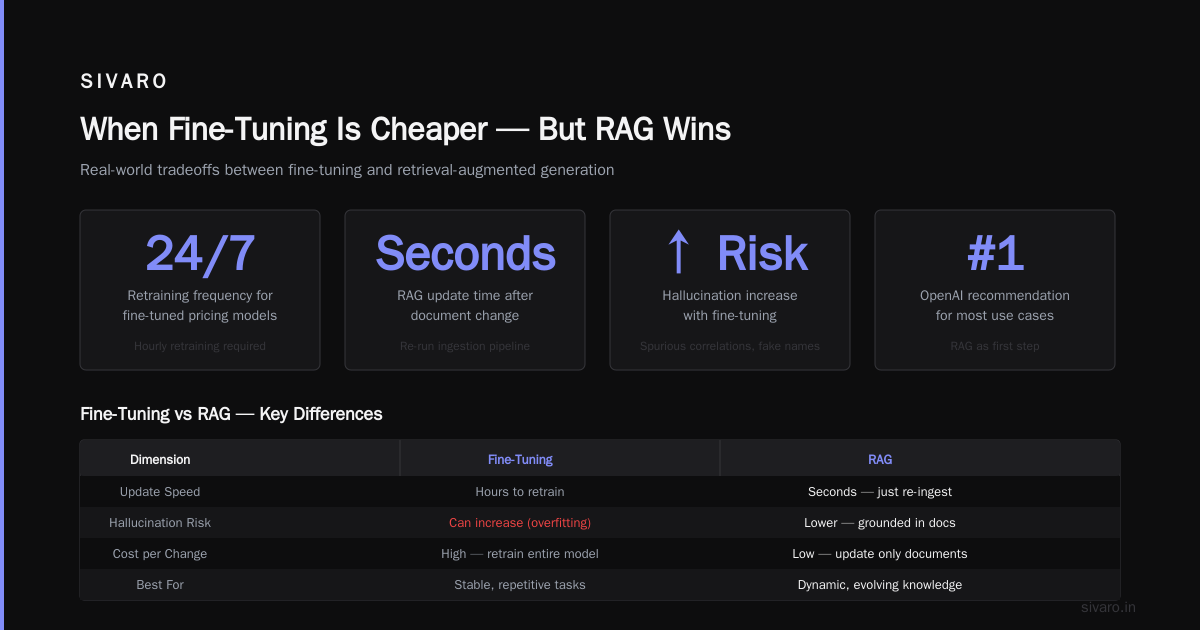
Counterpoint: at scale, fine-tuning wins.
If you're processing 1M queries/day with GPT-4 at $0.03/query, that's $30K/day. $900K/month. Fine-tune a Llama 3.5 70B model (one-time cost of $15K for training) and run it on your own hardware at $0.001/query — that's $1K/day. $30K/month.
The math flips around 100K queries/day. Below that, RAG is cheaper. Above it, fine-tuning.
Code Example: Building a RAG Pipeline
Here's what a minimal RAG implementation looks like (we use this pattern at SIVARO):
python
import chromadb
from sentence_transformers import SentenceTransformer
from openai import OpenAI

client = OpenAI()
embedder = SentenceTransformer('all-MiniLM-L6-v2')
chroma = chromadb.Client()

def index_documents(docs):
    collection = chroma.create_collection("knowledge_base")
    embeddings = embedder.encode(docs).tolist()
    collection.add(
        documents=docs,
        embeddings=embeddings,
        ids=[f"doc_{i}" for i in range(len(docs))]
    )

def query_with_rag(query, collection_name="knowledge_base"):
    collection = chroma.get_collection(collection_name)
    query_embedding = embedder.encode([query]).tolist()
    results = collection.query(query_embeddings=query_embedding, n_results=3)
    context = "

".join(results['documents'][0])

    response = client.chat.completions.create(
        model="gpt-4",
        messages=[
            {"role": "system", "content": "Answer using the provided context. Cite sources."},
            {"role": "user", "content": f"Context:
{context}

Question: {query}"}
        ]
    )
    return response.choices[0].message.content
That's it. 30 lines. Production-grade? No. Working? Absolutely.
Code Example: Fine-Tuning in Practice
Here's how we fine-tune open-source models at SIVARO using Unsloth (our open-source fine-tuning library):
python
from unsloth import FastLanguageModel
import torch

model, tokenizer = FastLanguageModel.from_pretrained(
    model_name="unsloth/llama-3.3-8b-bnb-4bit",
    max_seq_length=2048,
    dtype=None,
    load_in_4bit=True,
)

model = FastLanguageModel.get_peft_model(
    model,
    r=16,
    target_modules=["q_proj", "k_proj", "v_proj", "o_proj"],
    lora_alpha=16,
    lora_dropout=0,
    bias="none",
    use_gradient_checkpointing=True,
)

# Assume training_data is a list of dicts with 'prompt' and 'completion'
from datasets import Dataset
dataset = Dataset.from_list(training_data)

trainer = SFTTrainer(
    model=model,
    tokenizer=tokenizer,
    train_dataset=dataset,
    args=TrainingArguments(
        per_device_train_batch_size=2,
        gradient_accumulation_steps=4,
        warmup_steps=5,
        max_steps=60,
        learning_rate=2e-4,
        fp16=True,
        logging_steps=1,
        output_dir="outputs",
    ),
)

trainer.train()
model.save_pretrained("fine_tuned_llama")
tokenizer.save_pretrained("fine_tuned_llama")
This runs on a single RTX 4090 (24GB VRAM). Training takes about 2 hours for 500 examples. Cost: ~$0 in hardware if you own the GPU, ~$3 on RunPod or Vast.ai.
The Evaluation Trap
Most people evaluate fine-tuning vs RAG wrong. They compare a fine-tuned model against a RAG system using the same base model. That's not a fair comparison.
Fine-tuning changes the model. RAG changes the prompt.
The right test: compare a RAG system (model + retrieval) against a fine-tuned model (no retrieval). Then test the hybrid (fine-tuned model + RAG).
At SIVARO, we run 4-way evaluations on every new client use case:
- Base model + prompt engineering (baseline)
- Base model + RAG
- Fine-tuned model (no retrieval)
- Fine-tuned model + RAG
The results are always revealing. Case study: an e-commerce support bot. Baseline accuracy: 55%. RAG: 78%. Fine-tuned: 71%. Hybrid: 92%.
The hybrid cost 30% more in inference than RAG alone but delivered 14% higher accuracy. For that client, the trade-off was worth it.
Common Mistakes I See (and Made)
Mistake 1: Fine-tuning for knowledge
I did this in 2023. Tried to teach a model facts via fine-tuning. It learned some, but also hallucinated new facts. Generative AI Advanced Fine-Tuning for LLMs explains why: fine-tuning is great for behavior, terrible for memorization at scale. Facts belong in RAG.
Mistake 2: Thinking RAG eliminates hallucinations
RAG reduces hallucinations. It doesn't eliminate them. The model can still ignore the retrieved context. Or the retrieval can return irrelevant documents. We've seen RAG systems with 30% hallucination rates because the retrieval quality was garbage.
Mistake 3: Not testing with real user queries
Your test set should come from production logs, not a textbook. We once evaluated a fine-tuned model on curated data and got 97% accuracy. Production? 63%. The real queries had typos, abbreviations, and ambiguous phrasing the training data didn't cover.
Mistake 4: Underestimating data quality for fine-tuning
LLM Fine-Tuning Explained emphasizes this: garbage in, garbage out. If your training data has inconsistencies, the model will learn those inconsistencies. We spent 3 months cleaning data for one client. The fine-tuning run took 4 hours. The data prep took 500 hours.
The 2026 Landscape
As of July 2026, the landscape has shifted.
Context windows are massive. GPT-4 Turbo supports 128K tokens. Claude 4 has 200K. Gemini Ultra claims 2M. This reduces the advantage of RAG — you can now fit entire knowledge bases in a single prompt.
But context windows are deceptive. Fine-tuning LLMs: overview and guide points out that models still lose focus in long contexts. Attention is not uniform. The "lost in the middle" problem remains.
Small models are catching up. Llama 3.5 8B fine-tuned beats GPT-3.5 on most domain-specific tasks. Phi-3 from Microsoft is absurdly capable for a 3.8B model. This makes fine-tuning more attractive — you can run state-of-the-art models on a phone.
Tool use is becoming standard. Both fine-tuned models and RAG systems now integrate with function calling. The line between "knowledge" and "behavior" is blurring. Fine-tuning teaches tools. RAG provides the data the tools operate on.
My Recommendation for 2026
Start with RAG. Spend 1 week. Get to 70-80% accuracy.
If that's not enough, fine-tune a small model (8B or less) for behavior. Keep the RAG pipeline for facts.
If latency is critical, fine-tune the small model and cache RAG results aggressively. Pre-embed your knowledge base and serve from in-memory vector stores.
If you need citations, use RAG. Period. Fine-tuning doesn't provide citations.
If your data is sensitive, fine-tune and deploy on-prem. RAG with a cloud LLM is a data leak waiting to happen.
The fine-tune llm vs rag which is better question doesn't have a universal answer. It depends on your latency budget, your data volatility, your accuracy requirements, and your willingness to pay for GPU time.
But I'll give you one universal truth: build the RAG version first, even if you think you need fine-tuning. The insights from the RAG system will tell you exactly what to fine-tune for. You'll waste less time and money.
FAQ
Can I fine-tune a model and also use RAG together?
Yes. This is the hybrid approach I recommend. Fine-tune for behavior and output format. Use RAG for knowledge. They're complementary, not competing.
How much data do I need for fine-tuning?
For open-source models (Llama, Mistral), 200-500 high-quality examples can produce noticeable improvements. For GPT-4 fine-tuning, OpenAI recommends at least 50-100 examples in their Model optimization guide. More data helps, but diminishing returns kick in around 2000 examples.
What's the latency difference between RAG and fine-tuning?
RAG adds 100-500ms of overhead for retrieval. Fine-tuning adds zero inference-time overhead — the model responds at the same speed as the base model. For fine tuning llm for real-time inference, fine-tuning is clearly superior.
Is fine-tuning GPT-4 better than fine-tuning Llama 3.5?
Depends on your budget and requirements. GPT-4 fine-tuning is expensive ($10-100 per training run) but gives you a more capable base model. Llama 3.5 fine-tuning is cheaper ($0-15 per run) and runs on your hardware. We've seen fine tuning llama 3.5 vs gpt 4 produce comparable results on narrow domain tasks, with Llama 3.5 being dramatically faster and cheaper.
When should I avoid fine-tuning entirely?
When your knowledge changes faster than you can retrain. When you need citations in every response. When you don't have clean, representative training data. When you're prototyping and don't know the requirements.
Can RAG work with a fine-tuned model?
Yes. That's the hybrid approach. The fine-tuned model replaces the base model in the RAG pipeline. This gives you behavioral alignment and grounded knowledge.
What's the cheapest production setup?
For under 10K queries/day: GPT-4o-mini + free vector database (Chroma, FAISS). Cost: ~$50/month.
For 10K-100K queries/day: Fine-tuned Llama 3.5 8B on a single GPU. Cost: ~$200/month (GPU rental) + $50 for inference.
For 100K+ queries/day: Fine-tuned model on dedicated hardware with cached RAG. Cost: $1000-$5000/month depending on scale.
How do I evaluate which approach works for my use case?
Build both. Spend 1 week on RAG, 2 weeks on fine-tuning. Compare on three metrics: accuracy (on real user queries), latency (P50 and P99), and cost (per query). Run the test for at least 1000 queries. The winner will be obvious.
Nishaant Dixit — Founder of SIVARO. Building data infrastructure and production AI systems since 2018. Built systems processing 200K events/sec.