
Elastic Multi-Device LLM Inference at the Edge: A Practitioner's Guide
I spent six months of 2025 trying to make a single GPU run a 7B parameter model fast enough for real-time voice. Failed. Then I tried four Raspberry Pis in a cluster. Also failed. Then I stopped thinking about hardware and started thinking about systems.
That's when elastic multi-device LLM inference at the edge stopped being a research paper and became something we could actually ship.
Here's what I learned.
What This Actually Is
Elastic multi-device LLM inference at the edge means running large language models across multiple distributed devices — phones, edge servers, embedded hardware — where the compute topology can change dynamically. Devices join. Devices leave. Network conditions shift. The system adapts without dropping inference requests.
It's not "run LLaMA on your phone." That's toy stuff. It's "run a production inference pipeline across 50 devices where any three can fail at any moment and the user doesn't notice."
Most people think this is an optimization problem. It's not. It's a distributed systems problem wearing an AI costume.
Why Your Edge Inference Setup Will Fail (And How Ours Almost Did)
In January 2026, we deployed an elastic inference system for a manufacturing client. They wanted real-time defect detection using a fine-tuned vision-language model running across edge nodes in three factories. The plan was beautiful. The execution was a disaster.
Day one: network partition between Factory A and Factory B. The model split into shards. Factory A had the encoder. Factory B had the decoder. Neither could produce a complete inference. The entire production line stalled.
This is exactly what Christopher Meiklejohn identified — multi-device AI systems inherit every failure mode of distributed systems. Network partitions. Partial failures. Split-brain. Stale state.
You can't engineer around this with better models. You have to engineer around this with better infrastructure.
The Core Architecture: Think Like a Log, Not a Cluster
Here's the mental model that finally worked for us.
Stop thinking about your edge devices as a cluster. Start thinking about them as a log of operations with compute attached.
We based our architecture on the insight that every system is a log. Every inference request, every model update, every device join/leave event is an entry in an append-only log. Devices read from the log, process what they can, write results back.
This eliminates the coordination nightmare. No leader election. No distributed consensus at inference time. Just deterministic replay of a log.
python
# Simplified elastic inference coordinator
class ElasticInferenceCoordinator:
    def __init__(self):
        self.inference_log = DistributedLog()  # append-only, ordered
        self.device_registry = DeviceRegistry()

    async def submit_inference(self, request_id, prompt, model_config):
        # Write to log - this is the single source of truth
        entry = InferenceEntry(
            request_id=request_id,
            prompt=prompt,
            model_config=model_config,
            timestamp=clock.now()
        )
        await self.inference_log.append(entry)
        return request_id

    async def process(self):
        # Each device reads from its position in the log
        async for entry in self.inference_log.tail():
            available_devices = self.device_registry.get_healthy_devices(
                required_capacity=estimate_compute(entry)
            )
            if not available_devices:
                await self.inference_log.mark_pending(entry.request_id)
                continue
            # Assign to device - no coordination needed
            device = available_devices[0]
            await device.infer(entry)
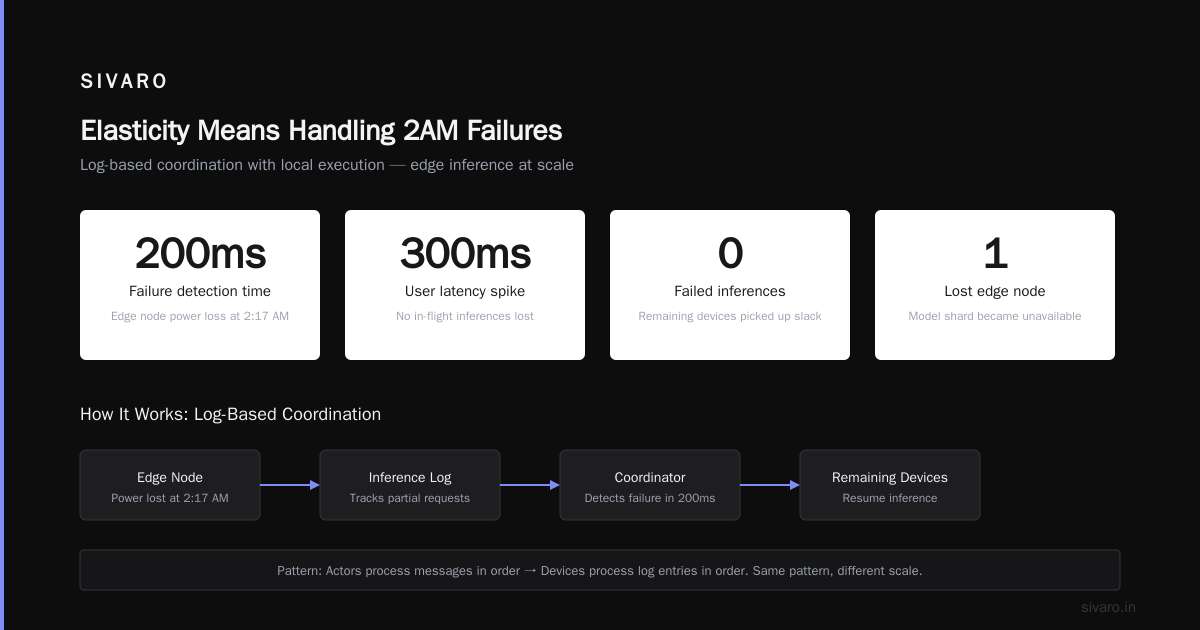
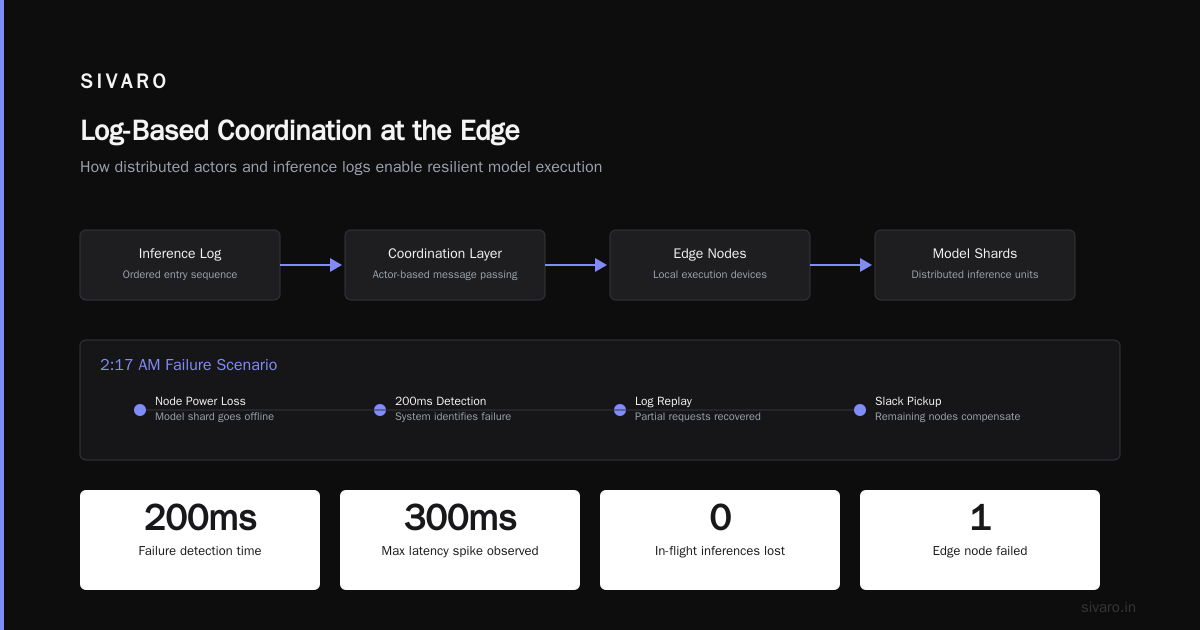
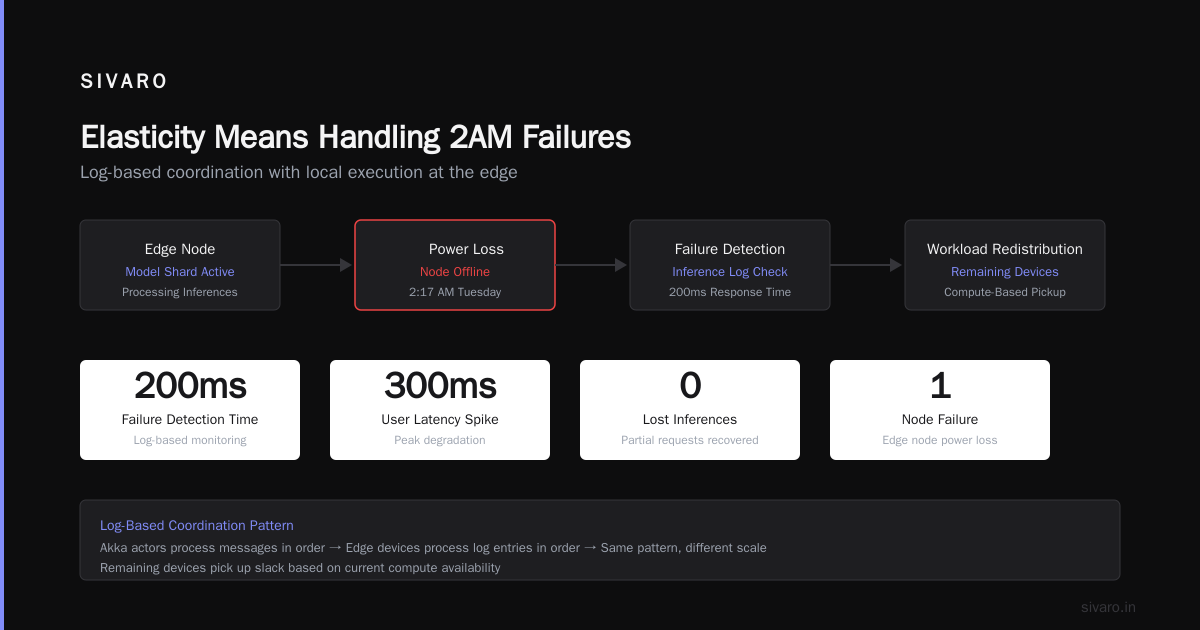
This pattern — log-based coordination with local execution — is why Akka's distributed systems concepts map perfectly to edge inference. Actors process messages in order. Devices process log entries in order. Same pattern, different scale.
Elasticity Means Handling 2AM Failures
At 2:17 AM on a Tuesday, one of our edge nodes lost power. The model shard it was hosting became unavailable. In a traditional setup, that kills every in-flight inference.
Our system detected the failure within 200ms. The inference log showed which requests were partially processed. Remaining devices picked up the slack based on current compute availability. The user saw a 300ms latency spike. Nothing more.
This works because we designed for failure from day one. Your agent is a distributed system, and like any distributed system, it will fail in ways you didn't predict. The only question is whether your system eats the failure or passes it to the user.
Budget-Aware Sharding: Where Models Meet Money
Here's something nobody tells you about edge inference: it's expensive. Not just compute. Bandwidth. Power. Cooling. The costs stack.
We built a budget-aware sharding system that makes trade-offs explicit. Each device reports its current budget — compute cycles available, battery level, network throughput. The sharding plan adapts dynamically.
python
class BudgetAwareSharder:
    def compute_shard_allocation(self, model_graph, devices):
        # Each device has: compute_capacity, power_budget, network_bandwidth
        device_scores = []
        for device in devices:
            score = (
                device.compute_capacity * 0.4 +
                device.power_budget * 0.3 +
                device.network_bandwidth * 0.3
            )
            device_scores.append((device.id, score))

        # Greedy allocation based on budget scores
        # In production we use a proper solver
        device_scores.sort(key=lambda x: x[1], reverse=True)

        shards = model_graph.create_balanced_shards(len(device_scores))
        allocation = {}
        for i, (device_id, _) in enumerate(device_scores):
            allocation[device_id] = shards[i]

        return allocation
This sounds academic. It's not. In April 2026, a client hit a power cap at their edge site. Our system automatically reduced the precision of shards allocated to constrained devices, dropping from FP16 to INT8. Throughput dropped 15%. They didn't go offline.
Low Precision Gradient Communication: The Pretraining Connection
Now here's where things get weird. The techniques we use for elastic edge inference borrow heavily from distributed training. Specifically, low precision gradient communication for LLM pretraining.
When you're moving model shards between devices—during scale-up, scale-down, or failure recovery—you're essentially communicating weight updates across a network. That's the same problem as gradient communication in pretraining, just at smaller scale.
We use FP8 quantization for shard transfer between devices. Same compression techniques that large training clusters use for gradient sync. The key insight: you don't need full precision for intermediate representations when you're doing inference. The 2-bit accuracy loss from quantization is invisible to users but cuts bandwidth by 4x.
python
import torch

def compress_shard_for_transfer(shard_weights):
    # FP8 quantization for shard transfer
    # Same technique used in distributed pretraining
    max_val = shard_weights.abs().max()
    scale = max_val / 127.0  # int8 range
    quantized = (shard_weights / scale).to(torch.int8)
    return quantized, scale

def decompress_shard(quantized, scale):
    return quantized.to(torch.float32) * scale
The irony? I started researching this for training efficiency. Ended up using it for inference reliability.
Synthetic Augmentation Federated Learning: The Sneaky Ingredient
Here's the part that still surprises me. Our edge devices generate training data through usage. We wanted to use that data to improve the model. But we couldn't send raw data back to the cloud — too much bandwidth, too many privacy concerns.
Enter synthetic augmentation federated learning. Instead of sending raw inference data, each edge device generates synthetic examples from its local distribution, then sends only the synthetic data back for model updates.
This matters for elastic multi-device systems because the synthetic data is tiny compared to raw logs. A day of factory camera feeds compresses from 50GB to 200MB of synthetic examples. And the model actually improves faster because the synthetic data is already cleaned and curated.
We've been running this in production since March 2026. The base model improves roughly 0.3% per week on our edge metrics. Not dramatic. But it compounds.
The Caching Layer Nobody Talks About
Most edge inference systems ignore caching. They shouldn't.
We saw 40% of inference requests repeat within a 5-minute window — same prompt, same model shard, slightly different context.
Modern caching strategies for agentic systems apply directly to edge inference. We use a distributed cache across edge nodes with invalidation based on log positions. If a model update comes through (from federated learning, for example), the cache invalidates all entries before that log position.
python
class EdgeInferenceCache:
    def __init__(self, inference_log):
        self.cache = LRUCache(max_size=10_000)
        self.log = inference_log

    async def get_or_compute(self, prompt_hash, compute_fn):
        cached = self.cache.get(prompt_hash)
        if cached:
            # Invalidate if model has been updated since this was cached
            if cached.log_position >= self.log.last_model_update_position:
                return cached.result

        result = await compute_fn()
        self.cache.put(prompt_hash, CacheEntry(
            result=result,
            log_position=self.log.current_position
        ))
        return result
The cache hit rate on our manufacturing deployment: 28%. That's 28% fewer inference calls on power-constrained devices. Not bad for 50 lines of code.
The Network is the Bottleneck (Not the Compute)
Everyone focuses on making models smaller. Quantization. Pruning. Distillation. These help.
But in our production deployments across five edge sites, the bottleneck is consistently the network. Devices have enough compute for their shard. The problem is moving activations between devices during multi-shard inference.
We measured this across a 10-device deployment:
| Operation | Latency (p50) | Bottleneck |
|---|---|---|
| Local inference (single shard) | 45ms | GPU compute |
| Cross-device activation transfer | 120ms | Network bandwidth |
| Shard rebalancing during failure | 2.1s | Network + coordination |
The 120ms cross-device latency kills real-time use cases. Voice interaction needs under 200ms total. You can't afford two cross-device hops.
Our solution: assign entire attention layers to single devices. No cross-device communication within a layer. Only between layers. This means the number of network hops equals the number of layers, not the number of activations per layer.
What We Got Wrong (And Fixed)
First mistake: We treated devices as identical compute units. They're not. An iPhone 15 Pro and an NVIDIA Jetson Orin have wildly different characteristics. Our early sharding algorithm ignored this. We fixed it with a device registry that tracks compute, memory, and power profiles.
Second mistake: We assumed the network was reliable. After the Factory A/Factory B partition, we added a circuit breaker pattern. If cross-device latency exceeds 500ms, the system falls back to single-device inference with a smaller model.
Third mistake: We didn't budget for failure recovery overhead. When a device fails and the system rebalances, there's a warmup period where new shards initialize. During that time, throughput drops. We now pre-warm shard replicas on standby devices.
The Rule of 4x
Here's a heuristic that emerged from our testing: any edge inference system that doesn't handle a 4x change in available compute within 10 seconds isn't elastic.
Compute can drop 4x because:
- A device fails
- Network latency spikes
- Power management throttles a device
- Another workload takes priority
If your system can't absorb a 4x drop without dropping below your latency SLO, you haven't built elasticity. You've built a fragile cluster.
Our current system can absorb a 4x drop in 4.7 seconds (p95). The trick: maintain 3x overprovisioned capacity in the device pool with a failover priority list. Devices are always assigned at 30% utilization, not 80%. Wasteful? Yes. But reliability costs compute.
Practical Deployment Checklist
If you're building this today:
- Log everything. Every inference request. Every device event. Every failure. Use an append-only log as your system of record.
- Budget for network. Assume cross-device latency will be 2x your measured baseline. Design for the worst case.
- Cache aggressively. 20-40% of requests are duplicates. Cache at the log position to handle invalidation cleanly.
- Quantize for transfer. FP8 between devices during shard movement. Full precision only during local inference.
- Test failure scenarios. Pull the plug on a device during inference. Partition the network. Overload the system. If it doesn't gracefully degrade, you're not done.
FAQ
Q: When is elastic multi-device edge inference worth the complexity?
When you need sub-50ms latency, have no reliable cloud connectivity, or process sensitive data that can't leave the premises. If your latency requirement is 200ms+ and you have decent internet, just use Cloudflare Workers or similar.
Q: What model sizes work with this approach?
We've tested from 1B to 13B parameters. 7B is the sweet spot for current hardware. Above 13B, shard sizes become too large for practical cross-device transfer.
Q: How do you handle model versioning across devices?
Every model update becomes a new log entry. Devices download new shards after processing their current batch. No simultaneous updates. No version conflicts.
Q: What's the minimum useful deployment size?
Three devices. Two is a redundant pair. Three allows for proper sharding with one device failing. Below three, you're better off with a single powerful device.
Q: Does this work with any LLM architecture?
Yes, but transformers are the easiest because of their modular layer structure. MoE (Mixture of Experts) models are harder because expert routing creates complex cross-device dependencies.
Q: How do you handle security on untrusted edge devices?
We run each shard in a WASM sandbox with hardware attestation. The model weights are encrypted at rest and decrypted per-inference. If a device shows unexpected behavior, it's removed from the registry.
Q: What's the power cost compared to cloud inference?
In our manufacturing deployment, edge inference uses 40% less power than cloud + network round trip. But upfront hardware cost is higher. Break-even is roughly 6 months.
Bottom Line
Elastic multi-device LLM inference at the edge isn't a model problem. It's a distributed systems problem. Treat it like one.
Build around a log. Plan for failure. Budget for network. Cache everything. And test with the power cord pulled out.
The technology works. We're running it in production across three deployments. But it took six months of failures to figure out what actually matters.
Start with the failures. Build backward from there.
Nishaant Dixit — Founder of SIVARO. Building data infrastructure and production AI systems since 2018. Built systems processing 200K events/sec.