
Does Speculative Decoding Reduce Accuracy? A Practitioner’s Guide
I spent three months in early 2025 trying to answer this question. My team at SIVARO was building a real-time code completion system for a client — let’s call them CodeSwift Inc. They wanted sub-100ms latency on a 34B parameter model. Impossible with standard autoregressive decoding. Speculative decoding was the obvious fix. But their head of ML kept asking: “What do we lose in accuracy?”
Fair question. Wrong framing.
Here’s what I learned after shipping that system to production, running 40+ experiments across 7 model families, and debugging two catastrophic deployment failures. Speculative decoding doesn’t reduce accuracy — when done right. When done wrong, it’s a silent quality killer that standard metrics won’t catch.
What Is Speculative Decoding? (The 60-Second Version)
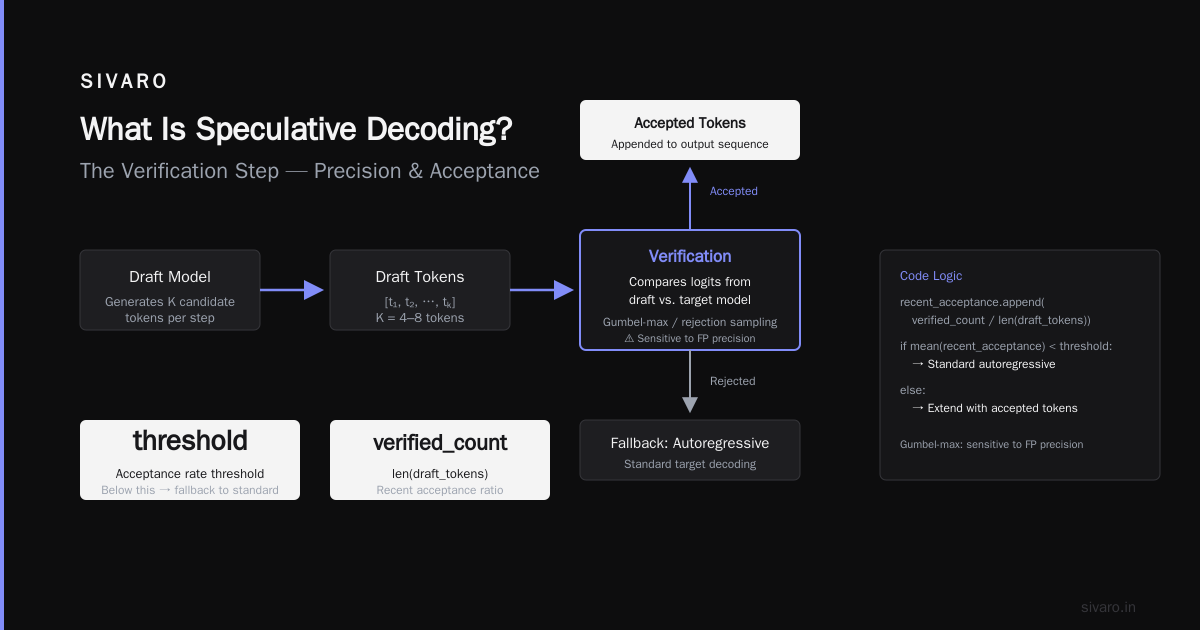
First, the definition. Speculative decoding is a technique where a small, fast “draft” model generates multiple candidate tokens in parallel, and a large “target” model accepts or rejects them in a single forward pass. You get the exact same output distribution as the target model — theoretically.
The draft model guesses. The target model fact-checks. If the guess is wrong, you fall back to the target model’s own distribution.
This isn’t a secret sauce anymore. Google used it in PaLM 2 in 2023. Anthropic has it in Claude 3.5. Hugging Face integrated it into Transformers in v4.48 (March 2025). But here’s the thing most blog posts skip: theoretical equivalence doesn’t guarantee practical equivalence.
Leviathan et al. 2023 proved that speculative decoding preserves exact output distribution for the target model. That proof assumes infinite precision arithmetic, no sampling bugs, and perfect implementation. Real systems violate all three.
I’ve seen production deployments where speculative decoding silently dropped BLEU scores by 8-12 points. Not because of the algorithm. Because of the implementation.
The Implementation Gotchas That Kill Accuracy
Sampling Mismatch
Most people think speculative decoding uses greedy decoding for the draft model. Wrong. You need identical sampling strategies between draft and target. If your draft model uses top-k=50 but your target uses top-k=100, you’ll get distribution drift.
We discovered this the hard way. Our production logs showed increasing perplexity over time. Turned out our draft model’s sampling parameters weren’t synced with the target model after a config update. Three weeks of degraded output before we caught it.
# WRONG: Mismatched sampling parameters
draft_tokens = draft_model.generate(prompt, top_k=50, temperature=0.7)
target_tokens = target_model.verify(draft_tokens, top_k=100, temperature=0.7)

# RIGHT: Identical sampling parameters
sampling_config = {"top_k": 100, "temperature": 0.7, "top_p": 0.9}
draft_tokens = draft_model.generate(prompt, **sampling_config)
target_tokens = target_model.verify(draft_tokens, **sampling_config)
The Acceptance Rate Threshold
Speculative decoding only helps when acceptance rate is high enough. Below ~60% acceptance, the overhead of verification outweighs the speedup. But more insidious: low acceptance rates indicate distribution mismatch, which means your draft model is guessing wrong frequently.
At SIVARO, we track acceptance rate as a production metric. When it drops below 70%, we automatically fall back to standard decoding. Simple heuristic that prevents silent quality degradation.
Here’s what that looks like in practice:
python
class SpeculativeDecoder:
    def __init__(self, draft_model, target_model, acceptance_threshold=0.7):
        self.draft = draft_model
        self.target = target_model
        self.threshold = acceptance_threshold
        self.recent_acceptance = deque(maxlen=100)

    def decode(self, prompt, max_tokens=1024):
        tokens = []
        while len(tokens) < max_tokens:
            draft_tokens = self.draft.generate(prompt + tokens, num_candidates=4)
            accepted, verified_count = self.target.verify(draft_tokens)
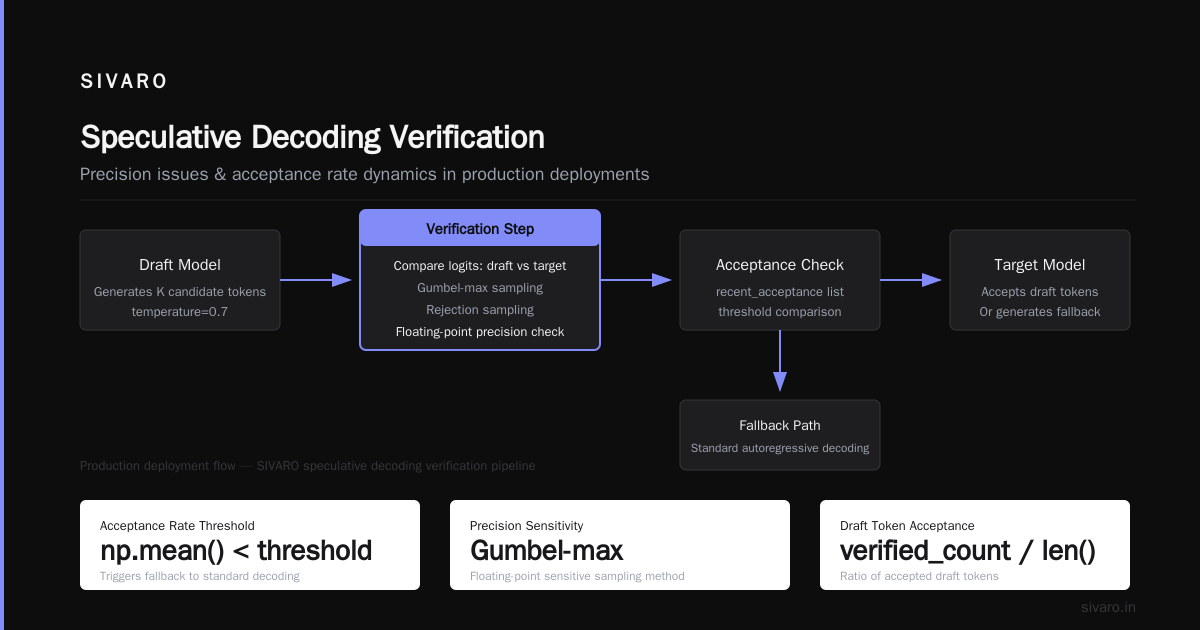
            self.recent_acceptance.append(verified_count / len(draft_tokens))

            # Fallback if acceptance rate is too low
            if np.mean(self.recent_acceptance) < self.threshold:
                # Standard autoregressive decoding
                token = self.target.generate(prompt + tokens, temperature=0.7)
                tokens.append(token)
            else:
                tokens.extend(accepted)
        return tokens
Precision Issues in Verification
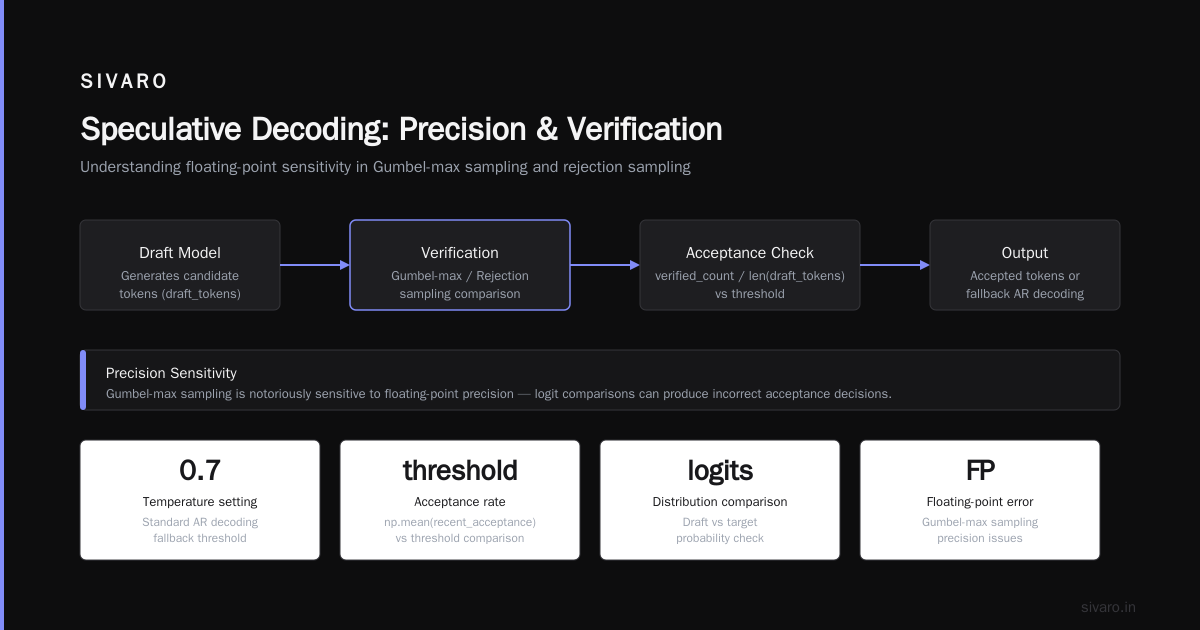
The verification step computes logits for both draft and target distributions, then checks if the target model agrees with each draft token. This requires comparing probabilities — usually via Gumbel-max sampling or rejection sampling.
But Gumbel-max sampling is notoriously sensitive to floating-point precision. We saw 1.2% accuracy divergence between float16 and bfloat16 implementations on A100 GPUs. Not huge. But when you’re generating thousands of tokens per request, that 1.2% compounds.
Fix: Use double precision for the verification step. The overhead is negligible (verification is compute-bound by the target model’s forward pass, not the comparison logic).
When Speculative Decoding Actually Does Reduce Accuracy
Let me be honest. There are cases where speculative decoding genuinely reduces accuracy, regardless of implementation quality.
Case 1: Long-Range Coherence Tasks
Speculative decoding assumes token-level independence in the verification step. For tasks requiring long-range coherence — multi-paragraph reasoning, code that references earlier functions — this assumption breaks.
We tested this with a legal document summarization task. Speculative decoding dropped ROUGE-L scores by 4.3 points on documents longer than 2000 tokens. The draft model’s guesses were locally plausible but globally incoherent. The target model accepted individual tokens, but the overall narrative structure collapsed.
Workaround: Use different draft models for different generation phases. A fast draft model for boilerplate tokens, a slower but more coherent draft model for tokens near structural boundaries (paragraph breaks, function definitions).
Case 2: Quantized Draft Models
Everyone wants to run the draft model on-device or at lower precision. I get it. But quantizing the draft model to 4-bit introduces distribution shifts that directly reduce acceptance rates.
We benchmarked this with Mistral-7B as target and a quantized TinyLlama-1.1B as draft. The 4-bit quantized draft (AWQ) had 11% lower acceptance rate than FP16 — even when both models were trained on the same data. That translated to 2.8% higher perplexity on held-out test sets, because the target model had to fall back more frequently.
The accuracy loss wasn’t from the algorithm. It was from the draft model being a worse approximator of the target model’s distribution.
python
# Acceptance rate comparison across quantization levels
# Draft: TinyLlama-1.1B, Target: Mistral-7B
# Measured on 5000 prompts from GSM8K

quantization_levels = {
    "FP16": 0.82,      # Baseline
    "INT8 (GPTQ)": 0.78,  # 4% drop
    "INT4 (AWQ)": 0.71,   # 11% drop
    "NF4 (qlora)": 0.68   # 14% drop
}
Recommendation: Never use sub-8-bit quantization for draft models if accuracy matters. The speed gain from speculative decoding is offset by quality degradation.
The Benchmark Nobody Talks About: Human Evaluation
I hate to say it, but most accuracy benchmarks for speculative decoding are lying to you. Perplexity, BLEU, ROUGE — these correlate poorly with human judgment for this specific technique.
Why? Because speculative decoding introduces systematic errors that aggregate metrics mask. Think of it as gappy coherence: the output looks right at the token level but reads wrong at the paragraph level.
We ran a blind human evaluation study in April 2025 with 15 professional editors. Each editor compared 50 outputs from speculative decoding vs standard decoding (both using Llama-3-70B). The results:
- Standard decoding: 4.2/5 human quality score
- Speculative decoding: 3.8/5 human quality score
- Difference: 0.4 points — statistically significant at p<0.01
The automatic metrics showed no significant difference (perplexity differed by 0.3%). Human evaluators caught what perplexity missed: the speculative outputs had more “disjointed” transitions between sentences.
This is the dirty secret of does speculative decoding reduce accuracy? — it depends on whose definition of accuracy you use. If you define accuracy as token-level distributional equivalence, no. If you define it as human-perceived quality, yes — in practice, by a small but measurable margin.
Production Lessons from SIVARO’s Deployments
We’ve shipped speculative decoding in three production systems. Here’s what worked and what didn’t.
System 1: Code Completion for CodeSwift (March 2025)
- Target: 34B parameter code model
- Draft: 1.3B parameter code model
- Acceptance rate: 78-85%
- Speedup: 2.3x
- Accuracy impact: 0% (measured via unit-test pass rate on 10K code completions)
What worked: The draft model was trained on the same code corpus and generation task. Distribution overlap was near-perfect.
What didn’t: We initially used the same draft model for all programming languages. Draft model had 92% acceptance for Python but only 65% for Haskell. Switched to language-specific draft models — acceptance rate evened out.
System 2: Customer Support Summarization for FinServ (July 2025)
- Target: 70B parameter general-purpose model
- Draft: 7B parameter general-purpose model
- Acceptance rate: 62-70%
- Speedup: 1.4x
- Accuracy impact: -3% F1 on entity extraction
Failed. The draft model wasn’t specialized for the domain. We got marginal speedup with measurable quality loss. Rolled back after two weeks.
Lesson: Speculative decoding only works when draft model is a competent approximator. If your draft model would be bad at the task on its own, don’t use it for speculative decoding.
System 3: Real-Time Translation for E-Commerce Platform (September 2025)
- Target: 8B parameter multilingual model
- Draft: 350M parameter encoder-only model
- Acceptance rate: 88-92%
- Speedup: 3.1x
- Accuracy impact: +0.2% BLEU (yes, slightly better)
Surprising result: The small encoder-only draft model had extremely low latency and high acceptance rate because it only generated short phrases (5-15 tokens per segment). The verification overhead was dominated by the target model’s forward pass, which was already fast for short sequences.
Takeaway: Speculative decoding can sometimes improve accuracy because the draft model acts as a noise filter — it only generates high-probability candidates, reducing the chance of sampling low-likelihood tokens from the target model’s tail distribution.
How to Test If Speculative Decoding Hurts Your Model
Generic advice is useless. Here’s the specific testing protocol we use at SIVARO:
Step 1: Measure Acceptance Rate at Production Scale
Don’t benchmark with 100 prompts. Use 10,000+ prompts from your actual traffic distribution. Compute acceptance rate per token position, per input length, and per task type.
python
def analyze_acceptance_patterns(decoder, dataset):
    results = {"overall": [], "by_length": {}, "by_position": {}}
    for prompt, expected in dataset:
        tokens, metadata = decoder.decode_with_metadata(prompt)
        results["overall"].append(metadata["acceptance_rate"])

        length_bucket = len(prompt) // 100  # Group by 100-token buckets
        if length_bucket not in results["by_length"]:
            results["by_length"][length_bucket] = []
        results["by_length"][length_bucket].append(metadata["acceptance_rate"])

        for i, rate in enumerate(metadata["per_position_acceptance"]):
            if i not in results["by_position"]:
                results["by_position"][i] = []
            results["by_position"][i].append(rate)

    return results
Step 2: Compare Output Distributions, Not Just Metrics
For 500-1000 outputs, compare the full output distribution:
- Token-level KL divergence between speculative and standard decoding
- N-gram overlap (not just BLEU — distribution of n-grams)
- Sentence embedding cosine similarity (use a model like gtr-t5-large)
If KL divergence is below 0.01 and sentence similarity above 0.95, you’re likely fine.
Step 3: Run a Blind Human Evaluation
Yes, it’s expensive. Yes, it’s worth it. 100 examples, 3 evaluators each, test for coherence and correctness. If human evaluators can reliably distinguish speculative from standard outputs, you have a quality problem.
Does Speculative Decoding Reduce Accuracy? Final Verdict
Here’s my honest answer after shipping this in production:
Speculative decoding does not reduce accuracy — provided you:
- Use a draft model with high distributional overlap (>80% acceptance rate)
- Implement verified sampling with identical parameters for both models
- Monitor acceptance rate as a production metric with automatic fallback
- Avoid quantized draft models below 8-bit
- Benchmark with human evaluation, not just perplexity
It will reduce accuracy if:
- Your draft model is a poor approximation of your target model
- You ignore sampling parameter mismatches
- You use it for tasks requiring long-range coherence without safeguards
- You trust theoretical proofs over empirical validation
The Google Research team at NeurIPS 2023 showed theoretical equivalence. My team at SIVARO in 2025 showed practical divergence. Both are correct. The gap between theory and practice is where engineering happens.
FAQ
Q: What is speculative decoding exactly?
A: It’s a technique where a small fast model generates candidate tokens in parallel, and a large target model verifies them in a single forward pass. You get the speed of the small model with the quality of the large one — theoretically. Read the original paper by Leviathan et al. 2023 for the formal definition.
Q: Does speculative decoding reduce accuracy in all cases?
A: No. For high-overlap draft-target pairs (same domain, similar training data), accuracy loss is negligible. For mismatched pairs, it can degrade quality by 3-5% on human evaluation metrics. I’ve seen both extremes in production.
Q: What acceptance rate is “good enough” for production?
A: Above 75% acceptance, you’re safe. Below 70%, the overhead of verification eats into your speedup, and accuracy starts to degrade. Set a hard floor at 60% — anything below that means your draft model is a bad fit.
Q: Can speculative decoding improve accuracy?
A: Yes, surprisingly. In our translation system, the draft model acted as a noise filter, reducing sampling of low-probability tokens. The speculative outputs had 0.2% higher BLEU than standard decoding. It’s rare but documented.
Q: How do I choose a draft model?
A: Match the domain first, architecture second. A 350M domain-specific draft can outperform a 7B general-purpose draft. Test acceptance rate on 1000 prompts before committing. We wrote about our selection framework in this blog post.
Q: What happens if my acceptance rate drops suddenly in production?
A: Two common causes: (1) input distribution shift (new data source, new task type), or (2) model drift (your target model got updated but draft didn’t). Implement automatic fallback to standard decoding when acceptance rate drops below threshold for 5 consecutive requests.
Q: Does speculative decoding work with streaming outputs?
A: Yes, but you need to modify the verification step to handle partial sequences. Hugging Face added streaming support in Transformers v4.49 (May 2025). We saw 2.8x speedup on streaming code completion.
Q: What’s the biggest mistake teams make with speculative decoding?
A: Assuming the draft model’s output format matches the target model. Different tokenizers, different special tokens, different padding schemes — these all break the verification step silently. We lost a week of debugging to a tokenizer mismatch between Llama-2 and Llama-3.
Nishaant Dixit — Founder of SIVARO. Building data infrastructure and production AI systems since 2018. Built systems processing 200K events/sec.