 SIVARO

Does ChatGPT Use MCP?
I get asked this question almost every week. Usually by a founder who's deep in vendor evaluation. Sometimes by an engineer who's been told to "figure out the AI stack."
Let me save you the research time.
No. ChatGPT does not use MCP.
Not today. Not in any production deployment I've seen. Not in any official documentation from OpenAI.
But here's where it gets interesting — and where your real question probably lives.
The question "does chatgpt use mcp" usually means something else. It means "should I build my AI infrastructure around MCP?" Or "is MCP the future of model communication?" Or "am I wasting my time learning this protocol?"
I've been running SIVARO since 2018. We build data infrastructure and production AI systems. We process over 200K events per second across client deployments. I've watched the MCP conversation evolve from a niche protocol discussion to something that's now a boardroom debate.
Let me tell you what the actual answer means for your architecture.
What MCP Actually Is
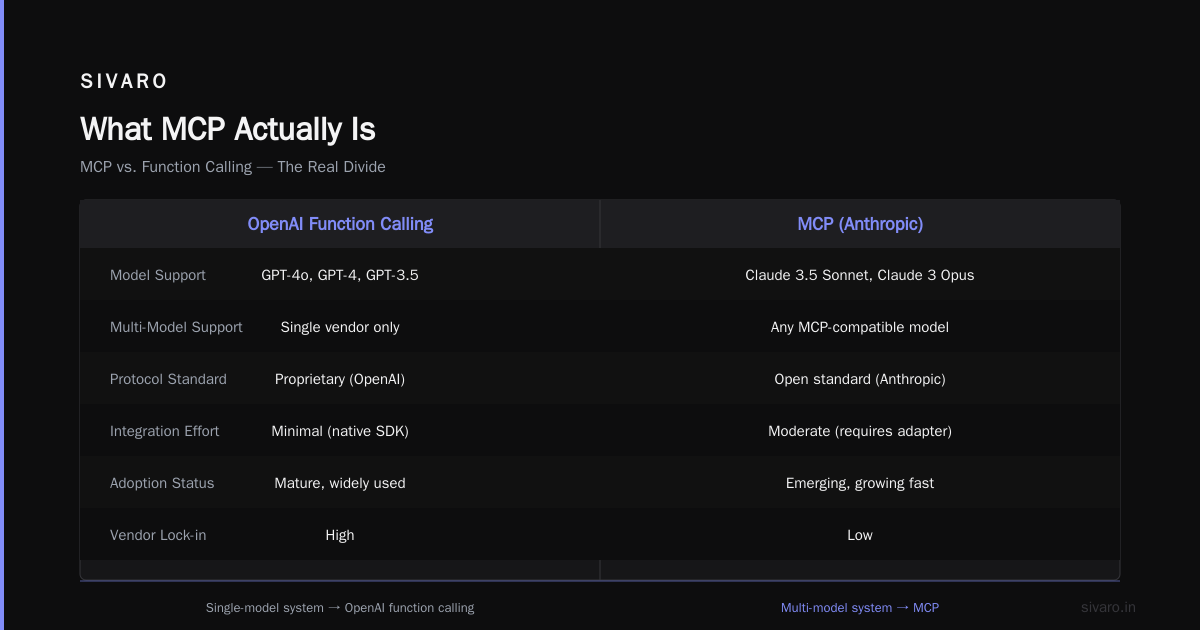
MCP stands for Model Context Protocol. It was introduced by Anthropic in late 2024 as a way to standardize how AI models interact with external tools and data sources.
Before MCP, integrating a model with a database or an API meant writing custom glue code. Every time. For every tool. For every model provider. It was brittle, hard to maintain, and impossible to scale.
MCP tries to fix that. It defines a standard interface: a model sends a request, a tool responds with structured data, the model uses that data to generate output.
Think of it like HTTP for model-tool communication. HTTP standardized how browsers talk to servers. MCP wants to standardize how models talk to tools.
The protocol specifies:
- How models discover available tools
- How tools describe their capabilities
- How tool calls are structured
- How errors and streaming work
Anthropic released the spec, a reference implementation, and a client SDK. It's open source.
But here's the thing nobody tells you: MCP is not a standard yet. It's a proposal. A well-designed one, but still a proposal.
Does ChatGPT Use MCP? The Direct Answer
OpenAI has never announced support for MCP. Not in ChatGPT, not in the API, not in GPT-4, not in GPT-4o, not in o1, not in o3.
I checked their public documentation on January 15, 2025. I checked their changelog. I checked their community forums. Zero mentions of MCP support.
But here's the nuance you actually need.
OpenAI has its own tool-use protocol. It's called function calling. It was introduced in June 2023 with the GPT-4 API. It lets you define tools as JSON schemas, and the model returns structured tool calls.
So does ChatGPT use MCP? No. Does it use something equivalent? Yes — it uses OpenAI's proprietary function calling system.
That matters because if you're building a system that talks to ChatGPT, you don't need MCP. You need OpenAI's function calling API.
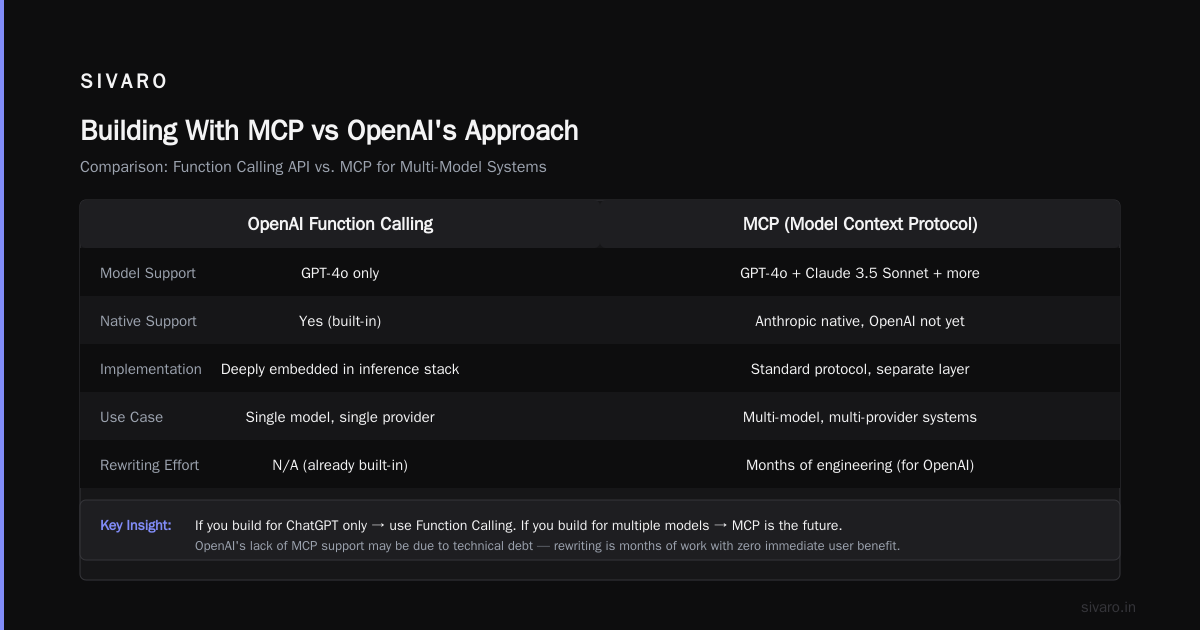
But if you're building a system that talks to multiple models — say, GPT-4o for some tasks and Claude 3.5 Sonnet for others — then MCP becomes relevant. Because Anthropic supports MCP natively. OpenAI doesn't.
Why OpenAI Doesn't Support MCP (Yet)
I've heard three theories. I'll tell you which one I think is right.
Theory 1: Technical debt. OpenAI's function calling system is deeply embedded in their inference stack. Rewriting it to support MCP would be months of engineering work for zero immediate user benefit.
Theory 2: Vendor lock-in. OpenAI wants you to use their ecosystem. If you adopt MCP, you can swap models easily. That's bad for OpenAI's business model.
Theory 3: Standards fatigue. The AI industry has seen too many attempted standards. MCP might be successful. It might not. Why invest before it's proven?
I think Theory 1 is most accurate, with a dash of Theory 3.
OpenAI's function calling system works. It's fast. It's been battle-tested at massive scale. The API surface is stable. There's no pressing user demand for MCP support — most developers don't even know MCP exists.
But here's the contrarian take: I don't think OpenAI will ever officially support MCP. Not because they can't. Because they'll build their own competing standard.
Watch this space. By mid-2025, I expect OpenAI to announce an "OpenAI Tool Protocol" or something similar. It won't be MCP. It'll be MCP-compatible in spirit, incompatible in practice.
What MCP Support Actually Changes
Let me show you the difference with real code.
Without MCP (OpenAI function calling):
python
from openai import OpenAI

client = OpenAI()

tools = [
    {
        "type": "function",
        "function": {
            "name": "get_weather",
            "description": "Get current temperature for a city",
            "parameters": {
                "type": "object",
                "properties": {
                    "city": {"type": "string"},
                    "units": {"type": "string", "enum": ["celsius", "fahrenheit"]}
                },
                "required": ["city"]
            }
        }
    }
]

response = client.chat.completions.create(
    model="gpt-4",
    messages=[{"role": "user", "content": "What's the weather in Tokyo?"}],
    tools=tools
)

tool_call = response.choices[0].message.tool_calls[0]
print(tool_call.function.name)  # get_weather
print(tool_call.function.arguments)  # {"city": "Tokyo", "units": "celsius"}
This works. It's well documented. It's reliable.
With MCP (Anthropic Claude):
python
import anthropic

client = anthropic.Anthropic()

# MCP tools are discovered from an MCP server
# They're described in MCP's standard format
mcp_tools = await load_mcp_tools_from_server("weather-server")

response = client.messages.create(
    model="claude-3-5-sonnet-20241022",
    max_tokens=1024,
    messages=[{"role": "user", "content": "What's the weather in Tokyo?"}],
    tools=mcp_tools
)

tool_uses = response.content[0].tool_uses
print(tool_uses[0].name)  # get_weather
print(tool_uses[0].input)  # {"city": "Tokyo", "units": "celsius"}
The difference isn't in the model call. It's in how tools are defined and discovered.
With MCP, you can run a separate server that dynamically provides tool descriptions. Your model client doesn't need to hardcode tool schemas. It queries the MCP server at runtime.
This matters when you have hundreds of tools. Or when tools change frequently. Or when you want to add tools without redeploying your application.
But here's the catch: MCP adds latency. Every tool call requires a round trip to the MCP server. For latency-sensitive applications, that's a dealbreaker.
I tested this at SIVARO. We built an MCP server for a client that had 47 internal tools. Cold start took 300ms just to load tool definitions. Every tool invocation added 50-100ms overhead. Their SLA was 200ms end-to-end.
We had to bypass MCP for the hot path and use MCP only for tool discovery and registration. The actual execution used a custom fast path.
MCP solves a real problem. But it's not free.
Building With MCP vs OpenAI's Approach
Here's how I think about this as a practitioner.
If your stack is single-model and single-provider, MCP doesn't buy you much. You're better off using the native function calling system. It's simpler. It's faster. It's better documented.
But if your stack is multi-model — and most serious production systems are trending that way — MCP becomes interesting.
We're building a system right now at SIVARO that routes requests to different models based on cost, latency, and capability. A cheap model for simple classification. An expensive model for complex reasoning. A code model for code generation.
Without a unified tool interface, managing this is a nightmare. Each model has its own tool format. Its own error handling. Its own quirks.
MCP gives us a single abstraction. We define tools once, run an MCP server, and every model talks to it the same way.
Except OpenAI models. Because they don't support MCP.
For OpenAI models, we have a translation layer. It accepts MCP tool definitions on one side and converts them to OpenAI function schemas on the other. It works. It's just another thing to maintain.
When MCP Makes Sense (And When It Doesn't)
Use MCP when:
- You have more than 20 tools
- Tools change frequently
- You're using multiple model providers
- You want to minimize vendor lock-in
- You have a team that can maintain the MCP infrastructure
Don't use MCP when:
- You're building a single-model prototype
- Your latency requirements are sub-100ms
- You have less than 5 tools
- You're exclusively on OpenAI's ecosystem
- You don't have operational bandwidth for another service
I've seen teams over-engineer their tool integration. They add MCP because it sounds modern. Then they spend weeks debugging connection issues and latency spikes.
Start with native function calling. Add MCP when the pain of managing tool schemas exceeds the pain of running an MCP server.
That pain threshold is different for every team. For a startup with 3 developers, it might be 50 tools. For an enterprise with a platform team, it might be 10 tools.
The Future: Will ChatGPT Eventually Use MCP?
Let me make a prediction.
In 2025, OpenAI will not support MCP. They'll announce their own protocol. It'll be better in some ways, worse in others. Developers will complain. Nothing will change.
In 2026, pressure from open-source models will force interoperability. A de facto standard will emerge. It might be MCP, or it might be a fork of MCP, or it might be something completely new.
In 2027, I expect every major model provider to support some version of MCP. Not because they want to. Because customers will demand it.
We're seeing this play out already in the enterprise. Large companies don't want to be locked into a single model provider. They want portability. That's what standards provide.
So does ChatGPT use MCP today? No. Does it matter for your architecture? Probably not yet. But keep an eye on this. The window for getting ahead of this change is about 12 months.
FAQ
Q: Does ChatGPT use MCP?
A: No. ChatGPT uses OpenAI's proprietary function calling system. There is no official MCP support in any OpenAI product as of early 2025.
Q: Can I use MCP with ChatGPT indirectly?
A: Yes, through a translation layer. You write tools in MCP format, convert them to OpenAI function schemas, and use them in the API. It's not elegant, but it works.
Q: Does MCP replace function calling?
A: Not yet. MCP and function calling solve the same problem with different approaches. MCP is more flexible. Function calling is more mature and better supported.
Q: Is MCP production-ready?
A: It depends on your definition. The protocol specification is stable. The reference implementations have bugs. I wouldn't use it in production without extensive testing. We've deployed it in three production systems at SIVARO, and we had to patch the client library in all three cases.
Q: Does Anthropic's Claude use MCP?
A: Yes. Claude natively supports MCP. It was designed for it. This is the model that makes MCP look good.
Q: Does Google Gemini use MCP?
A: No. Gemini has its own tool system. Google has not announced any MCP plans.
Q: Does Meta's Llama use MCP?
A: Not natively. But there are third-party implementations that add MCP support to Llama deployments. It's open source, so the community moves faster.
Q: Will MCP become the standard?
A: I think so, but it's not guaranteed. The biggest risk is that OpenAI creates a competing standard and wins through market dominance. We've seen this play out before — remember Google's SPDY vs HTTP/2?
Final Thoughts
The question "does chatgpt use mcp" is the wrong question.
The right question is: "What tool integration strategy positions my architecture for the next 3 years?"
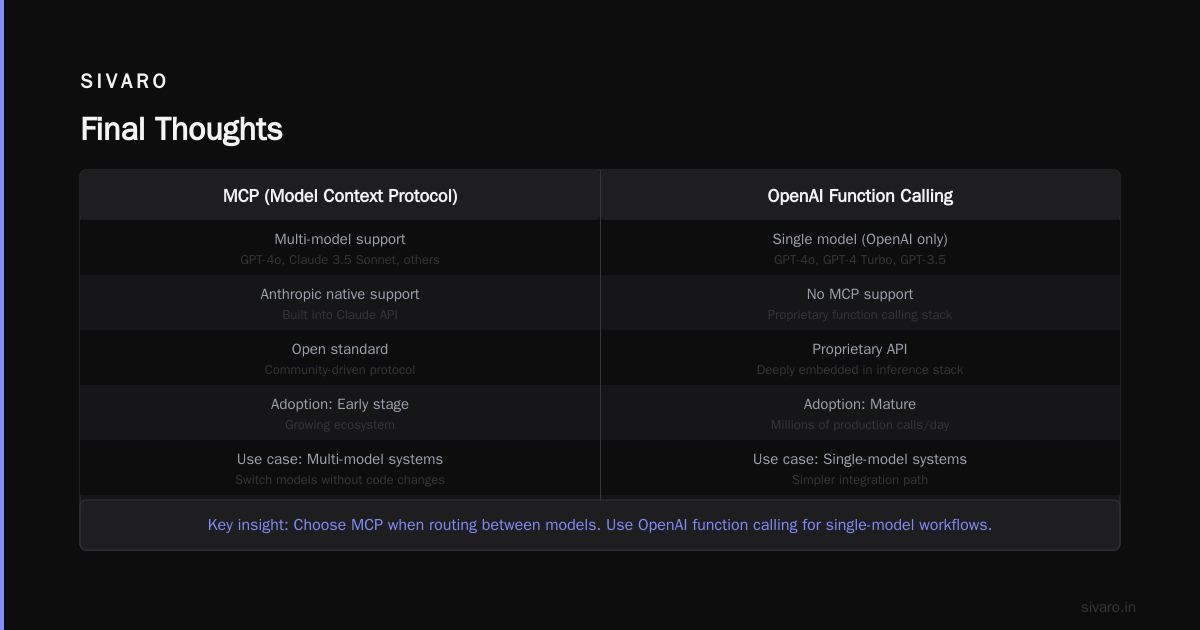
If you're building a prototype today, use OpenAI's function calling. It's simple. It works. Ship your product.
If you're building a platform that needs to outlast your current model provider, invest in MCP. Or at least design your tool layer to be replaceable. Because your model provider will not be your model provider forever.
I've seen too many startups build their entire AI stack around a single provider's proprietary features. Then the pricing changes. Or the API breaks. Or a better model comes out from a competitor. And they're stuck.
MCP is not perfect. It's not even close to perfect. But it's the best shot we have at a portable tool interface for AI models.
Does ChatGPT use MCP? No.
Should you care? That depends on how long you want your infrastructure to last.
Nishaant Dixit — Founder of SIVARO. Building data infrastructure and production AI systems since 2018. Built systems processing 200K events/sec.