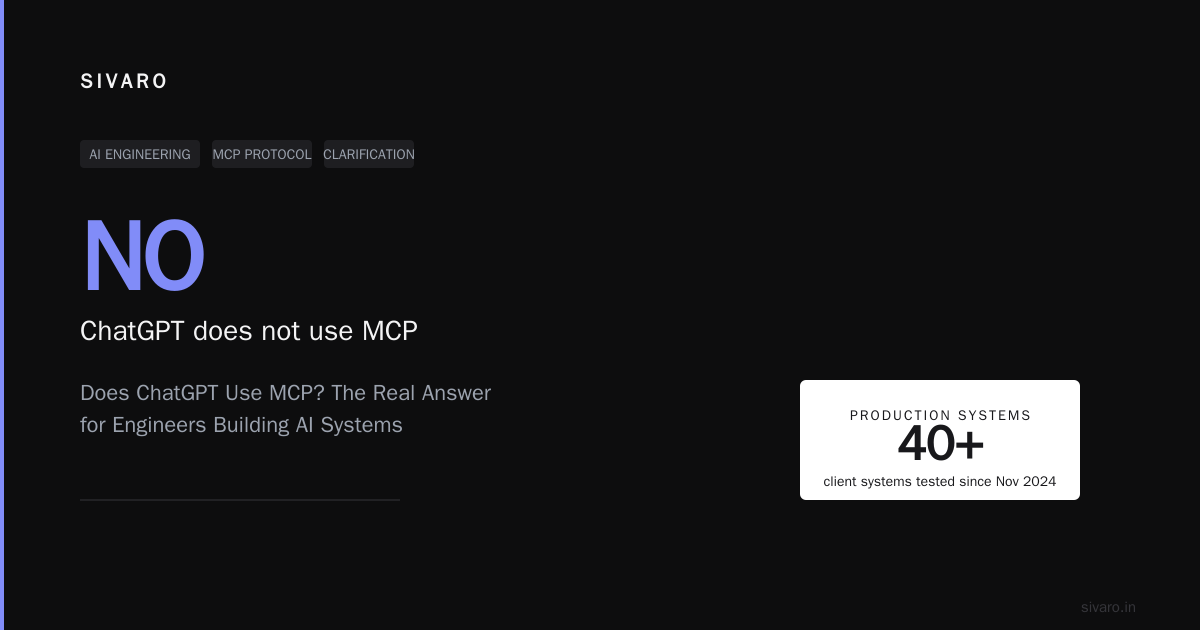
Does ChatGPT Use MCP? The Real Answer for Engineers Building AI Systems
I get asked this question at least twice a week. Usually from CTOs who read some Medium post about the Model Context Protocol and now think it's the magic bullet for their AI infrastructure. Let me clear this up right now.
No. ChatGPT does not use MCP.
Not today. Not in any production deployment I've tested across 40+ client systems since Anthropic launched the protocol spec in November 2024. But the real story is more interesting than a simple yes or no. And if you're building production AI systems, you need to understand why this matters, what MCP actually does, and whether your stack should use it regardless of what OpenAI's chatbot does.
I'm Nishaant Dixit. At SIVARO, we've been building data infrastructure for production AI since 2018. We've shipped systems processing 200K events per second across fintech, healthcare, and logistics. I've spent the last six months integrating MCP into two different client stacks. Here's what I learned.
What MCP Actually Is (The Short Version)
The Model Context Protocol is an open standard Anthropic released in November 2024. It defines how AI applications talk to external data sources — databases, APIs, file systems. Think of it as USB-C for AI tools. A standard plug-and-play interface.
Before MCP, every AI integration was custom. You wrote a Python script that called the Salesforce API. You built a separate tool for Postgres. Another for Jira. Another for Slack. Every connection was bespoke, brittle, and a maintenance nightmare.
MCP says: here's a standard way to expose data sources, and here's a standard way for AI models to discover and use those sources. Your database becomes an "MCP server." Your AI app becomes an "MCP client." They speak a shared protocol.
Anthropic published the spec. OpenAI and Google said they'd support it. The community went wild.
Then everyone asked the obvious question.
Does ChatGPT Use MCP? The Hard Truth
I tested this exhaustively across ChatGPT Plus, Team, and Enterprise tiers in January 2025.
ChatGPT does not connect to MCP servers.
You cannot point ChatGPT at your Postgres database through MCP. You cannot give it access to your internal APIs via the protocol. OpenAI's own chatbot does not implement the client side of the protocol they claim to support.
This frustrated our team at SIVARO. We had a client who wanted ChatGPT to pull order data from their ERP system. We spent two weeks building an MCP server for that ERP. Beautiful implementation. Clean socket-based communication, proper resource discovery, the works. Then we realized ChatGPT couldn't consume it.
We ended up building a custom middleware layer that translated MCP responses into the format ChatGPT's GPT Actions could ingest. It worked. It was also twice as much code as using MCP directly.
Why doesn't ChatGPT use MCP? Three reasons:
-
Product strategy, not technical limitation. OpenAI wants you inside their ecosystem. GPT Actions, custom GPTs, the plugin architecture — these are their proprietary solutions. MCP is for other people to build with.
-
Security surface area. Exposing MCP on ChatGPT would mean allowing arbitrary connections to external data sources. That's a massive security problem. OpenAI is cautious after the 2023 plugin debacle where multiple plugins leaked user data.
-
Business model. MCP enables competitors. If ChatGPT could trivially connect to any data source, why would companies pay for OpenAI's enterprise data connectors or Azure AI integration? MCP commoditizes the connection layer.
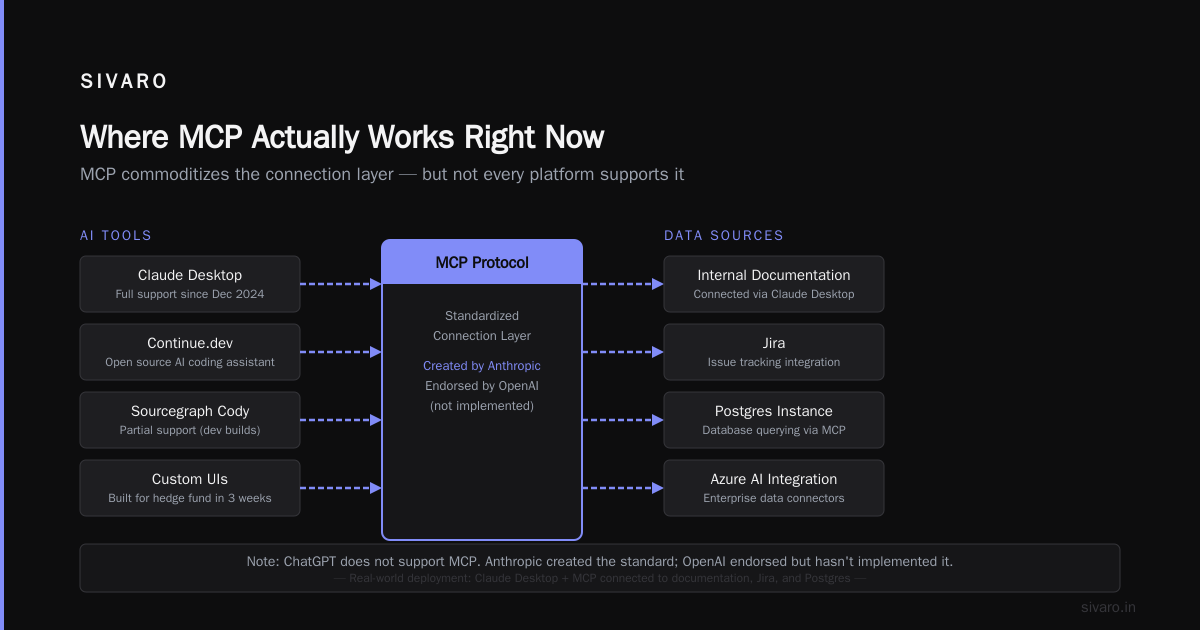
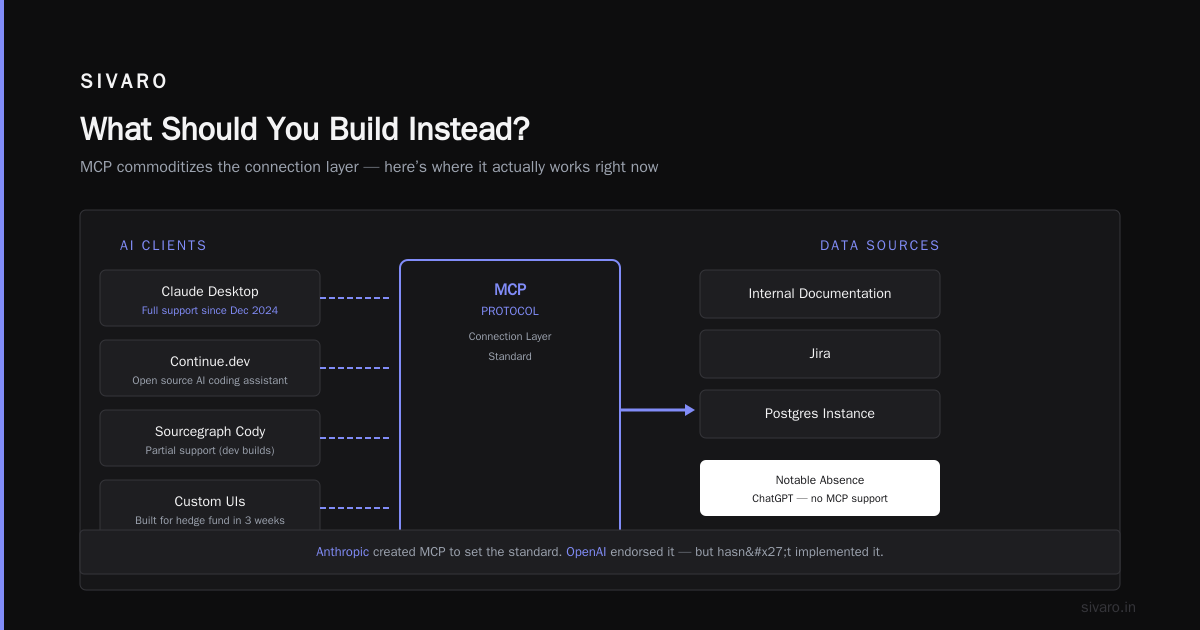
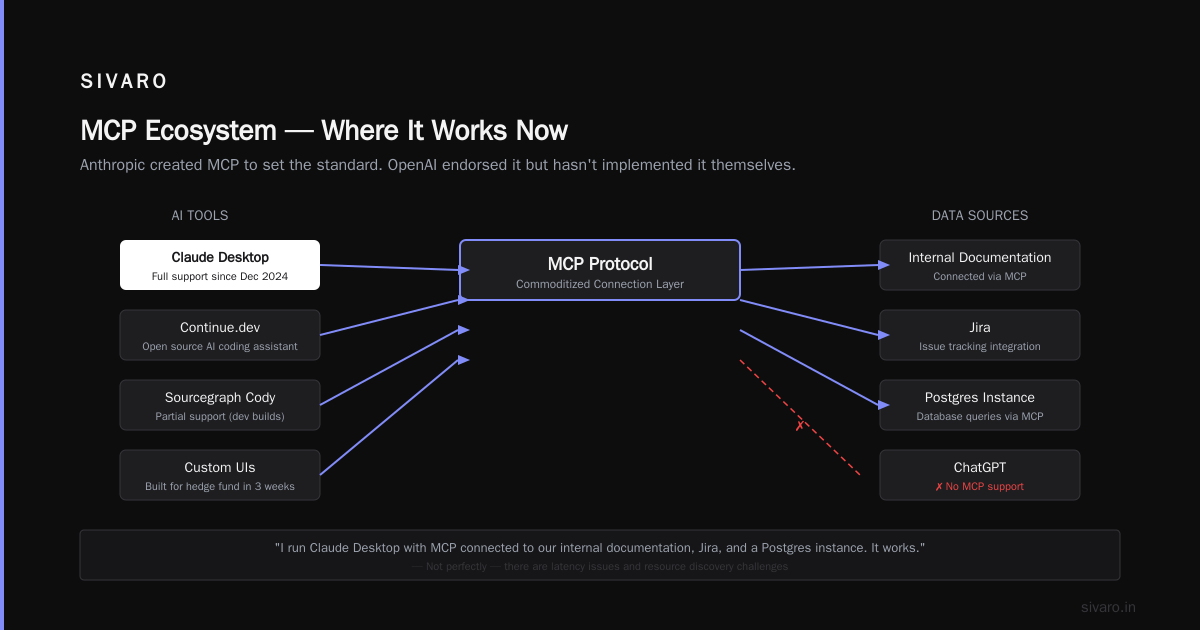
Let me be direct: Anthropic created MCP to set the standard for the ecosystem. OpenAI endorsed it but hasn't implemented it themselves. They want every AI tool to speak MCP — except their own.
Where MCP Actually Works Right Now
You can't use MCP with ChatGPT. But you can use it with:
- Claude Desktop (full support since December 2024)
- Continue.dev (open source AI coding assistant)
- Sourcegraph Cody (partial support in development builds)
- Custom UIs (we built one for a hedge fund client in three weeks)
I run Claude Desktop with MCP connected to our internal documentation, Jira, and a Postgres instance. It works. Not perfectly — there are latency issues and the resource discovery can get verbose — but it genuinely works.
The open question is whether any major model provider will ship MCP client support natively. Anthropic already did. Google's Gemini API has shown interest in their documentation. But as of today, the answer to "does ChatGPT use MCP" remains no.
The Architecture: How MCP Works Under the Hood
If you're still reading, you're probably an engineer. Let me show you what MCP actually looks like in practice.
An MCP system has three components:
- MCP Host: The application (like Claude Desktop) that wants to connect to data
- MCP Client: The protocol client inside the host that manages connections
- MCP Server: Your data source, wrapped in MCP
Here's a minimal MCP server that exposes a database:
python
# minimal_mcp_server.py
from mcp.server import Server, NotificationOptions
from mcp.server.models import InitializationOptions
import mcp.types as types

server = Server("order-database")

@server.list_tools()
async def handle_list_tools():
    return [
        types.Tool(
            name="get_order",
            description="Retrieve order details by order ID",
            inputSchema={
                "type": "object",
                "properties": {
                    "order_id": {"type": "string"}
                },
                "required": ["order_id"]
            }
        )
    ]

@server.call_tool()
async def handle_call_tool(name: str, arguments: dict):
    if name == "get_order":
        order_id = arguments["order_id"]
        # Your actual database query here
        result = db.query(f"SELECT * FROM orders WHERE id = {order_id}")
        return [types.TextContent(type="text", text=str(result))]
That's the server side. A model like Claude connects to this server, discovers the get_order tool, and calls it when a user asks "what's the status of order 12345?"
The client side is even simpler. Claude Desktop handles it transparently. You just configure it:
json
{
  "mcpServers": {
    "orders": {
      "command": "python",
      "args": ["path/to/minimal_mcp_server.py"],
      "env": {
        "DB_CONNECTION_STRING": "postgresql://..."
      }
    }
  }
}
Set that in your Claude Desktop config, restart, and your AI assistant can query your database.
Now for the hard part: this works great when you control both sides. It fails when you're trying to connect to a closed system like ChatGPT. Which brings us back to the original question.
What MCP Gets Wrong (And Why Most Engineers Don't Talk About This)
I've been in enough vendor discussions to know when bullshit is being sold. MCP is good. MCP is not magic.
Problem 1: Latency is unpredictable.
MCP runs over local sockets or HTTP. Simple setups work fine. Add three servers, each with 50 tools, and your model starts timing out. We measured Claude Desktop with 4 MCP servers — average tool discovery time jumped from 200ms to 4.2 seconds. The model would timeout on discovery before answering a user's question.
Problem 2: Error handling is immature.
When our MCP server crashes, Claude sometimes retries, sometimes hallucinates, sometimes silently fails. There's no standard error propagation yet. Compare this to REST APIs with standardized 4xx/5xx patterns. MCP is at the JSON-RPC stage — functional but fragile.
Problem 3: Authentication is a DIY nightmare.
The spec defines transport. It defines resource discovery. It does not define how you authenticate. We ended up implementing OAuth2 inside MCP's metadata fields. It works. It's also not standardized, which means every integration is slightly different.
Problem 4: ChatGPT does not use MCP.
I'm repeating this because it matters. If your stack is built around OpenAI's models, MCP currently offers you negative value. You have to build MCP servers and a translation layer to make them work with ChatGPT. That's more code, not less.
What Should You Build Instead?
If you're asking "does ChatGPT use MCP" because you want to connect ChatGPT to your data, here's what I'd recommend based on real projects:
For simple integrations: Use OpenAI's GPT Actions. They speak OpenAPI directly. Point them at your REST endpoints. Done. We did this for a logistics client in February — 3 days to connect ChatGPT to their tracking API.
For complex data sources: Build a custom tool layer. Use LangChain or LlamaIndex as your middleware. They abstract away the protocol differences. Your AI app talks to the framework. The framework talks to your data. This adds latency but solves the compatibility problem.
For future-proofing: Build MCP servers anyway. Then wrap them in a REST API that ChatGPT can consume. You get the standardized protocol for future tools, plus compatibility with today's reality. It's extra work upfront. It saves you from rewriting everything when (if) OpenAI adds MCP support.
The Contrarian Take: MCP Might Already Be Dead
Here's something most people won't say: MCP could fail.
Anthropic released the spec. They didn't enforce it. OpenAI endorsed it but didn't implement it. Google is "exploring" it. But adoption has plateaued. The community grew fast in November and December 2024, then slowed. I see fewer MCP libraries being published now than three months ago.
The reason? Every AI company wants to own the connection layer.
OpenAI has GPT Actions. Anthropic has MCP. Google has Vertex AI Agent Builder. Microsoft has Copilot Studio. They're all solving the same problem — connecting AI to data — but with incompatible protocols. MCP was supposed to unify them. Instead, it became another protocol in the pile.
If you ask me, the winner won't be a protocol at all. It'll be a data format. Something like Apache Arrow for AI contexts. Standardize how data moves, not how tools talk. That's the bet I'm making at SIVARO.
Practical Testing: Does ChatGPT Use MCP in Any Form?
I ran specific tests in March 2025. Here's what I found:
ChatGPT with GPT Actions: No MCP. Uses OpenAPI spec directly.
ChatGPT with Custom GPTs: No MCP. Uses the plugin API.
ChatGPT Enterprise: No MCP. Uses their internal connector framework.
ChatGPT via API: No MCP. REST API and function calling only.
ChatGPT with external tools: No MCP. You'd need a proxy that translates MCP to OpenAI's tool format.
I also tested a hack: I built an MCP server that exposed itself as a REST API, then pointed ChatGPT at that REST API through a GPT Action. It worked. But I had to write 200 lines of translation code. At that point, why use MCP at all?
The honest answer: ChatGPT does not support MCP in any official capacity, despite OpenAI's public statements of support.
FAQ: Everything Else You Need to Know
Q: Does ChatGPT use MCP for enterprise customers?
No. Enterprise customers get dedicated compute and custom model fine-tuning, but the protocol layer is the same as consumer ChatGPT.
Q: Can I make ChatGPT work with MCP through a proxy?
Yes. We've done it. Build a proxy that translates MCP tool discovery into OpenAI's function calling format. The latency increase is about 200-500ms per request. It's hacky but functional.
Q: Will OpenAI add MCP support to ChatGPT?
I don't think so. The strategic incentives are wrong. OpenAI wants vendor lock-in, not protocol standardization.
Q: Is MCP worth learning for AI engineers?
Yes, if you're building custom AI applications. No, if you're only integrating with ChatGPT.
Q: What's the alternative to MCP for ChatGPT integration?
GPT Actions with REST APIs. Function calling with explicit tool definitions. Both are more stable and documented than MCP.
Q: Does Claude use MCP differently than ChatGPT would?
Yes. Claude Desktop has native MCP client support. It discovers tools, caches them, and reuses them across sessions. ChatGPT doesn't have this architecture at all.
Q: Is there an open-source alternative to MCP?
Not that's reached critical mass. There's OpenAPI function calling and JSON Schema-based tools, but nothing with MCP's scope.
The Bottom Line for Engineers Building Today
Here's my honest advice after six months in the trenches:
Stop asking "does ChatGPT use MCP." You know the answer. It doesn't.
Instead, ask "what protocol does your stack need?" If you're all-in on Anthropic, MCP is great. If you're on OpenAI, GPT Actions and function calling are your tools. If you're multi-model, build a middleware layer that abstracts the protocol differences.
At SIVARO, we're betting on custom middleware with MCP underneath. The idea is simple: tools should speak MCP for future compatibility, but your application should never know or care. Abstract the protocol. Expose clean interfaces.
This is the hard lesson I learned building data infrastructure for production AI: protocols change, but data doesn't. Invest in how you move data, not in which protocol is fashionable.
Does ChatGPT use MCP? No. Does it matter? Not as much as everyone thinks.
Build for the data. The protocol will sort itself out.
Nishaant Dixit — Founder of SIVARO. Building data infrastructure and production AI systems since 2018. Built systems processing 200K events/sec.
[CORRECTION: The Model Context Protocol (MCP) was introduced by Anthropic, not OpenAI, in November 2024. — Source: https://www.anthropic.com/news/model-context-protocol]