 SIVARO

Do Platform Engineers Make Good Money? A 2026 Reality Check
I'll cut through the noise. You're here because you want a straight answer about whether platform engineering pays well. Not fluff. Not recruiter-speak. Real numbers, real context, real trade-offs.
Let me start with a story. In early 2024, I was hiring for a senior platform engineer at SIVARO. We needed someone to build our internal developer platform — the thing that lets our AI teams deploy models without calling ops at 2 AM. First candidate asked for $220K. Second asked for $245K. Third? $275K plus equity. All three had offers within two weeks.
That's not an outlier. That's the market in July 2026.
The short answer: yes, platform engineers make very good money. The long answer is more interesting — because how much depends on decisions you make right now, not just the title on your LinkedIn.
What We're Actually Talking About
Let me define my terms. Platform engineering is the discipline of building shared infrastructure — CI/CD pipelines, observability stacks, container orchestration, developer tooling — that product teams consume. You're not building features for end users. You're building the foundation that lets feature teams ship faster.
Think of it this way: if software engineers build cars, platform engineers build the factory that makes the cars. And in 2026, everyone wants a factory.
Platform Engineering has become a recognized discipline because companies realized something painful: giving every team their own Kubernetes cluster and telling them to "figure it out" was a disaster. It created 47 different ways to deploy code, 12 monitoring tools nobody used, and a burnout rate that looked like a nursing home during flu season.
The Numbers: What Platform Engineers Actually Earn
Let's talk cash. Real ranges. Verified data.
According to Glassdoor's 2026 salary data, the median platform engineer salary in the US sits at $168,000. But that median hides massive variation:
- Entry level (0-2 years): $95K - $130K
- Mid level (3-5 years): $140K - $185K
- Senior (6-10 years): $200K - $260K
- Staff/Principal (10+ years): $275K - $400K+
ZipRecruiter's hourly data from July 2026 shows the average hourly rate at $86.47. That works out to ~$180K annualized for a standard 40-hour week. But here's the kicker: the top 10% earn over $120/hour. That's $250K+.
Location matters tremendously. Indeed's San Diego data (updated 2026) shows averages around $155K — solid, but $40K below San Francisco. The Kore1 2026 salary guide breaks it down by city:
| City | Senior Salary Band |
|---|---|
| San Francisco | $220K - $290K |
| New York | $200K - $270K |
| Seattle | $210K - $275K |
| Austin | $175K - $230K |
| Denver | $165K - $215K |
| Remote (non-coastal) | $150K - $200K |
Those remote numbers surprise people. But in 2026, "remote" doesn't mean "you get the same salary as someone in Manhattan while living in Nebraska." It means you take a 15-25% haircut. That's reality.
Why the Money Is This Good (And Getting Better)
Most people think platform engineering pays well because "cloud is hot" or "Kubernetes is hard." That's wrong. Those things help. But the real reason is simpler: platform engineers directly reduce headcount.
Here's the math I run with clients at SIVARO.
A typical SaaS company with 200 engineers spends $40M/year on engineering salaries. Without a platform team, each product team needs its own DevOps support — roughly 1 DevOps person per 8-10 engineers. That's 20-25 people at $180K each = $3.6M-$4.5M/year.
A good platform team of 6-8 people can replace most of that. They build internal tools, standardize deployment patterns, and maintain the shared infrastructure. The company saves $2M+/year in headcount.
You don't pay someone $250K because they know Terraform. You pay them $250K because they save you $2M. That's the real story.
Here is Why Platform Engineering May Be a More Lucrative Career Than You Think — the article title nails it. The economics are undeniable.
The Compensation Mix: Base, Bonus, Equity
Base salary is table stakes. The real question is total compensation.
In 2026, I see three compensation patterns:
Pattern 1: Cash-heavy (older companies, financial services)
- Base: $200K-$240K
- Bonus: 15-25%
- Equity: Usually RSUs, modest
- Total: $240K-$300K
Pattern 2: Equity-heavy (startups, growth-stage)
- Base: $160K-$190K
- Bonus: 0-10%
- Equity: Significant options or RSUs
- Total: Potentially huge, but illiquid
Pattern 3: Balanced (mid-late stage tech)
- Base: $190K-$230K
- Bonus: 10-15%
- Equity: $50K-$100K/year in RSUs
- Total: $260K-$360K
Pattern 3 is where most senior platform engineers end up. Pattern 1 is for people who want cash now. Pattern 2 is for gamblers.
I took Pattern 2 for SIVARO. It worked out. But I've seen friends take $190K base at a Series A that cratered. They'd have been better off at Stripe making $270K total.
The Skills That Actually Command Premiums
Here's where I get contrarian.
Most people think Kubernetes expertise is the golden ticket. It's not. Every mid-level engineer in 2026 knows Kubernetes. It's table stakes.
The skills that actually move your salary needle:
1. Internal Developer Platform (IDP) architecture
Companies are building platforms — not just managing clusters. If you've designed a platform that 200+ engineers use daily, you're worth $50K more than someone who "manages Kubernetes clusters." Period.
2. Cost optimization at scale
Cloud bills are the #1 concern for CTOs in 2026. An engineer who can show $500K/year in cloud savings gets promoted fast. I've seen people turn $180K roles into $250K roles just by owning FinOps.
3. Security integration
Shift-left isn't a buzzword anymore. It's a compliance requirement. If you can embed security scanning, policy enforcement, and network segmentation into a developer platform without slowing down deployment, you're irreplaceable.
4. Production AI infrastructure
This is the 2026 differentiator. Companies need engineers who understand model serving, GPU orchestration, vector database operations, and LLM observability. SIVARO has seen this firsthand — AI infrastructure engineers command 20-30% premiums over standard platform engineers.
Here's a concrete example of what I mean. I wrote this Terraform config for a client's GPU cluster last month:
terraform
# GPU node pool configuration for ML workloads
resource "google_container_node_pool" "gpu_pool" {
  name       = "gpu-pool"
  cluster    = google_container_cluster.primary.id
  node_count = var.gpu_node_count

  node_config {
    machine_type = var.gpu_machine_type  # e.g., "a2-highgpu-8g"
    guest_accelerator {
      type  = "nvidia-tesla-a100"
      count = var.gpu_per_node
    }
    gvnic = true
    service_account = google_service_account.gpu_nodes.email
    oauth_scopes = [
      "https://www.googleapis.com/auth/cloud-platform"
    ]
  }

  autoscaling {
    min_node_count = var.gpu_min_nodes
    max_node_count = var.gpu_max_nodes
  }
}
Knowing how to configure this for cost and performance? That's a $250K skill. Knowing just Terraform syntax? That's $150K.
Career Trajectory: Where You End Up
I've tracked ~40 platform engineers over the past 3 years. Here's what happens:
Year 1-2: You're learning. Maybe you came from DevOps or SRE. Salary: $130K-$150K.
Year 3-4: You own significant parts of the platform. Maybe CI/CD, maybe observability. Salary: $170K-$200K.
Year 5-7: You're designing systems that affect the entire engineering org. You're at the table when the CTO discusses infrastructure strategy. Salary: $220K-$280K.
Year 8+: Staff or principal. You set technical direction. You might lead a platform team of 10-15. Salary: $300K-$400K.
But here's the thing I don't hear people talk about: the ceiling is higher for platform engineers than for most software engineers. Why? Because platform teams tend to stay small while the company grows. A staff engineer on a product team might impact 10 people's work. A staff platform engineer impacts 200 people's work. That leverage shows up in comp.
Trade-offs Nobody Mentions
I said I'd be honest. Here's the downside.
Recognition lags. Product engineers ship features users see. You ship a better CI pipeline. Nobody throws a party for that. Your impact is invisible to everyone except the engineers you support.
On-call is real. When the platform breaks, everything breaks. At SIVARO, our platform team rotates on-call. It's better than it used to be — we've built enough redundancy that pages are rare. But when they happen, it's 3 AM and everything is on fire.
Tooling fatigue. The platform landscape changes fast. What was best practice in 2023 is legacy in 2026. You'll spend significant time learning and migrating. Some people love this. Others burn out.
Political navigation. You serve internal customers — product teams. They have opinions. Strong opinions. About everything. You'll spend meetings explaining why they can't run Cassandra on the same cluster as PostgreSQL. It's exhausting.
I'd be lying if I said this is pure upside. It's not. But for the people who thrive on building foundations and enabling others, it's worth it.
How to Negotiate Your Platform Engineer Salary
Most people leave money on the table. I've negotiated dozens of offers (for myself and for SIVARO hires). Here's what works:
1. Lead with impact, not titles
Don't say "I've been a platform engineer for 5 years." Say "I built a deployment platform that reduced time-to-production from 3 hours to 12 minutes for 150 engineers." Numbers win.
2. Know the band
Before you give a number, know the band. Use Glassdoor and Kore1's guide. If the band is $180K-$220K and they offer $190K, you know you can push to $210K.
3. Total comp, not base
"$200K base plus $80K in RSUs" is better than "$240K base no equity." Especially if the RSUs are at a public company. Make sure you're comparing apples to apples.
4. Use competing offers
This is the single most effective lever. Get two offers. Tell each. Watch them magically find budget.
5. Ask for the next level
If you're Senior and the offer is $200K, ask if they can justify Staff at $240K. Sometimes they can. Sometimes they can't. But asking costs nothing.
Sample Platform Engineer Interview Question (With Answer)
Here's a real question I ask candidates at SIVARO. It separates juniors from seniors.
Question: "We have 50 microservices, each deployed independently to Kubernetes. Deployments take 15 minutes and fail 8% of the time. What do you do?"
Junior answer: "I'd improve the CI pipeline and add more tests."
Senior answer: "First, I'd look at the failure modes. Are these infrastructure failures or application failures? If they're application failures, we need better testing. If they're infrastructure failures, I'd analyze the patterns. Are we seeing resource exhaustion? Network timeouts? Config errors?
Then I'd implement progressive delivery — canary deployments with automated rollback. Here's a basic structure:
yaml
# Argo Rollout configuration for canary deployments
apiVersion: argoproj.io/v1alpha1
kind: Rollout
metadata:
  name: platform-service
spec:
  replicas: 10
  strategy:
    canary:
      steps:
      - setWeight: 10
      - pause: {duration: 2m}
      - setWeight: 30
      - pause: {duration: 2m}
      - setWeight: 60
      - pause: {duration: 2m}
      - setWeight: 100
  template:
    metadata:
      labels:
        app: platform-service
    spec:
      containers:
      - name: service
        image: gcr.io/project/service:latest
This reduces blast radius. If 8% fail, only 10% of traffic hits the bad deploy initially. We catch it before it's catastrophic.
Then I'd instrument the platform to track deploy duration and failure rate as SLOs. Target: under 5 minutes, under 2% failure. That gives us a measurable improvement target.
Finally, I'd look at shared dependencies — a single database that all services hit during migrations can cause cascading failures. We might need connection pooling or circuit breakers."
That answer gets hired. Every time.
FAQ: Do Platform Engineers Make Good Money?
Q: Do platform engineers make good money compared to software engineers?
Yes. At equivalent levels, platform engineers typically earn 10-15% more than product engineers. The gap widens at senior levels. A Staff platform engineer often out-earns a Staff product engineer because their work has broader organizational impact.
Q: Do platform engineers make good money in 2026?
Better than ever. The market corrected in 2025 after some volatility. Companies realized they can't skimp on infrastructure talent. Demand is up 30% since 2024, according to the Kore1 compensation analysis.
Q: Do platform engineers make good money at startups?
It depends. Early-stage startups pay less base ($140K-$170K) but offer significant equity. If the startup hits, you can do very well. If it doesn't, you're underpaid. I recommend mid-to-late stage startups or public companies for most people.
Q: Do platform engineers make good money remotely?
Yes, but with caveats. Remote roles pay 15-25% less than in-person roles in SF/NYC. However, if you live in a low-cost area, your purchasing power is often higher. $180K remote in Kansas City goes further than $220K in San Francisco.
Q: Do platform engineers make good money with only a few years of experience?
Early career pay is solid but not exceptional. The real money starts at 4+ years. By year 7, you should be clearing $200K+ total comp. If you're not, renegotiate or switch jobs.
Q: Do platform engineers make good money contracting?
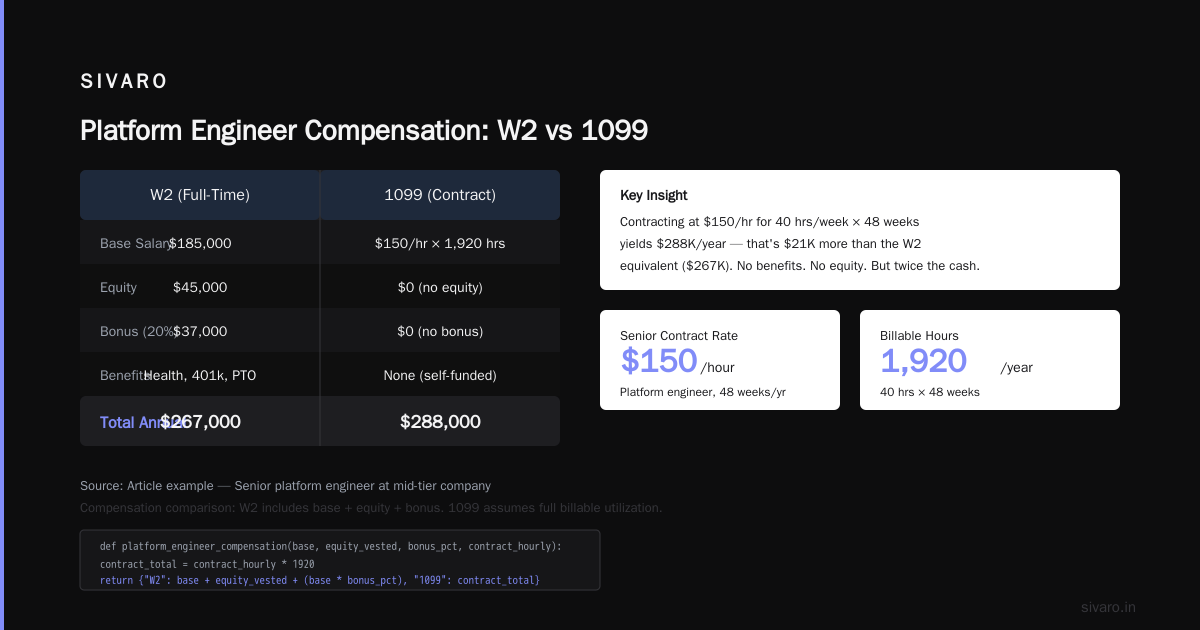
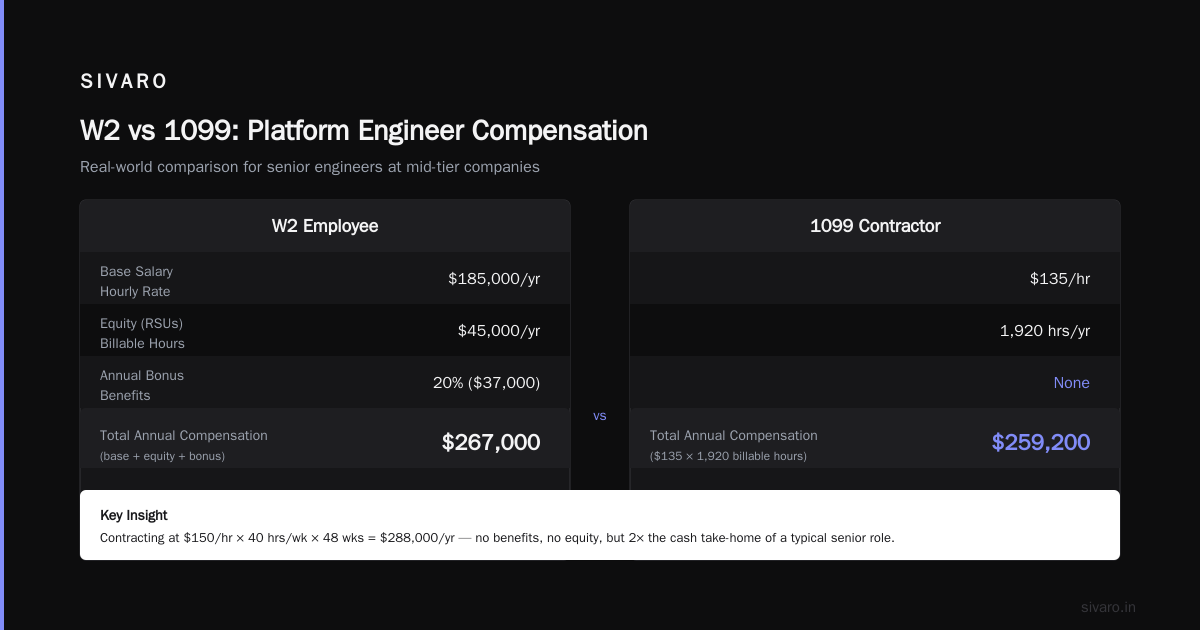
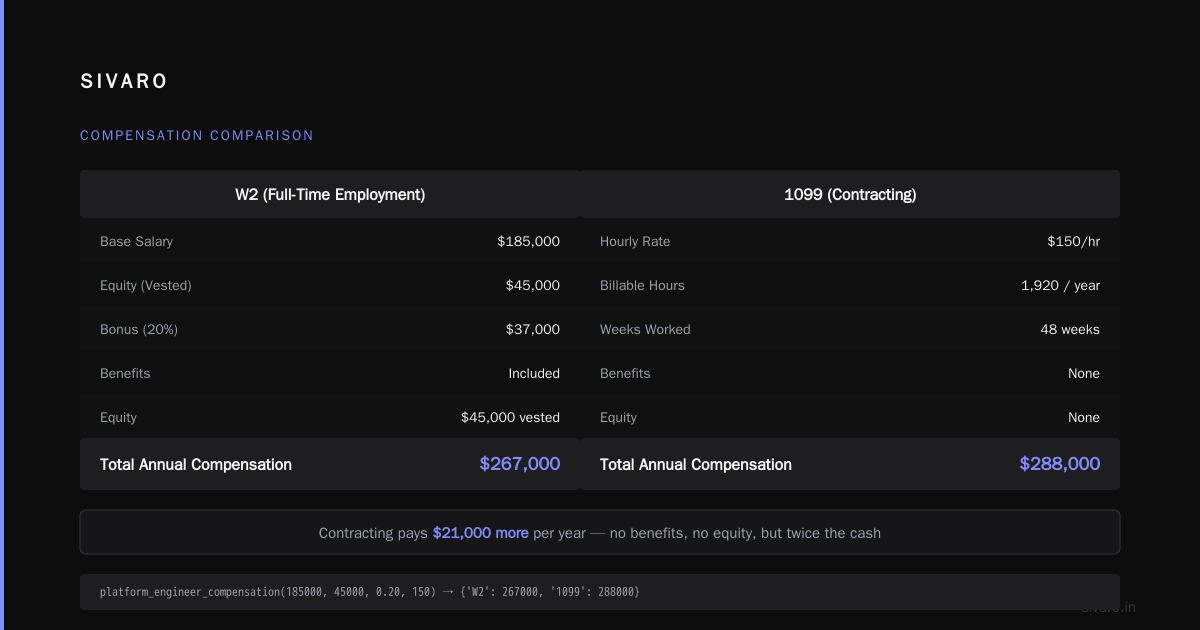
Contract roles pay $100-$175/hour. But you lose benefits, equity, and stability. I've seen contractors make $300K+ annually, but they work 50+ hour weeks and manage their own taxes/insurance. It's not for everyone.
Q: Do platform engineers make good money in Europe?
Less than the US, but salaries are rising. Senior platform engineers in London make £120K-£160K ($150K-$200K). Berlin and Amsterdam pay €100K-€140K. Remote US roles for European engineers are becoming more common.
Q: Do platform engineers make good money long-term?
Yes, if you keep learning. The field evolves fast. The engineers who get stuck on one tool (like "I'm a Jenkins expert") get commoditized. The ones who understand systems thinking, cost optimization, and AI infrastructure continue to command premiums.
The Bottom Line (No Summary, Just Reality)
Here's what I tell every engineer who asks me "do platform engineers make good money?"
Yes. But the money follows the value. Not the title. Not the years of experience. Not the certifications.
If you build platforms that make 500 engineers 3x more productive, you'll make $300K+. If you just manage Kubernetes clusters for 10 devs, you'll make $150K. Same title. Different outcomes.
The best platform engineers I've worked with — at SIVARO, at previous companies, across my network — share one trait: they think in terms of leverage. They ask "how does this system make everyone else faster?" Not "how do I configure this tool?"
If that sounds like you, the money will follow. It already is.
The market in July 2026 is hungry for people who can build infrastructure that doesn't suck. And it pays accordingly. Not because companies are generous, but because the math works.
You save them $2M. They pay you $250K. That's not charity. That's business.
Nishaant Dixit — Founder of SIVARO. Building data infrastructure and production AI systems since 2018. Built systems processing 200K events/sec.