 SIVARO
Distributed System Architecture: What It Is and Why It Broke at 3 AM
I was staring at a terminal at 3:14 AM on a Tuesday in Q2 2026. A GPU cluster we'd built for a financial services client had just eaten 47 requests in a row. The logs showed network partitions. The nodes couldn't agree on whose copy of the data was real. The client's trading desk was blind for six minutes.
That's when you start asking hard questions about what is the distributed system architecture? Not the textbook definition — the real one. The kind where your choices at design time determine whether you sleep at night or explain to a VP why 200K transactions vanished.
Distributed system architecture is how you make multiple computers work together as one coherent system. Sounds simple. It's not. It's the discipline of managing failure, inconsistency, latency, and disagreement across machines that can't trust each other and shouldn't have to.
In this guide, I'll walk you through what actually matters. The patterns that survive production. The traps that don't. And the uncomfortable truth about modern AI infrastructure — which is that most distributed systems being built today aren't ready for the load they're about to get.
The Crashing Machine That Taught Me Architecture
Here's a story that still makes me wince.
Mid 2024. We were building a real-time fraud detection pipeline. Three-node Kubernetes cluster. Simple enough. A single machine went down during a memory spike — some misconfigured garbage collector in our model-serving container. We expected the other two nodes to pick up the slack.
They didn't.
What we'd built wasn't really distributed. It was a monolith with three copies that happened to share a network. When one failed, the others couldn't agree on state. Transactions that should have been idempotent doubled. The database split into two islands that didn't know the other existed.
We spent three weeks untangling that mess. Rewrote the state management layer. Switched to a consensus protocol. Added proper partitioning.
That's the moment I stopped treating distributed system architecture as an academic concern. It's a survival skill.
The Fallacy We All Keep Repeating
Most engineers I talk to think distributed systems are about scaling.
They're wrong.
Distributed system architecture is about failure. Scale is a side effect.
You don't build a distributed system because traffic is high. You build it because a single machine will fail, and you need your system to survive that. Every other benefit — horizontal scaling, geographic distribution, fault isolation — follows from that single assumption.
The problem is that most architectures I see in 2026 still assume the network is reliable. That latency is zero. That bandwidth is infinite. That topology doesn't change. That there's one administrator. That transport cost is free. That the network is homogeneous.
These are the Eight Fallacies of Distributed Computing, formalized by Sun Microsystems back in the 90s. They're still the reason your cluster fails at 3 AM.
Real talk: Every time a vendor tells you their system "just works" across machines, ask them how it handles network partitions. If they hesitate, walk.
The Two Problems You Can't Avoid
In my experience, every distributed system comes down to two problems:
- Partial failure — Some nodes work. Some don't. You can't tell which until you try.
- No shared clock — Two machines can't perfectly agree on what time it is.
Everything else — consistency, consensus, replication, partitioning — is just coping mechanisms for these two.
Let me show you what I mean with a concrete example.
python
# Naive "distributed" counter — don't run this in production
class DistributedCounter:
    def __init__(self):
        self.count = 0

    def increment(self):
        # This will fail when the network blips
        response = http.post("http://other-node/inc", json={})
        if response.status_code == 200:
            self.count += 1
            return True
        return False  # What do we do here?
This code looks fine until the other node is slow, or down, or split-brained. Then you have to decide: do you record the increment locally and hope to sync later? Block until you hear back? Reject the operation?
That's the fundamental tension in what is the distributed system architecture? — you're always choosing between availability and consistency.
The CAP Theorem (and Why It Matters for Your GPU Cluster)
You've heard of CAP. Consistency, Availability, Partition Tolerance. Pick two.
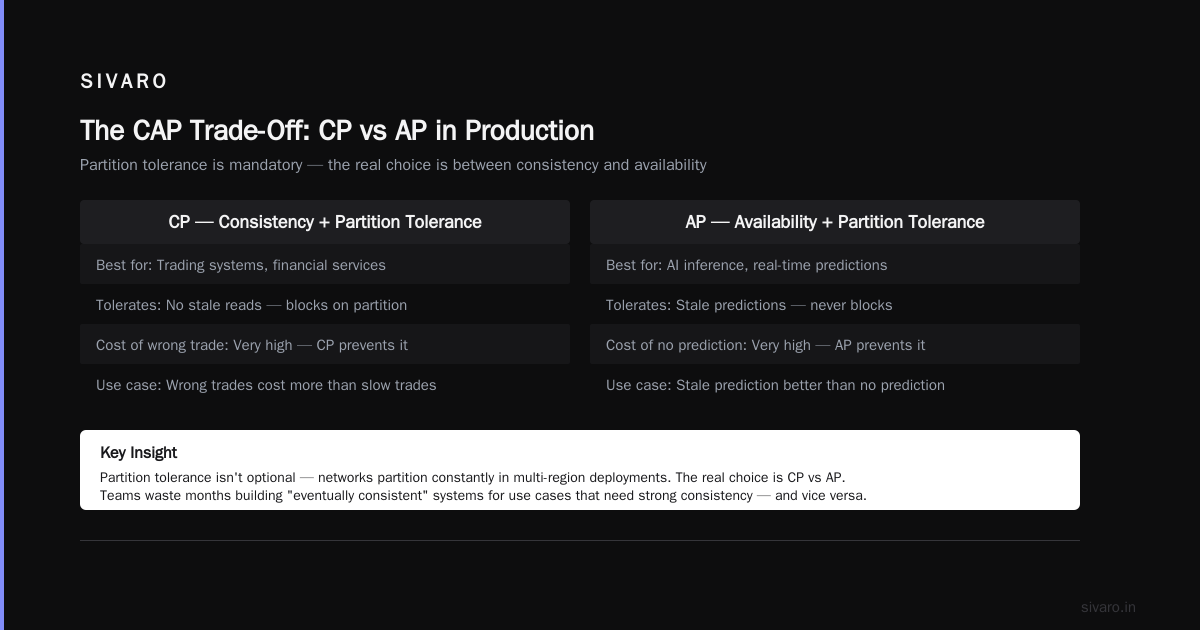
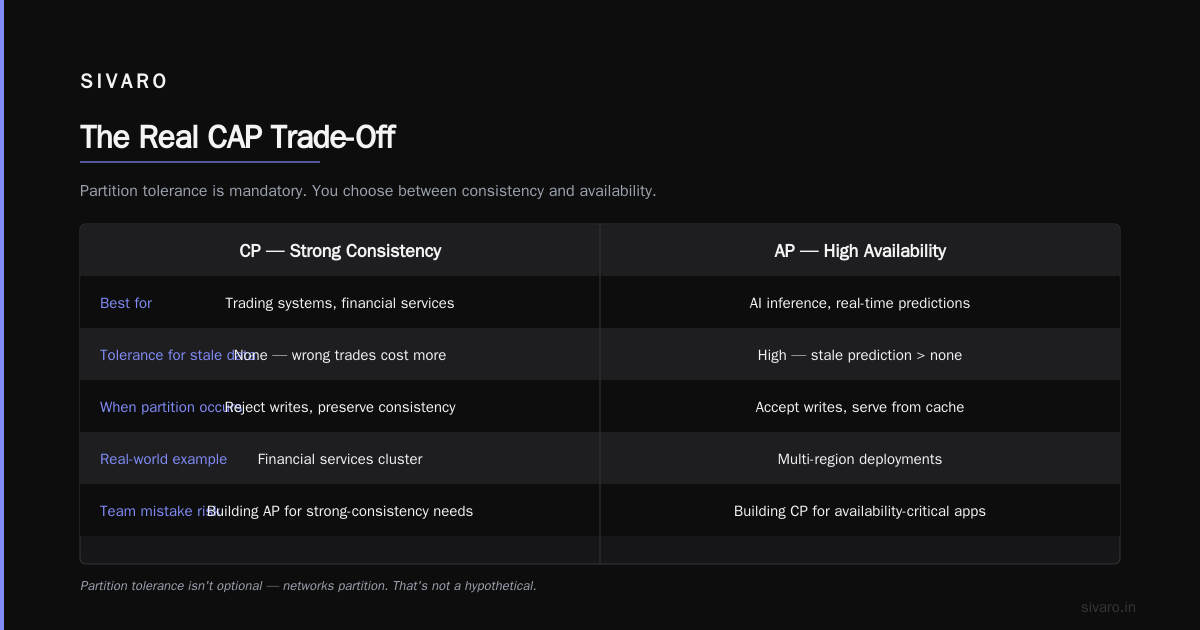
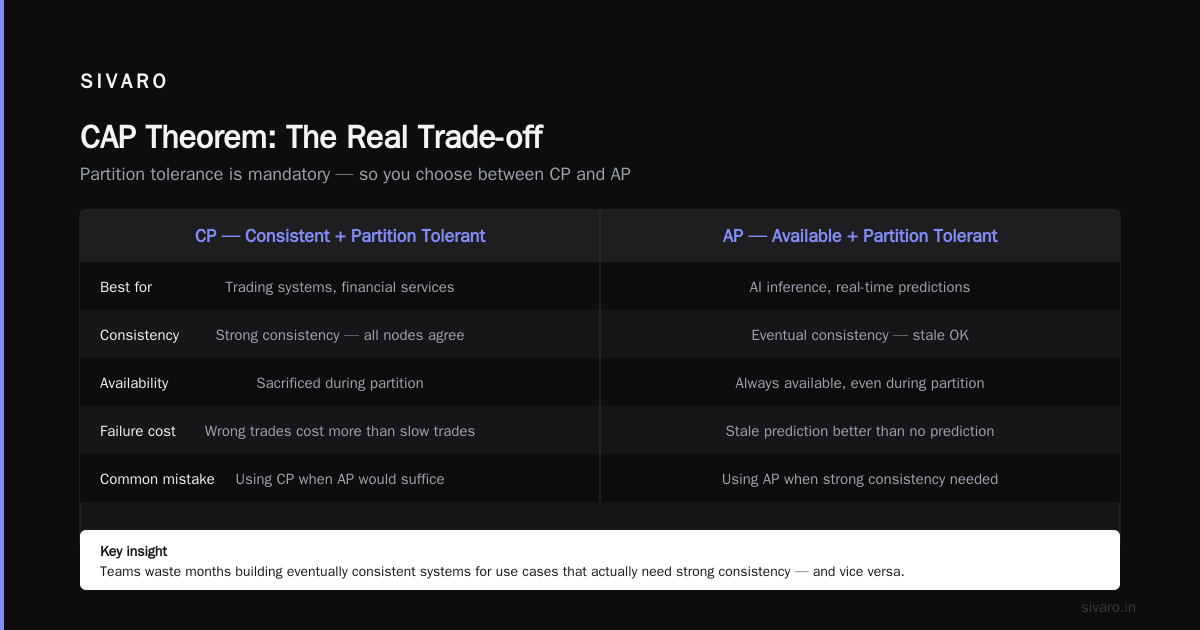
But here's what most explanations miss: Partition tolerance isn't optional. Networks partition. That's not a hypothetical. It happened to us in that financial services cluster. It happens constantly in multi-region deployments.
So really, you're choosing between CP (Consistency + Partition Tolerance) and AP (Availability + Partition Tolerance).
For an AI inference cluster serving real-time predictions, you usually want AP. A stale prediction is better than no prediction. A trading system? CP, always. Wrong trades cost more than slow trades.
I've seen teams waste months trying to build "eventually consistent" systems for use cases that actually needed strong consistency. And I've seen equally painful fails where engineers forced two-phase commit on high-throughput streaming workloads.
The rule I use: If you can tolerate a few seconds of staleness, go AP. If stale data causes financial or safety damage, go CP. But never pretend you can avoid the choice.
Consistency Models: What I Actually Run in Production
There's a lot of theory here. Linearizability. Sequential consistency. Causal consistency. Eventual consistency.
In practice, I use four models:
- Strong consistency — Reads always see the latest write. Expensive. Uses consensus (Raft, Paxos). Good for ledgers, balances, inventory.
- Causal consistency — If event A caused event B, everyone sees A before B. Cheaper than strong. Good for social feeds, collaborative editing. This is what Bluesky ATProto trademark uses under the hood for their decentralized social graph.
- Read-your-writes — You see your own writes immediately. Others might not. Good for user-facing apps where individual experience matters.
- Eventual consistency — Given enough time, all replicas converge. Cheap. Good for DNS, CDNs, analytics.
Which one do I default to? Causal consistency. It gives you a sanity guarantee without the throughput hit of full consensus. Most teams I've worked with at SIVARO end up here.
go
// Simplified causal consistency tracking
type Event struct {
    ID      string
    Data    string
    Depends []string // IDs of events this event depends on
}

func (e *Event) IsReady(seen map[string]bool) bool {
    for _, dep := range e.Depends {
        if !seen[dep] {
            return false
        }
    }
    return true
}
The Blocklace CRDT Attack Nobody's Talking About
Let me get into something uncomfortable.
CRDTs (Conflict-Free Replicated Data Types) are supposed to be the silver bullet for distributed state. They let replicas diverge and then merge without conflict. No consensus needed. Sounds perfect.
But in late 2025, researchers demonstrated a practical attack against blocklace-based CRDTs — a specific implementation structure that chains CRDT operations like blocks. The attack works by flooding the system with legitimate-looking operations that never converge. The system keeps merging, keeps adding operations, and the state grows unbounded. Memory exhaustion follows. The cluster falls over.
We saw this in a messaging system prototype. Someone intentionally sent conflicting updates from multiple clients. The CRDT library we were using — a popular open-source one — collapsed under the load. Merge operations became O(n²). We had to shut down the service and manually truncate the operation log.
The lesson: CRDTs are not magic. They have tradeoffs like everything else. Blocklace structures in particular are vulnerable to what I call "convergence denial" attacks — an adversary can keep the system from ever reaching a stable state.
What we do now: Implement bounded operation logs. Force periodic compaction. And always, always test under adversarial conditions.
Time, Clocks, and the Ordering Nightmare
You can't order events without timestamps. But you can't trust timestamps either. Machine clocks drift. NTP sync has error margins. And quantum effects? Yeah, they matter at nanosecond resolution on modern hardware.
This is where logical clocks come in. Lamport clocks. Vector clocks. Hybrid logical clocks.
I use hybrid logical clocks in most of my systems. They combine physical time with a logical counter. If two events happen at the same physical time, the counter breaks the tie. You get the best of both worlds — human-readable timestamps with logical ordering guarantees.
python
class HybridLogicalClock:
    def __init__(self):
        self.physical = time.time_ns()
        self.logical = 0

    def tick(self, received_physical=None):
        now = time.time_ns()
        if received_physical:
            self.physical = max(now, received_physical)
        else:
            self.physical = max(now, self.physical)

        if self.physical == max(now, received_physical) if received_physical else self.physical:
            self.logical += 1
        else:
            self.logical = 0

        return (self.physical, self.logical)
This isn't perfect. But it's good enough for 99% of what you'd build.
What This Means for AI Infrastructure in 2026
Here's where this hits home.
AI workloads are fundamentally different from traditional distributed systems. You're synchronizing hundreds of GPUs. Gradients need to arrive in the right order. Model parameters need to be consistent across machines. And the communication patterns are all-to-all, not request-reply.
Most people think building a GPU cluster is about buying hardware. GPU Cluster Explained: Architecture, Nodes and Use Cases will tell you about node types, interconnects, and network topologies. That's table stakes.
The hard part is the software architecture. The distributed state management. The gradient synchronization scheme. The fault tolerance when one GPU dies mid-training.
I've seen teams spend six figures on A100 clusters, then lose weeks to NCCL timeouts because they didn't account for network topology. The 5 Key Considerations when Building an AI & GPU Cluster guide gets this right — you need to think about data locality, interconnect bandwidth, and job scheduling from day one.
For smaller teams, I've started recommending services like Vast.ai: Rent GPUs for experimentation before committing to on-prem. The What is the best option to setup on premise GPU cluster for ... thread on NVIDIA's forums has real conversations from people who've done this. Read it before you wire up a data center.
The Pattern I Actually Use
Let me give you something concrete. Here's the reference architecture I've settled on after seven years of building these systems:
- State layer: A distributed key-value store with causal consistency. RocksDB on each node, connected via an internal RPC layer. No consensus for reads — we accept stale reads under partition.
- Compute layer: Stateless workers that pull work items from a partitioned queue. Each partition maps to a consistent hash ring. Workers don't communicate with each other.
- Consensus layer: Raft for the metadata that matters — cluster membership, config changes, critical counters. Everything else uses CRDTs with bounded operation logs.
- Monitoring: Every node exports causality graph metadata. We can reconstruct the exact chain of events leading to any state.
yaml
# service.yml — simplified config for the pattern
consensus:
  algorithm: raft
  nodes: 5
  election_timeout: 150ms

storage:
  engine: rocksdb
  sync_mode: async  # accepts stale reads

partitioning:
  algorithm: consistent_hashing
  virtual_nodes: 256
  rebalance: manual  # no automatic rebalancing — too dangerous
This isn't perfect. It's not elegant. But it survives production.
When You Shouldn't Build Distributed
Here's a contrarian take: most systems don't need to be distributed.
I've walked into companies running six-node Cassandra clusters handling 500 requests per second. A single PostgreSQL instance would handle that with better consistency, lower latency, and less operational complexity.
Distributed system architecture adds cost. Networking. Operational complexity. Debugging difficulty. You should only pay that cost when:
- Your availability requirements exceed what a single machine can provide (five nines or higher)
- Your data volume exceeds what fits on one machine
- Your latency requirements demand geographic distribution
- You need to survive the failure of an entire availability zone
Everything else? Use a monolith. Use a relational database. Use a queue if you need async processing. Don't build distributed until you have to.
I learned this the hard way. We spent months building a distributed state machine for a system that could have run on a single Postgres box. We'd been solving a problem that didn't exist yet.
Building Your Own GPU Cluster: The Reality Check
If you're serious about on-premise AI infrastructure, here's what actually matters.
First, What Is a GPU Cluster and How to Build One gives you the basics — node types, networking, storage tiers. But the real bottleneck is always the interconnect. NVLink vs InfiniBand vs Ethernet. The topology determines your all-reduce performance, and that determines your training throughput.
Second, power and cooling. A single H100 draws 700W. A rack of 16 draws 11.2KW. The NVIDIA forum thread I mentioned has horror stories about teams who didn't calculate cooling requirements and had their clusters throttle in summer months.
Third, software. Kubernetes with the NVIDIA device plugin. A job scheduler that understands GPU topology. Monitoring that tracks temperature, power draw, and ECC errors per GPU. Most people focus on hardware. The smart teams focus on the orchestrator.
The Real Answer to "What Is the Distributed System Architecture?"
Here it is, plain and direct:
Distributed system architecture is a set of principles and patterns for building systems that survive partial failure. It's not about scaling. It's not about performance. It's about making machines cooperate despite their fundamental inability to fully trust each other.
You design for the moments when:
- A node crashes silently
- The network drops a message
- Two nodes think they're both the leader
- A clock is off by 47 seconds
- A rogue client floods the system with contradictory writes
If your architecture handles those, you've got something real. If it doesn't, you've got a monolith that happens to be spread across multiple machines.
FAQ
What is the distributed system architecture?
It's the practice of designing systems where multiple computers coordinate to appear as a single coherent system. The key challenges are partial failure, lack of a shared clock, and the need for consensus across unreliable networks.
Do I need distributed systems for a small company?
Probably not. Most small companies can handle their workload on a single beefy server. Only distribute when you need availability beyond what one machine can provide, or when your data exceeds a single machine's capacity.
What's the difference between a GPU cluster and a distributed system?
A GPU cluster is a type of distributed system specialized for parallel compute workloads, particularly AI training and inference. The distributed architecture challenges are the same — consistency, fault tolerance, network topology — but the performance constraints are tighter because of the all-to-all communication patterns in gradient synchronization.
How does the Bluesky ATProto trademark relate to distributed architecture?
ATProto is a decentralized social networking protocol that uses distributed system patterns — specifically, it implements causal consistency and uses CRDT-like structures for state management. It's a real-world example of distributed architecture applied to social media, with the trademark ensuring protocol compatibility across implementations.
What is a blocklace conflict-free replicated data type attack?
It's an adversarial exploitation of certain CRDT implementations where an attacker floods the system with legitimate-but-conflicting operations, preventing convergence. In blocklace CRDTs, where operations form a chain-like structure, the attack can cause unbounded state growth and memory exhaustion.
Should I use CRDTs or consensus protocols?
Use CRDTs when you can tolerate eventual consistency and want low-latency local writes. Use consensus (Raft, Paxos) when you need strong consistency. Many production systems use both — Raft for metadata and critical state, CRDTs for content and collaboration.
What's the biggest mistake teams make?
Assuming the network is reliable. Most distributed system failures I've seen trace back to code that didn't handle network partitions, slow responses, or transient failures. Always code defensively — assume any network call can fail or stall.
How do I learn distributed system architecture?
Build something that fails. Then fix it. Read the literature — Leslie Lamport's papers, Martin Kleppmann's "Designing Data-Intensive Applications". But nothing teaches like a production incident at 3 AM.
Nishaant Dixit — Founder of SIVARO. Building data infrastructure and production AI systems since 2018. Built systems processing 200K events/sec.