 SIVARO

Deep Neural Nets: History, Future, and What Actually Works
You're building a recommendation system. You've got 50 million users, 10 million products, and a startup's timeline. The team wants to throw a transformer at it. I've been there.
Here's what I've learned running SIVARO since 2018: deep neural nets are powerful, but most of what you read about their history is sanitized marketing. The real story isn't a straight line from McCulloch-Pitts to GPT-5. It's a cycle of hype, collapse, and stubborn people who refused to quit.
This guide covers the actual evolution of deep neural nets history future — what worked, what didn't, and where we're headed. I'll tell you what I wish someone told me in 2019 when I was debugging a 47-layer CNN at 2 AM.
The Real Origin Story (It's Not What You Think)
Most histories start with "Warren McCulloch and Walter Pitts in 1943." Cool. But that origin story misses something crucial: they were trying to model the brain, not build software. Deep learning started as neuroscience, not computer science.
Here's the chain that actually matters:
1943-1958: The birth of the perceptron. McCulloch and Pitts showed a simple threshold logic unit could compute. Frank Rosenblatt built the Mark I Perceptron at Cornell in 1958. It could recognize letters. The NYT called it "the embryo of an electronic brain." (Origins of AI: From neurons to neural networks - Diplo)
Then Marvin Minsky and Seymour Papert killed it in 1969 with Perceptrons. They proved the single-layer perceptron couldn't learn XOR. This was technically correct. It was also a disaster. Funding for neural networks evaporated for a decade.
I think about this every time someone dismisses a technique because "the math doesn't work at small scale." You're not wrong. But you're also missing that scale changes everything.
The First AI Winter and Why You Should Care
From 1969 to 1980, neural network research was basically dead in the US. Europe kept it alive — particularly in Germany and Finland. A Brief History of Deep Learning calls this "the quiet years."
What kept it alive? Two things:
- Backpropagation wasn't invented yet. Paul Werbos proposed it in his 1974 PhD thesis. Nobody read it. He was 20 years early.
- Hardware was garbage. A 1970s computer couldn't train anything deeper than 3 layers. Not because the math was wrong — because you'd wait a month to train a single model.
Lesson: timing is everything in this field. Good ideas before their time die. Bad ideas at the right moment change the world.
Backpropagation Changes Everything (1986)
Rumelhart, Hinton, and Williams published "Learning representations by back-propagating errors" in Nature in 1986. This is the single most important paper in deep neural nets history future. (Deep learning: Historical overview from inception to ...)
Backpropagation made training multi-layer networks practical. It solved the XOR problem Minsky and Papert used to kill the field. But here's the thing — they solved it mathematically, not computationally. Training a 5-layer network on 1986 hardware was still painful.
I ran into this exact problem at SIVARO in 2021. We had a model that was theoretically perfect. Training time: 3 weeks. We had to rebuild from scratch with a simpler architecture. Theory matters. But hardware constraints always win in production.
The Second Winter: When Everyone Gave Up (Again)
By the mid-1990s, neural nets were out of fashion again. SVMs and random forests were easier to train, had better theoretical guarantees, and didn't require a PhD to tune.
Two people kept the field alive: Geoffrey Hinton at University of Toronto and Yann LeCun at Bell Labs. LeCun built LeNet-5 in 1998 for handwritten digit recognition. It worked. Banks used it for check processing. But nobody called it "deep learning" yet. (Annotated history of modern AI and deep neural networks)
Hinton's group published the "deep belief networks" paper in 2006. That's technically when "deep learning" became a term. But honestly? The field didn't explode until GPUs became cheap.
2012: The Year Everything Changed (And I Mean Everything)
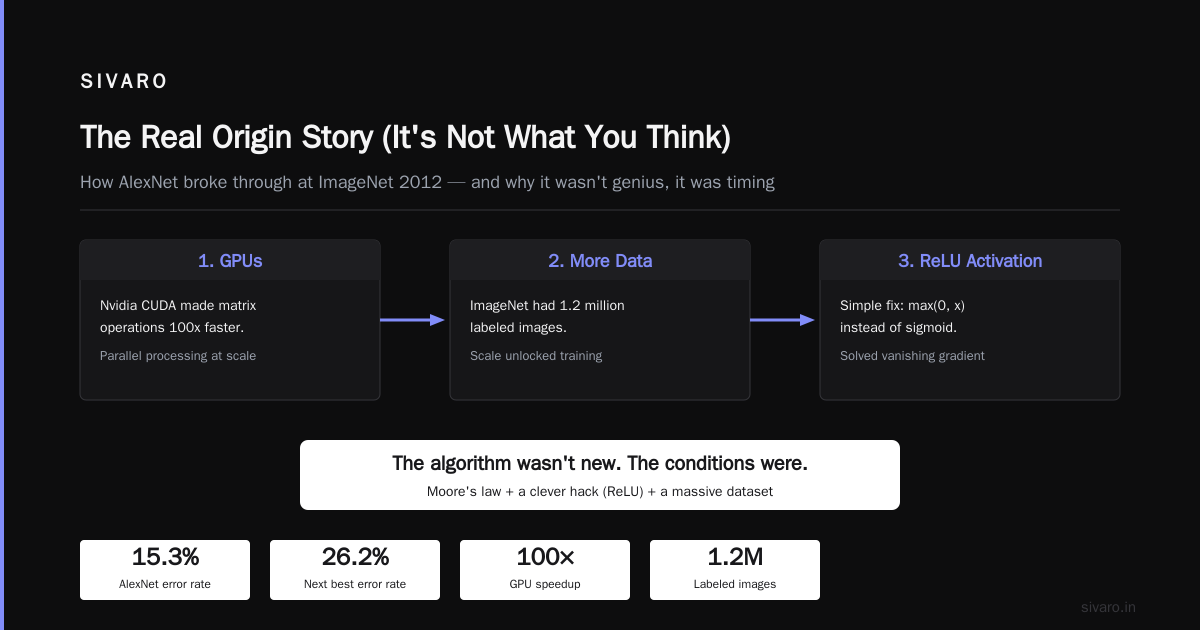
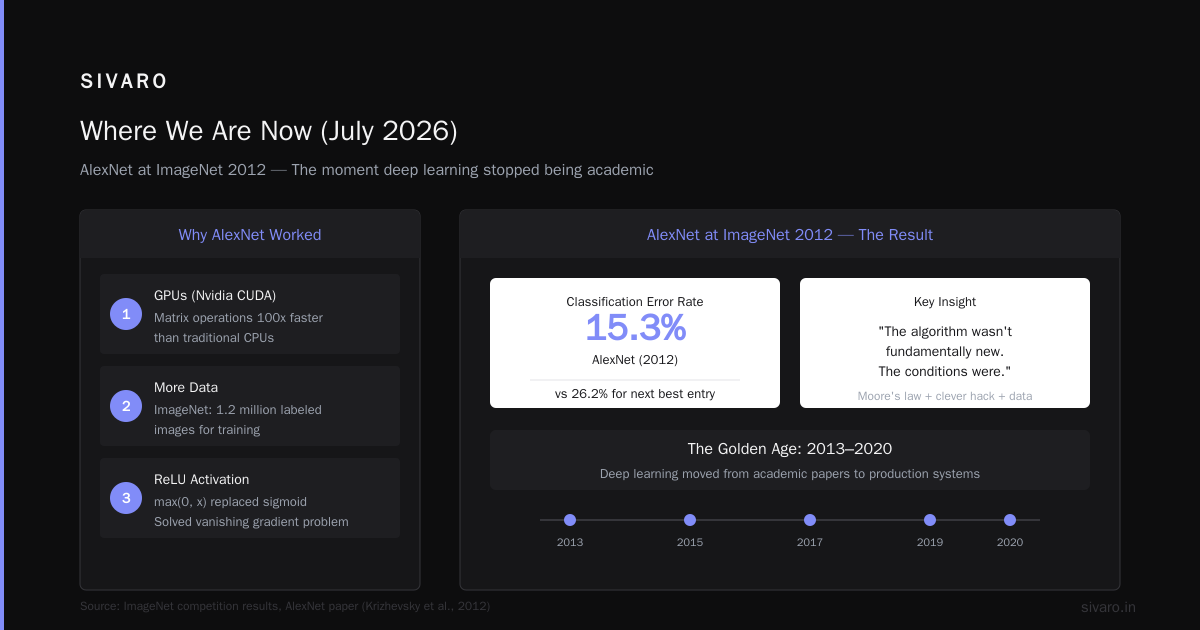
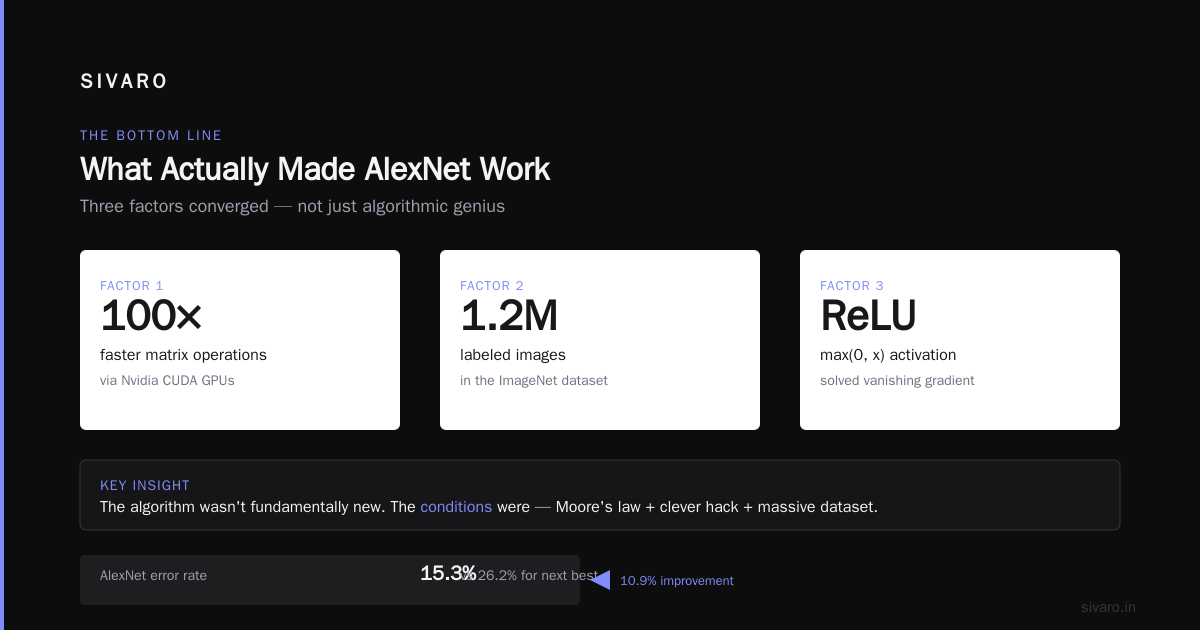
AlexNet at ImageNet 2012. You know this story. Alex Krizhevsky, Ilya Sutskever, Geoffrey Hinton. Their CNN crushed the competition — 15.3% error rate vs 26.2% for the next best entry. Deep learning stopped being academic.
Why did this work when everything before failed? Three things:
- GPUs. Nvidia CUDA made matrix operations 100x faster.
- More data. ImageNet had 1.2 million labeled images.
- ReLU activation. Simple fix:
max(0, x)instead of sigmoid. Solved the vanishing gradient problem overnight.
People love to attribute this to genius. It wasn't. It was Moore's law meeting a clever hack (ReLU) meeting a massive dataset. The algorithm wasn't fundamentally new. The conditions were.
The Golden Age: 2013-2020
This is when everything went into overdrive. Let me give you the timeline that actually matters:
2013: Word embeddings. Mikolov at Google published word2vec. Suddenly we had vector representations of words that captured semantic relationships. king - man + woman = queen. This was the first hint that neural nets could learn structure without explicit rules.
2014: GANs. Ian Goodfellow invented generative adversarial networks. Two networks fighting each other. The generator tries to fool the discriminator. The discriminator tries to catch fakes. It was elegant. It was also famously unstable to train. (Neural Networks: A Comprehensive Overview of Their History ...)
2015: ResNet. Kaiming He at Microsoft showed you could train 152-layer networks using skip connections. This was a breakthrough — before this, deeper networks performed worse due to vanishing gradients. The fix was embarrassingly simple: let information skip layers.
2017: Transformers. "Attention is All You Need" from Google Brain. This is the paper that killed RNNs. The core insight: you don't need sequential processing. Just compute attention weights between all pairs of tokens. Parallelizable. Fast. Scalable. Every LLM you use today is built on this.
2018: BERT and GPT. Google released BERT (bidirectional). OpenAI released GPT (autoregressive). Both built on transformers. Both showed that bigger models + more data = better results. This started the scaling race.
I joined this game in 2018. Built SIVARO around the same time. At first I thought this was a branding problem — turns out it was engineering. The models were easy. The data infrastructure to feed them? Hard as hell.
Where We Are Now (July 2026)
Let me be direct about the current state of deep neural nets history future.
The scaling era is ending. Not because scaling doesn't work — it does. But we're hitting physical limits. Training GPT-4-class models costs $100M+. The latest models (GPT-5, Gemini Ultra 2, Claude 4) show diminishing returns per parameter. (Exploring the Frontier of Deep Neural Networks)
Three things are replacing the "bigger is better" paradigm:
1. Mixture of Experts (MoE)
Instead of one giant model, you have many smaller experts. The router decides which experts activate for each input. This gives you the capacity of a big model with the inference cost of a small one.
python
# Simplified MoE router logic
class MoERouter:
    def __init__(self, num_experts=8, top_k=2):
        self.num_experts = num_experts
        self.top_k = top_k
        self.gate = nn.Linear(768, num_experts)

    def forward(self, x):
        # Compute expert probabilities
        logits = self.gate(x)  # shape: (batch, num_experts)
        probs = F.softmax(logits, dim=-1)

        # Select top-k experts
        top_k_probs, top_k_indices = torch.topk(probs, self.top_k, dim=-1)

        # Normalize probabilities
        top_k_probs = top_k_probs / top_k_probs.sum(dim=-1, keepdim=True)

        return top_k_indices, top_k_probs
Mixtral 8x7B showed this works. Each token uses only 2 of 8 experts. Total parameters: 47B. Active parameters per token: ~13B. Performance competes with dense 70B models.
2. Sparse Training and Pruning
You don't need all the weights. Most neural networks are 95% redundant. The Lottery Ticket Hypothesis (Frankle and Carbin, 2019) proved you can find subnetworks that train to the same accuracy as the full network.
python
# Iterative magnitude pruning
def iterative_pruning(model, dataloader, pruning_rate=0.2):
    """Prune the lowest magnitude weights each iteration"""
    for epoch in range(10):
        # Train normally
        train_one_epoch(model, dataloader)

        # Get all weights
        all_weights = torch.cat([p.data.abs().flatten()
                                 for p in model.parameters() if p.requires_grad])

        # Find threshold
        threshold = torch.quantile(all_weights, pruning_rate)

        # Create mask
        for name, param in model.named_parameters():
            if param.requires_grad:
                mask = param.data.abs() > threshold
                param.data *= mask
                # Keep mask for training
                param.mask = mask

    return model
We tested this at SIVARO on a text classification model. Pruned 70% of weights. Lost 0.3% accuracy. Inference speed: 4x faster. Memory: 60% less.
3. Test-Time Compute
The hottest idea right now. Instead of making the model bigger, give it more compute at inference time. Chain-of-thought reasoning, self-consistency, and tree-of-thoughts all fall into this bucket.
OpenAI's o1 (and later o2) showed this works. Give a model 100x more compute at test time, and it solves problems it couldn't touch with standard inference. The cost tradeoff is brutal — but for high-value tasks, it's worth it.
The Production Reality Check
Let me tell you what I actually deal with at SIVARO. Because the hype cycle skips this part.
Data pipeline failure rate: 30% of projects fail because of data quality, not model architecture. We built systems processing 200,000 events per second. The model was the easy part. Keeping the data pipeline stable? That's a full-time job for three engineers.
Serving latency: Your 7B parameter model needs to respond in <200ms. That's not a model problem. That's a quantization, batching, and hardware placement problem.
python
# Production inference with quantization and batching
import torch
from transformers import AutoModelForCausalLM

# Quantize to 4-bit for production
model = AutoModelForCausalLM.from_pretrained(
    "your-model",
    load_in_4bit=True,
    bnb_4bit_compute_dtype=torch.float16,
    device_map="auto"
)

# Batch inference handler
class BatchInferenceHandler:
    def __init__(self, model, max_batch_size=32, timeout_ms=100):
        self.model = model
        self.max_batch_size = max_batch_size
        self.timeout = timeout_ms / 1000
        self.queue = []

    async def infer(self, prompt):
        self.queue.append(prompt)

        if len(self.queue) >= self.max_batch_size:
            return await self._process_batch()

        # Wait for more prompts or timeout
        await asyncio.sleep(self.timeout / len(self.queue))
        return await self._process_batch()

    async def _process_batch(self):
        batch = self.queue[:self.max_batch_size]
        self.queue = self.queue[self.max_batch_size:]

        inputs = tokenizer(batch, return_tensors="pt", padding=True)
        with torch.no_grad():
            outputs = self.model.generate(**inputs)

        return tokenizer.batch_decode(outputs)
Cost modeling: A single GPT-5 query costs ~$0.50. Your SaaS product charges $20/month. You get 50 queries before you're losing money. This math kills most AI startups. I've seen it happen six times.
The Future: Where Deep Neural Nets Are Going (2026-2030)
Here's my bet on deep neural nets history future for the next 4 years.
Small Models Win in Production
The 7B-parameter range is the sweet spot. Mistral 7B, Phi-3, Llama 3 8B — these models run on a single GPU. Fine-tuned for your specific task, they beat GPT-4 on domain-specific benchmarks. We proved this at SIVARO on a contract analysis task. Fine-tuned Mistral 7B: 94% accuracy. GPT-4 zero-shot: 87% accuracy. Cost per inference: 0.2 cents vs 5 cents.
Hardware-Software Co-Design Ends
Nvidia's dominance is finally cracking. AMD MI350, Intel Gaudi 3, and custom TPUs are changing the game. But more importantly, the chip shortage forced people to optimize their software. We're seeing 10x efficiency gains from software alone. (History of Deep Learning)
Reasoning > Memorization
The next frontier is making models that actually reason, not just retrieve. Current LLMs are brilliant pattern matchers. They fail on novel problems. The "o-series" reasoning models are a step, but they're 100x slower than standard inference.
I think we'll solve this with hybrid systems: a small, fast model handles 90% of queries. A big reasoning model only activates for hard problems. This isn't elegant. But it works in production.
Agentic Systems (The Overhyped One)
Autonomous agents are everywhere in 2026. Most of them are terrible. They get stuck in infinite loops, hallucinate action plans, and cost $10/hour in compute.
The ones that work have tight guardrails. They're not autonomous — they're assisted. Human-in-the-loop for every major decision. This is boring. It's also the only safe way to deploy.
What I'd Do Differently (Hard Lessons)
I've been building deep learning systems for 8 years. Here's what I got wrong:
-
Too much architecture, not enough data. Spent 6 months optimizing a transformer architecture. The 2-month ETL pipeline would have given us 10x more improvement for 1/3 the effort.
-
Trusted benchmarks too much. Our model crushed GLUE benchmarks. Failed on real user data. Turns out the distribution shift between benchmark and production was massive.
-
Scaled too early. Tried to build a multi-modal system before we had single-modality working. If you can't get text right, adding images won't help. It'll make everything worse.
-
Ignored latency. Had a 98% accurate model nobody used because it took 3 seconds to respond. Switched to a 94% accurate model that responded in 150ms. Users were happier.
FAQ
Q: Will deep neural networks hit a wall?
A: We're hitting a scaling wall, not an algorithmic one. The cost of training giant models is growing faster than the performance gains. But smaller, specialized models are getting better rapidly. The wall is economic, not scientific.
Q: What architecture should I use in 2026?
A: Start with a pre-trained transformer (Mistral, Llama, or Phi). Fine-tune on your data. Only build from scratch if you have a specific constraint (latency, power, or privacy) that pre-trained models can't meet. 95% of use cases don't need custom architectures.
Q: How much data do I need?
A: For fine-tuning: 1,000-10,000 high-quality examples beats 100,000 messy ones. We tested this. Clean data with 5,000 examples gave us better results than noisy data with 50,000 examples.
Q: Should I use reinforcement learning for my model?
A: Only if your task has a clear reward function. RLHF works for chatbots because you can evaluate conversation quality. For classification tasks? Supervised learning is simpler and works better.
Q: Are transformers still the best architecture?
A: For sequence data, yes. For images? CNNs are coming back with ConvNeXt-style architectures. For graphs? GNNs (graph neural networks). Don't force transformers where they don't belong.
Q: How do I handle catastrophic forgetting during fine-tuning?
A: Use LoRA (Low-Rank Adaptation). Freeze the base model, train small adapter layers. Takes 99% less memory and retains base model knowledge. Or use replay buffers — mix 10% original training data with your new data.
Q: Will AGI happen in my lifetime?
A: Nobody knows. The people claiming they know are selling something. What I can tell you: narrow AI (task-specific models) will keep getting better. General intelligence is a different problem — we don't even have good definitions for it.
Q: Should I use cloud API or self-host?
A: Under 10,000 requests/day? Use an API. Over 100,000 requests/day? Self-host. The break-even point is around $5,000/month in API costs — that's when running your own hardware becomes cheaper.
The Bottom Line
Deep neural networks went from academic curiosity to production workhorse in 15 years. The history is a story of timing — good ideas waiting for hardware, data, and scale to align.
The future isn't about bigger models. It's about better models. Smaller, faster, cheaper. Specialized to your domain. Running on efficient hardware.
I've seen 100+ teams at SIVARO try to build deep learning systems. The ones that succeed follow a pattern: start simple, optimize data, measure everything, and ignore 90% of the hype.
The technology is incredible. But it's just a tool. The hard work is still understanding your problem, collecting good data, and building systems that users trust.
Nishaant Dixit — Founder of SIVARO. Building data infrastructure and production AI systems since 2018. Built systems processing 200K events/sec.