 SIVARO
Cost Effective vs Cost Efficient: Which Is Better?
Last week, a CTO from a Series B fintech sat in my office. He was proud of their AI agent deployment. "We cut inference costs by 60%," he said. "Super efficient."
I asked, "Did it improve your fraud detection rate?"
Silence.
They'd swapped GPT-4 for a quantized 8B model. Cost per token dropped from $0.03 to $0.004. But false positive rate jumped from 2% to 11%. They flagged more fraud, but burned their ops team on useless alerts. Total cost of operations? Up 20%.
That's the trap. He optimised for cost efficiency. He needed cost effectiveness.
Which is better, cost effective or cost efficient? The short answer: it depends on your goal. The longer answer is what this guide is for. I'll show you how we distinguish them at SIVARO, why most people get it wrong, and how to make the choice without burning money.
The Problem: Everyone Thinks These Are Synonyms
I hear "cost effective" and "cost efficient" used interchangeably every day. In boardrooms, blog posts, vendor pitches. They're not the same. Treating them as synonyms is like calling a Ferrari and a minivan "good cars." Depends if you're racing or hauling kids.
Cost efficiency is about input metrics: cost per token, cost per hour, cost per task. It answers "how much resource did I spend per unit output?"
Cost effectiveness is about outcome metrics: business value per dollar, goal achievement per dollar, revenue generated per dollar. It answers "did I get what I wanted for what I spent?"
Influence Of Artificial Intelligence on Cost Efficiency research shows that AI-driven cost efficiency can improve organizational performance — if the cost savings don't degrade outcomes. That "if" is doing a lot of work.
Most people optimise for the wrong one because it's easier to measure. Tokens are countable. Business value is fuzzy.
Defining the Two: One Is About Outcomes, the Other About Inputs
Cost effective = meet or exceed the objective for a given cost. The objective could be a business metric — revenue lift, user retention, accuracy threshold. If spending $1000 on a model gets you 95% accuracy vs $500 for 80%, the $1000 model is more cost effective despite being less efficient.
Cost efficient = minimize resource consumption per unit of output. That's your cost per API call, your watts per inference, your labour hours per deployment. Efficiency is about waste reduction.
Cost Efficiency - an overview defines it as producing a given output at minimum cost. But "given output" is the trap — you can produce the wrong output cheaply.
Let me give you a concrete framework we use at SIVARO. We draw a simple 2x2:
| High Effectiveness | Low Effectiveness | |
|---|---|---|
| High Efficiency | Ideal | Cheap failure |
| Low Efficiency | Worth it | Avoid |
Everyone wants top-left. But engineering reality often forces a choice between top-right (efficient but ineffective) and bottom-left (effective but expensive). Which is better, cost effective or cost efficient? In my experience, bottom-left beats top-right nine times out of ten. A cheap system that doesn't solve the problem is waste. An expensive system that solves it can be scaled.
Where the Confusion Hurts Most: AI Systems
AI amplifies the confusion because unit economics are new to most teams. We've all been trained to optimise for latency, throughput, and cost per token. Those are efficiency metrics. They're necessary but not sufficient.
Consider AI agents. The Economics of AI Agents: Cost Per Task vs Cost Per Employee analysis shows that cost per task can look great — pennies per completion — but if the task completion rate is 70% (and the human alternative was 98%), the effective cost of fixing errors wipes out any savings.
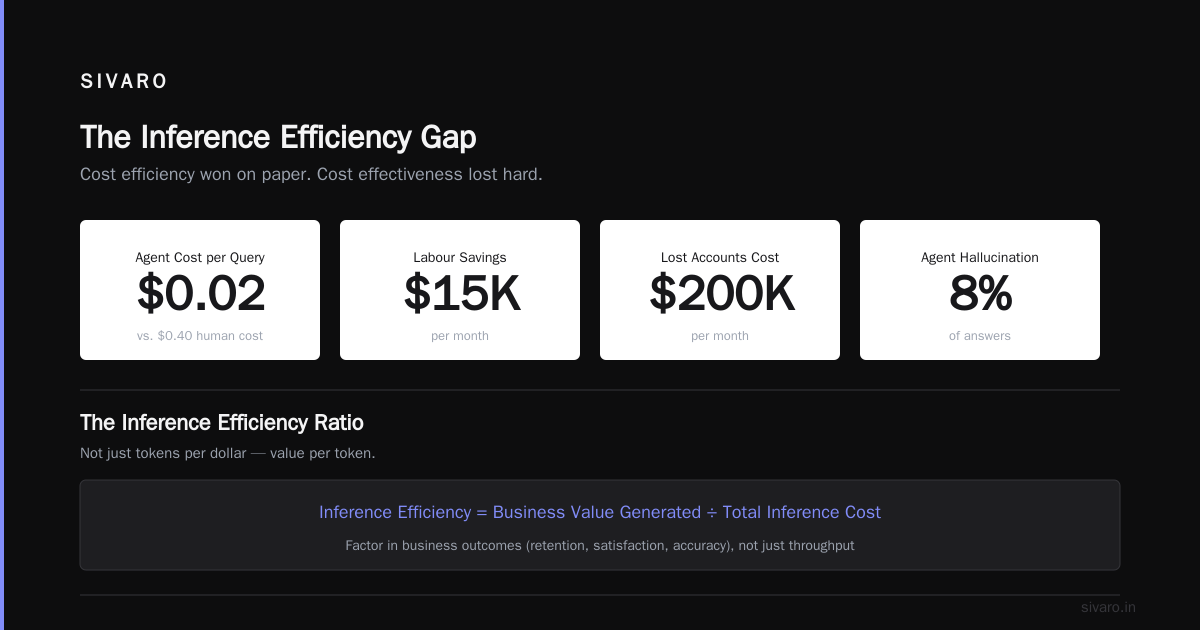
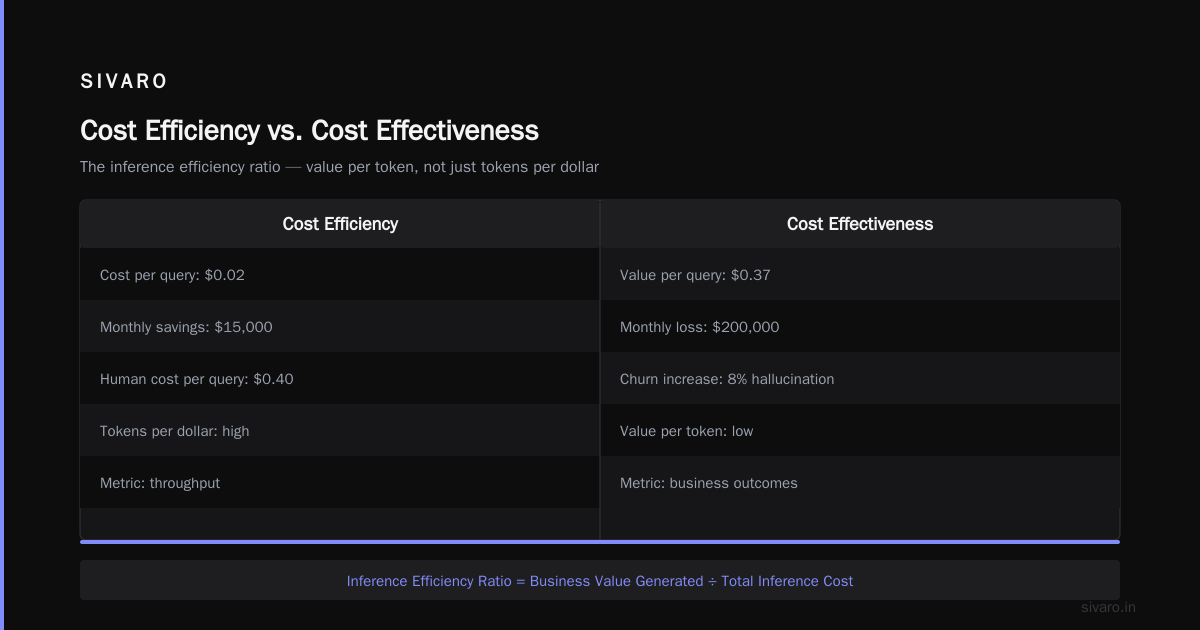
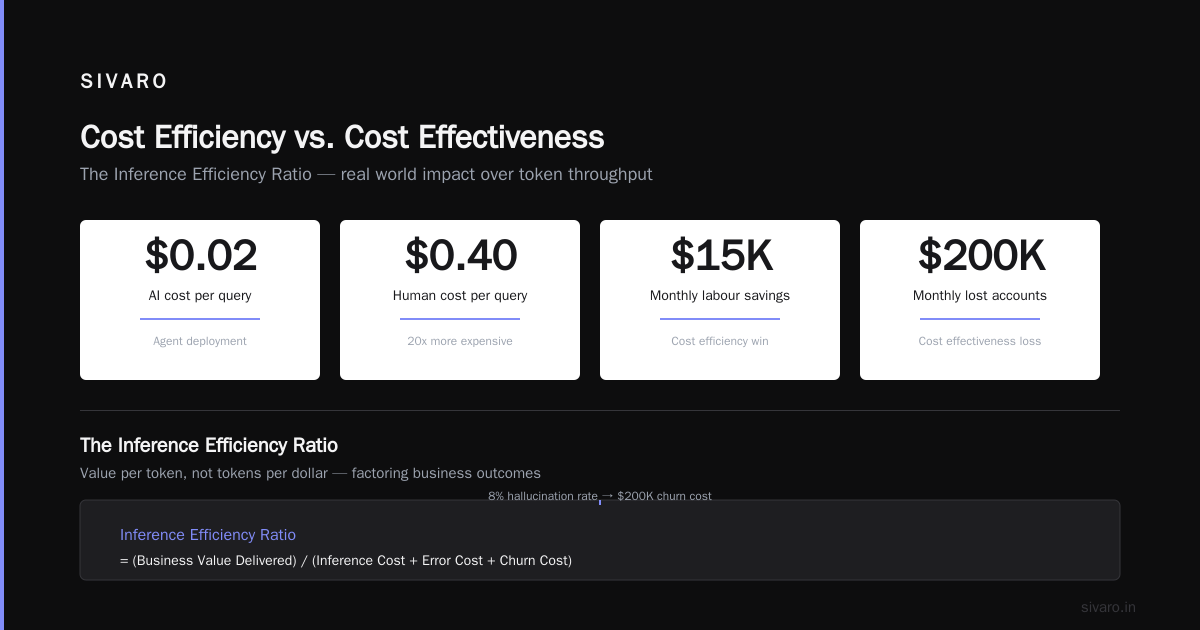
I worked with a logistics company in early 2025. They deployed an agent to answer shipment tracking queries. Cost per query: $0.02. Human cost: $0.40. Huge efficiency gain. But the agent hallucinated 8% of answers. Customers complained. Churn increased. They saved $15K/month on labour but lost $200K/month in lost accounts.
Cost efficiency won on paper. Cost effectiveness lost hard.
That's when I started calculating the inference efficiency ratio — not just tokens per dollar, but value per token. How to Calculate the Inference Efficiency Ratio breaks this down: you need to factor in business outcomes, not just throughput.
How We Measure Cost Effectiveness at SIVARO
We don't start with cost. We start with value. For every AI feature, we define a primary success metric. For a chatbot, it's resolution rate. For a fraud model, it's precision at a recall target. For a content generation system, it's user engagement lift.
Then we calculate:
cost_effectiveness = business_value_delta / total_cost
Where business value delta is measurable: saved hours, increased revenue, reduced error cost.
Here's a Python snippet we use internally to compare model candidates:
python
def cost_effectiveness(models, business_value_fn):
    results = []
    for model in models:
        cost = model['monthly_cost']
        value = business_value_fn(model)
        if cost > 0:
            results.append({
                'model': model['name'],
                'cost_effectiveness': value / cost,
                'value': value,
                'cost': cost
            })
    return sorted(results, key=lambda x: x['cost_effectiveness'], reverse=True)

# Example usage
candidate_models = [
    {'name': 'GPT-4', 'monthly_cost': 12000},
    {'name': 'Claude 3.5', 'monthly_cost': 8000},
    {'name': 'Fine-tuned Mistral', 'monthly_cost': 3000}
]

def mock_value_fn(model):
    # Simplified: resolution rate * total queries * value per resolution
    rates = {'GPT-4': 0.94, 'Claude 3.5': 0.91, 'Fine-tuned Mistral': 0.82}
    return rates[model['name']] * 200000 * 2.5  # $2.50 per resolved query

ranking = cost_effectiveness(candidate_models, mock_value_fn)
print(ranking)
Result? Often the cheaper model loses because its lower resolution rate destroys value.
How We Measure Cost Efficiency
Cost efficiency is easier. It's a straight-up unit metric.
For LLM inference:
cost_efficiency = total_tokens_output / total_cost
Or for a pipeline:
cost_efficiency = completed_tasks / (compute_hours * hourly_rate + api_costs)
AI Unit Economics FAQ: How to Measure AI Cost, Value, Margin provides a solid template. The key is to include all costs — not just inference, but prompt engineering, fine-tuning, human oversight.
Here's a real efficiency tracking script we use:
python
class InferenceCostTracker:
    def __init__(self, model_id, hourly_rate=5.0):
        self.model_id = model_id
        self.hourly_rate = hourly_rate
        self.total_cost = 0
        self.total_tokens = 0

    def record_inference(self, tokens, duration_seconds):
        compute_cost = (duration_seconds / 3600) * self.hourly_rate
        token_cost = tokens * 1.5e-6  # $1.5 per million tokens (example)
        self.total_cost += compute_cost + token_cost
        self.total_tokens += tokens

    def report_efficiency(self):
        if self.total_cost == 0:
            return float('inf')
        return self.total_tokens / self.total_cost

tracker = InferenceCostTracker('my-model')
tracker.record_inference(450, 0.5)  # 450 tokens, 500ms
tracker.record_inference(1200, 1.2)
print(f"Tokens per dollar: {tracker.report_efficiency():,.0f}")
That tells you efficiency. It says nothing about whether those tokens actually helped a customer.
The Trade-off: You Can't Have Both at Once
Here's the hard truth. In most AI systems, improving cost efficiency degrades cost effectiveness beyond a tipping point. The cheapest model per token has the worst accuracy. The most efficient inference setup (batching, quantization, pruning) distorts output quality.
I've seen this pattern repeat:
- Team deploys GPT-4. Works great. Costs $50K/month.
- Switch to a fine-tuned 8B model. Costs $8K/month. Efficiency jumps 6x.
- Accuracy drops 7%. Not terrible, but bad enough that manual verification costs balloon.
- Real cost including verification? $22K/month. Savings cut in half.
Measuring AI Cost Efficiency vs Business Value makes this point: you have to measure both, because optimizing solely for cost efficiency can destroy business value.
So which is better, cost effective or cost efficient? If you force a binary — and I think you shouldn't, but I'll play along — then cost effectiveness wins for any system where outcomes matter. Which is most systems.
But you also can't ignore efficiency, because an expensive effective system will blow your budget and never scale.
When Cost Effectiveness Wins
Cost effectiveness wins when the cost of failure is high. Examples:
- Medical diagnosis AI: A false negative costs lives. You pay for the best model, even if it's 3x more expensive per inference.
- Financial trading agents: A missed arbitrage opportunity costs millions. Latency and token efficiency are secondary.
- Customer-facing chatbots: A bad answer churns a customer. LTV lost > inference cost saved.
In these cases, I always tell teams: start with the most capable model. Prove effectiveness. Then trim efficiency only if it doesn't degrade KPIs.
We had a healthcare client in 2025 using GPT-4 for triage. Cost per triage: $0.12. They tested a distilled model at $0.04 but error rate went from 1.2% to 4.8%. In clinical triage, that 3.6% error meant potential misdiagnoses. Regulatory risk alone made the efficient option unacceptable. Cost effective choice: keep paying for the good model.
When Cost Efficiency Wins
Cost efficiency matters when the output is commoditized and failure cost is low. Examples:
- Batch summarization of internal memos: If the model misses a nuance, nobody dies. Use the cheapest acceptable model.
- Content moderation on user-generated text: Flagging false positives is better than missing a violation. Even a weaker model with high recall works, and you can optimise for cost per flag.
- Evaluation pipelines: Running thousands of automated evals on synthetic data. You don't need GPT-4 for each; a good small model with sufficient accuracy for relative ranking is fine.
In these cases, I recommend setting a minimum effectiveness threshold (e.g., 85% recall), then selecting the most efficient model that meets it. This is what A C-Level Guide to LLM Unit Economics recommends: calculate cost per quality-adjusted task.
Let's codify that:
python
def quality_adjusted_cost_efficiency(quality_score, cost_per_task):
    # quality_score in [0,1] — e.g., accuracy or resolution rate
    effective_cost = cost_per_task / quality_score
    return effective_cost

# Example
models = [
    ('Cheap-llama', 0.82, 0.003),
    ('Mid-mistral', 0.91, 0.007),
    ('GPT-4', 0.97, 0.024)
]

for name, quality, cost in models:
    adj_cost = quality_adjusted_cost_efficiency(quality, cost)
    print(f"{name}: $/adjusted-task = ${adj_cost:.4f}")
Often the mid-range model wins this metric. That's your sweet spot.
A Framework for Decision-Making
At SIVARO, we use a simple decision process:
- Define the KPIs. Not token cost. The business KPI. Resolution rate. Precision. Revenue lift. Customer satisfaction score.
- Set a minimum acceptance threshold. e.g., "95% of queries resolved without escalation."
- Test candidate models against the threshold. Only consider those that pass.
- Among passing models, pick the most efficient.
This is cost effectiveness first, efficiency second. You don't trade effectiveness for efficiency unless the efficiency gain is extreme and the effectiveness loss is trivial.
AI Unit Economics: Cost, Scale, and Sustainability Guide puts it well: "Unit economics for AI should reflect value delivered, not just resources consumed."
The trap is step 2. Most teams skip it. They pick a model based on benchmark accuracy or cost per token, then deploy, then discover it doesn't move the needle. That's backward.
One more thing: don't forget operational efficiency. A model might have low inference cost but high latency that forces you to add compute. Or high hallucination rate that demands human review. These are hidden efficiency killers.
How to Calculate the Inference Efficiency Ratio recommends including all downstream costs: verification, re-runs, fallback systems. I'd add: include training overhead if you fine-tune, include prompt engineering time, include monitoring.
FAQ
1. Which is better, cost effective or cost efficient?
It depends on context, but generally: cost effective first. If your system doesn't achieve its goal, no amount of efficiency saves you. Efficiency matters after you've validated effectiveness. In a budget-constrained scenario, you might need efficiency first to even fit a solution — but that's rare.
2. Can something be both cost effective and cost efficient?
Yes. That's the ideal. A model that delivers 98% resolution rate at $0.005 per query is both. But achieving both usually requires investment — better data, better prompt engineering, better architecture. It's a destination, not a starting point.
3. How do I measure cost effectiveness for AI?
Define the business value metric (revenue, retention, error reduction), calculate the delta from using the AI, and divide by total cost (inference, ops, oversight). See the code example above.
4. When should I prioritise cost efficiency?
When your system already meets KPI thresholds and you need to scale. Or when the task is low-stakes (internal tools, batch processing). Or when budget is the hard constraint.
5. What's a common mistake leaders make?
Thinking cost per token is the only metric. It's easy to measure, so it becomes the default. But it overlooks quality. I've seen companies switch to cheaper models and lose customers. The savings evaporate.
6. Do open-source models improve cost effectiveness?
Sometimes. Fine-tuning a small open model on your domain data can match or beat GPT-4 for your specific task, at a fraction of the cost. But you pay in engineering time. For many companies, the break-even point is 6-12 months. A C-Level Guide to LLM Unit Economics has good numbers on this.
7. How do I communicate this to my board?
Don't lead with "cost per token." Lead with "cost per resolved customer issue" or "cost per dollar revenue." They care about business outcomes. Show a chart of cost effectiveness trend over time, with both value and cost axes.
8. How often should I reassess the trade-off?
Quarterly, at minimum. Model releases happen fast. A model that was too inefficient six months ago may now be both effective and efficient. We reevaluate our recommendations every quarter at SIVARO.
Final Word
Which is better, cost effective or cost efficient? I'll give you my hard stance: cost effective is better, by orders of magnitude, for any system that touches customers or critical decisions. Cost efficiency is a supporting metric. It's the engine, not the direction.
Start with effectiveness. Prove you're solving the problem. Then squeeze every penny of efficiency out of it — but never at the cost of effectiveness.
If you're building AI today, especially agents or customer-facing features, spend your first month on value validation. Not model comparison. Not benchmarks. Ask: "Does this actually help my users?" If yes, then ask: "How cheap can I make it?"
That sequence is the difference between a cost-effective system and a cheap failure.
Nishaant Dixit — Founder of SIVARO. Building data infrastructure and production AI systems since 2018. Built systems processing 200K events/sec.