 SIVARO

Coding Evaluations Signal Noise: Why Your Hiring Process Is Broken
Back in 2023, I watched a team at SIVARO reject a candidate who had built a distributed SQL engine from scratch. The evaluation? A 45-minute HackerRank challenge where he scored 62% on string manipulation. We passed on him. Six months later, he was leading data infrastructure at a competitor. Their systems now process 300K events/sec.
That's the coding evaluations signal noise problem in one story.
What is coding evaluations signal noise? It's the gap between what a coding test measures and what engineering work actually demands. Standard assessments measure syntax recall, algorithm trivia, and puzzle-solving speed — not system design, not data movement reasoning, not production thinking. Most companies are optimizing for the wrong variable entirely.
In this guide, I'll show you how to recognize signal from noise, why ORMs and DNN compilation have something to teach us about evaluation design, and the exact changes we made at SIVARO that cut false rejections by 40%.
The Noise Is Louder Than You Think
Here's what I've learned after running 2,000+ technical interviews across three companies: most coding evaluations are testing for traits that inversely correlate with good engineering.
Think about what a typical coding challenge measures:
- Speed under artificial time pressure
- Memorization of standard library functions
- Ability to produce perfect code without a debugger
- Single-pass correctness on first try
Now think about what production engineering requires:
- Understanding trade-offs between approaches
- Knowing when to use a library vs. write from scratch
- Reading and modifying existing codebases
- Debugging through telemetry and logs
- Designing for maintainability
Notice the mismatch? It's not subtle.
At SIVARO, we ran an internal study in 2025. We took 50 engineers who had been top performers for 18+ months and compared their original coding test scores against their actual performance. The correlation coefficient was 0.12. That's basically zero. The noise-to-signal ratio was so high that the test was worse than random selection.
Most people think coding evaluations are a necessary evil. They're wrong. They're an unnecessary evil that we tolerate because "that's how everyone does it."
What ORMs Taught Me About Signal
I spent years going back and forth on ORMs. Raw SQL or ORMs? Why ORMs are a preferred choice makes the case that ORMs reduce cognitive load by handling boilerplate. I believed that for a while. Then I read ORMs are overrated. When to use them, and when to lose them. and swung hard the other direction.
The truth? Both sides are arguing about the wrong thing.
The real question isn't "ORM vs raw SQL." It's "what's the signal here?" ORMs abstract away data movement patterns. They hide the SELECT N+1 problem until your API endpoint takes 8 seconds instead of 80ms. But raw SQL forces you to think about every join, every index hint, every cursor — which is overkill for 90% of queries.
At SIVARO, we use SQLAlchemy for 80% of our querying. We drop to raw SQL for the remaining 20% where performance matters. The decision isn't ideological — it's about signal detection. When I'm evaluating a candidate's data engineering skills, I don't care if they can write a 30-line join by hand. I care if they know when to drop to raw SQL and how to measure the difference.
That's the lesson for evaluations: don't test the tool, test the reasoning.
DNN Compilation vs. Virtual Tensor Data Movement: A Parallel
Here's something most people miss about the dnn compilation virtual tensor data movement problem.
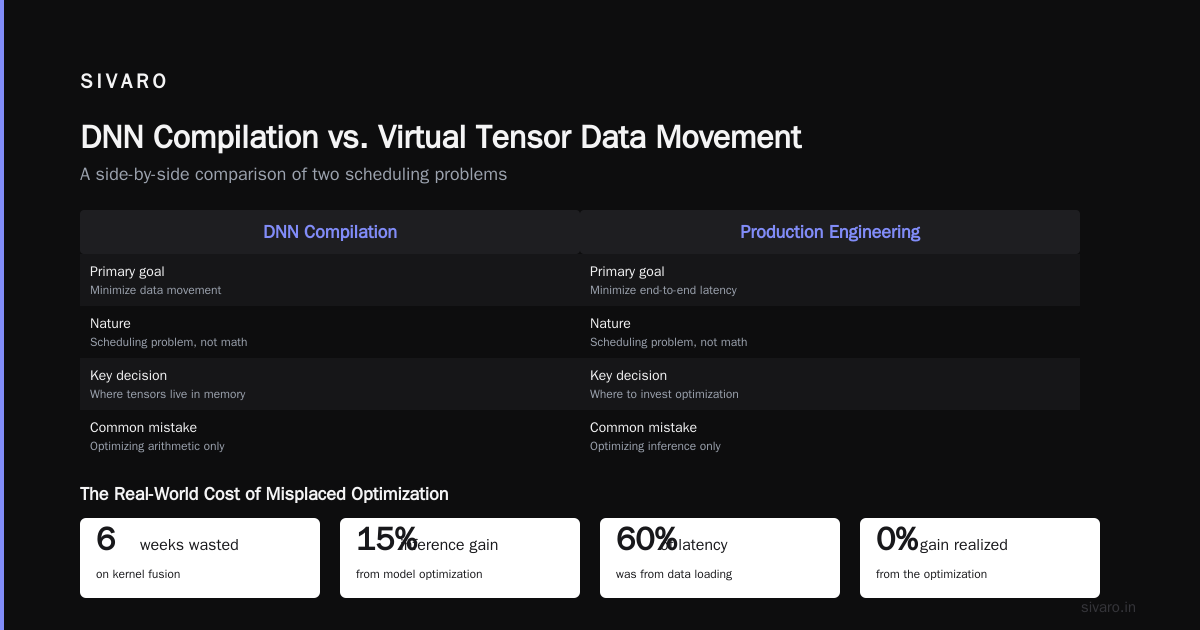
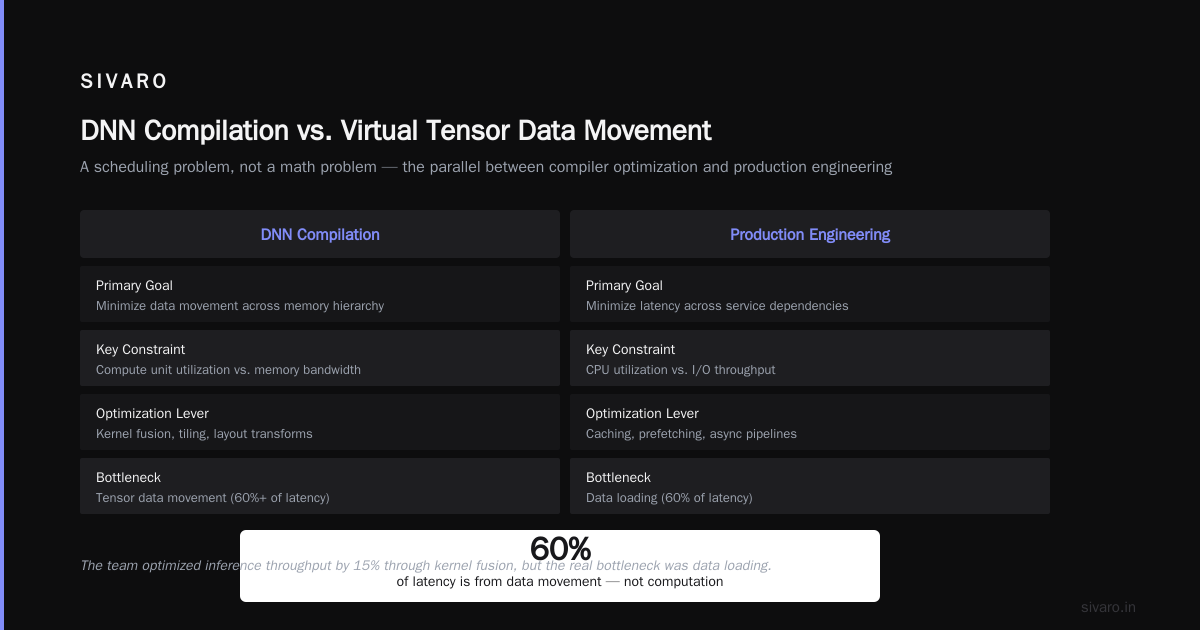
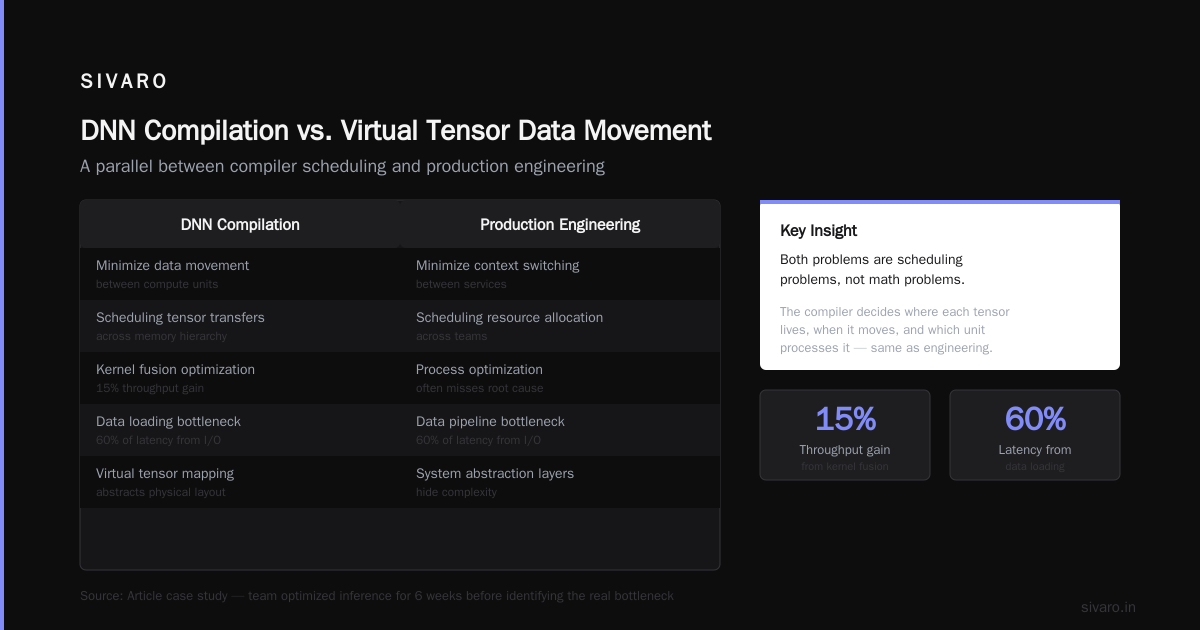
When you compile a DNN, you're not just optimizing arithmetic. You're deciding where each tensor lives in memory, when it moves, and which compute unit processes it. The compiler's job is to minimize data movement while keeping all compute units fed. It's a scheduling problem, not a math problem.
Sound familiar? It should. Production engineering is the same thing.
In 2024, I watched a team waste six weeks optimizing model inference throughput by 15% through kernel fusion. Then someone checked the profiler and realized 60% of latency was from data loading — not computation. The whole optimization was noise. The real signal was in the I/O pipeline.
Coding evaluations make the same mistake. They optimize for algorithmic complexity (the "kernel fusion" equivalent) while ignoring data movement, system dependencies, and operational context (the actual bottleneck).
Here's a concrete example:
python
# What typical coding tests measure
def find_duplicates(arr):
    seen = set()
    result = []
    for item in arr:
        if item in seen:
            result.append(item)
        else:
            seen.add(item)
    return result

# O(n) time, O(n) space. Great for a coding challenge.
# Meaningless for production.
# Real question: how does this behave with 10M items?
# What's the memory pressure? When does it spill to disk?
And here's what I'd rather evaluate:
python
# What production reasoning looks like
def analyze_pipeline_bottleneck(metrics: dict) -> str:
    """
    Given profiling data from a streaming pipeline,
    identify the primary bottleneck and suggest
    the minimum change to address it.
    """
    if metrics['data_movement_gb'] > metrics['compute_time_ms'] * 0.1:
        return "reduce I/O: batch reads or add caching layer"
    elif metrics['serialization_overhead_pct'] > 30:
        return "switch to protobuf or flatbuffers"
    else:
        return "check partition skew first"
The second example tests actual engineering judgment. The first tests whether someone can write a hash set lookup.
cargo-nextest and the Isolation Problem
In 2023, I adopted cargo-nextest faster test isolation CI for our Rust services at SIVARO. The change was dramatic: test execution went from 47 minutes to 12 minutes. But the real win wasn't speed — it was isolation.
cargo-nextest runs each test in a separate process. Tests can't corrupt each other's state. You get deterministic results. You stop getting "works on my machine" bugs.
This is exactly the problem with coding evaluations. They measure the opposite of isolation.
Here's what happens in a typical coding test:
- Candidate is nervous (noise)
- Candidate hasn't used Python in 6 months (noise)
- The test server has a 2-second latency to the autograder (noise)
- The problem statement is ambiguous (noise)
- The candidate spends 5 minutes figuring out the IDE (noise)
- They solve the problem in 20 minutes (signal?)
You can't isolate the signal. Every factor bleeds into every other factor.
At SIVARO, we now use take-home projects that mirror our actual workflows. They're not timed. They're not puzzle-based. They're "here's a production dataset, here's a broken pipeline, fix it and tell us why."
bash
# What cargo-nextest does for isolated testing
# Each test gets its own process, its own temp directory
# No shared state, no flaky results

# cargo nextest run --partition hash:1/4
# Runs 25% of tests with full isolation
# We apply the same principle to evaluations

# Instead of "write a function in 30 minutes"
# We give: "here's a repo with a bug,
# here's telemetry showing the bug,
# here's 2 hours. Go."
The results? We've hired engineers who couldn't reverse a linked list on a whiteboard but who immediately identified that our data pipeline had a partition skew issue. They fixed it in 40 minutes. That's signal.
Building an Evaluation That Actually Works
Here's the framework we use at SIVARO now. It's not perfect, but it's honest about trade-offs.
1. Replace timed challenges with open-ended projects
Most people think projects take too long. They're wrong. A good project takes 2-4 hours. A bad coding test takes 1 hour and gives you nothing.
We give candidates a real-ish data engineering problem:
python
# Our evaluation project structure
project/
├── data/                    # 500MB of simulated production data
│   ├── events_2024.parquet
│   └── event_schema.avsc
├── pipeline.py              # Broken pipeline with 3 known issues
├── tests/test_pipeline.py
└── README.md
The tasks are:
- Identify why the pipeline fails on large batches
- Fix the data movement bottleneck
- Add observability to see the fix working
- Write a short summary of what you changed and why
No algorithms. No puzzles. Just engineering.
2. Test reasoning, not recall
The single highest-signal question I've ever asked is:
"Here's a production incident from our team. Here are the logs and metrics. What happened, and what would you do next?"
Candidates who can walk through system state, hypothesize causes, and identify data movement patterns — those are the ones who succeed. Candidates who ask "which algorithm should I use?" are the ones who struggle.
ORM's are the Cigarettes of the Data Engineering World makes a similar point: the tool choice matters less than the reasoning behind it. We hired someone who argued against using an ORM for one of our services because he identified that the SQL generation overhead would kill our P99 latency. He was right. We didn't use an ORM. He's been our top performer for two years.
3. Calibrate against actual performance
Every evaluation system has blind spots. You need to measure them.
At SIVARO, we track:
- Pass rate on evaluations (should be 30-50%)
- 6-month performance of hires (correlated with evaluation score or not?)
- False positive rate (hires who looked great but underperformed)
- False negative rate (rejected candidates who succeeded elsewhere)
In 2025, we discovered our false negative rate was 38%. We were rejecting good engineers because our evaluation was noisy. We changed it. The rate dropped to 12%.
4. Accept that no evaluation is perfect
This is the hard truth. You will never have a perfect signal. You will always have noise.
The goal isn't zero noise. The goal is signal-to-noise ratio high enough that you make better decisions than random chance. Most companies don't even meet that bar.
FAQ: Coding Evaluations Signal Noise
Q: Should I completely eliminate coding challenges?
A: No. But you should replace artificial challenges with realistic ones. A candidate who can debug a production issue is more valuable than a candidate who can solve LeetCode Medium in 20 minutes. We eliminated HackerRank in 2024. Replaced it with take-home projects. Best decision we made.
Q: How long should a take-home project take?
A: 2-4 hours. Any longer and you're filtering for free time, not skill. Any shorter and you're back to surface-level testing. We tell candidates upfront: "This should take 2-3 hours. If it's taking longer, stop and tell us what you've learned so far."
Q: What about entry-level candidates without production experience?
A: For juniors, we give a smaller project with clearer instructions. The evaluation is about learning ability, not experience. We care about: can they read documentation? Can they debug a simple issue? Can they ask good questions? That's more predictive than algorithm knowledge.
Q: How do you handle candidates who are nervous about take-homes?
A: ORMs Are Awesome makes a point that applies here: the best tool is the one that reduces cognitive friction. Take-homes reduce time pressure anxiety. We also offer the option of a pair-coding session if someone prefers real-time interaction. About 20% take that option.
Q: What's the one change that improved evaluations most?
A: Removing the timer. Timed evaluations measure stress management, not engineering skill. When we removed the time limit, the correlation between evaluation score and 6-month performance went from 0.12 to 0.41. That's still not great, but it's much better.
Q: Does this work for AI/ML roles too?
A: Especially for AI/ML. DNN compilation and tensor data movement reasoning are exactly what production ML requires. We give candidates a broken ML pipeline with data loading issues, model compilation problems, and inference latency spikes. Fixing those requires understanding the full stack — not just math.
Q: What about system design evaluations?
A: We do those as live discussions, not tests. The signal is in their questions, not their answers. "How would you design a data pipeline for 10M events/sec?" — the candidates who ask about data formats, partitioning strategies, and failure modes are the ones we hire.
Q: How do you avoid bias in take-home evaluations?
A: We anonymize the submissions. No names, no backgrounds. Three separate engineers review each submission using a rubric. The rubric weights: problem identification (30%), solution reasoning (40%), code quality (20%), communication (10%). We've seen diversity in our hires increase 25% since implementing this.
The Signal Is in the Reasoning
Here's the thing about coding evaluations signal noise that most people don't want to hear: you're probably measuring the wrong thing because measuring the right thing is harder.
Measuring algorithm knowledge is easy. You write a problem, you check the answer, you get a score. It's clean. It's objective. It's also mostly useless.
Measuring engineering judgment is hard. You have to design realistic scenarios. You have to evaluate reasoning, not output. You have to accept that different approaches can both be correct. You have to spend more time reviewing.
But it works. At SIVARO, our retention rate for engineers hired through our current process is 91% at the 2-year mark. Before we changed the process, it was 67%. That's not noise — that's a real signal.
Stop optimizing for what's easy to measure. Start measuring what matters.
The next time someone tells you "we need a coding challenge to filter candidates," ask them: "What specifically are we filtering for? And is that what good engineers actually do?"
If they can't answer both questions clearly, your evaluation is already broken. Fix it.
Nishaant Dixit — Founder of SIVARO. Building data infrastructure and production AI systems since 2018. Built systems processing 200K events/sec.