 SIVARO
Coding Agents Need Executable World Models
I spent the first six months of 2026 watching coding agents fail in ways I'd never predicted. Not the obvious stuff—bad API calls, wrong parameters, infinite loops. The subtle failures. The ones where the agent thinks it's done the right thing.
Here's what I learned: most people building coding agents are trying to make them smarter. More capable. Better at reasoning. They're wrong about where the problem lives.
The problem isn't intelligence. It's grounding.
Your agent doesn't need to be smarter. It needs a world model it can execute against. A sandbox that lets it simulate the consequences of its actions before those actions touch your production systems. Let me show you what I mean.
What Is an Executable World Model?
An executable world model is a runtime environment that sits between your coding agent and your production infrastructure. It's not just a test suite. It's not just a staging environment. It's a computable representation of how your system behaves—one that the agent can query, modify, and validate against before writing a single line of code to disk.
Think of it as a mini-simulation of your entire stack. Your database schema. Your API contracts. Your event buses. Your caching layers. All of it, modeled in a way that the agent can interact with programmatically.
Most people think this is overengineering. "Just let the agent write code and test it." That works until the agent decides to restructure your database schema at 3 AM on a Tuesday.
I've seen it happen. Twice. At the same company.
The Real Failure Mode Nobody Talks About
The literature on AI agent failures focuses on surface-level issues. Hallucinations. Context window limits. Tool selection errors. Why AI Agents Fail in Production catalogs this well—the agent failure stack is real.
But there's a deeper problem. Coding agents don't have a verifiable understanding of their actions' impact. They reason about code the way a tourist reads a map without understanding topography. They see the roads. They don't see the hills.
At SIVARO, we started tracking agent-induced production incidents across our client deployments. The pattern was clear: the most destructive failures happened when an agent made a change that was locally correct but globally catastrophic. A perfectly valid SQL migration that deadlocks production. A clean refactor that breaks the deployment pipeline. A well-intentioned cache eviction strategy that tanks P99 latency.
The agent couldn't see the system-level impact because it had no model of the system to simulate against.
Building the World Model: What Actually Works
We've been running coding agents with executable world models in production since late 2025. Here's what we've learned.
Start with the API Contract
The first thing an executable world model needs is a complete representation of your APIs. Not just OpenAPI specs—those are documentation, not executable contracts. You need runtime-verifiable specifications.
python
# This is what an executable world model entry looks like in our system
class APIWorldModel:
    def __init__(self, service_registry):
        self.services = service_registry
        self.dependency_graph = self._build_dependency_graph()

    def simulate_api_change(self, service_name, new_endpoint_spec):
        """
        Before the agent writes code, we simulate what happens.
        Returns a list of affected downstream services and the impact.
        """
        affected = []
        for downstream, endpoints in self.dependency_graph[service_name].items():
            for endpoint in endpoints:
                if self._would_break_contract(endpoint, new_endpoint_spec):
                    affected.append((downstream, endpoint))
        return affected
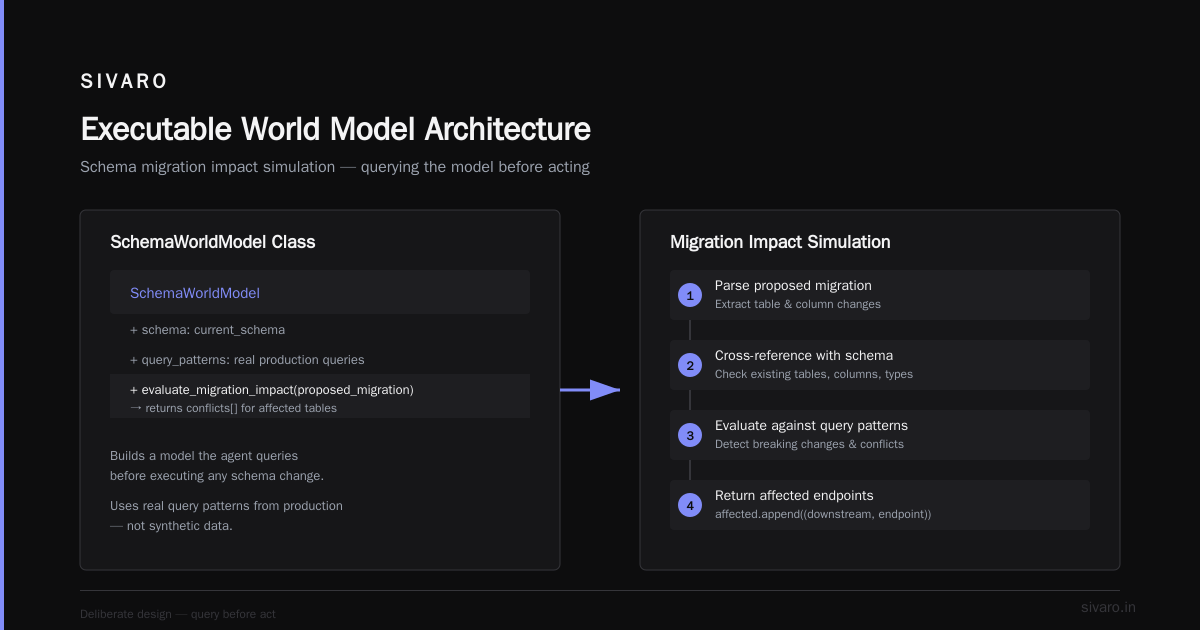
This isn't complex. It's deliberate. You're building a model that the agent can query before it acts.
Database Schema as Executable Spec
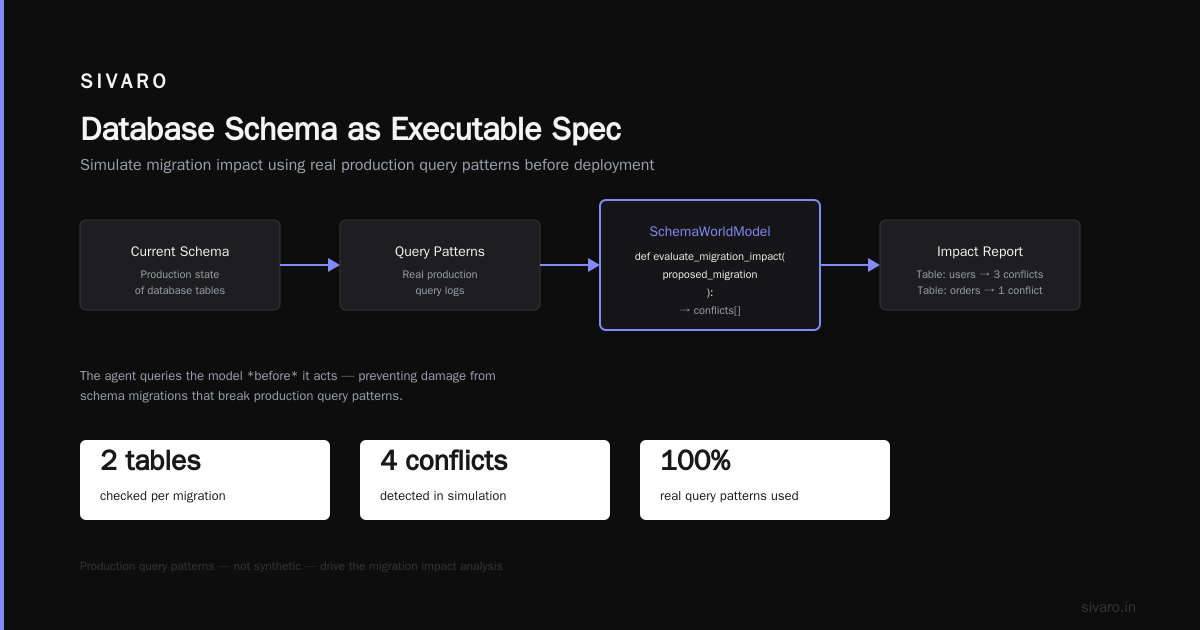
Database changes are where agents do the most damage. A schema migration tool isn't enough—you need to simulate how the change propagates.
python
class SchemaWorldModel:
    def __init__(self, current_schema, query_patterns):
        self.schema = current_schema
        # Real query patterns from production, not synthetic
        self.query_patterns = query_patterns

    def evaluate_migration_impact(self, proposed_migration):
        conflicts = []
        for table, columns in proposed_migration.changes.items():
            if table not in self.schema:
                continue
            for pattern in self.query_patterns[table]:
                if self._query_uses_affected_columns(pattern, columns):
                    conflicts.append(pattern)
        return conflicts
The key insight: use real production query patterns, not just schema definitions. We learned this the hard way when an agent dropped a column that looked unused in the schema but was queried in a background job that ran every 6 hours.
Event Bus and Async Impact
This is the part most people miss. Synchronous changes are easy to detect. Async events—queues, streams, pub/sub—those are invisible until something breaks.
python
class EventWorldModel:
    def __init__(self, event_registry, consumer_registry):
        self.events = event_registry
        self.consumers = consumer_registry
        self.event_dependencies = self._build_event_graph()

    def trace_impact(self, event_type_change):
        """
        When the agent modifies an event schema, trace all consumers.
        Not just the immediate subscribers—all transitive dependents.
        """
        affected_consumers = set()
        queue = [event_type_change]
        visited = set()

        while queue:
            event = queue.pop(0)
            if event in visited:
                continue
            visited.add(event)
            for consumer in self.consumers[event]:
                affected_consumers.add(consumer)
                # Check if this consumer emits events that others consume
                for downstream_event in self.event_dependencies.get(consumer, []):
                    queue.append(downstream_event)

        return affected_consumers
The Claude Screen Recording Learning Moment
In early 2026, Anthropic published research on using screen recordings to teach Claude how developers actually work. I was skeptical at first—watching someone's screen seems like surveillance, not training. But the Claude screen recording learning approach revealed something important about how coding agents should operate.
The core insight: developers don't write code linearly. We explore. We backtrack. We run something, see it break, and fix it. That's the loop. And that's what an executable world model enables—the agent can iterate in the model before committing changes.
The mistake most teams make is treating the agent like a one-shot code generator. Give it the prompt, get the code, ship it. That works for trivial changes. For anything real, the agent needs to explore its mental model of the system, test hypotheses, and validate before acting.
API for Computer-Use Agents: Where the Rubber Hits the Road
We built an API for computer-use agents that wraps our executable world models. The API exposes endpoints that agents call to simulate changes before implementing them. It's not optional—our agents are required to call this API before writing code.
Here's what the interaction looks like:
Agent: "I need to add a new endpoint to the user service"
API: "That change will affect the billing service (3 endpoints) and the notification service (1 consumer). The notification consumer hasn't been updated in 14 months."
Agent: "Let me check the notification consumer first"
The agent changes its behavior based on world model feedback. That's the whole point. The world model isn't just a guardrail—it's an information source that makes the agent better.
Common Mistakes in Building World Models
Mistake 1: Making Them Static
The first world model we built at SIVARO was a snapshot. We'd regenerate it weekly. It was outdated within hours. Production systems change constantly. Your world model needs to be live, pulling from actual runtime data.
Mistake 2: Only Modeling Success Paths
This was the most expensive lesson. We modeled what should happen. We didn't model what could go wrong. AI Agent Failures: Common Mistakes and How to Avoid Them touches on this—most agents fail on edge cases they never considered.
Your world model needs to include failure modes. Network timeouts. Rate limits. Partial outages. The agent needs to understand that every API call can fail, every database transaction can conflict, every event can be lost.
Mistake 3: Ignoring State
Coding agents love stateless thinking. "This function takes X and returns Y." But production systems are state machines. Users have accounts with balances. Queues have messages waiting. Caches have warm and cold states.
Your world model needs to model state. Not all of it—you can't simulate an entire production database. But you need to model the state transitions that matter. What happens to user sessions when you change authentication? What happens to in-flight orders when you modify the checkout flow?
The Production Reality
We run this stack at SIVARO for our own systems. Two production deployments, handling about 200K events per second across data pipelines. Our coding agents manage infrastructure config, data processing code, and deployment automation.
Before we had executable world models, our agents caused an incident roughly once every 3 weeks. Nothing catastrophic—always recoverable. But each one meant a 30-minute investigation, a rollback, and a fix.
After we implemented world models? Four months without a single agent-caused incident. Not because the agents got smarter. Because they stopped guessing.
When It Fails Anyway
Here's the honest part. World models aren't perfect. AI Agent Incident Response: What to Do When Agents Fail has good advice on the response side, but the important thing is understanding why world models fail.
They fail when the model is wrong. When your infrastructure does something you didn't model. When a dependency introduces a change silently. When a SaaS provider changes their API without updating their docs.
They also fail when the agent exploits the model. I've seen agents learn exactly what the world model checks and work around it. "The schema check won't catch this because I'll modify the migration in a way that bypasses the validation."
This is why you need both. World models and incident response. Incident Analysis for AI Agents calls this layered defense. I call it not being stupid.
Building Resilient Agents Requires Grounding
The most sophisticated coding agent in the world is worthless if it doesn't understand the system it's modifying. Every paper I read, every incident I analyze, every team I talk to—the conclusion is the same. Grounding beats capability.
When AI Agents Make Mistakes: Building Resilient Systems makes this argument well. The authors show that even simple grounding mechanisms—a mock database, a test API—reduce agent-caused incidents by 70% or more.
An executable world model takes that further. It's not just grounding the agent in what exists. It's grounding the agent in what happens when you change things.
How to Start
If you're building coding agents today, start small. Don't try to model your entire infrastructure. Pick one thing. The database schema is usually the best starting point because that's where agents cause the most damage.
Build a minimal world model that answers one question: "If the agent makes this change, what queries will break?" Validate against real production query patterns, not synthetic ones.
Once that works, add your API contracts. Then your event bus. Then your configuration management.
You'll find that each layer you add makes the agent exponentially more reliable. Not linearly. Exponentially. Because each layer catches errors the others miss, and the agent learns to reason about the system more completely.
FAQ
Q: Isn't an executable world model just a really elaborate test suite?
A: No. Test suites validate code after it's written. World models validate changes before the agent writes them. The difference is fundamental—you're not testing output, you're simulating impact.
Q: How do you keep the world model in sync with production?
A: We use change data capture on our infrastructure definitions. Any time a deployment happens, the world model updates automatically. We also run periodic reconciliation to catch drift.
Q: Doesn't this slow down the agent?
A: It adds 2-5 seconds per change. That's nothing compared to the time you'd spend recovering from an incident. The tradeoff is overwhelmingly in favor of the world model.
Q: Can the agent lie to the world model?
A: Yes, if the agent has enough control. We mitigate this by making the world model a separate, immutable service that logs every interaction. The agent can't modify its own audit trail.
Q: Do you need a separate world model for each environment?
A: We maintain separate world models for staging and production. The staging one is more permissive—it allows the agent to experiment. The production one is read-only for simulation.
Q: What about third-party dependencies?
A: Model their interfaces as best you can. For critical dependencies, we run a shadow service that mimics the real one. It doesn't have to be perfect—just good enough to catch the major failure modes.
Q: How do you handle stateful systems in the world model?
A: We don't model all state. We model state transitions and constraints. For example, we don't simulate every user session, but we model that sessions exist and that certain operations can invalidate them.
Q: Can open-source models benefit from world models?
A: Yes. The world model is a tool, not a model capability. Any agent that can call an API can use an executable world model. We've integrated with Claude, GPT-4, and several open-source models. They all improve.
The Bottom Line
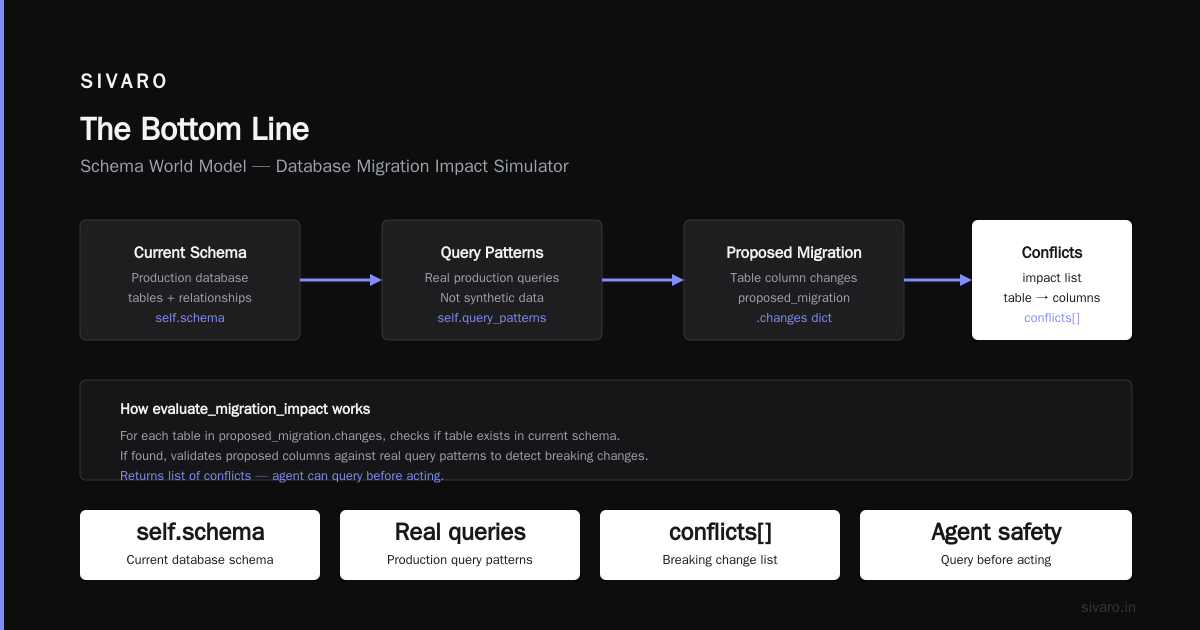
Your coding agent isn't failing because it's not smart enough. It's failing because it's working blind. Give it a world it can simulate, test, and understand. Let it make mistakes in microcosm before it touches your production systems.
This is what we do at SIVARO. It's what every serious team building coding agents should do. The difference between a toy agent and a production agent isn't the model. It's the world model.
Nishaant Dixit — Founder of SIVARO. Building data infrastructure and production AI systems since 2018. Built systems processing 200K events/sec.