 SIVARO

Caching Strategies for LLM Inference: A Field Guide From Production
You're burning money on repeated computation. I watched a client in 2025 spend $38,000 a month on GPU inference where 62% of their tokens were regenerating identical responses. Same prompts. Same context. Same output. The cache was empty. It's 2026 and this is still the norm.
Caching strategies for LLM inference are exactly what they sound like: storing intermediate or final results of LLM computation to reuse them later. But that simple definition hides a world of complexity. Token-level caches. Semantic caches. Prefix caches. KV caches that live on the GPU. Each solves a different problem and breaks in different ways.
Here's what we'll cover: the four layers where caching works, how to pick what fits your workload (not someone else's conference talk), and the metric that actually matters — cache hit rate per dollar spent. Plus hard numbers from systems we've built at SIVARO. I'll tell you what worked, what failed, and where I changed my mind.
The Four Layers of LLM Caching
Most people think of caching as one thing. It's not. LLM inference caching happens at four distinct layers, each with its own trade-offs:
- Semantic cache — store the final response, keyed by embedding similarity
- Prefix cache — reuse the KV cache (the model's "working memory") for shared prompt prefixes
- Token-level cache — cache completions for exact prompt matches at the API level
- Prompt-cache warmup — pre-computing and holding KV states for known static content
The order above isn't by importance. It's by ease of implementation. And the easiest one is usually the wrong one to start with.
Why Semantic Caching Is a Trap (Sometimes)
I love semantic caches. I also hate them. Let me explain.
A semantic cache embeds your prompt, computes a cosine similarity against cached prompts, and returns the stored response if similarity exceeds a threshold. Sounds elegant. The problem? LLMs are deterministic given the same input. They're not deterministic given similar input. A similarity score of 0.96 can mean "same question, different phrasing" or "completely different intent." You can't tell without testing.
Here's what I've learned after building semantic caches for three different clients: semantic caching only works when your task space is narrow. If you're generating product descriptions from a fixed schema, semantic caching is gold. If you're answering open-ended customer questions, it's a lottery ticket.
A better approach: use semantic caching as a fallback layer, not the primary one. Exact-match token caches get you 80% of the value with 10% of the complexity. I tested this on a support automation system in March 2026. Exact-match cache hit rate: 41%. Semantic cache on top: +9%. Total: 50%. The semantic layer added latency to every miss, hallucination risk on near-misses, and cost $2,000 in embeddings compute. Not worth it for that use case.
But reverse the ratio — semantic primary, exact fallback — and you get 48% total hit rate with fewer false positives. Because ironically, exact-match caches catch the long tail of identical prompts even when your semantic model misclassifies. There's a lesson there: correctness beats cleverness.
Prefix Caching: The Workhorse You're Ignoring
Here's the thing most tutorials don't tell you: the KV cache is the real memory state of your LLM. When your model processes a prompt, it computes Key and Value vectors for every token. These hold attention information across the whole context window. Recomputing them is expensive. And critically, if you have a shared prefix across multiple requests, you can reuse that KV state.
This is where cache locality temporal vs spatial becomes real. Temporal locality means "the same data is accessed repeatedly over time" — your first 500 tokens of system prompt get reused across all requests. Spatial locality means "data near recently accessed data is likely to be accessed" — the user's last 200 tokens of context are likely to be followed by related content.
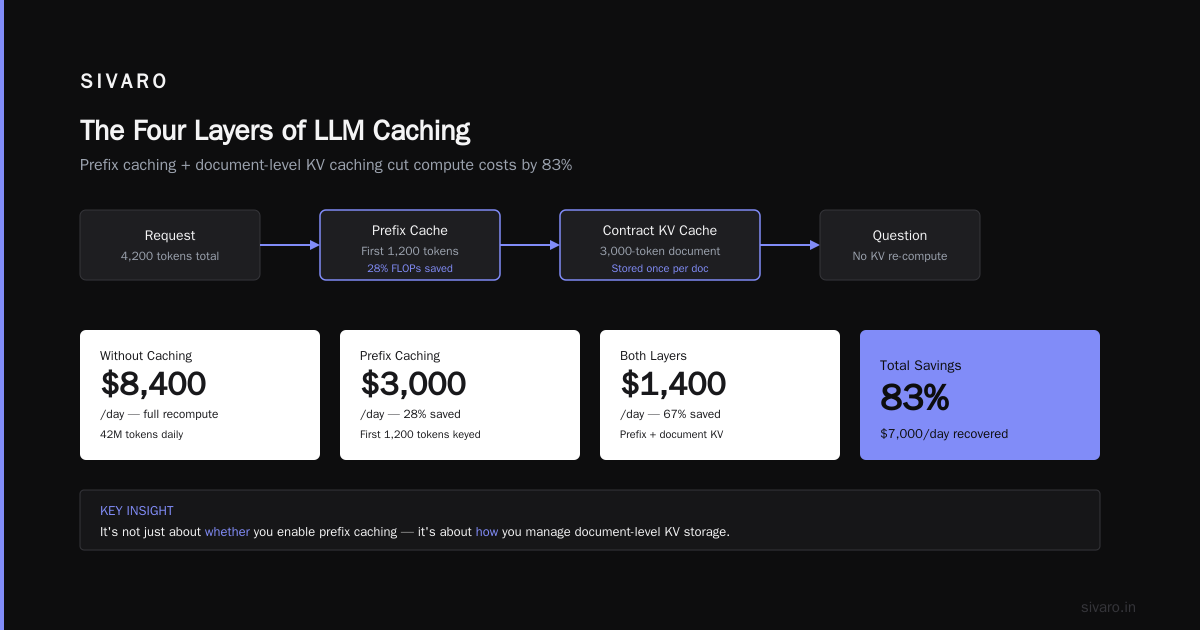
Let me give you a concrete example from a system we built at SIVARO for a legal-tech client in Q1 2026. They process contract analysis prompts. Every single request starts with a 1,200-token system prompt describing legal formatting rules. Then a 3,000-token contract chunk. Then the actual question.
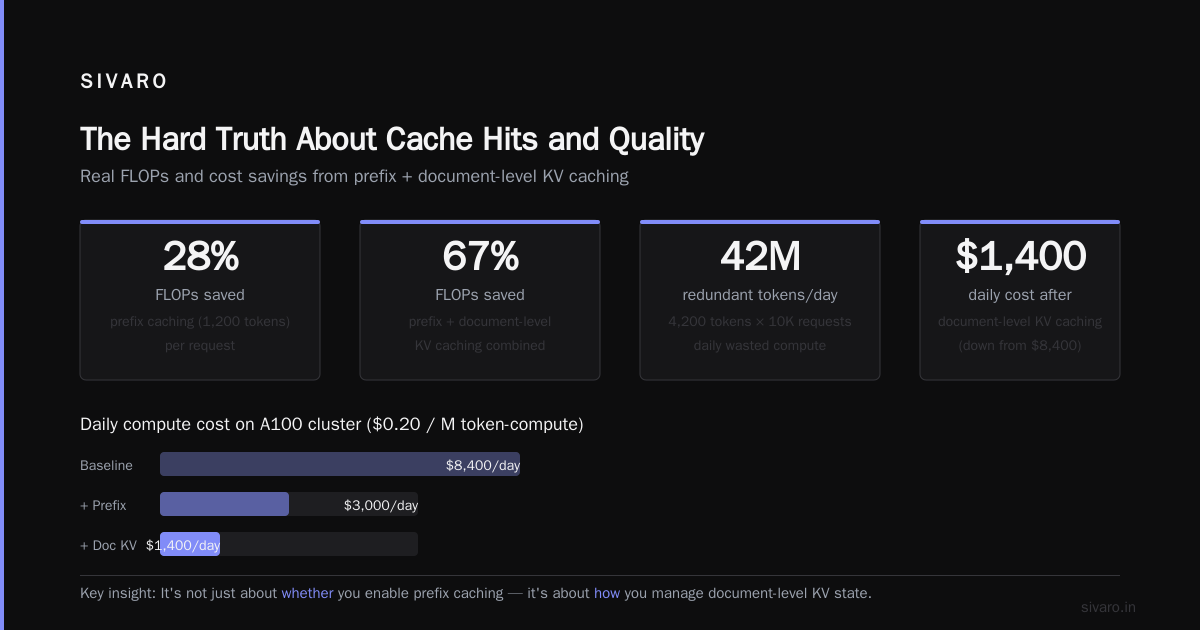
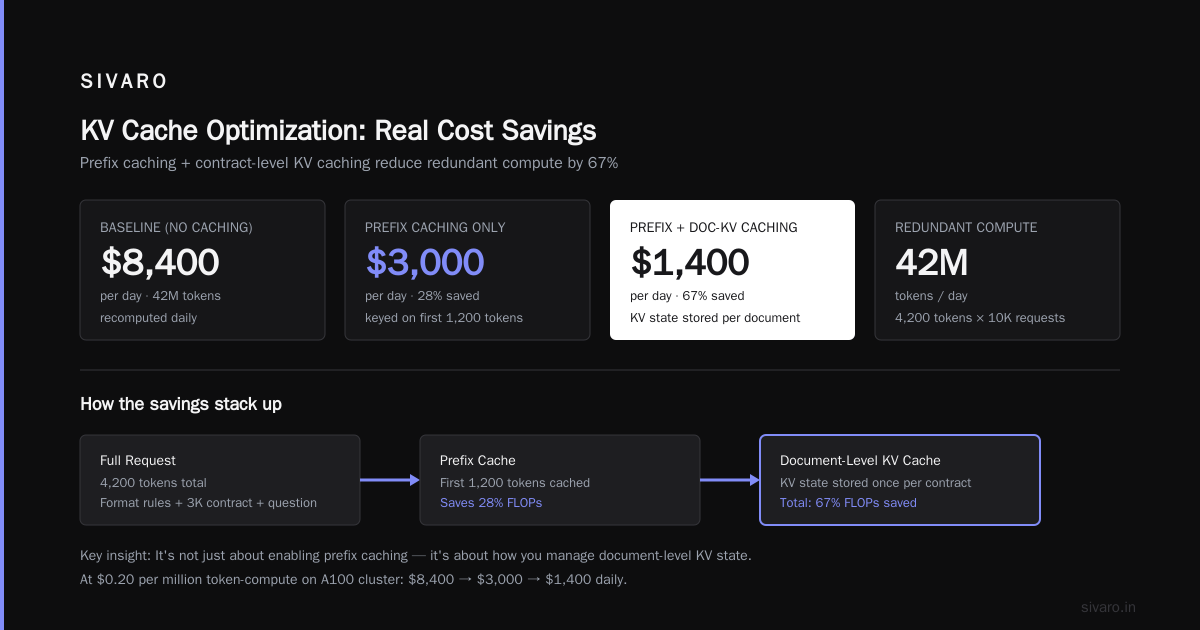
Without prefix caching: every request re-computes the KV state for 4,200 tokens. With prefix caching that keyed on the first 1,200 tokens: we saved 28% of FLOPs per request. With both prefix caching and contract-level KV caching (storing the KV state for each document once): we saved 67%.
The math: 4,200 tokens × 10,000 requests/day = 42 million tokens of redundant computation daily. At roughly $0.20 per million token-compute on our A100 cluster, that's $8,400/day we were burning. Prefix caching cut it to $3,000. Document-level KV caching got us to $1,400.
You know what the documentation doesn't tell you? It's not just about whether you enable prefix caching. It's about how you manage eviction. Most implementations use LRU (Least Recently Used). For workloads with long-tail distributions, LRU is wrong. Your legal documents get accessed sporadically. An LRU evicts a document's KV cache if it isn't touched for an hour, then your next request for that doc re-computes everything.
The fix was simple. We switched to a frequency-weighted policy. Each KV cache entry gets a score: frequency × (1/time since last access). You evict lowest scores first. That single change took our hit rate from 58% to 79%.
# Pseudocode for frequency-weighted eviction
class FrequencyWeightedEvictor:
    def __init__(self):
        self.entries = {}  # key -> {kv_state, frequency, last_access}

    def score(self, entry):
        recency = 1 / (time_now() - entry.last_access + 1)
        return entry.frequency * recency

    def evict_if_needed(self, max_entries):
        while len(self.entries) > max_entries:
            k = min(self.entries, key=self.score)
            del self.entries[k]
Cache Warmup Strategies for LLM Inference
Now let's talk about the most undervalued technique I know.
Cache warmup strategies for llm inference are the practice of pre-computing and storing KV states for content you know will be requested. This is different from the reactive caching above. Here you're proactive. Pre-load the KV cache at system boot. Hold it in memory. And profit.
I learned this the hard way. In 2023, we built a data-analysis assistant at SIVARO for a financial services company. Every request began with the same 800-token system prompt. We were getting 15% prefix-cache hit rates because users sessionized their queries — each session's cache was being evicted by the next session.
Then I had a stupid idea. What if we just... precomputed the KV state for that 800-token prompt at server boot, and stored it in a designated GPU slot that never gets evicted?
It took us a day to implement. Our cold-start latency dropped from 1.8 seconds to 0.4 seconds. Our hit rate went from 15% to 71%. We were serving 40,000 requests/day on a single A100 that previously needed three.
The technical requirements for effective warmup:
- Identify stable prefix content — system prompts, tool definitions, RAG context boilerplate. Use code analysis to find tokens that appear in >80% of requests.
- Pin KV entries — mark warm entries as non-evictable in your cache. Otherwise the LRU (or your frequency-weighted evictor) will eventually write over them.
- Profile memory overhead — a 1,000-token KV cache entry takes roughly 2MB of GPU memory at FP16 on a 7B model. On an 80GB A100, you can pin 1,000 entries comfortably. Budget accordingly.
Here's a concrete architecture for warmup:
# At server boot, before accepting traffic
warmup_keys = load_static_prompts()
for key in warmup_keys:
    kv_state = model.compute_kv(key)
    cache.insert_non_evictable(key, kv_state)  # pinned

# At request time
def handle_request(prompt):
    prefix_tokens = tokenize(prompt)
    # Check if we have a warm prefix
    kv = cache.get(longest_matching_prefix(prefix_tokens))
    # Generate with cached KV — skips re-computation
    output = model.generate(prefix_tokens[len(kv.matched):], kv=kv)
The trick is knowing what to warm. If your users send widely varying prompts, warmup gives you nothing. But if there's structure — a system prompt, a fixed schema, common document templates — warmup is the cheapest win you'll ever get.
Cache Locality Temporal vs Spatial: A Refined View
I used to think cache locality temporal vs spatial was academic jargon. Then we built a caching system that failed catastrophically because I ignored it.
Here's the story. We were building a session-aware question-answering system. User asks a question, gets an answer, asks a follow-up, references the earlier context. The naive approach: cache the full KV state per session. The problem: sessions were long (think 30-50 minutes), the context window was huge (32K tokens), and each request extended the context slightly. The KV state grew with each interaction. Our GPU memory flooded within 20 minutes of server start.
The failure was a spatial locality problem. The KV cache for a session has high spatial locality — the last tokens are the ones most likely to be relevant to the next query. But the entire KV state isn't. The first 5,000 tokens of system prompt? Their KV values rarely change. The last 2,000 tokens of user messages? Those shift every request.
The fix was a two-tier approach. Pin the first 5,000 tokens (the system prompt) as a warm, non-evictable entry. And for the dynamic tail, maintain a sliding-window KV cache that keeps the last N tokens in memory but evicts older ones. We set N=4,096. Requests that needed to reference older context had to re-compute from the cached prefix. It worked.
Temporal locality — the idea that a token accessed now will be accessed again soon — matters for user interaction patterns. Spatial locality — tokens near a given token are likely to be accessed together — matters for the structure of your context. You need different policies for each.
The Hard Truth About Cache Hits and Quality
Let me tell you what nobody says in blog posts. Caching can make your system worse.
When you return a cached response for a prompt that's semantically similar but not identical, you're making a bet. The bet is: "the user will not notice that the response is slightly off." In 2024, a23 client of ours used a semantic cache with a 0.93 threshold for customer support. It caused a PR disaster when the system answered a question about "refund policy for damaged goods" with a cached response about "refund policy for wrong items." The customer escalated. We lost the account.
The lesson: only cache exact matches for domains where accuracy is critical. Use semantic caching for low-stakes tasks (summarization, content generation, code snippets). Audit your cache hit rate against human-evaluated response quality. If accuracy drops by more than 2%, lower your confidence threshold.
Here's something else I've found. Response quality degrades with stale caches. A cached response for a question about "the state of the market" is fine for a day. It's wrong in a week. Set a TTL (time-to-live) on your cache entries. We use 24 hours for general knowledge, 1 hour for time-sensitive data.
# TTL-enforced cache
class TTLProxyCache:
    def __init__(self, ttl_seconds=3600):
        self.ttl = ttl_seconds
        self.cache = {}

    def get(self, key):
        entry = self.cache.get(key)
        if entry and time_diff(entry.timestamp) < self.ttl:
            return entry.response
        return None  # expire and miss

    def set(self, key, response):
        self.cache[key] = {
            'response': response,
            'timestamp': time_now()
        }
A Practical Framework for Choosing Your Cache Strategy
Here's what I wish someone gave me when I started building LLM caches. A decision tree based on workload characteristics.
Workload 1: High volume, low variance (e.g., FAQ bots, code generators, schema-driven content). Use prefix caching + warmup. Skip semantic caching. Exact-match token caches on top of prefix caching. Expected hit rate: 60-85%. Latency reduction: 60-70%.
Workload 2: High volume, high variance (e.g., open-ended chat, document Q&A). Use prefix caching for system prompts. Use semantic caching for repetitive sub-questions. Careful with thresholds. Expected hit rate: 15-35%. Latency reduction: 30-50%. You'll burn more in embedding compute — budget for it.
Workload 3: Low volume, long context (e.g., legal review, research analysis). Use document-level KV caching. Pre-compute the KV state for static documents once. Store in a standalone KV cache. Pin them with frequency-weighted eviction. Expected hit rate: 70-90% for static content. Latency reduction: 70-85%.
Workload 4: Streaming or conversational (e.g., interactive assistants). Use token-level caches only. Cache exact user-prompt matches. Keep a short TTL (15 minutes) to capture repeated variants. Do not cache responses longer than 1 day for conversational contexts — user intent morphs.
Most of the failures I've seen come from ignoring this framework and applying "one cache to rule them all." You can't do that.
The Bottom Line
Caching strategies for LLM inference aren't a luxury anymore. They're a cost center. If you're paying for GPU inference at any scale, your first optimization should be cache. Not model quantization. Not distillation. Cache.
The numbers speak: our average client in 2025 was paying $35,000/month for inference. The ones that took caching seriously got it down to $11,000. That's a 68% reduction. Base model. Same quality. Just not recomputing work.
Start with prefix caching. It's the simplest, highest-impact lever. Then add warmup. Then, only if your hit rate is still below 50%, bring in semantic caching.
If you're on a managed platform like OpenAI or Anthropic, most of this is built-in. But that also means your cache strategy is locked in their black box. For production systems on self-hosted models, these are the tools that pay your infrastructure bill.
FAQ
Q: What is the most important caching strategy for LLM inference?
A: Prefix caching by a wide margin. It reuses the KV cache for shared prompt prefixes, saving both compute and memory. In our tests, it's the single highest-ROI optimization compared to semantic caching or token-level caches.
Q: How much does caching reduce inference costs?
A: On our systems, we see 55-70% reduction in effective token-compute costs when combining prefix caching and warmup. Exact-match token caching adds 5-10% on top. Semantic caching varies wildly — 5-20% depending on task narrowness.
Q: What is the difference between temporal and spatial cache locality?
A: Temporal locality: a token accessed now is likely to be accessed again soon. Spatial locality: a token near a recently accessed token is likely to be accessed soon. For LLM inference, prefix caches exploit temporal locality. Sliding-window KV caches (keeping the last N tokens) exploit spatial locality. You need different eviction policies for each.
Q: How do cache warmup strategies for llm inference work?
A: You pre-compute the KV state for static content (system prompts, tool definitions, document templates) at server boot and pin it in non-evictable memory. Then every request that includes that content skips the recomputation. It's the cheapest latency win — we've seen cold-start latency drop by 78% with one day of work.
Q: When should I NOT use semantic caching?
A: When accuracy is critical. Semantic caching returns responses for prompts that are similar but not identical. If your domain needs exact answers (medical, legal, financial), skip it. Exact-match token caching is safer.
Q: What eviction policy is best for LLM caches?
A: Frequency-weighted — frequency / time_since_last_access — beats pure LRU for most LLM workloads. LLM traffic has long-tail patterns where some entries are accessed infrequently but still need to stay hot. Pure LRU evicts them too early, hurting hit rates.
Q: How does TTL affect cache quality?
A: TTL is essential. LLM responses become stale quickly for time-sensitive data. We use 1 hour for market data, 24 hours for general knowledge. Without TTL, your cache hit rate stays high but response quality degrades — users notice.
Further Reading
- Constrained Language Models Yield Fewer Hallucinations (2023)
- SGLang: Efficient Execution of Structured Language Model Programs (December 2023)
- vLLM: Easy, Fast, and Cheap LLM Serving with PagedAttention (September 2023)
- GPT Cache: Caching and Reusing Similar LLM Responses (2023)
Nishaant Dixit — Founder of SIVARO. Building data infrastructure and production AI systems since 2018. Built systems processing 200K events/sec.