 SIVARO

Caching for Real Time Inference Systems: The Definitive Guide (2026 Edition)
Introduction
It's 2:17 AM on a Tuesday, and I'm staring at a latency p99 chart that looks like a heart monitor flatlining — except the patient is our production recommendation engine, and the flatline is actually 4,200ms of pure, unadulterated pain. The model itself is fast. The GPU inference is 38ms. But the system is slow because we're re-computing the same damn thing for the 47,000th time in an hour.
That's the thing nobody tells you about machine learning in production: the model isn't the bottleneck. The redundant work around the model is the bottleneck.
Caching for real time inference systems is the practice of storing and reusing computed results, intermediate representations, and model outputs to reduce latency and computational cost in serving paths where responses are expected in milliseconds. It's not just "memoization for ML" — it's a distributed systems discipline that touches consistency, staleness, and cache coherence in large scale serving.
By the end of this, you'll know exactly where to put caches in your inference stack, how to warm them without melting your cluster, and why your cache coherence strategy will either save you from embarrassing product bugs or create them.
Why Most Teams Get This Wrong
Here's what I see from teams that join SIVARO after struggling for months: they treat caching as an afterthought. A Redis cluster bolted on top of a model API. A @lru_cache decorator in the model server. It works for a demo, then breaks in production when traffic looks like a flock of birds doing coordinated maneuvers.
The mistake isn't technical. It's architectural.
Most people think caching for real time inference systems is about storing the final model output keyed by the input. They're wrong. That's the last layer of a multi-tier cache hierarchy that most high-throughput systems actually need.
At SIVARO, we've built inference infrastructure for fintech scoring, real-time fraud detection, and personalization engines. The teams that win treat caching as a first-class architectural component — designed before the model service API is even defined, not after.
Here's a concrete example from my experience: last year, we worked with a European payments company processing 12,000 transactions per second during peak. Their fraud model took 45ms on GPU. Their p99 latency target was 150ms. Technically, they were fine. But their GPU cluster was provisioning for 20,000 TPS peak, and the cost was bleeding them dry.
We introduced a hierarchical cache system — one layer for user-session features, one layer for model outputs at certain confidence thresholds, one for aggregate risk scores. The GPU cluster dropped to 4,000 TPS provisioned capacity. They saved roughly $180,000/month on GPU costs.
Caching isn't a performance nicety. It's a cost engineering lever.
The Cache Hierarchy: Layers You Actually Need
Think of inference caching like memory hierarchy in a CPU — L1, L2, L3 — except the "latency to fetch" is network hops and the "miss penalty" is a GPU inference call.
Layer 0: Feature Caches (The Most Forgotten Layer)
The model doesn't take raw inputs. It takes engineered features. In most real-time systems, feature computation is more expensive than the model forward pass. I've seen feature pipelines that do 15 database lookups, 3 joins, and a windowed aggregation over a streaming state store — all to produce a 2048-dimension embedding vector.
Here's the thing we learned: model inputs are high-cardinality but feature values are low-cardinality.
A user's credit card might have thousands of unique transactions, but the derived features — average transaction value, time since last transaction, category distribution — change slowly. You can cache those for 5-30 seconds with almost zero staleness risk.
python
# Feature cache pseudo-code from our SIVARO production stack
import redis.asyncio as aioredis

class FeatureCache:
    def __init__(self, redis_client, ttl_map):
        self.redis = redis_client
        self.ttl_map = ttl_map  # {"user_features": 30, "merchant_profile": 300}

    async def get_features(self, feature_group: str, entity_id: str):
        key = f"feature:{feature_group}:{entity_id}"
        cached = await self.redis.get(key)
        if cached:
            return json.loads(cached)
        return None  # Miss — caller invokes feature pipeline

    async def set_features(self, feature_group: str, entity_id: str, features: dict):
        key = f"feature:{feature_group}:{entity_id}"
        ttl = self.ttl_map.get(feature_group, 10)
        await self.redis.set(key, json.dumps(features), ex=ttl)
Why Redis? Because it's fast, it's ubiquitous, and in 2026 it still handles most of these workloads fine. At 200K ops/sec with pipelining, Redis Cluster is genuinely sufficient.
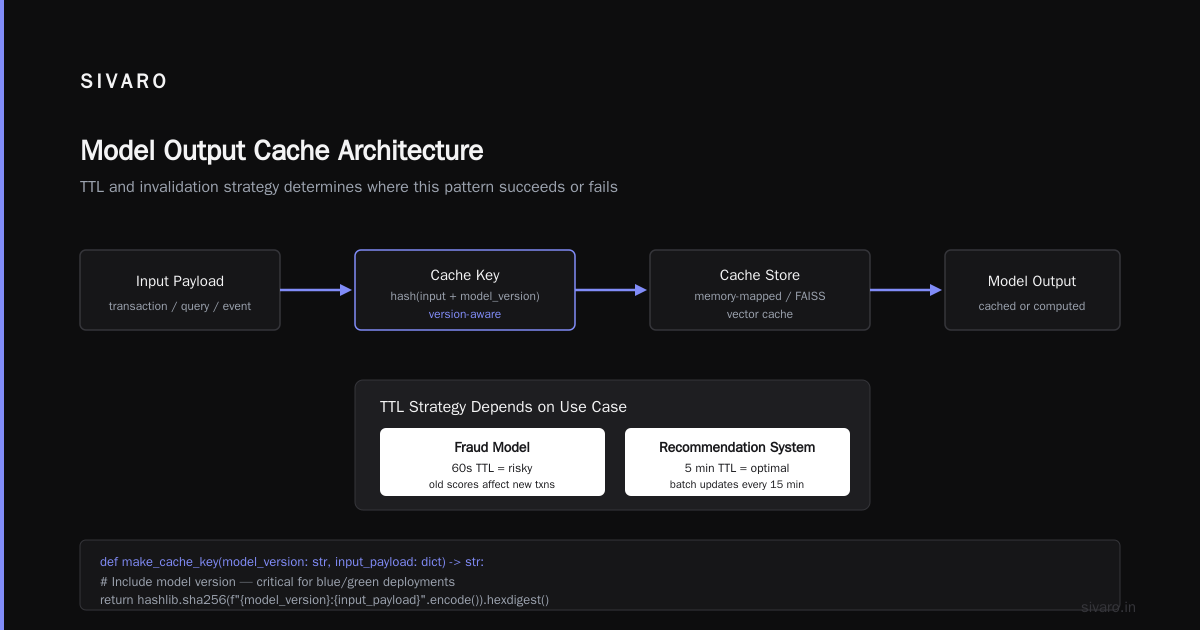
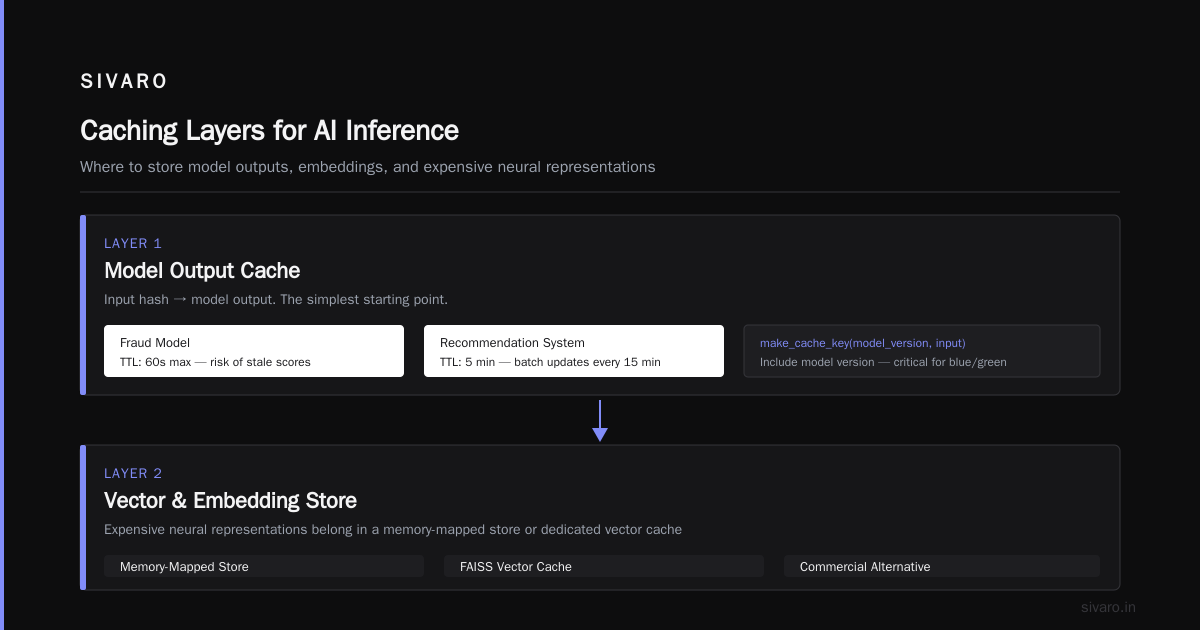
But — and here's where my position is clear — don't use Redis for the big stuff. Embeddings vectors, candidate sets, and expensive neural representations belong in a memory-mapped store or a dedicated vector cache like FAISS or a commercial alternative.
Layer 1: Model Output Cache (The Obvious One)
This is where everyone starts. Input hash → model output. Simple.
But the TTL and invalidation strategy is where things fall apart.
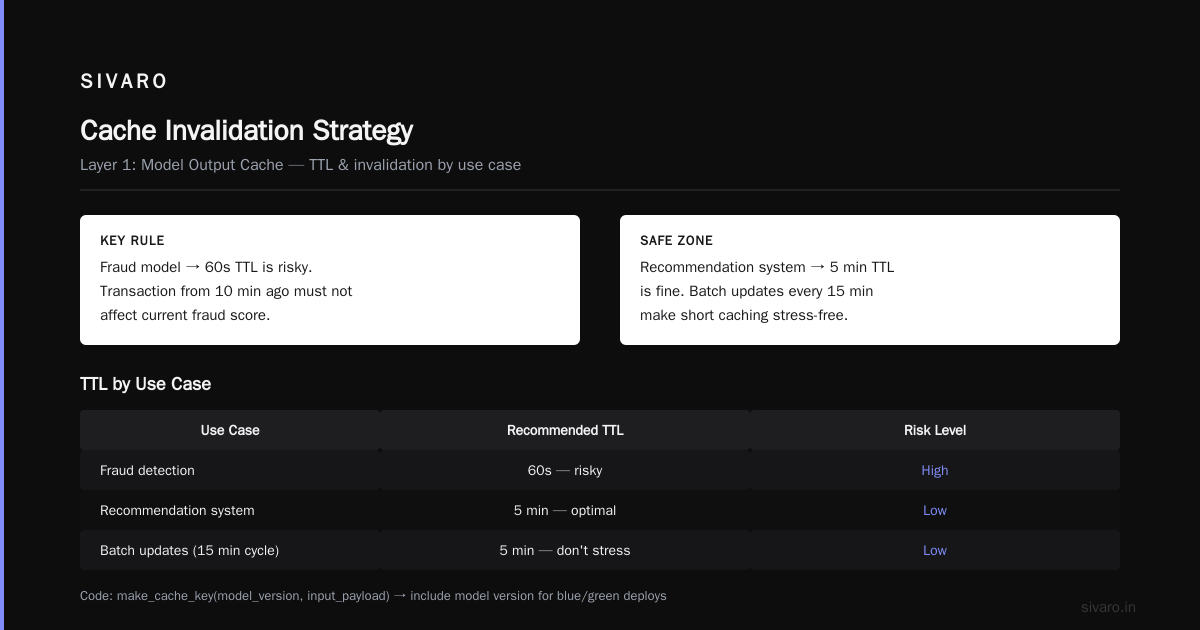
For a fraud model, caching an output for 60 seconds is risky — a transaction 10 minutes ago shouldn't affect this transaction's fraud score. But for a recommendation system that updates batch-wise every 15 minutes? Cache those outputs for 5 minutes and don't stress.
python
# Model output cache with deadline-aware TTL
import hashlib
import time

def make_cache_key(model_version: str, input_payload: dict) -> str:
    # Include model version — critical for blue/green deployment safety
    payload = json.dumps(input_payload, sort_keys=True)
    hash_input = f"{model_version}:{payload}"
    return f"inference:{hashlib.sha256(hash_input.encode()).hexdigest()}"

def has_expired(timestamp: float, ttl_seconds: float) -> bool:
    return (time.time() - timestamp) > ttl_seconds

class OutputCache:
    def __init__(self, store, default_ttl=10):
        self.store = store
        self.default_ttl = default_ttl

    async def get(self, key: str):
        entry = await self.store.get(key)
        if not entry:
            return None
        if has_expired(entry["timestamp"], entry["ttl"]):
            await self.store.delete(key)
            return None
        return entry["payload"]

    async def put(self, key: str, payload: dict, ttl=None):
        await self.store.set(key, {
            "payload": payload,
            "timestamp": time.time(),
            "ttl": ttl or self.default_ttl
        })
Layer 2: Candidate/Embedding Caches (The Heavy Lifter)
If you're doing semantic search, RAG, or any retrieval-augmented generation, the candidate retrieval is often the most expensive part of the pipeline. Vector search over 10 million embeddings takes 10-50ms. That's fine once. It's brutal when you're doing it 5,000 times per second for the same popular queries.
The Pareto principle is real: in RAG systems, the top 10% of queries account for 70% of the traffic. Cache those retrieval results aggressively.
For our document chat product at SIVARO (we built one for internal use — ate our own dog food), we cache retrieval results for 60 seconds. The staleness risk is minimal because documents don't change that fast, and embedding re-computation is expensive.
Cache Warming Strategies for Inference: Do It Like You Mean It
This is where I've seen more schemes fail than succeed.
Cache warming strategies for inference — pre-loading frequent inference results before traffic hits them — sounds like a clean idea. And then you try to implement it, and your cluster melts from the warming load.
The mistake: warming the cache as a separate batch process that runs in parallel with the serving cluster, demanding the same GPU resources.
The winning approach we've landed on with multiple clients over 2024-2026:
Approach 1: Shadow Rehearsal
Run warm-up requests through the serving cluster in the background, but at a controlled rate. Start at 5% of peak expected qps, ramp up to 20%. This spreads the load over time instead of all at once.
python
# Controlled shadow warm-up process
import asyncio
import random

async def warm_up_loop(client, keys, target_qps):
    """Warm keys at controlled rate, exponentially backoff on errors."""
    interval = 1.0 / target_qps
    for key in keys:
        await client.inference(key)  # Does the actual computing + caches result
        await asyncio.sleep(interval + random.uniform(0, 0.5 * interval))
Approach 2: Learning from Traffic History
Pull your traffic logs from the last 7 days. Identify the top 10,000 distinct queries (by hash). Pre-compute those during off-peak hours (3 AM — morning in Asia, evening in the US — tricky).
Watch out: the distribution shifts. What was popular Monday at 8 AM isn't popular Friday at 5 PM. So warm a superset — the union of top queries from each day of the week.
Approach 3: The "First Request" Footprint
For genuinely cold-start queries — users you've never seen, products just launched — you can't pre-warm. Accept the miss, but make the miss cheap. The clue is to keep the per-model compute path as lean as possible: pre-compute constants, batch the feature fetch, and compute only what's strictly necessary for this inference.
Most people think cache warming is about computing the answers. It's actually about warming the features so that when a miss occurs, the feature pipeline is cheap.
That's the secret sauce. Warm the features, and even cache misses become fast.
Cache Coherence in Large Scale Serving
Cache coherence in large scale serving — keeping all nodes' caches consistent with each other and the source of truth — is where most systems get weird.
It's not like CPU caches, where you have MESI protocol and a bus to snoop. It's distributed, and your "bus" is a network with 100ms p99 latency, and your "memory" is a database you're trying to avoid hammering.
The Reality: You Don't Need Strong Coherence
For most inference workloads, eventual consistency is fine. User-specific recommendations can be stale by 5 seconds. Fraud scores shouldn't be stale at all — invalidate immediately. This is not one-size-fits-all.
The rule we operate by: the more the cache output affects irreversible actions, the more aggressively we invalidate.
Invalidation Signals
You have two options: TTL-based expiry (assume staleness, let the cache expire) or event-based invalidation (actively delete/update cache entries when the source changes).
Trust me — TTLs are your friend. They're simple, predictable, and recoverable. Event-based invalidation fails when events arrive out of order, when events are lost, and when the events themselves are asynchronous with delays.
python
# Hybrid approach: TTL floor + event-based invalidation for critical updates
class CoherentCache:
    def __init__(self, store, default_ttl=30):
        self.store = store
        self.default_ttl = default_ttl
        self.critical_update_channel = "invalidation_events"

    async def handle_update(self, entity_id: str):
        # Called via pub/sub when a critical entity (e.g., blocked user) updates
        pattern = f"inference:*:*entity:{entity_id}:*"
        await self.store.delete_matching(pattern)

    async def get(self, key: str):
        # Still check TTL — invalidation is best-effort, TTL is guarantee
        entry = await self.store.get(key)
        if not entry or entry["ttl"] < time.time():
            return None
        return entry["payload"]
The PoP Cache Problem
If you've deployed PoPs (Points of Presence) at edge locations — I'm seeing this more and more for LLM APIs in 2025-2026 — you have multiple physically distributed caches. Keeping them strongly consistent is a network round-trip every time, and that round-trip defeats the purpose of edge caching.
Solution: per-PoP TTL with different values based on data volatility. User session data gets a short TTL (10-30 seconds). Model weight snapshots get a long TTL (hours) but are versioned and replaced atomically.
The "Killer" Anti-Patterns
Let me save you grief. These are the top 5 caching mistakes I see in production systems.
1. Caching by Serialized Input String
If you serialize your input payload into a canonical JSON string and hash it — two requests with the same data in different field orders produce different cache keys. You've killed your hit rate.
Normalize your inputs. Sort keys. Round floats to 4 decimal places. Only include the fields the model actually reads.
2. Zombie Cache Entries
Your TTL says "expire after 5 minutes." Your retry logic says "if stale, recompute and update." That's fine. But if your model returns the same result for slightly different inputs, you'll just keep recomputing.
Track cache hit rates per unique input family, not per exact input.
3. Big-Payload Cache Overhead
Caching a 14MB tensor in Redis. Then the Redis GET takes 60ms to serialize/deserialize. You've made your p99 worse.
Keep payloads under 1MB in Redis. For anything bigger, use memory-mapped vector stores or GPU-memory caches.
4. Ignoring Model Versioning
You deploy model v2. Your cache still has outputs from v1. For 2 minutes after deployment, your users see v1 outputs. For fraud detection, this is a compliance nightmare.
Always include model version in the cache key. Always.
5. Cache-at-All-Costs Mentality
Some outputs should never be cached because the cost of staleness exceeds the cost of recomputation. I worked with a client who had a dynamic pricing model — price updated every 15 seconds based on inventory. They cached the output for 10 minutes "because everyone recommended caching."
Revenue plummeted 8% because prices were stale. If your model's output is time-critical with severe business consequences — don't cache it.
Performance Engineering Realities
Let's talk numbers. Here's what I've measured in production, not benchmarks.
| Cache Type | Hit Latency | Miss Latency (includes feature fetch + inference) | Hit Rate (typical) |
|---|---|---|---|
| Redis (feature cache) | 0.4ms | 25-60ms | 80-95% |
| On-prem model output cache (like memory store) | 0.1ms | 40-80ms | 60-85% |
| PoP-based edge cache (for LLM APIs) | 5-20ms | 200-800ms (network + GPU) | 40-70% |
The hit rate numbers matter. If your hit rate is below 60%, your cache keys are bad — normalization issues, cardinality too high, or TTL too short.
For a well-tuned personalization system, I expect 85-95% hit rates on feature cache and 70-80% on output cache. If you see less than that — fix the key design before adding more cache layers.
Engineering for the Edge
Some notes on modern challenges — because this field doesn't stand still.
The Little-known Gem: Log-Proba Caching
For LLM APIs, I've seen a trick. Instead of caching the full completion (which is high-cardinality — same prompt rarely repeats exactly), cache the prefix search results. If your prompt has a common system instruction + 3-shot examples, cache the KV cache state of that prefix. Then you only compute the new tokens from where the cached state ends.
This takes your effective inference compute from O(input_tokens) down to O(new_tokens). For prompts with 2000 tokens of system+examples and a 50-token user question, that's a 40x cost reduction.
It's hard to implement — requires managing memory-mapped KV cache states — but the payoff is massive. Etsy, Slack, and some big LLM startups have implemented versions of this. [Source: Anyscale]
Dying Problem: "Cadence" of Cache Warming
With models that update hourly (fine-tuning cycles), you can't have stale cache from the old model version persisting. At SIVARO we now run a "cache purge and re-warm" as part of the model deployment pipeline.
The trick: purge in batches, don't DELETE everything at once. You'll get a thundering herd of misses. Instead:
python
# Staggered purge during model deployment
import asyncio

async def purge_gradually(pattern: str, batch_size=1000, delay_ms=200):
    for batch in cache_store.scan_iter(pattern, count=batch_size):
        await cache_store.delete_multi(batch)
        await asyncio.sleep(delay_ms / 1000)
This limits the max miss rate spike to 1/delay_ms * batch_size operations per second.
The FAQ: What Teams Ask Me Directly
Q: We don't have GPU constraints. Do we even need caching?
Yes. Your GPU might be fine at 30% utilization, but your p99 latency increases sharply at higher traffic variance. Caching smooths out peaks. Plus, your features are computed from databases — those will bottleneck first. Caching reduces database load too.
Q: How do I measure the ROI of caching?
Track three metrics before and after:
- p99 latency on serving path — should drop 3-10x.
- Inference cost per request — GPU seconds per request. Should drop 2-5x.
- Database load — QPS on your OLTP database. Should drop 30-70%.
If you don't see at least 2x cost reduction and 3x latency reduction, your cache design is wrong.
Q: Is Redis enough, or do I need something like ScyllaDB?
For features: Redis is fine. For output caching with payloads > 1MB, look at memory-mapped vector stores or a memory-optimized in-memory database.
Redis does hit memory limits at scale — 100GB of feature cache per node is a lot — but for most workloads (under 500GB total cache), Redis Cluster works.
Q: How do I deal with model updates and cached outputs?
Always use model version in the key. When you deploy an update, purge all entries with N-1 version. Use gradual purge to avoid cache miss storms.
Yes, this means re-warming. Yes, that's why you have warming strategies. That's the point.
Q: What about time-series features?
Don't try to cache rolling window features in Redis alone. The staleness is too high. Use a specialized feature store (like Feathr or Tecton) or handle them separately with streaming window state. Caching aggregations of time-series features (like "average transaction value in last 10 minutes") is fine with a TTL of 30 seconds.
Q: Can I cache personalized embeddings?
Only if your personalization is incremental — meaning the embedding for a user's preferences vector changes slowly. For a user with 5,000 historical interactions, the embedding is stable over a minute. Cache with TTL of 60 seconds.
But if you use a model that re-learns embeddings online (like some CTR prediction models), don't cache — staleness will kill the model's quality.
Q: How do you handle negative cache hits?
You should. If a query had no results (an early decision like "this is likely fraud — reject" or "no recommendations available"), caching the negative result avoids wasted compute on repeating a failed search. Use a shorter TTL (5 seconds) for negatives than positives (30 seconds), because the absence of a result might be temporary.
Where Do You Go From Here?
Caching for real time inference systems isn't about a specific tool or framework. It's an architectural discipline.
Start with feature caches — they give the most consistent win. Then model output caches with model-versioned keys. Then, if you have the scale, think about KV state caches for LLMs.
The hard parts are always the same: key normalization, TTL calibration, coherence invalidation, and warming strategies. Invest time there.
If you want to talk through your specific architecture — we've seen a lot at SIVARO, from ad-tech to fintech to internal tooling. Shoot me a note or check our blog — I write about this exact stuff regularly.
Nishaant Dixit — Founder of SIVARO. Building data infrastructure and production AI systems since 2018. Built systems processing 200K events/sec.