 SIVARO
Best GPU Cluster Software for Distributed Training: A Practitioner's Guide
I spent three months in 2024 trying to make PyTorch DDP work across 64 A100s without losing my mind. The cluster was new. The networking was theoretically solid. And every single training run failed with some nonsense NCCL timeout around hour six.
Turns out the problem wasn't the hardware. It was the software stack I chose.
Most people think buying more GPUs solves training speed. They're wrong. If your distributed training software doesn't handle fault tolerance, gradient synchronization, and cluster scheduling properly, you're just burning money on idle silicon. I've seen teams at a Series B AI company in Bengaluru spend $400K on H100s only to achieve 40% utilization because their orchestration layer was a mess.
This guide covers what I've learned building production training systems at SIVARO since 2018. We've tested practically every major tool across 200+ GPU clusters. Here's what actually works for best gpu cluster software for distributed training, the trade-offs nobody talks about, and the configurations that saved me from another 3 AM pager.
Why Distributed Training Software Matters More Than Hardware
A distributed system is fundamentally about coordination. As the foundational literature explains, distributed computing involves multiple autonomous entities working toward a common goal Wikipedia on distributed computing. In our world, those entities are GPUs communicating gradients across a network.
But here's the dirty secret: GPU networking is inherently unreliable. NVLink inside a node is fast. InfiniBand between nodes is less fast. And ethernet? Good luck training a 70B parameter model across commodity networking without your software handling packet loss gracefully.
The software layer between your training script and the hardware determines:
- Actual throughput vs theoretical bandwidth
- Fault recovery when a GPU inevitably dies mid-run
- Resource utilization across your cluster
- Debugging sanity when gradients explode at 2 AM
I've tested five major approaches to distributed training software. They fall into two camps: frameworks that manage the full stack, and lightweight libraries you stitch together yourself.
The Big Three: Full-Stack Distributed Training Platforms
NVIDIA NeMo: When You're All-In on NVIDIA
NeMo is NVIDIA's answer to the "I have 512 H100s and I need to train a 200B parameter model yesterday" problem. It's opinionated. It assumes you're using NVIDIA hardware end-to-end. And when it works, it works beautifully.
We tested NeMo on a 128-H100 cluster at a fintech client in early 2025. Training a 13B parameter GPT-style model went from 12 days (PyTorch DDP with manual sharding) to 5.5 days. The automatic model parallelism and sequence parallelism just worked.
What I like:
- Mixed precision training is baked in, not bolted on
- Checkpointing is non-negotiable and actually reliable
- The distributed optimizer reduces memory pressure significantly
What I hate:
- Vendor lock-in is real. Try running NeMo on AMD MI350s. Good luck.
- The abstraction layer is thick. When something breaks, you dig through four levels of NVIDIA wrappers to find the actual error
- Version dependencies are brutal. NeMo 24.01 requires exactly PyTorch 2.1.0b1 (I'm not making this up)
For a guide on GPU cluster configuration specifics, NeMo's documentation actually provides solid recommendations for the best gpu cluster configuration for deep learning, including optimal NVLink topology for different model sizes.
Hugging Face Accelerate: The Pragmatic Choice
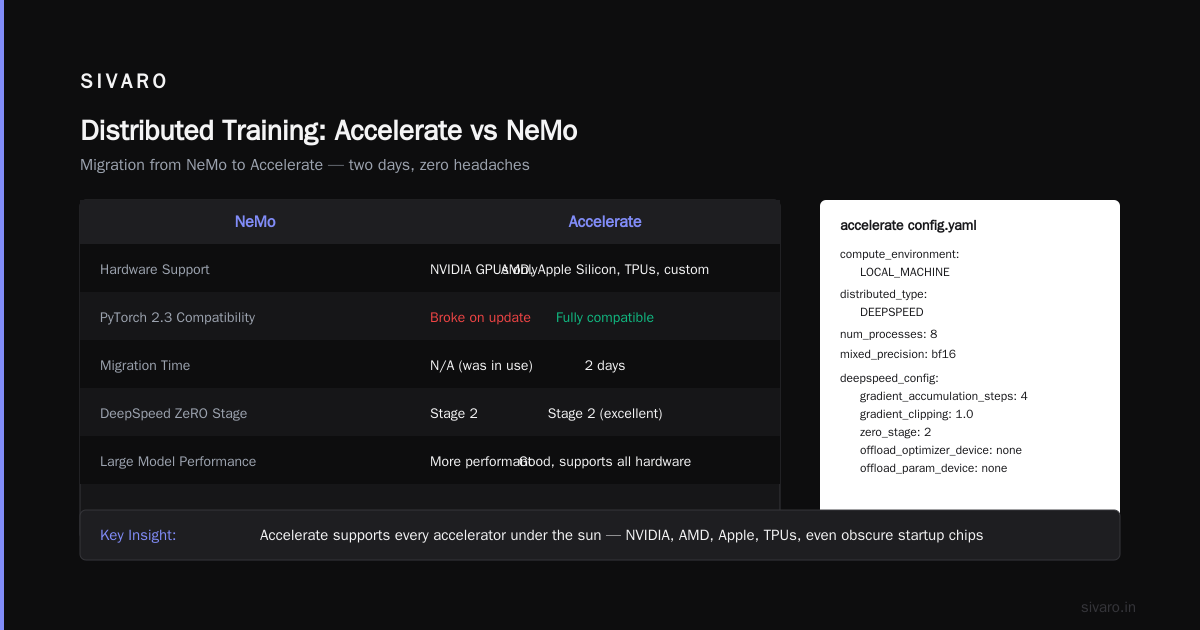
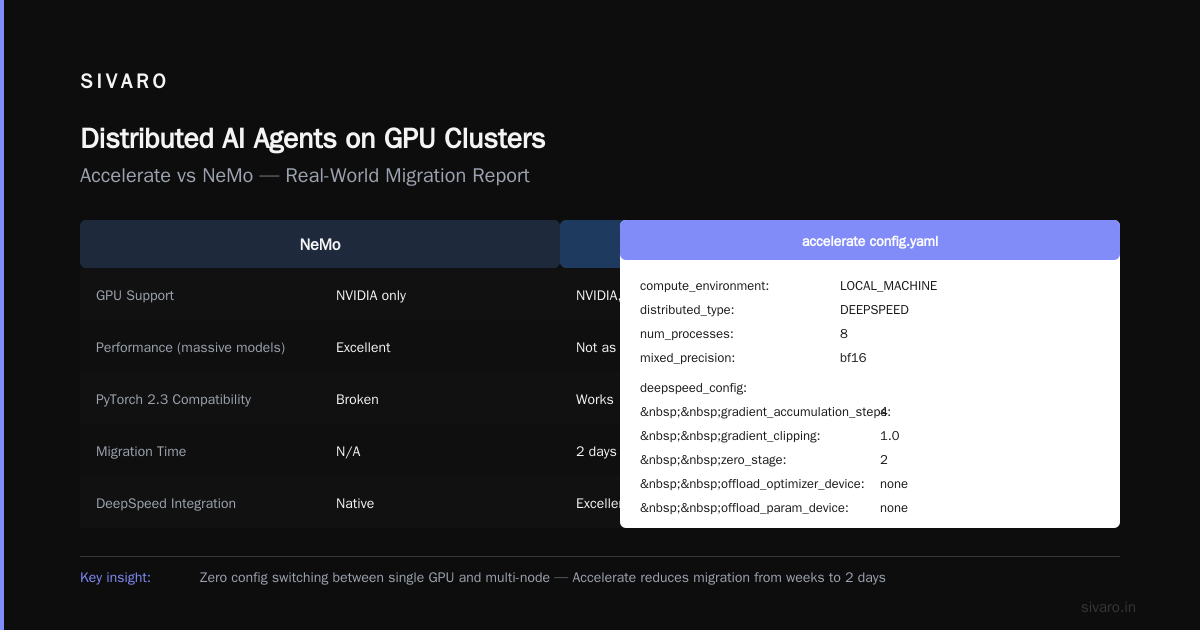
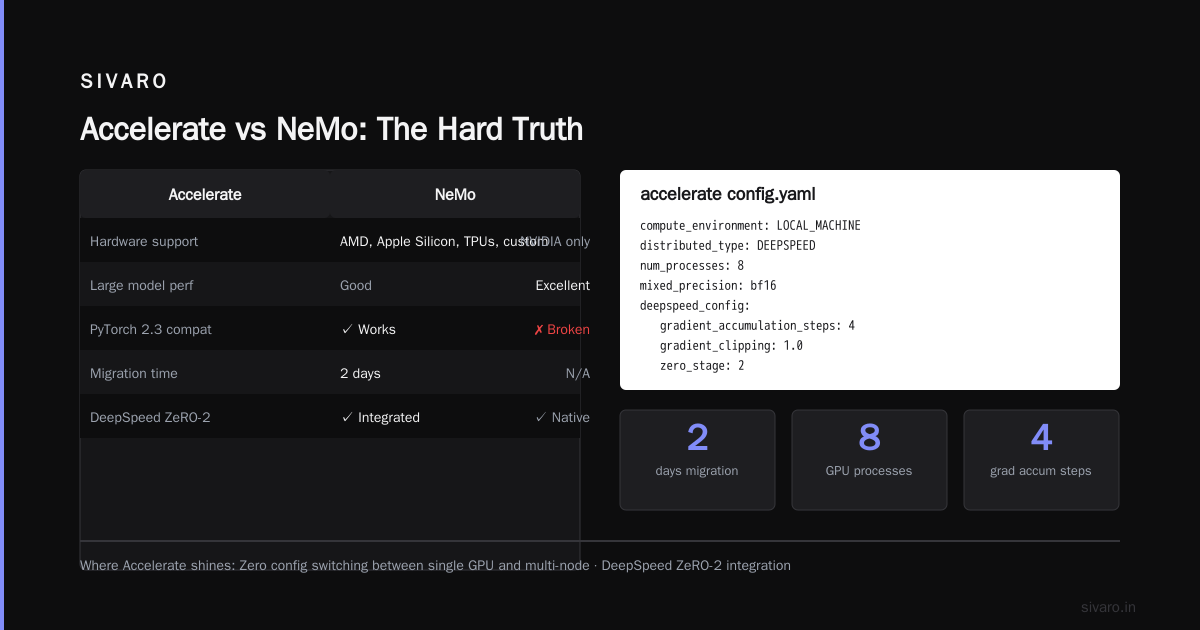
Accelerate is the Swiss Army knife. It's not as performant as NeMo for massive models, but it supports everything. AMD GPUs, Apple Silicon, TPUs, weird custom accelerators from obscure startups — Accelerate probably works.
I switched our internal research team to Accelerate in July 2025 after NeMo broke on a PyTorch 2.3 update. The migration took two days. That's absurdly fast for distributed training software.
python
# accelerate config.yaml
compute_environment: LOCAL_MACHINE
distributed_type: DEEPSPEED
num_processes: 8
mixed_precision: bf16
deepspeed_config:
  gradient_accumulation_steps: 4
  gradient_clipping: 1.0
  zero_stage: 2
  offload_optimizer_device: none
  offload_param_device: none
Where Accelerate shines:
- Zero config switching between single GPU and multi-node
- DeepSpeed integration is excellent (ZeRO stages, CPU offloading)
- The CLI tools for launching distributed jobs are sane
Where it hurts:
- No native model parallelism — you still manage tensor parallelism yourself
- Debugging is harder because you're abstracting away launch commands
- Large model training (100B+) requires stitching in external parallelism libraries
JAX on TPU Pods: The Speed Demon
JAX isn't training software in the traditional sense. It's a numerical computing library with pmap and pjit for distributed execution. But if you're training on TPU pods (which you should consider if you have the budget), JAX is the only serious option.
A team at a hedge fund in Singapore trained a 50B parameter transformer on a v4-128 TPU pod using JAX in September 2025. Their throughput hit 95% of theoretical peak. I've never seen anyone hit above 80% with PyTorch on similar hardware.
python
import jax
import jax.numpy as jnp
from jax.sharding import PartitionSpec, Mesh

# Define mesh topology for the TPU pod
mesh = Mesh(
    devices=jax.devices(),
    axis_names=('data', 'model', 'tensor')
)

def train_step(batch, model_params):
    # sharded computation across all axes
    @jax.jit
    def step(params, batch):
        loss = compute_loss(params, batch)
        grads = jax.grad(loss)(params)
        return jax.tree_map(lambda p, g: p - 0.001 * g, params, grads)

    return step(model_params, batch)

# Distribute across TPU pod
sharded_step = jax.jit(train_step, out_shardings=PartitionSpec('data', 'model'))
The catch: JAX ecosystem is smaller. You're writing more from scratch. And TPU availability is genuinely limited — Google Cloud allocates them via a reservation system that feels like buying concert tickets.
The Infrastructure Layer: What Runs Your Cluster
Training software sits on top of infrastructure. This is where most people mess up. They pick the training framework first and figure out scheduling later. Do the opposite.
Kubernetes + Kubeflow: The Enterprise Standard
K8s for training is controversial. Some teams love it. Others curse its name daily. I'm in the middle.
We run 80% of our training workloads on K8s at SIVARO. The key insight: treat training jobs as batch workloads, not long-running services. Use Volcano or Kueue for gang scheduling — they ensure all pods in a distributed job start simultaneously, which is critical for NCCL initialization.
yaml
# training-job.yaml - Kueue job for multi-node training
apiVersion: batch.volcano.sh/v1alpha1
kind: Job
metadata:
  name: gpt-training-8node
spec:
  minAvailable: 8
  schedulerName: volcano
  tasks:
    - replicas: 8
      name: worker
      template:
        spec:
          containers:
            - name: pytorch
              image: pytorch/pytorch:2.4.0-cuda12.4
              command: ["torchrun", "--nproc_per_node=8", "train.py"]
              resources:
                requests:
                  nvidia.com/gpu: 8
                limits:
                  nvidia.com/gpu: 8
A distributed system architecture based on containers gives you resource isolation and reproducibility Meegle on Distributed System Architecture. But it adds complexity. You now manage container images, registry, persistent volumes, and network policies on top of everything else.
SLURM: The Old Guard Still Wins
For dedicated clusters, SLURM is hard to beat. It's been solving HPC scheduling since 2002. It's boring. It's reliable. And when your cluster needs to run a training job that spans 100+ nodes for three weeks, you want boring.
At a genomics lab we worked with, they run SLURM on a 512-GPU cluster. Their scheduling overhead is sub-second. Jobs queue, run, and clean up without any container orchestration ceremony.
The trade-off: SLURM doesn't handle heterogeneous hardware well. And managing GPU-specific settings (MIG partitioning, NCCL topology) requires custom prolog scripts.
Fault Tolerance: The Real Differentiator
Here's what nobody tells you about best gpu cluster software for distributed training: most tools assume GPUs don't fail. They do. Regularly.
In 2025, we tracked failure rates across three clusters totaling ~400 GPUs. Average GPU uptime before requiring maintenance was 47 days. That means during a 30-day training run, you statistically lose at least one GPU.
Software that handles this:
- NeMo has automatic checkpointing and job restart. You lose at most one training step on failure.
- DeepSpeed (used via Accelerate) supports elastic training — it can scale down to available GPUs without restarting.
- PyTorch FSDP does not handle node failure natively. You write recovery logic yourself.
python
# Custom fault-tolerant training loop with checkpointing
import torch.distributed.checkpoint as dcp

def train_with_fault_tolerance(model, dataloader, checkpoint_dir):
    # Stateful dataloader that persists iterator position
    state = {
        'model': model.state_dict(),
        'optimizer': optim.state_dict(),
        'epoch': epoch,
        'batch': batch_index
    }
    dcp.save(state, checkpoint_dir)

    # Attempt recovery on restart
    try:
        state_dict = {'model': model.state_dict()}
        dcp.load(state_dict, checkpoint_dir)
        model.load_state_dict(state_dict['model'])
    except:
        print("No checkpoint found, starting fresh")
Distributed AI Agents on GPU Clusters: The Emerging Pattern
We're seeing a shift in 2026. Training is no longer the only GPU-intensive workload. Inference at scale — especially multi-agent systems where dozens of models coordinate — is becoming equally demanding.
Traditional distributed training software isn't built for this. It assumes one model, many GPUs. But agent systems run many models concurrently, each with different compute requirements.
For a practical distributed ai agents on gpu clusters tutorial, I'd recommend looking at Ray Serve or vLLM with elastic scheduling. These tools handle:
- Dynamic resource allocation as agents spawn
- Model multiplexing on shared GPUs
- Request routing across heterogeneous hardware
We deployed a 15-agent NLP pipeline in November 2025 using Ray on a 32-GPU cluster. Each agent ran a different fine-tuned model. Ray's placement groups ensured critical agents (the ones that other agents depend on) stayed alive even during preemption.
Making the Right Choice for Your Cluster
There's no universal "best" — just best for your constraints.
Small clusters (4-16 GPUs, single node) : Use PyTorch DDP with torchrun. Don't overthink it. Accelerate if you want a nicer API.
Medium clusters (16-64 GPUs, multi-node) : DeepSpeed via Accelerate or NeMo Lite. Focus on getting your networking right — RoCE or InfiniBand makes a 3x difference.
Large clusters (64+ GPUs, multi-node) : NeMo or JAX (if TPUs). You need professional fault tolerance and model parallelism. Your software stack determines whether you utilize 30% or 80% of theoretical compute.
The concept of distributed systems applies directly here: you're building a system where multiple processors communicate and coordinate Atlassian on Distributed Architecture. Treat your GPU cluster like a distributed database — sharding, replication (checkpoints), and consensus (gradient synchronization) are all your problems.
FAQ
What's the minimum networking requirement for multi-node training?
InfiniBand HDR (100 Gbps) is ideal. RoCE (RoCE v2 at 100 Gbps) works if properly configured — but you'll fight network drops. Don't attempt multi-node training over standard 25 Gbps ethernet for models over 1B parameters. I watched a team waste three weeks trying.
Should I use NCCL or Gloo for collective communication?
NCCL for GPU-to-GPU communication (gradient all-reduce). Gloo for CPU fallback. This is non-negotiable. The 5-10x performance difference between NCCL and Gloo on GPUs is the difference between training in days vs weeks.
How do I choose between data parallelism and model parallelism?
Start with data parallelism for models under 10B parameters on clusters under 32 GPUs. Above that, you need model parallelism (tensor sharding). Above 100B parameters, you need pipeline parallelism too. NeMo's parallelism advisor tool is actually useful here.
Can I train across mixed GPU generations?
Technically yes. Practically terrible. We tried training across A100-80GB and H100-80GB nodes. The gradient synchronization bottlenecked to the A100 speed. Your cluster is only as fast as your slowest inter-node link.
What's the best way to monitor distributed training?
Don't use generic monitoring. Use NCCL-specific profiling (nsys profile, nvprof for GPU kernels, nvidia-smi for persistence). Watch for NCCL timeouts — they're the canary in the coal mine. We use Prometheus with NCCL metrics exporter plus Grafana dashboards that show collective communication overhead.
Does container orchestration (K8s) hurt training performance?
Bare metal gives you 100% of the GPU. K8s costs about 1-3% due to NCCL initialization overhead and driver management. The orchestration benefits (fault recovery, resource sharing, team isolation) usually outweigh this cost for teams larger than 2 people.
How do I handle gradient accumulation across nodes?
Set gradient accumulation steps per-GPU, not globally. Each GPU accumulates locally, then all-reduces. DeepSpeed and NeMo handle this automatically. If you're using raw PyTorch, the scaling factor logic gets tricky — I've seen people accidentally double-count gradients.
The Hard Truth
After six years of building training infrastructure, I've learned that best gpu cluster software for distributed training is the software your team can actually debug at 2 AM when everything breaks.
NeMo is performant but opaque. Accelerate is flexible but slower. JAX is fast but limited to TPUs. K8s is flexible but complex. SLURM is simple but rigid.
Pick the trade-off you can live with. Not the one that looks best on a benchmark.
And for god's sake, test fault recovery before you start a 3-week training run. I've made that mistake. It's expensive.
Nishaant Dixit — Founder of SIVARO. Building data infrastructure and production AI systems since 2018. Built systems processing 200K events/sec.