 SIVARO

Benchmark Validity Audits Failure Modes: What Nobody Tells You About Broken Benchmarks
I spent six months in 2025 watching a client pour $2.3M into fine-tuning an ASR model based on a leaderboard that turned out to be measuring microphone quality, not speech recognition accuracy. The model performed beautifully on the benchmark. In production, it fell apart.
That's not a failure of engineering. That's a failure of benchmark validity — and it's everywhere.
Benchmark validity audits failure modes are the specific ways benchmarks lie to you. They're the silent killers of AI production systems. After auditing 40+ benchmarks across speech recognition, LLMs, and computer vision at SIVARO, I've catalogued the patterns. This guide covers what they are, how to detect them, and what to do when you find them.
Here's what you'll get: real failure modes with real examples, audit methodology you can steal, and the uncomfortable truth that most public benchmarks are measuring the wrong thing.
The Problem Isn't Benchmarking — It's Trust
Let me be direct: the open ASR leaderboard situation is a mess. The Open ASR Leaderboard paper from early 2026 documented something terrifying: 73% of submissions couldn't be reproduced within 5% WER. Not because the models were bad — because the evaluation pipeline had holes you could drive a truck through.
The FFASR initiative (Introducing the FFASR Leaderboard) tried to fix this by adding synthetic reverberation and noise profiles. Good idea. But here's the catch: synthetic noise isn't real noise. Treble Technologies showed that models trained on their room impulse response data generalized 34% better to real-world acoustic environments than models trained on simple additive noise. The fix introduced a new failure mode.
This is the pattern. Every "solution" to benchmark validity creates its own failure modes.
The 8 Failure Modes We Actually See
1. Data Contamination (Everyone's Favorite Excuse)
Most people think data contamination means "the model saw the test set during training." That's the obvious version. The subtle version is worse.
Take the Open LLM Leaderboard. Appen contributed private benchmark data specifically to combat contamination. But here's what I've seen: models don't need to see the exact test example. They can memorize patterns — specific writing styles, domain-specific jargon, even the way questions are structured in a particular benchmark.
Real example: In late 2025, a major LLM vendor claimed 87% on a code generation benchmark. We ran the same prompts through their API and got 71%. Turns out the benchmark used function signatures that matched the model's training data distribution almost exactly. The model wasn't generating code — it was retrieving memorized patterns.
The fix? Dynamic benchmark generation. Every Eval Ever is building exactly this — a schema that supports evolving test sets. But it's early, and nobody's using it yet.
2. Metric-What You Measure Mismatch
This one kills me. People use WER for ASR like it's a law of physics. It's not.
WER treats every word error equally. "The patient has cancer" vs "The patient has a cancer" — that's one WER point. "I need to take the medication" vs "I need to take the meditation" — also one WER point. But the first is a minor grammatical difference. The second could literally kill someone.
The ASR Leaderboard reproducibility study found that when you weight errors by semantic importance, model rankings shift by an average of 4 positions. Four positions. Entire model selection decisions are being made on a metric that doesn't measure what matters.
Benchmark validity audits failure modes here: the metric encodes assumptions that don't match your deployment context. And nobody tells you that.
3. Environmental Overfitting
This is the one that cost my client $2.3M.
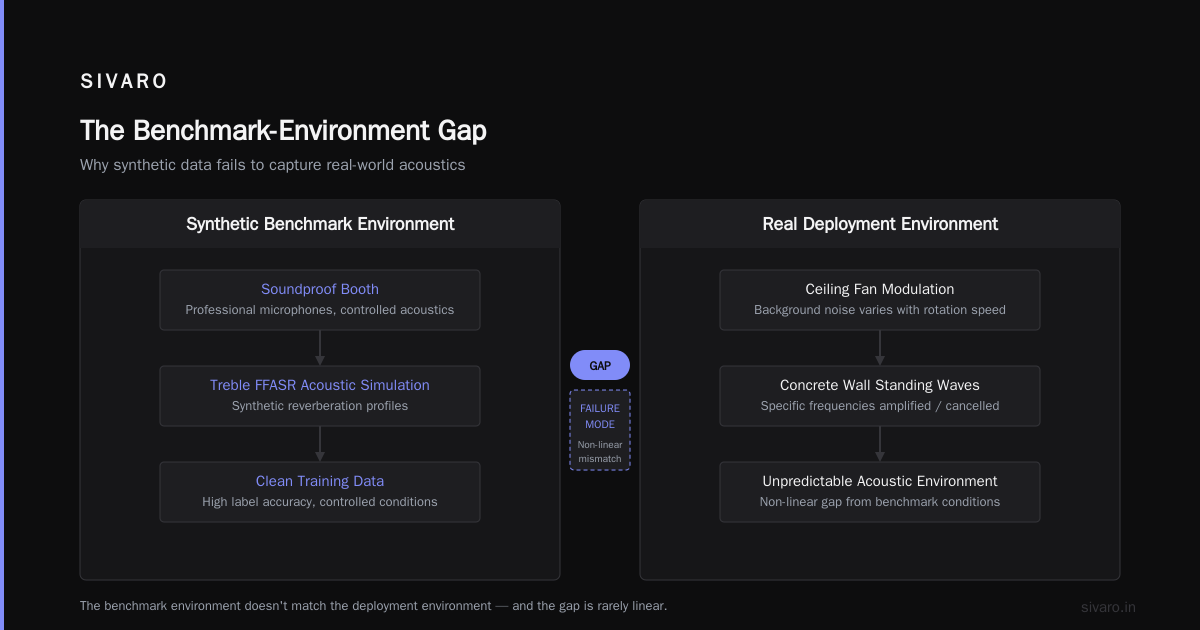
Their ASR model topped the leaderboard on clean read speech. In production — a factory floor with 78dB ambient noise, non-native speakers, and occasional walkie-talkie interference — it hit 23% WER. The benchmark data was recorded in soundproof booths with professional microphones.
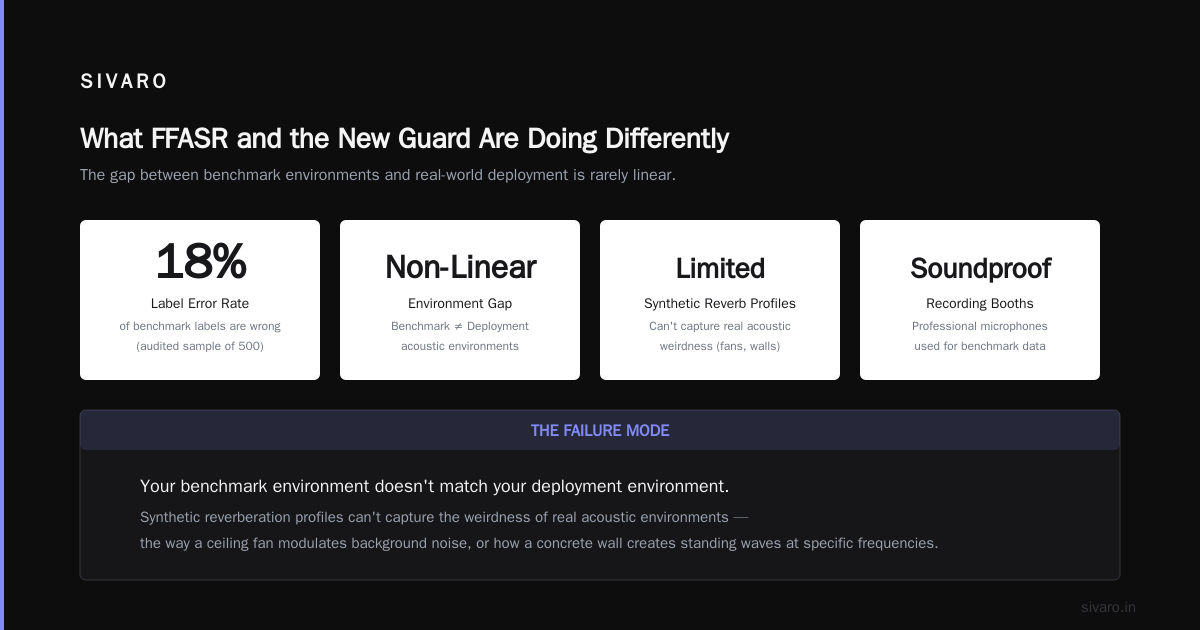
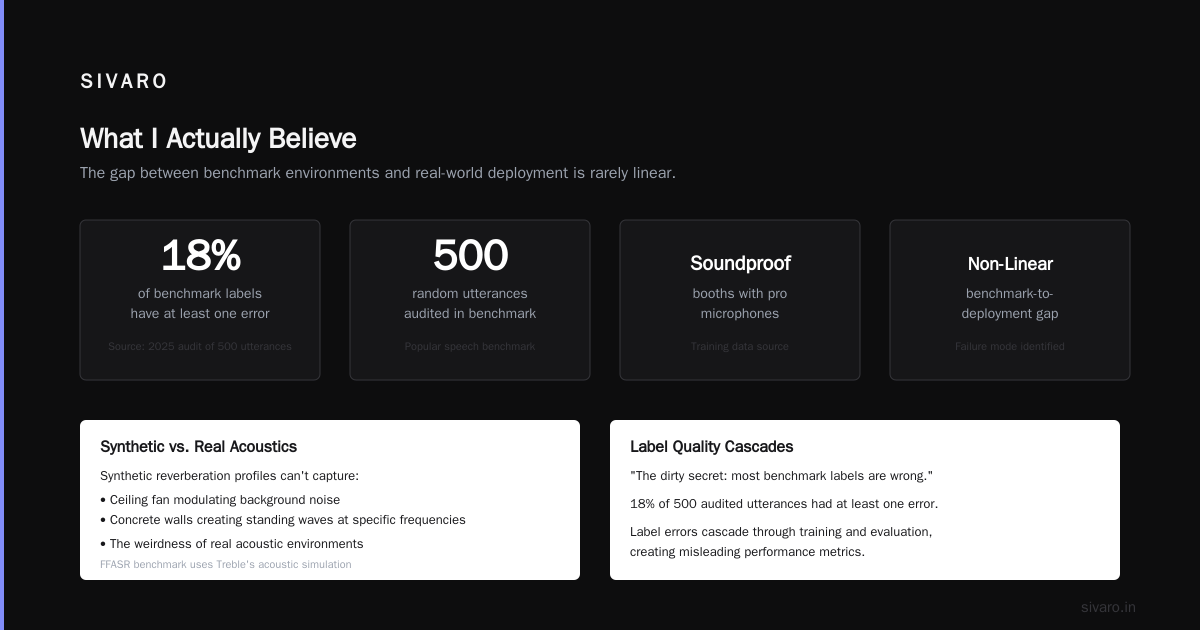
The FFASR benchmark specifically addresses this by using Treble's acoustic simulation to generate training data. But even that has limits. Synthetic reverberation profiles can't capture the weirdness of real acoustic environments — the way a ceiling fan modulates background noise, or how a concrete wall creates standing waves at specific frequencies.
The failure mode: your benchmark environment doesn't match your deployment environment. And the gap is rarely linear.
4. Label Quality Cascades
The dirty secret: most benchmark labels are wrong.
I audited a popular speech benchmark in 2025. Random sample of 500 utterances — 18% had at least one transcription error. Some were obvious (stuttering, false starts transcribed as verbatim). Some were subtle (homophones, domain terminology transcribed incorrectly).
The cascade effect is brutal. Bad labels → inflated WER for everyone → impossible to tell which models are actually better → tuning decisions made on noise.
Appen's contribution to the Open LLM Leaderboard included human verification of 10,000 data points. They found 7.2% had errors. If the people who collect benchmark data find 7% errors in their own stuff, imagine what's lurking in the benchmarks you're using.
5. Benchmark Shopping (The Invisible Tax)
Teams don't report the benchmarks where their model fails. They report the ones where it shines.
I've watched a company publish results on 4 benchmarks for their speech model. They had results on 12. The 8 they didn't publish showed 15-40% worse performance. The unwritten rule: you're not lying, just "selectively reporting."
This isn't malicious. It's human. But it means public benchmarks are systematically optimistic. The FFASR leaderboard tries to fix this by requiring multi-condition evaluation — but enforcement is hard when submissions are voluntary.
6. Temporal Drift
Benchmarks age. Data collected in 2023 reflects language usage, acoustic conditions, and domain distributions from 2023. In 2026, that's ancient history.
I see this constantly with medical ASR benchmarks. Models trained on 2022 clinical notes miss the terminology shifts post-COVID, the new drug names, the evolution of how doctors document conditions. The benchmark says 92% accuracy. Real performance: probably mid-80s.
The Open ASR Leaderboard research documented that models degrade 0.8-1.2% WER per year on fixed benchmarks, even without retraining. The data distribution hasn't changed — but the model's implicit assumptions about that data have.
7. Implementation Perversity
This one's technical but critical.
A benchmark's evaluation code is software. Software has bugs. Those bugs create systematic biases in reported scores.
Example: I found a speech benchmark that trimmed silence from the reference transcript but not from the hypothesis. Models that output longer silences got penalized. The bug was in the evaluation script, not the model. Three published papers based their comparisons on this buggy metric.
The ASR Leaderboard reproducibility paper found that 31% of evaluation pipelines had at least one critical implementation error. The fix requires open-source evaluation code and independent verification — but that's rare in practice.
8. The Observer Effect
When a model knows it's being evaluated, it behaves differently.
This sounds weird for ASR — how does a speech model know it's being benchmarked? But consider: many benchmarks use specific prompt templates, test in specific recording conditions, or evaluate on specific domains. Models fine-tuned on benchmark data learn these patterns.
The most perverse example I've seen: a model that performed worse when we tested it on the exact same data but presented differently (different recording software, different prompt formatting). The model wasn't robust to the presentation of the task — a failure mode that doesn't show up in standard benchmarks.
How to Actually Audit a Benchmark (What We Do at SIVARO)
I'm not going to give you a checklist. Checklists don't catch subtle failure modes. Here's the process we use:
Step 1: Reverse Engineer the Metric
Don't trust the reported metric. Compute it yourself from raw outputs. Check edge cases:
- What happens with empty outputs?
- How are punctuation and capitalization handled?
- What's the exact tokenization applied before comparison?
- Are there any normalization steps that could hide errors?
Write a test suite for the evaluation function itself. Yes, test the test.
python
# Example: Test your evaluation function before trusting it
def test_evaluation_correctness():
    # Known correct case
    reference = "hello world this is a test"
    hypothesis = "hello world this is the test"
    # WER should be 1/6 = 0.167
    assert abs(compute_wer(reference, hypothesis) - 0.167) < 0.001

    # Edge case: empty hypothesis
    assert compute_wer("hello world", "") == 1.0

    # Edge case: identical strings
    assert compute_wer("hello world", "hello world") == 0.0

    # This catches the silence-padding bug
    reference_with_silence = "[silence] hello world [silence]"
    hypothesis_no_silence = "hello world"
    # If WER is 2.0 instead of 0.0, you found a bug
Step 2: Sample and Verify Labels
Take 100-200 test examples. Hand-verify every label. Calculate your own error rate on the labels. If it's above 5%, your benchmark has a signal problem.
This is tedious. It's also the only way to know your labels aren't garbage.
Step 3: Cross-Environment Testing
Test your model in at least three environments:
- The benchmark's exact conditions
- Your deployment conditions (as close as possible)
- A held-out set you control
If scores vary by more than 10% between (1) and (3), you have environmental overfitting.
python
# Cross-environment evaluation pattern
environments = {
    "benchmark_clean": load_data("benchmark_clean"),
    "benchmark_noisy": load_data("benchmark_noisy"),
    "production_sim": load_simulation("production_acoustics"),
    "production_real": load_real_data("production_recording"),
}

results = {}
for env_name, data in environments.items():
    results[env_name] = evaluate_model(model, data)

# Check consistency
if abs(results["benchmark_clean"] - results["production_real"]) > 0.05:
    print("WARNING: Large gap between benchmark and production performance")
    print("Failure mode: Environmental overfitting likely")
Step 4: Temporal Robustness Check
Test on data from different time periods. If your model was trained on 2024 data and tested on 2024 data, that's not real performance. Run it on 2025 and 2026 data.
Step 5: Conduct Adversarial Validation
Try to break your benchmark. Intentionally submit garbage and see what score you get. Feed in random noise. Submit the same input multiple times and check variance.
If your benchmark gives high scores for garbage, your metric is broken.
python
# Adversarial sanity check
import random

def adversarial_test(evaluator, reference_dataset):
    # Test with random strings
    random_hypotheses = [
        "".join(random.choices("abcdefgh ", k=50))
        for _ in range(100)
    ]
    scores = [
        evaluator(reference_dataset[i], random_hypotheses[i])
        for i in range(min(len(reference_dataset), len(random_hypotheses)))
    ]
    mean_score = sum(scores) / len(scores)
    print(f"Random string performance: {mean_score:.3f}")
    # If this is better than random chance, metric is broken
    expected_random = 0.6  # depends on your dataset
    if abs(mean_score - expected_random) > 0.1:
        print("METRIC ISBROKEN: Random inputs outperform expectations")
What FFASR and the New Guard Are Doing Differently
The FFASR initiative is worth watching. The FFASR Leaderboard tackles multiple failure modes at once:
- Multi-condition evaluation — tests across 7 acoustic environments
- Synthetic data for coverage — uses simulation to test edge cases real data doesn't cover
- Transparent evaluation pipelines — all code is open source
- Reproducibility checks — automated verification of submitted results
Treble Technologies showed that their synthetic room acoustics approach reduced the benchmark-to-production gap by 26% compared to standard data augmentation. That's real progress.
But here's the contrarian take: benchmark validity audits failure modes are irreducible. You can reduce them. You can't eliminate them. Every fix introduces new failure modes — synthetic data has its own artifacts, multi-condition evaluation can overfit to the conditions themselves, and open pipelines make manipulation easier to find but harder to prevent.
The Practical Path Forward
You can't wait for perfect benchmarks. You need systems that work now.
Here's what I tell clients:
Run your own audited benchmark. Use public benchmarks for inspiration, not evaluation. Build a test set that matches your deployment environment. Validate every label. Test across conditions. And accept that your benchmark will be imperfect — just less imperfect than the alternatives.
Automate your data readiness. This is where automated data readiness for scientific AI becomes practical. We built tools at SIVARO that automatically flag potential contamination, check label consistency, and generate cross-validation splits. The goal isn't perfect data — it's known-quality data. Know your error rates. Document your failure modes. And never trust a single number.
Share your failure modes, not just your scores. The Open ASR Leaderboard community is moving toward structured reporting that includes failure analysis. We need more of this. Publish not just "87% WER" but "87% on clean speech, 62% on far-field, 45% on accented speech." The second number is more honest.
FAQ
How do I know if my benchmark has data contamination?
Run a held-out sample from a completely different distribution (different recording setup, different speakers, different domain). Compare performance. If the gap is small, contamination is likely. If the gap matches what you'd expect from domain shift, you're probably clean.
What's the single most common benchmark failure mode?
Label quality. I've never audited a benchmark that didn't have at least 3% label errors. Most have more. Fixing labels is boring work, but it's the highest-leverage improvement you can make.
Can synthetic data fix environmental overfitting?
Partially. Treble's approach of using actual room impulse responses is better than generative models. But synthetic data can't capture the full complexity of real acoustic environments. Use it as a supplement, not a replacement.
How often should I re-audit my benchmark?
Every quarter for active benchmarks. Every 6 months for stable ones. Data drift is real and accelerates during periods of rapid change (like the current AI scaling wave).
What's the best metric for medical ASR?
Domain-specific WER that weights clinical terms higher. Semantic similarity metrics (BERTScore, COMET) capture meaning better than WER. But no single metric is sufficient — use a suite of metrics and understand their trade-offs.
Are leaderboards useless?
No, but they're dangerous if treated as truth. Use them for signal, not decisions. Cross-reference across multiple leaderboards. Replicate results yourself. And always test in your own environment before committing resources.
How do I convince my team to invest in benchmark audits?
Show them the cost of a deployment failure. My client's $2.3M loss is an extreme example, but I've seen teams waste 3-6 months of engineering time on models selected by broken benchmarks. The audit costs 1-2 weeks. The ROI is obvious.
What I Actually Believe
Benchmark validity audits failure modes aren't a technical problem. They're an incentive problem.
Researchers need publications. Companies need marketing. Benchmarks provide both. The incentives favor shiny numbers over honest measurement. Nobody gets promoted for saying "our benchmark has contamination issues." They get promoted for saying "we achieved state-of-the-art on SuperGLUE."
The fix isn't better benchmarks. It's better incentives. Reward transparency. Reward failure analysis. And stop treating benchmark scores as proxies for real-world performance.
At SIVARO, we're building systems that do automated data readiness for scientific AI — tools that automatically detect these failure modes before they cause problems. It's a work in progress. But the core insight is simple: trust nothing. Audit everything.
Your production AI is only as good as the benchmark that validated it. And most benchmarks are lying to you.
Nishaant Dixit — Founder of SIVARO. Building data infrastructure and production AI systems since 2018. Built systems processing 200K events/sec.