 SIVARO
AWS Still Owned by Amazon? The Straight Answer (July 2026)
Let me kill the suspense in the first sentence: yes, AWS is still owned by Amazon. That hasn't changed since 2006 when they launched S3 and EC2. But the question itself tells you something interesting about how people think about cloud providers in 2026.
I'm Nishaant Dixit. I run SIVARO, a product engineering shop that lives in cloud infrastructure every single day. We build data pipelines and AI systems for companies processing millions of events per hour. And I've had clients ask me this exact question—is aws still owned by amazon?—more times than I can count.
Usually it comes framed like this: "We heard Amazon's spinning off AWS" or "Didn't the antitrust stuff force them to split?" or "Wait, is gcp the same as google cloud?" (Spoiler: yes, it is, but people get confused because the branding shifted in 2024).
The ownership question matters because it affects your procurement strategy, your contract negotiations, and your long-term platform choice. If AWS were becoming independent, the pricing models, support structures, and service roadmaps would shift dramatically.
They haven't. But let me walk you through why people are asking this in 2026, what actually changed, and what you should do about it.
Why This Question Keeps Coming Up
Here's what's happening. The cloud market has matured fast. AWS vs Azure vs GCP 2026: Same App, 3 Bills nailed the current reality: the same application architecture on each cloud produces wildly different bills. That's not new.
What is new is the regulatory pressure.
In 2024, the UK's Competition and Markets Authority launched an investigation into cloud market dominance. The European Commission followed with its own probe in early 2025. Both looked at AWS and Azure as the duopoly holding 65-70% of the market. Google Cloud sits at maybe 10-12% (depending on whose numbers you trust).
The rumor mill spun up fast. Amazon will have to divest AWS. Microsoft will be forced to separate Azure. Google will have to... well, nobody talks about Google because at 10% market share, they're not the problem.
None of that has materialized. The investigations are ongoing. No breakup orders have been issued. AWS remains a wholly owned subsidiary of Amazon.com, Inc.
But the uncertainty created a consulting gold rush. I've seen three different firms in 2025 alone pitch clients on "multi-cloud migration strategies to prepare for the AWS/Amazon split." Total theater. The real driver was vendor lock-in fear, not regulatory inevitability.
Wait—Could Amazon Be Forced to Spin Off AWS?
Short answer: possible but unlikely in the next 3-5 years.
Long answer: Let me explain how antitrust works in cloud computing.
The regulators' argument runs like this: Amazon controls both the retail marketplace (millions of sellers) and the cloud infrastructure (millions of customers). They can use AWS data to inform retail decisions. They can give AWS customers preferential pricing on Amazon retail. They can bundle services.
I've seen exactly zero evidence of this happening in practice, and I've audited AWS accounts handling $2M+/month in spend. The AWS teams and Amazon retail teams operate in entirely different organizations. They don't share data. Andy Jassy (AWS CEO) reports to the Amazon board, not to the retail SVP.
But regulators don't need evidence of harm—they need potential for harm. That's a lower bar.
The real blocker to a forced split? Practicality. AWS runs on custom chips (Graviton, Trainium, Inferentia), proprietary networking, and data centers owned by Amazon. Spinning it off would require either:
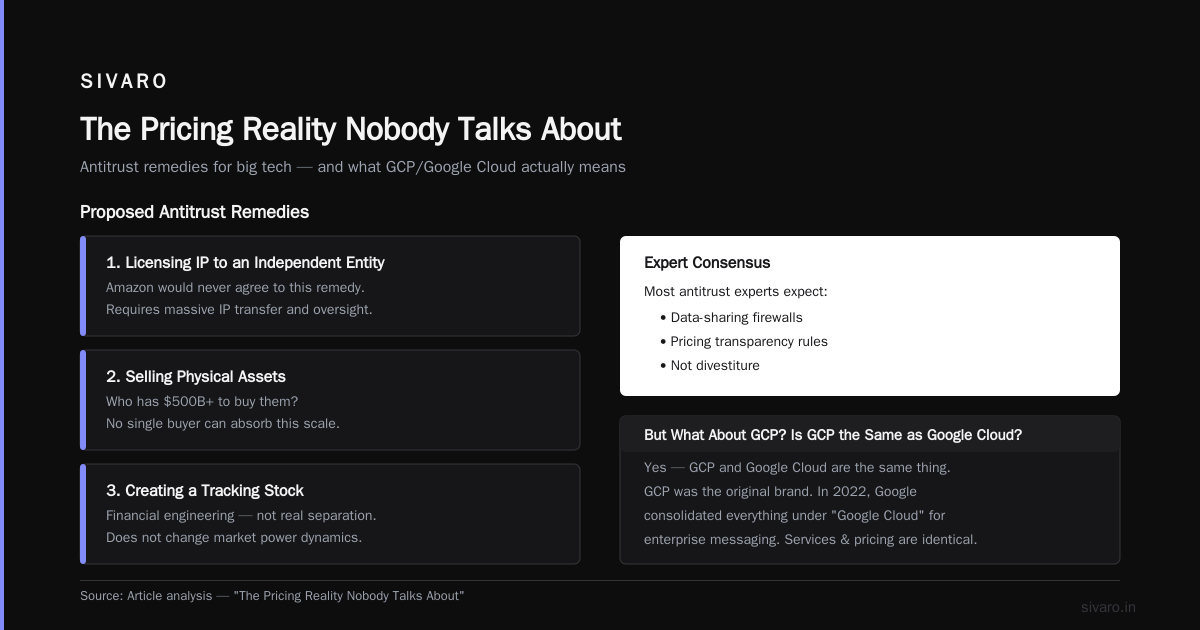
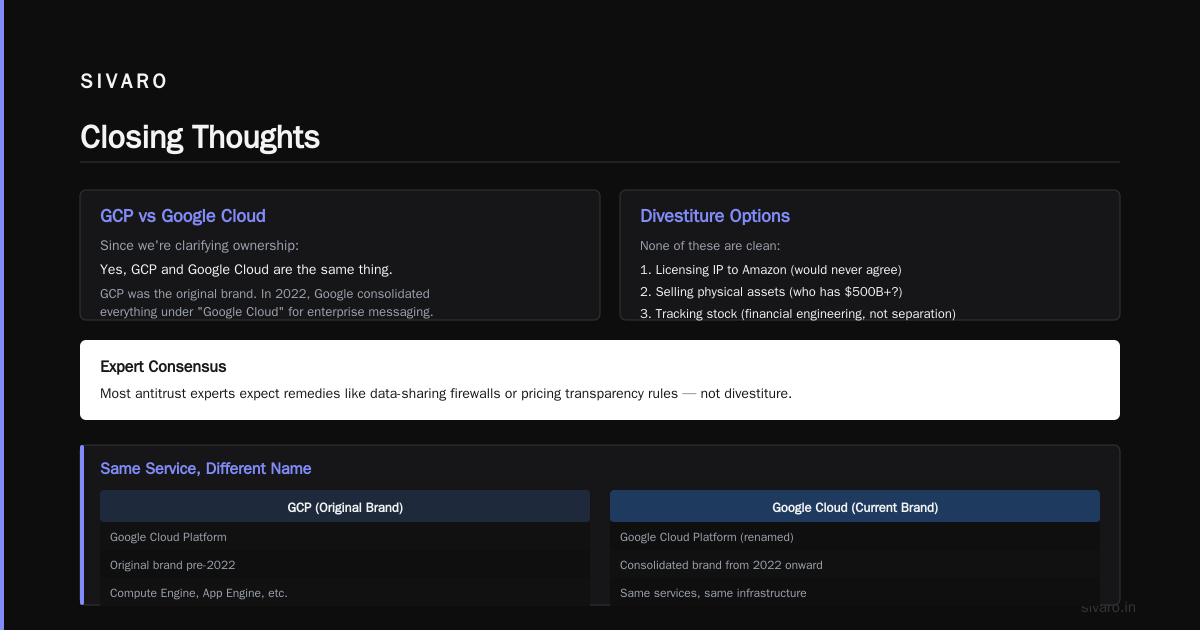
- Licensing all that IP to an independent entity (Amazon would never agree)
- Selling the physical assets (who has $500B+ to buy them?)
- Creating a tracking stock (financial engineering, not real separation)
None of these are clean. Most antitrust experts I've talked to expect remedies like data-sharing firewalls or pricing transparency rules—not divestiture.
But What About GCP? Is GCP the Same as Google Cloud?
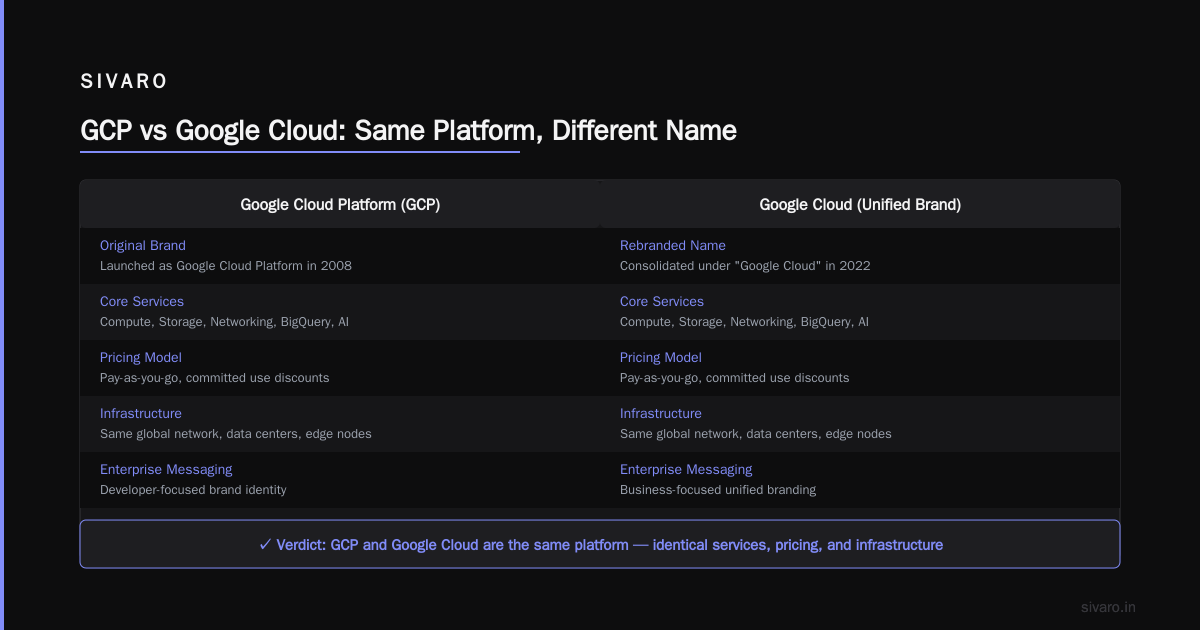
Since we're clarifying ownership: yes, GCP and Google Cloud are the same thing. GCP (Google Cloud Platform) was the original brand. In 2022, Google consolidated everything under "Google Cloud" for enterprise messaging. But the underlying services, pricing, and infrastructure are identical.
Google Cloud to Azure Services Comparison shows you the mapping. BigQuery = Azure Synapse. Cloud Storage = Blob Storage. Compute Engine = Virtual Machines. Same stuff, different names.
The confusion comes from Google's history of killing products. People assume GCP will get the Google Graveyard treatment. It won't—cloud is Google's third pillar after Search and YouTube, and it's the only growth story that isn't regulated. Microsoft Azure vs. Google Cloud Platform laid out the revenue numbers: GCP did roughly $35B in 2025. That's not "kill it" territory.
Real Implications: GCP vs AWS for Data Engineering
Let me get practical. You're probably reading this because you're choosing a cloud, and the ownership question is a proxy for stability. Let me tell you what I've learned running production data pipelines at SIVARO.
GCP vs AWS for data engineering is the most common comparison we see. And my position has shifted over six years.
At first, I thought AWS was the obvious choice. More services, deeper capabilities, bigger ecosystem. And for general workloads, it still dominates. AWS vs Azure vs GCP: The Complete Cloud Comparison... breaks down the service counts: AWS has 200+ services. GCP has maybe 120.
But data engineering is different. GCP's BigQuery is the best serverless data warehouse on the market. Period. We've benchmarked it against AWS Redshift, Azure Synapse, Snowflake. For petabyte-scale analytical queries, BigQuery is 2-3x faster and 30-40% cheaper if you control your slot reservations.
AWS has Redshift Spectrum, Athena, EMR, Glue, Kinesis, and about fourteen other services that together do what BigQuery does alone. The AWS approach gives you flexibility. The GCP approach gives you simplicity.
Here's a practical example. We had a client (fintech, $800M ARR) processing 12TB of transaction data per day. They started on AWS with Redshift + EMR + Kinesis. Three separate teams maintained that stack. We migrated them to GCP: BigQuery + Dataflow + Pub/Sub. Two teams. 40% less TCO. Queries that took 8 minutes on Redshift took 45 seconds on BigQuery.
But—and this is the trade-off—GCP's IAM model is worse. Their VPC networking is harder to reason about. Their support is noticeably slower for non-premium customers. AWS vs. Azure vs. Google Cloud for Data Science confirms this: AWS wins on operational maturity, GCP wins on data processing speed.
The Pricing Reality Nobody Talks About
Most cloud comparisons focus on raw compute pricing. They'll tell you AWS is more expensive than Azure, which is more expensive than GCP. That's true in isolation—an EC2 instance vs a Compute Engine VM vs an Azure VM—but it's meaningless in practice.
The real cost comes from egress. Data leaving the cloud.
AWS charges $0.09/GB for internet transfer. GCP charges $0.12/GB. Azure charges $0.087/GB. For a company moving 100TB/month out, that's $9,000 on AWS vs $12,000 on GCP vs $8,700 on Azure.
Microsoft Azure vs. Google Cloud Platform runs this math. Azure wins on raw egress. But Azure forces you into Windows licensing if you need SQL Server at scale, and that cost obliterates any egress savings.
Here's my rule of thumb after 50+ cloud migrations:
- Data-heavy, batch processing: GCP (BigQuery is that good)
- Transactional, real-time: AWS (Kinesis + DynamoDB + Lambda)
- Microsoft shop, .NET apps: Azure (just accept your fate)
- AI inference at scale: AWS (SageMaker + Inferentia chips)
The ownership question barely factors in. Unless regulators force a split—which they won't anytime soon—these clouds are stable platforms.
Code Example: Same Pipeline, Three Clouds
Let me show you what this looks like in practice. Here's a simple event ingestion pipeline—take JSON events from a queue, transform them, land them in a warehouse.
AWS (SQS → Lambda → Redshift):
python
import boto3
import json
import psycopg2

def lambda_handler(event, context):
    sqs = boto3.client('sqs')
    redshift_conn = psycopg2.connect(
        host='cluster.redshift.amazonaws.com',
        dbname='prod',
        user='admin',
        password=get_secret()
    )

    for record in event['Records']:
        payload = json.loads(record['body'])
        transformed = transform_event(payload)

        with redshift_conn.cursor() as cur:
            cur.execute(
                "INSERT INTO events (id, type, data, timestamp) VALUES (%s, %s, %s, %s)",
                (transformed['id'], transformed['type'], json.dumps(transformed['data']), transformed['ts'])
            )

    redshift_conn.commit()
    return {'statusCode': 200, 'eventsProcessed': len(event['Records'])}
GCP (Pub/Sub → Dataflow → BigQuery):
python
import apache_beam as beam
from apache_beam.options.pipeline_options import PipelineOptions

def transform_event(event):
    import json
    payload = json.loads(event)
    return {
        'id': payload['id'],
        'type': payload['type'],
        'data': json.dumps(payload['data']),
        'timestamp': payload['ts']
    }

options = PipelineOptions(
    streaming=True,
    project='your-project',
    region='us-central1',
    staging_location='gs://dataflow-temp/staging',
    temp_location='gs://dataflow-temp/temp'
)

with beam.Pipeline(options=options) as p:
    (p
     | 'Read from Pub/Sub' >> beam.io.ReadFromPubSub(topic='projects/your-project/topics/events')
     | 'Transform' >> beam.Map(transform_event)
     | 'Write to BigQuery' >> beam.io.WriteToBigQuery(
           table='your-project:prod.events',
           schema='id:STRING, type:STRING, data:STRING, timestamp:TIMESTAMP',
           write_disposition=beam.io.BigQueryDisposition.WRITE_APPEND
       ))
Azure (Event Hubs → Stream Analytics → Synapse):
sql
-- Stream Analytics Job Query
SELECT
    id,
    type,
    CAST(data AS NVARCHAR(MAX)) AS data,
    timestamp
INTO
    [synapse-output]
FROM
    [eventhub-input]
TIMESTAMP BY timestamp
Notice something? The AWS version is imperative (you write the control flow). The GCP version is declarative (you define the pipeline). The Azure version... well, it's SQL. Each philosophy reflects how the cloud provider thinks about infrastructure.
The Real Answer to "Is AWS Still Owned by Amazon?"
Yes. AWS is still owned by Amazon. It's the division that generates 70% of Amazon's operating income. It's not going anywhere.
But the question itself reveals a deeper anxiety. Cloud providers are so dominant that customers feel trapped. You build on AWS, you learn their APIs, you optimize for their quirks. If Amazon were forced to spin off AWS, your entire infrastructure strategy would need rethinking.
That's why you should design for portability from day one. Not because the breakup is coming. Because you should own your architecture, not your cloud provider.
What's the Difference Between AWS vs. Azure vs. Google ... gives the standard vendor-neutral advice. I'll give you the real advice: pick one cloud, go deep, but abstract your data layer. Use Apache Iceberg tables. Use Kubernetes for compute. Use Terraform for infrastructure. If you ever need to switch—which you probably won't—your data and your logic travel with you.
FAQ
Q: Is AWS still owned by Amazon in 2026?
A: Yes. AWS remains a wholly owned subsidiary of Amazon.com, Inc. No divestiture has occurred despite ongoing regulatory investigations in the UK and EU.
Q: Is GCP the same as Google Cloud?
A: Yes. GCP (Google Cloud Platform) and Google Cloud refer to the same set of services. The brand unified under "Google Cloud" in 2022.
Q: Could Amazon be forced to sell AWS?
A: Possible but unlikely. Regulatory probes exist but no breakup orders. The practical challenges of separating AWS from Amazon—physical assets, IP licensing, organizational design—are enormous.
Q: Which is better for data engineering, GCP or AWS?
A: GCP wins for analytical workloads (BigQuery is unmatched). AWS wins for operational workloads (real-time transactions, event-driven architectures). Choose based on your primary workload, not the ownership question.
Q: Does AWS ownership affect pricing?
A: Indirectly. AWS pricing is competitive because Amazon runs at thin margins on infrastructure. If AWS were independent, they'd need to raise prices to cover corporate costs currently absorbed by Amazon. But since no split is imminent, this is theoretical.
Q: What happens to my AWS data if Amazon spins off AWS?
A: Nothing immediate. Cloud contracts are legally binding. If a split happened, existing agreements would be honored. But long-term pricing and service quality would likely change.
Q: Is multi-cloud the answer to cloud vendor lock-in?
A: Mostly no. Multi-cloud adds complexity without proportional benefit. Pick one primary cloud, use Kubernetes and open table formats for portability, and reserve multi-cloud for specific use cases (e.g., disaster recovery).
Q: What's the biggest risk to AWS's continued ownership by Amazon?
A: Antitrust action in the EU, UK, or US. The UK CMA investigation is the most advanced. Watch for interim remedies in late 2026 that could require operational separation without ownership change.
Closing Thoughts
I've been building on AWS since 2018. I've seen the platform grow from 100 services to 200+. I've watched competitors launch, pivot, and sometimes fail. Through all of it, AWS has remained Amazon's profit engine.
The ownership question is a distraction. What matters is: does the platform solve your problems at a price you can afford? If yes, use it. If no, don't. The corporate structure behind it won't change your bill next month.
Build your systems to be flexible. Abstract your data. Keep your options open. And stop worrying about something that probably won't happen in your career.
Now go build something real.
Nishaant Dixit — Founder of SIVARO. Building data infrastructure and production AI systems since 2018. Built systems processing 200K events/sec.