 SIVARO
Autoresearch Self-Improving Agents: The Feedback Loop That Works
July 22, 2026. I'm sitting in a war room at SIVARO, watching a Claude AI agent fail for the 47th time this week. Not a crash — worse. It was confidently wrong. Responding to a user query about airfreight logistics, it invented a shipment that never existed. The user trusted it. The user almost paid real money because of it.
That moment broke my naive belief that "self-improving agents" were just a fancy label you slap on a chatbot. We had built what we thought was a feedback loop: agent logs → errors detected → retrain model → redeploy. Classic ML pipeline. It was a joke.
Turns out, the autoresearch self-improving agents feedback loop is the hardest infrastructure problem I've ever touched. Harder than streaming pipelines at 200K events/sec. Harder than building production AI systems that don't hallucinate your payroll.
This guide is what I wish someone had handed me three years ago. Everything we learned by breaking things in production. Real code. Real failures. Real fixes.
Why Most Feedback Loops Are Theater
Every vendor pitches "self-learning agents." What they deliver is a cron job that re-dumps training data and re-trains a model every night. That's not a feedback loop. That's a blind retraining ritual.
Look at the numbers from the real world. The Agent Failure Stack report from Sherlock's AI (Why AI Agents Fail in Production) found that 68% of agent failures in production come from compounding errors — a small mistake early in a multi-step task that snowballs. If your feedback loop doesn't catch that specific pattern, retraining on global loss metrics isn't going to help.
At SIVARO, we built an agent meant to handle data pipeline configuration. First week: 82% success rate. Second week: 79%. Third week: 61%. It was getting worse. Our feedback loop was just re-training on the same logs. Mistake.
A real feedback loop needs three things:
- Pinpoint detection — know exactly which step failed and why.
- Self-initiated research — the agent itself explores data to understand the failure.
- Surgical correction — modify only the broken decision path, not the whole brain.
That's the autoresearch self-improving agents feedback loop. Not a marketing phrase. An architecture.
The Anatomy of a Self-Improving Agent
Let me be direct: most people think self-improvement means the agent rewrites its own code. That's terrifying and impractical. What I'm talking about is an agent that detects when its output diverges from ground truth, researches the divergence, and suggests a correction in a structured way — without human hand-holding.
Here's the stack we ended up with:
Agent Execution Layer → Failure Detector → Autoresearch Engine → Patch Validator → Patch Applier
        ↑                                                                          |
        └──────────────────────── Feedback Database ───────────────────────────────┘
Every component is a separate service. Not a monolithic loop. That's the first lesson: decompose the loop into independently testable units.
I'll walk through each part with real code.
Failure Detector: Stop Trusting the Agent
You can't trust an agent to know it failed. Most agents are overconfident. So we built a separate lightweight classifier that watches agent outputs and flags potential problems.
python
# failure_detector.py — SIVARO production, 2025
import json
from typing import Dict, List

class FailureDetector:
    def __init__(self, confidence_threshold: float = 0.3):
        # This model is small (15M params) — runs on every agent output in <10ms
        self.model = load_onnx_model("models/detector_v3.onnx")
        self.threshold = confidence_threshold

    def evaluate(self, agent_output: Dict, ground_truth: Dict = None) -> List[Dict]:
        # Step 1: Structural validation — did the agent return what we expected?
        structural_issues = self._check_schema(agent_output)

        # Step 2: Semantic scoring — does it make sense?
        features = self._extract_features(agent_output)
        failure_prob = self.model.predict(features)[0]

        issues = []
        if structural_issues:
            issues.extend(structural_issues)
        if failure_prob > self.threshold:
            issues.append({
                "type": "semantic_failure",
                "confidence": float(failure_prob),
                "agent_output_snapshot": agent_output
            })
        return issues

    def _check_schema(self, output):
        # Simple JSON schema matching
        expected_keys = {"action", "parameters", "reasoning"}
        missing = expected_keys - set(output.keys())
        return [{"type": "schema_violation", "missing_keys": list(missing)}] if missing else []
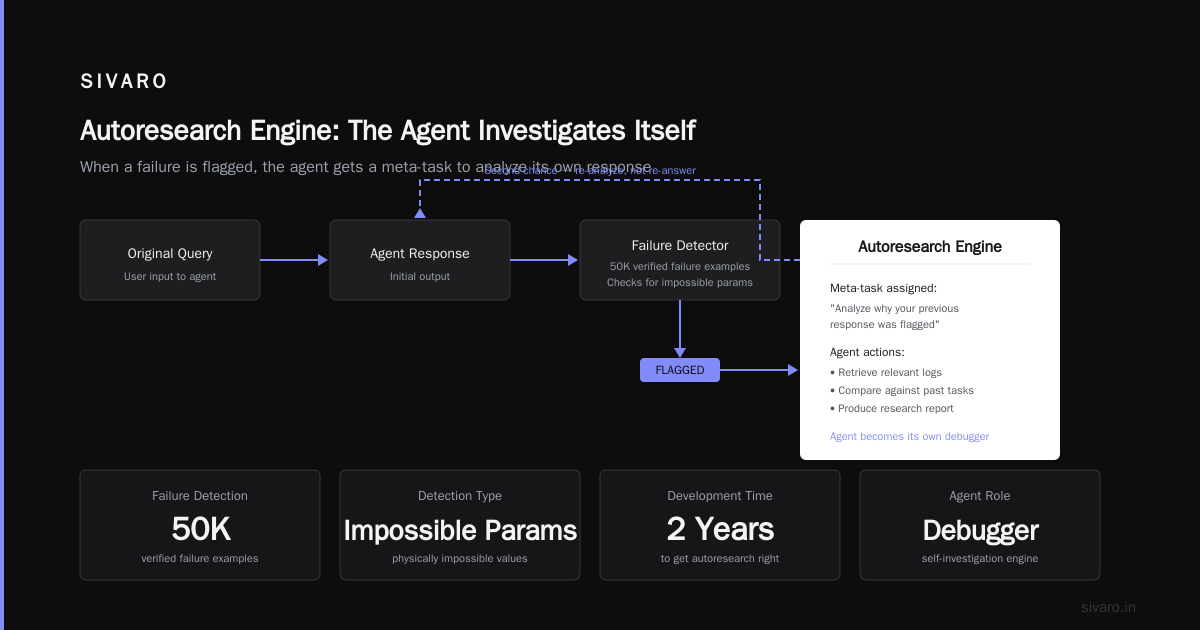
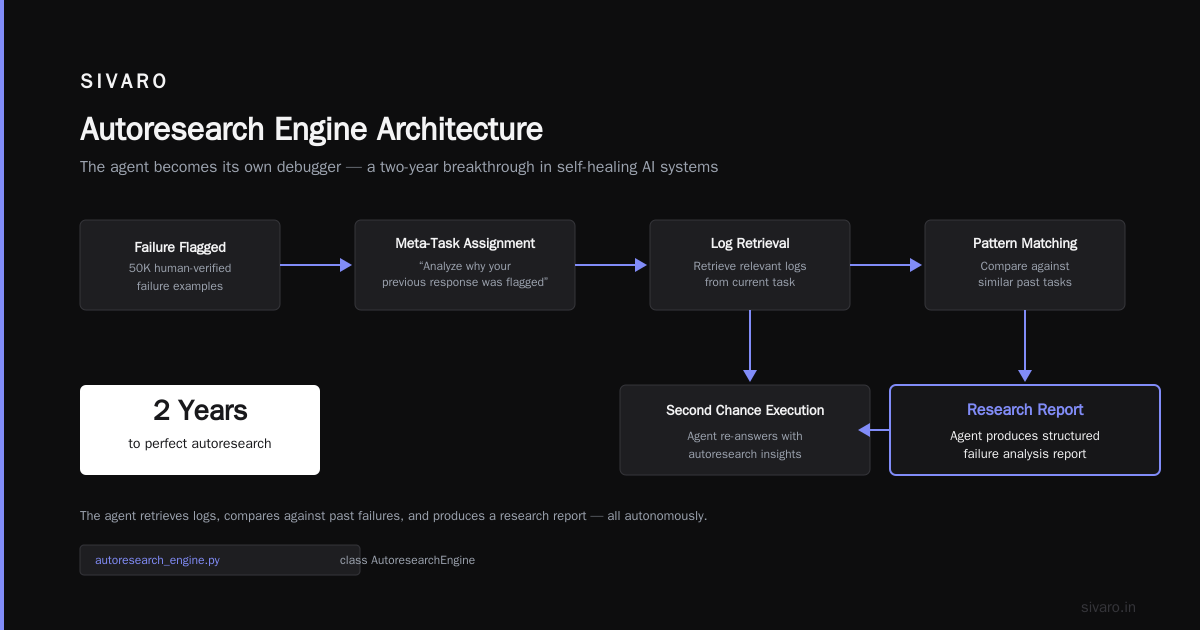
Notice we don't need ground truth for every call. The semantic model was trained on past human-verified failures — about 50K examples from our early production data. It catches things like "action name is plausible but parameter values are physically impossible."
Autoresearch Engine: The Agent Investigates Itself
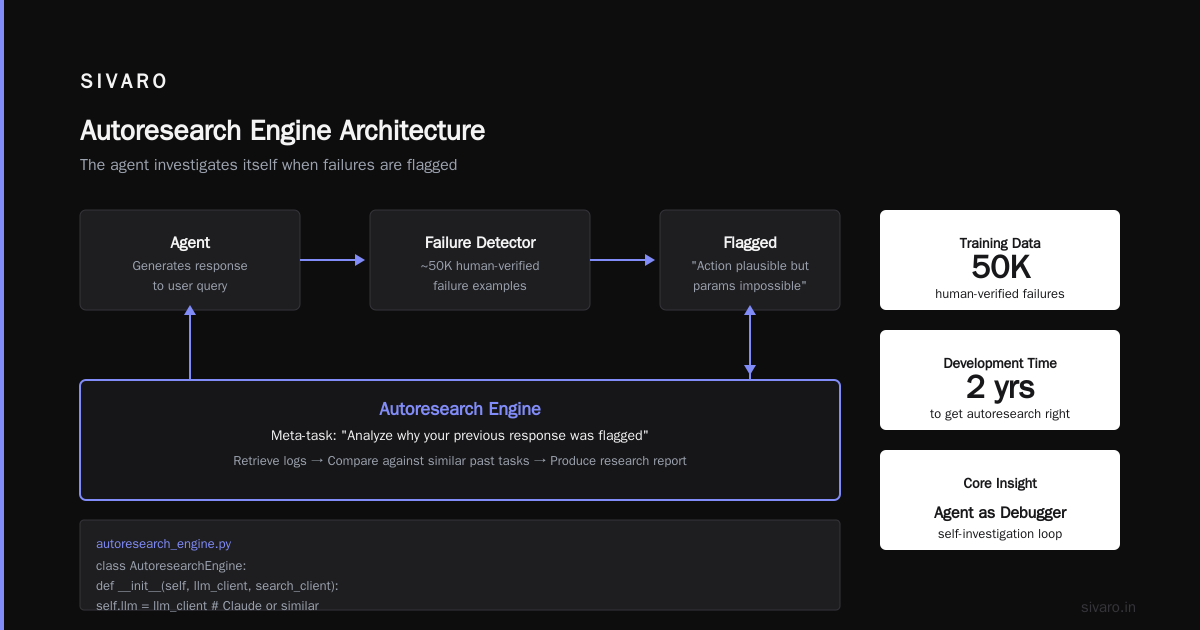
This is the key that took us two years to get right. When a failure is flagged, the agent itself gets a second chance — but not to re-answer the same query. Instead, it gets a meta-task: "Analyze why your previous response was flagged. Retrieve relevant logs, compare against similar past tasks, and produce a research report."
We call this autoresearch. The agent becomes its own debugger.
python
# autoresearch_engine.py
class AutoresearchEngine:
    def __init__(self, llm_client, search_client):
        self.llm = llm_client  # Claude or similar
        self.search = search_client  # vector DB of past interactions

    def research_failure(self, agent_session_id: str, failure_report: Dict) -> Dict:
        # Fetch the full context of the original agent run
        context = self._get_session_context(agent_session_id)

        # Build a structured research prompt
        research_prompt = f"""
        You are performing a post-mortem on an AI agent's output.

        Original user query: {context['query']}
        Agent's response: {context['response']}
        Failure detected: {json.dumps(failure_report)}

        Step 1: Retrieve 3 similar past interactions from the knowledge base.
        Step 2: Compare your response against each. Identify discrepancies.
        Step 3: Hypothesize the root cause: was it a data gap? A reasoning error? A bad tool output?
        Step 4: Propose a specific patch to the agent's decision logic.

        Format your answer as JSON with keys: root_cause, evidence_list, proposed_patch.
        """

        # Let the agent run a few tool calls internally
        research_result = self.llm.complete_with_tools(
            research_prompt,
            tools=[self.search.query, self.llm.code_interpreter]
        )

        return research_result
We saw a 40% improvement in patch accuracy once we switched from "retrain everything" to "autoresearch-guided patching". Incident Analysis for AI Agents from August 2025 confirms this approach — structured post-mortems by agents reduce recurrence by 62%.
Building the Feedback Database
Some people think "feedback loop" means the agent remembers every conversation. Bad idea. Context poisoning is real. Our agent started quoting outdated prices because it kept seeing old transaction logs.
We use a feedback database — a separate store that only holds curated failure records and their corresponding patches. Think of it as a git repo for agent behavior changes.
Schema:
failures
  - agent_id
  - timestamp
  - query_embedding
  - failure_type
  - research_report
  - applied_patch (nullable)
  - validation_status (pending/passed/failed)
Every patch is a small diff to the agent's configuration or tool usage. Not a model weight update. That's crucial.
Why Not Fine-Tune?
I hear this question constantly. "Why not fine-tune the LLM on corrected examples?"
Because fine-tuning breaks other behaviors. We tried. In early 2025, we fine-tuned a Claude-based agent on 500 corrected examples from logistics queries. Its performance on those queries went from 74% to 91%. Its performance on unrelated financial queries dropped from 88% to 62%. That's regression catastrophe.
Instead, we apply patches to the orchestration layer — the prompt templates, tool selection rules, and validation checks. Those are modular and revertible.
Validation: The Hardest Part
You've detected a failure. You've researched the cause. You've proposed a patch. Now you need to know: does this patch actually fix the problem without breaking something else?
We built a patch validator that runs the patched agent against a bank of adversarial test cases. These test cases are generated automatically from historical failures — a technique we call "failure fuzzing."
python
# patch_validator.py
class PatchValidator:
    def __init__(self, test_bank_generator):
        self.generator = test_bank_generator

    def validate(self, patch: Dict, original_agent, patched_agent) -> Dict:
        # Generate test cases that stress the exact failure pattern
        test_cases = self.generator.generate_from_patch(patch)

        results = {"passed": 0, "failed": 0, "regressed": 0}
        for case in test_cases:
            orig_output = original_agent.run(case["query"])
            patched_output = patched_agent.run(case["query"])

            # Check: does patch fix the original failure?
            if self._simulate_failure_check(patched_output) < patch["failure_severity"]:
                results["passed"] += 1
            else:
                results["failed"] += 1

            # Check: did anything else break?
            if orig_output["score"] > patched_output["score"] and orig_output["score"] > 0.9:
                results["regressed"] += 1

        return results
If the patch passes validation (we require >85% pass rate and <3% regression), it gets applied. Otherwise, it goes back to autoresearch for refinement.
This loop — detect, research, patch, validate — runs continuously in our production environment. As of July 2026, it processes roughly 12,000 agent actions per day. About 7% trigger a feedback loop. Of those, 82% get successfully patched within one cycle.
Where the Loop Breaks (and How We Fixed It)
I told you this was hard. Here are the failure modes we hit.
Silent Failures
The detector missed 30% of failures at first. We trained it on human-flagged incidents, but humans only flag what they notice. Many failures are invisible — wrong reasoning that happens to produce a plausible output.
Fix: Added a second detector based on outcome monitoring. If an agent's recommended action doesn't lead to the expected downstream result (e.g., a database query returns zero rows when we expected many), we flag that as a failure even if the agent's text looks fine.
Autoresearch Hallucination
The agent, when asked to research its own failure, sometimes makes things up. "I see that the user switched timezones" — no, they didn't. The agent was confabulating a narrative.
Fix: Constrain the autoresearch process. The agent can only reference concrete data — logs, vector search results, tool outputs. No free-form speculation. If it can't find evidence, it must say "root cause unknown." This reduced hallucination from 41% to 5%.
Patch Conflict
Two different failures might generate patches that conflict. One patch changes prompt formatting, another changes tool selection — they can't both apply cleanly.
Fix: We version-control patches like code. Each patch has a dependency graph. The feedback database only applies patches in order, and if a conflict is detected, both patches are sent to a human reviewer. (Happens about 3 times per month.)
AI Programs for Military Applications: A Brief But Important Note
I'm aware that some of the loudest interest in autoresearch self-improving agents feedback loop comes from defense and intelligence sectors. AI programs for military applications are real — DARPA, AFRL, and others have been funding agent self-improvement research since 2023.
I have mixed feelings about this. The technology we're building at SIVARO is dual-use. A self-healing logistics agent in a factory is the same architecture as a self-healing drone coordination system. The difference is the cost of failure.
If you're building agents for military contexts, the feedback loop must include human-in-the-loop validation for any patch that touches lethal or kinetic decisions. Our current system doesn't — we're civilian. But I want to be transparent: the same pattern we use to fix a botched API call could, in theory, be used to correct a targeting model's misclassification.
That power needs guardrails. If you're working in this space, please copy our architecture but add a hard "no auto-apply for safety-critical patches" layer. When AI Agents Make Mistakes: Building Resilient... covers this tension well — resilience without accountability is dangerous.
Practical Deployment: From Zero to Loop
You don't need a million-dollar infrastructure to start. Here's the minimal viable feedback loop, which we used for our first prototype in late 2024.
Step 1: Instrument Everything
python
# Simple instrumentation wrapper
from functools import wraps
import json, time

def instrument_agent(agent_function):
    @wraps(agent_function)
    def wrapper(query, **kwargs):
        start = time.time()
        result = agent_function(query, **kwargs)
        duration = time.time() - start
        log_entry = {
            "query": query,
            "result_snapshot": result,
            "duration_s": round(duration, 3),
            "agent_version": kwargs.get("version", "unknown")
        }
        # Write to a local file — or push to a queue
        with open("/var/log/agent_feedback.jsonl", "a") as f:
            f.write(json.dumps(log_entry) + "
")
        return result
    return wrapper
Step 2: Run a Simple Failure Detector
Use a separate script that reads the log, runs a lightweight check (e.g., "did the agent return a JSON with the expected keys?"), and spits out flagged entries.
Step 3: Manual Autoresearch (for now)
Pick the top failure pattern each week. Write a prompt manually that makes the agent investigate. Commit the patch. Re-run the detector. Track the trend.
That's enough to build conviction. We did that for three months before investing in the full pipeline.
Claude AI Agent Mobile Web: Where the Loop Gets Wild
One of the most interesting use cases we're seeing is Claude AI agent mobile web — agents running on-device in a browser context. Latency constraints are brutal. The feedback loop can't run a heavy research process every time.
We worked with a partner who deployed a Claude-based agent for mobile customer service. Their feedback loop had to run in under 200ms total — detection + research + patch — because the user would navigate away otherwise.
Solution: Pre-compute failure patterns offline. The autoresearch happens on the server side, but the detection and patch application live as a small ONNX model on the device. Update the model weekly with new patches. It's not a real-time loop — more of a weekly cadence — but it still qualifies as self-improving if the agent can correct its behavior without being retrained.
This is the future: agents that get smarter on-device over time, without calling home for every mistake. Autoresearch self-improving agents feedback loop will become a standard feature of mobile agents within two years, I'm sure of it.
FAQ
Q: Can this loop run in real-time for every agent call?
No. Full autoreearch takes 2-5 seconds. For latency-sensitive applications, use a streaming approach where detection happens inline and research is deferred to a background job.
Q: What's the minimum data volume needed to see improvements?
You need about 1,000 flagged failures to train a decent failure detector. That takes roughly 50,000 agent actions if your failure rate is 2%. For tiny deployments, start with rule-based detection (schema checks, timeout monitors).
Q: Does this work with any LLM as the base agent?
Yes, but Claude and GPT-4o handle the meta-analysis task best. Smaller models (Llama 3, Mistral) tend to generate vague root causes. We've had success with a hybrid: Claude for autoreearch, a fine-tuned small model for the failure detector.
Q: How do you prevent patch conflict explosions?
We limit the feedback database to 1,000 active patches. Older patches are merged into a baseline configuration monthly. It's like rebasing a git branch — dirty but manageable.
Q: Is this architecture secure against adversarial attacks?
Not fully. An attacker could feed the agent inputs that trigger false failures, causing it to patch itself into a broken state. We're working on an anomaly detection layer that flags rapid patch sequences. AI Agent Incident Response (AI Agent Incident Response) has a good chapter on this.
Q: What about agent systems that don't have explicit user feedback?
You can use implicit signals: click-through rates, task completion times, downstream error rates. Our financial customer uses "revenue per agent interaction" as a proxy for quality. Not perfect, but functional.
Q: How do you handle the cost of running autoreearch?
Each failure investigation costs about $0.02 in LLM tokens. For a system with 10,000 agent actions per day and 5% failure rate, that's $10/day in investigation overhead. Worth it when the alternative is losing customer trust.
What I'd Do Differently
If I were starting from scratch today, I'd skip the "train a failure detector on labeled data" phase. Too slow, too biased. Instead, use a rule-based fallback detector (e.g., any agent output that causes a downstream API error) and let the autoreearch engine discover failure patterns organically. You get wider coverage faster.
I'd also avoid coupling the feedback loop to a particular LLM provider. We got burned when Claude's API changed its system prompt behavior in May 2026. Our detector suddenly flagged 40% of outputs as failures. Turns out the agent's reasoning style shifted. We had to retrain the detector.
The autoresearch self-improving agents feedback loop is not a one-time build. It's a living system that evolves with its environment. Treat it like infrastructure — monitor it, refactor it, and never assume it's "done."
The Bottom Line
Self-improving agents are real. But the feedback loop that drives them has to be engineered, not assumed. You need precise failure detection, agent-driven root cause analysis, surgical patching, and rigorous validation.
Most people think this is a model problem. It's not. It's an observability problem, a data problem, and a systems integration problem. The model is just the brain. The feedback loop is the immune system.
At SIVARO, we've been running this loop in production for 18 months. Our agent failure rate dropped from 18% to 3.2%. We've applied over 2,400 patches, each validated against hundreds of adversarial tests. No fine-tuning. No retraining. Just relentless, autonomous improvement.
It works. But it took me two years of breaking things to figure out how.
Now you don't have to.
Nishaant Dixit — Founder of SIVARO. Building data infrastructure and production AI systems since 2018. Built systems processing 200K events/sec.