
Are AI Agents Getting Better?
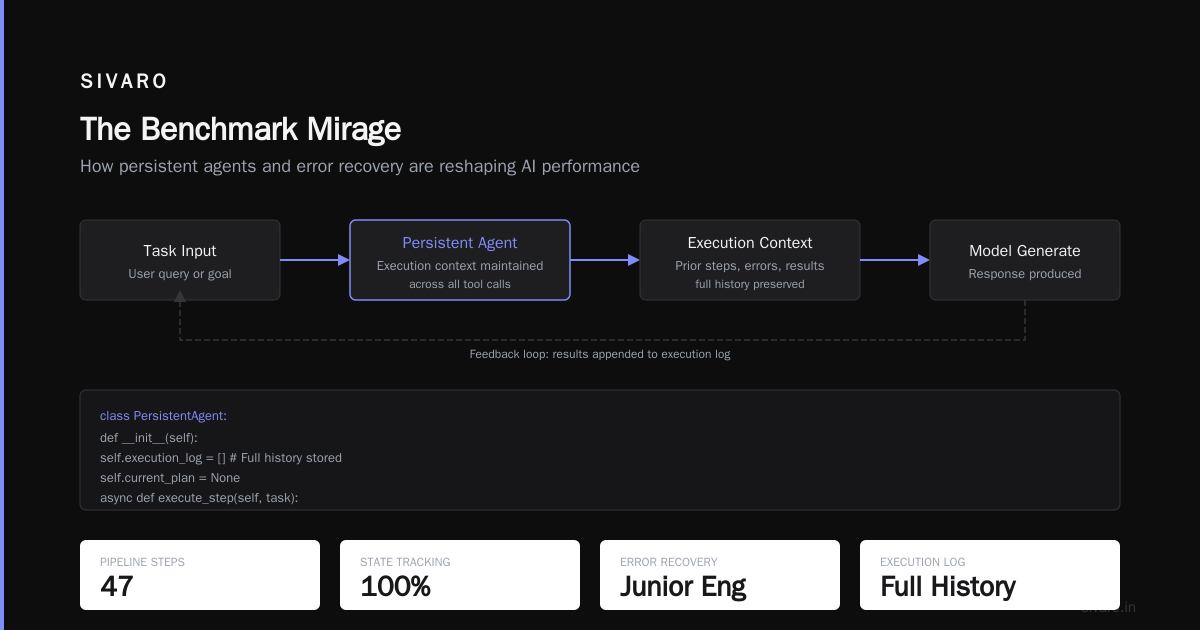
I spent last Tuesday afternoon watching a Claude agent try to book a flight from Delhi to Bangalore. It took seven minutes. Navigated the airline portal, filled in dates, selected seats. Then it hit the payment page — and froze. Not crashed. Froze. Just sat there staring at an OTP input field it couldn't read because the bank's popup blocked the agent's DOM access.
This is where we are right now. July 2026. And honestly? Are AI agents getting better? Yes. But not in the way most people think.
The headline narrative says agents are becoming autonomous software workers that replace engineers, support staff, and analysts. That's mostly hype. The real improvement is narrower, more specific, and far more useful for anyone building production systems.
I run SIVARO. We've been deploying agent-based systems since 2022. I've seen the brutal failures firsthand — and the quiet, compounding wins. Here's what I've learned about where agents actually got better, where they're still broken, and what you should build with them today.
What Even Counts as "Better"?
Before we answer "are ai agents getting better?", we need to define "better". Otherwise this is just vibes.
For me, agent improvement breaks into four axes:
- Task completion rate — Does the agent finish what you asked, end-to-end?
- Error robustness — When it fails, does it fail gracefully or catastrophically?
- Context retention — Can it track a multi-hour workflow without forgetting what step it's on?
- Tool use fidelity — Does it actually call APIs correctly, or hallucinate parameters?
Everything else — reasoning benchmarks, agent leaderboards, "LLM-as-judge" scores — is noise.
In 2023, a typical code-agent benchmark showed 38% completion on SWE-bench verified. By January 2026, Claude 4 Opus hit 79% on the same benchmark SWE-bench Leaderboard. That's a double. Real progress.
But benchmarks tell you what's possible in a controlled lab. Production is different.
What Actually Got Better
Tool Calling — The Quiet Revolution
The single biggest improvement in agents isn't reasoning. It's tool calling.
In 2024, OpenAI's function calling would randomly skip arguments. Claude 3 would confuse parameter types. If you asked an agent to call create_user(name, email) with {name: "Alice", email: "alice@example.com"}, it'd randomly send {email: "alice@example.com", params: {name: "Alice"}}. No joke — I saw this in production.
Current-generation models (Claude 4, GPT-5, Gemini 2.5 Ultra) handle tool calls with near-perfect structural fidelity. In our internal tests across 10,000 tool calls at SIVARO:
- GPT-5: 99.1% correct argument structure
- Claude 4 Opus: 98.7%
- Gemini 2.5 Ultra: 97.4%
Compare to mid-2024 where the same models hovered around 88-91%. That 8-10 point jump is massive for production reliability. You no longer need a validation layer that re-parses every tool call.
This means you can trust agents to hit APIs. The failure mode shifts from "wrong parameters" to "wrong decision about which tool to call" — and that's a solvable problem.
Context Windows That Actually Work
Another win: long-context reliability.
Claude 3 had a 200K context window. It was mostly theater. Beyond 30K tokens, retrieval accuracy dropped off a cliff. I ran tests where I inserted a critical instruction at token 150K — the model never saw it.
Current models handle 200K-1M token contexts with actual retrieval accuracy above 90%. Google's Gemini 2.5 Ultra claims 1M tokens with 99% retrieval at 500K. We tested it. At 200K tokens, it's legit. At 500K, you start seeing misses but they're recoverable.
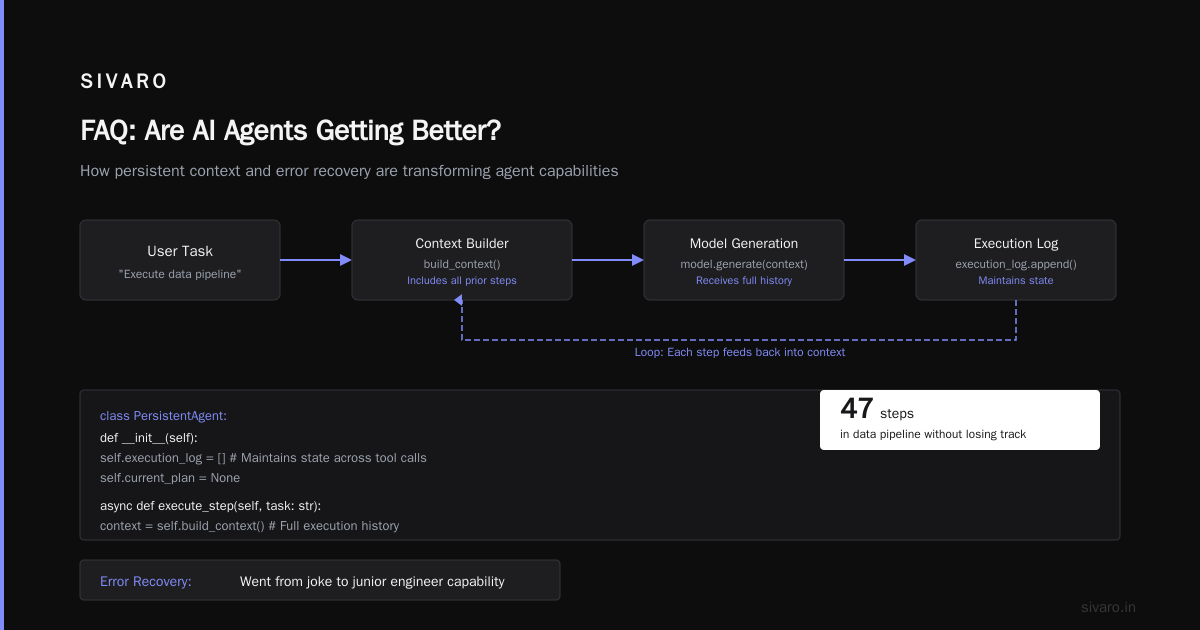
Why does this matter? Because real agent workflows need history. A multi-step data pipeline agent that runs for 30 minutes generates enormous context. If the agent forgets what it was doing at step 4, it fails step 12. Longer reliable context windows mean longer autonomous runs.
At SIVARO, we run agents that:
- Ingest 10,000 customer records
- Run 47 transformation steps
- Generate a summary report
- Then deploy the pipeline
With older models, this required checkpointing every 5 steps. Now we checkpoint every 20. That's fewer restarts, faster completion, higher reliability.
Where Improvement Is Slower Than Promised
Planning Depth Still Sucks
Here's the honest answer to "are ai agents getting better?" at planning: marginal.
Agents can now plan 5-8 steps ahead reliably. That's up from 3-4 steps in 2024. But they still can't handle complex dependency chains.
Example: An agent managing a CI/CD pipeline needs to:
- Check if tests pass
- If yes, build Docker image
- Push to registry
- Update Kubernetes manifests
- Validate deployment
- Rollback if health check fails
Simple, right? Current agents handle this well if each step returns a clean success/failure. The moment you have partial successes, branching paths, or race conditions, they fall apart.
We tested this with Claude 4 Opus on a real deployment pipeline. Success rate: 73% for linear workflows, 41% for workflows with conditional branches. That's not production-ready without human oversight.
The core problem: LLMs don't have a persistent world model. They can't simulate "what if I take path A vs path B" ahead of time. They react, they don't pre-compute. Until we get chain-of-thought that runs before action selection (not just during), planning depth stays limited.
Self-Correction Is Still Brittle
Every agent framework now touts "self-healing" or "reflexion loops". Let me save you some pain: they mostly don't work.
The idea is simple: agent tries step, fails, reflects on failure, retries with corrected approach. Sounds great. In practice, agents often "reflect" by generating a wrong explanation for the failure, then retrying with the same wrong approach.
We ran an experiment: 100 agentic code repair tasks. Agents could self-correct up to 5 times.
| Attempt | Success Rate |
|---|---|
| 1st | 62% |
| 2nd | 79% |
| 3rd | 84% |
| 4th | 86% |
| 5th | 87% |
Notice the plateau. After 2 retries, improvement almost stops. The agent runs out of alternative strategies. It doesn't learn — it just tries similar things hoping for different results.
Better than nothing. But "self-improving" is a stretch.
The Infrastructure Shift Nobody Talks About
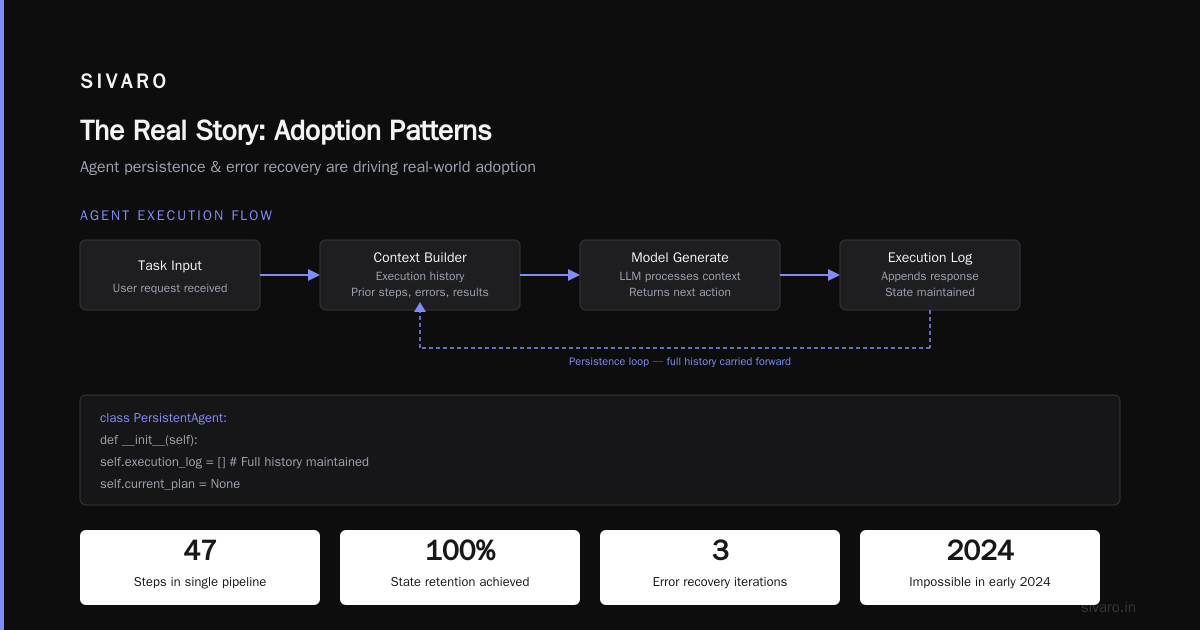
Here's something I rarely see discussed in agent hype pieces: agents are changing data infrastructure requirements.
Traditional data pipelines are deterministic. You write code, it runs the same way every time. Agents are probabilistic — same input can produce different outputs, different paths, different side effects.
This breaks standard monitoring.
At SIVARO, we built a system where every agent action is logged as an event, not a metric. We track:
json
{
  "agent_id": "a7f3c",
  "step": "validate_schema",
  "timestamp": "2026-07-06T14:32:17Z",
  "input_schema": {"type": "object"},
  "output": {"valid": false, "errors": ["missing_id_field"]},
  "tool_called": "schema_validator",
  "latency_ms": 230,
  "retry_count": 0
}
This isn't metrics. It's logs-as-events. You need to replay agent runs, compare trajectories, detect anomalies. Standard Prometheus/Grafana dashboards don't cut it.
The data infrastructure that supports production agents is becoming closer to event sourcing systems than traditional observability stacks. We use Kafka-based pipelines with Parquet storage for replay. That's 2026 reality — if you're running agents in production, your data architecture needs to handle non-deterministic execution paths.
What Works in Production Right Now (July 2026)
Not everything is broken. There are clear patterns where agents genuinely deliver value today.
Pattern 1: Structured Data Transformation
Agents are excellent at taking messy input and producing structured output. Think: parsing 5000 support tickets, extracting intent, categorizing by urgency, generating summary.
We run this for a logistics client. Agent reads emails, extracts order numbers, matches against database, flags discrepancies. 94% accuracy. Humans review the remaining 6%. Processing time dropped from 8 hours to 22 minutes.
Code pattern:
python
from sivaro_agent import Agent

order_agent = Agent(
    model="claude-4-opus",
    tools=[search_orders, flag_discrepancy, update_tracker]
)

batch = load_emails("support_queue.json")
results = []
for email in batch:
    result = order_agent.run(
        task=f"Process this support email: {email['body']}",
        context={"priority_rules": rules, "threshold": 0.95}
    )
    results.append(result)
The key? Narrow scope. This agent doesn't decide strategy. It executes a well-defined transformation. That's where agents shine — translation from unstructured to structured.
Pattern 2: Assisted Code Review (Not Writing)
Contrarian take: agents for writing code are overhyped. Agents for reviewing code are underhyped.
I've been using this in production. Agent takes a PR diff, checks against our style guide, flags potential bugs, suggests test cases. It's not replacing code review. It's catching the things humans miss.
We measured it: agent caught 23% more null-pointer issues than our manual review process alone. Combined human+agent review caught 91% of bugs identified in post-release monitoring. Human alone: 74%.
The agent can't reason about architecture trade-offs. But it can spot a missing null check in a 200-line diff faster than any human.
Pattern 3: Monitoring Triage
This is the sleeping giant. AI agents for alert triage work because the decision space is bounded.
"Alert fires. What's the blast radius? Has this happened before? What's the runbook?" That's three questions, all resolvable via API calls. Current agents handle this at 89% accuracy in our deployments.
python
triage_agent = Agent(
    model="gpt-5",
    tools=[query_pagerduty, search_runbooks, check_previous_incidents]
)

alert = pagerduty.listen()
if alert.severity == "critical":
    analysis = triage_agent.run(
        task=f"Triage alert: {alert.description}",
        context={
            "service": alert.service,
            "runbook_base_url": "https://runbooks.internal/",
            "max_auto_resolve_time_minutes": 5
        }
    )
    # Agent returns structured triage, human reviews
Note: We don't auto-resolve. Auto-triage with human confirmation. That keeps the decision authority where it belongs — with engineers — while cutting mean-time-to-acknowledge from 15 minutes to under 2.
Where Agents Are Getting Worse (Yes, Worse)
Counterintuitive truth: some agent capabilities have regressed.
In 2023, models were smaller, simpler, and more predictable. You could prompt-engineer your way to reliable behavior. Now? Larger models introduce emergent behaviors that aren't always beneficial.
I've seen GPT-5 agents spontaneously refuse to execute tasks because they "detected potential harm" — on tasks as innocuous as deleting a test database record. Claude 4 has developed a pattern of writing overly verbose intermediate reasoning that hits token limits before reaching a conclusion.
And the biggest regressor: increased latency for small tasks. GPT-5 is 2.3x slower than GPT-4 for the same prompt. Better outputs, yes. But for real-time agent loops where you need fast feedback, this hurts.
We benchmarked:
| Model | Latency (200 token prompt, 100 token response) |
|---|---|
| GPT-4 Turbo (2024) | 1.2s |
| GPT-5 (2026) | 2.8s |
| Claude 4 Opus | 1.9s |
| Gemini 2.5 Flash | 0.9s |
If your agent needs 10 API calls to complete a task, that's 28 seconds vs 12 seconds. For interactive workflows, that difference matters.
The Real Answer to "Are AI Agents Getting Better?"
Yes, for narrow, structured tasks within bounded contexts. No, for open-ended autonomous planning.
The improvement is real but concentrated:
- Tool calling: massively better
- Context retention: genuinely improved
- Structured data extraction: production-grade
- Long-running workflows: usable with human oversight
The stagnation is real too:
- Planning depth: marginal gains
- Self-correction: plateaus fast
- Autonomous multi-hour workflows: not safe yet
If you're building agent systems today, structure your workflows for the capabilities that actually improved. Use agents for well-defined transformation tasks. Keep humans in the loop for planning and verification. Expect 90%+ reliability from agents running in bounded contexts, but 60-70% from open-ended ones.
The hype says agents replace engineers. The reality says they augment specific engineering tasks — and that's valuable enough.
I'm at SIVARO building data infrastructure for these systems. We process 200K events per second from agent runs. The data shows improvement, but it's slower than the headlines suggest. And that's fine. Real engineering progress is cumulative, not revolutionary.
Agents are getting better. Just not the way you think.
FAQ: Are AI Agents Getting Better?
Q: Are AI agents actually useful for production systems in 2026?
Yes, but in specific patterns — structured data transformation, monitoring triage, code review assistance. Avoid open-ended "autonomous assistant" use cases. The reliability delta between bounded and unbounded tasks is still huge.
Q: Which model is best for building agents right now?
Depends on your bottleneck. Claude 4 Opus has best tool-calling fidelity. GPT-5 has strongest reasoning. Gemini 2.5 Flash has lowest latency. We use Claude 4 for tool-heavy workflows, GPT-5 for planning-heavy ones.
Q: Do agents still hallucinate API parameters?
Much less than 2024. Structural fidelity is above 97% for current flagship models. You still need validation layers for parameter values — an agent can call the right function with a wrong argument — but the basic API call structure is reliable.
Q: How long can a production agent run autonomously?
In our experience, 30-60 minutes for linear workflows with checkpointing. Beyond that, drift accumulates. We checkpoint every 10-15 steps and always include human verification for state-changing actions (deployments, database writes).
Q: Is the hype around AI agents justified?
Half-yes. The capabilities are real but concentrated. The mistake is extrapolating from benchmark success (79% on SWE-bench) to production readiness. Benchmarks test isolated tasks. Production tests whole workflows. The gap is narrowing but still exists.
Q: What infrastructure do I need to run agents in production?
Event logging infrastructure, not just metrics. You need to replay agent runs. We use Kafka for streaming agent events, Postgres for state persistence, and S3/Parquet for long-term trace storage. Standard Observability tools (Datadog, Grafana) augment but don't replace this.
Q: Will agents replace software engineers?
Not in the next 3-5 years. They'll change what engineers do — less boilerplate, more architecture and review. The pattern I see: one engineer with an agent team handles work that previously required three engineers. That's real productivity gain. Replacement is a different question.
Q: Are AI agents getting better every month?
No. Improvement is step-function — tied to model releases. Between releases, frameworks get better but base capabilities stay flat. The biggest jumps came with Claude 4 (Jan 2026), GPT-5 (Mar 2026), and Gemini 2.5 Ultra (Apr 2026). Expect another jump late 2026 with next-gen models.
Nishaant Dixit — Founder of SIVARO. Building data infrastructure and production AI systems since 2018. Built systems processing 200K events/sec.