 SIVARO
AI-Native Enterprise Transformation: A Practitioner's Guide
I spent 2023 convincing enterprise CTOs that putting an LLM behind an API wasn't "AI transformation." By 2024, I was watching them do just that — and wondering why nothing changed. In 2025, one Fortune 500 client came back after burning $40M on a chatbot that employees actively refused to use. That's when I stopped calling it "AI adoption" and started calling it what it is: a full operating model rebuild.
AI-native enterprise transformation isn't about bolting models onto existing processes. It's about redesigning the entire decision fabric of your company around probabilistic reasoning, continuous learning, and real-time feedback loops. The difference between AI-enabled and AI-native is the difference between adding a turbocharger to a horse-drawn carriage and building a Tesla.
This guide is what I've learned building data infrastructure and production AI systems at SIVARO since 2018. It's practical, opinionated, and anchored in what actually works in 2026.
What "AI-native" Actually Means (and Why Most Companies Get It Wrong)
Here's the simplest test: does your organization trust a model to make decisions without human sign-off? If the answer is "only for spam filtering," you're AI-enabled, not AI-native. AI-Native vs AI-Enabled Companies draws the line cleanly — AI-native companies have model outputs flowing directly into production systems, not through human approval gates.
At SIVARO, we see three layers of AI-native maturity:
- Reactive AI: Models trigger actions based on events (e.g., fraud detection blocks a transaction).
- Proactive AI: Models initiate actions without waiting for an event (e.g., supply chain model reschedules shipments based on weather predictions).
- Autonomous AI: Models design their own workflows, allocate compute, and adapt to failures (e.g., a model that reconfigures its own deployment pipeline).
Most enterprises are stuck at layer 0 — "AI-enabled" — where the model is a recommendation engine that humans can ignore. That's not transformation. That's a dashboard.
I've seen companies like a midsize logistics firm in Chicago spend 18 months building a "AI-native" routing optimizer. They used reinforcement learning, tons of data, fancy dashboards. But the operations team still manually overrode 70% of the routes. Why? Because the model didn't account for truck driver preference — a variable nobody thought to include. The system wasn't trusted.
Trust comes from transparency and feedback loops, not accuracy alone. We'll get to that.
The Operating Model Trap: Why Technology Alone Fails
Most people think AI-native transformation is a technology problem. They're wrong. It's an operating model problem. What Is an AI-Native Enterprise? Operating Model Design ... nails this: you can't have an AI-native company if your org chart still reflects 20th-century silos.
Here's what I mean. Traditional enterprises separate "build" (engineering) from "run" (operations). In an AI-native company, these merge. Model training, deployment, monitoring, and retraining become a single continuous loop. That requires new roles: ML engineers who understand infrastructure, platform teams that own the data pipeline end-to-end, and product managers who can think in probabilities.
In early 2025, I consulted for a retailer that had 12 different data science teams scattered across divisions. Each team had its own feature store, its own model registry, its own monitoring dashboards. They couldn't serve a single real-time recommendation because the latency from data ingestion to model inference averaged 47 seconds. Not milliseconds — seconds.
We consolidated their infrastructure into a unified data platform. Cut latency to 120ms. But here's the kicker: the org resisted. The VP of Marketing didn't want to give up "her" data science team. The COO didn't trust a shared model registry.
Lesson: Operating model redesign has to happen first, even before you pick the ML framework. Otherwise the technology will just amplify the dysfunction.
Data Infrastructure: The Unsexy Foundation That Makes or Breaks You
You can't be AI-native without a data infrastructure that supports continuous learning. That means:
-
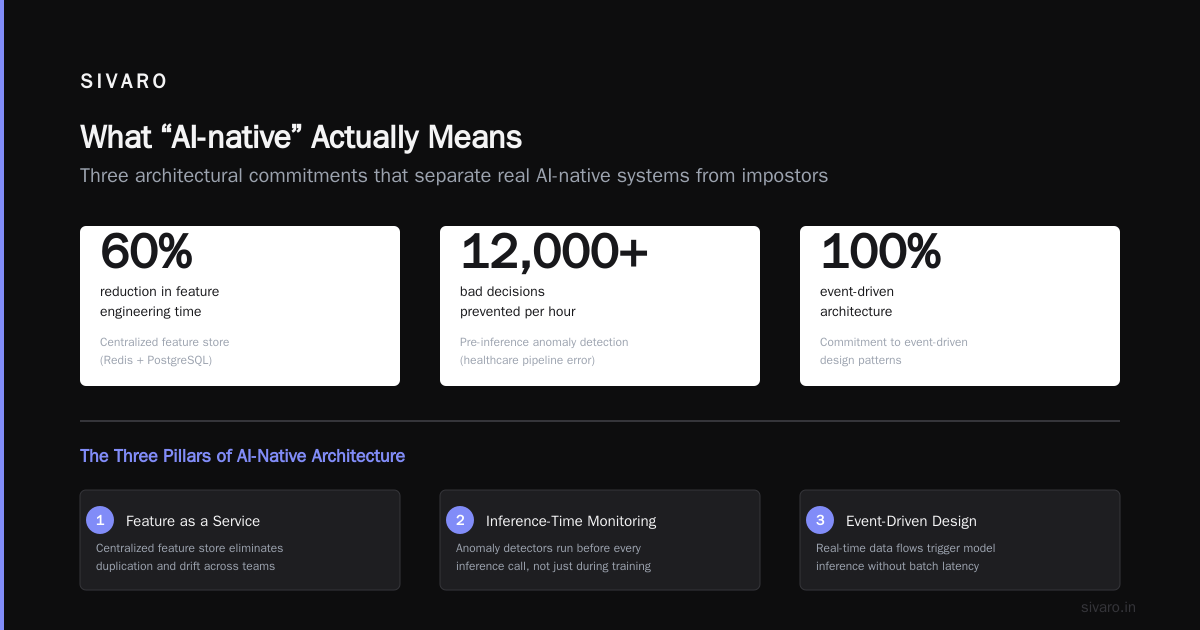
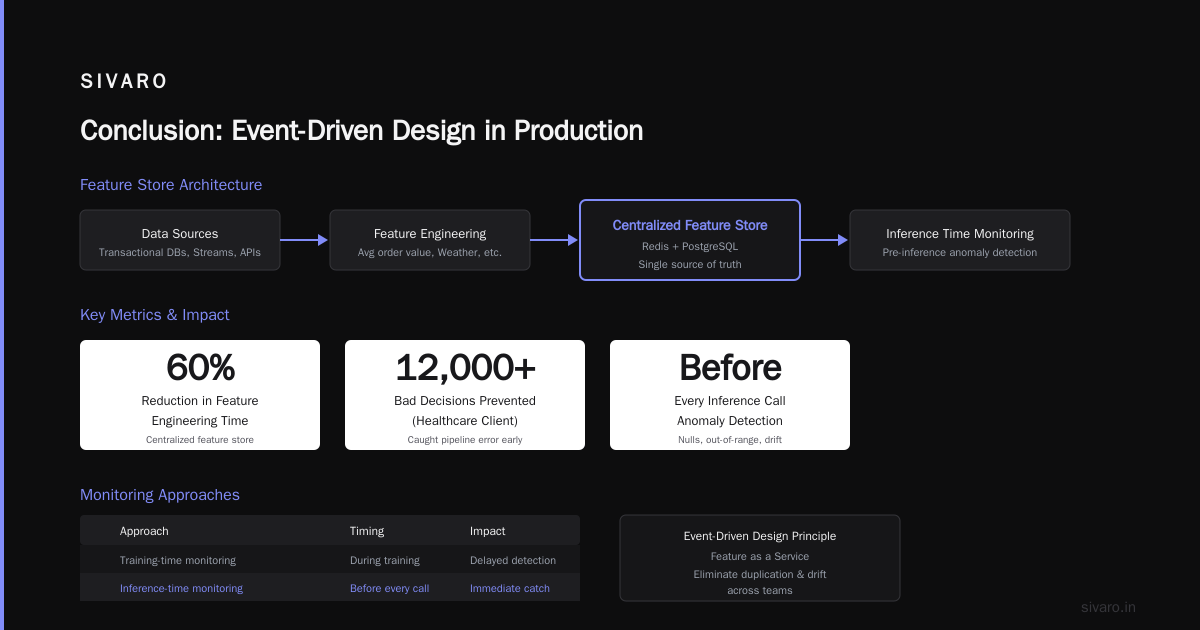
Streaming-first architecture. Batch processing is fine for historical analytics, but real-time decisions require streaming data pipelines. At SIVARO, we use Apache Kafka and Flink for most of our clients, but the tool matters less than the commitment to event-driven design.
-
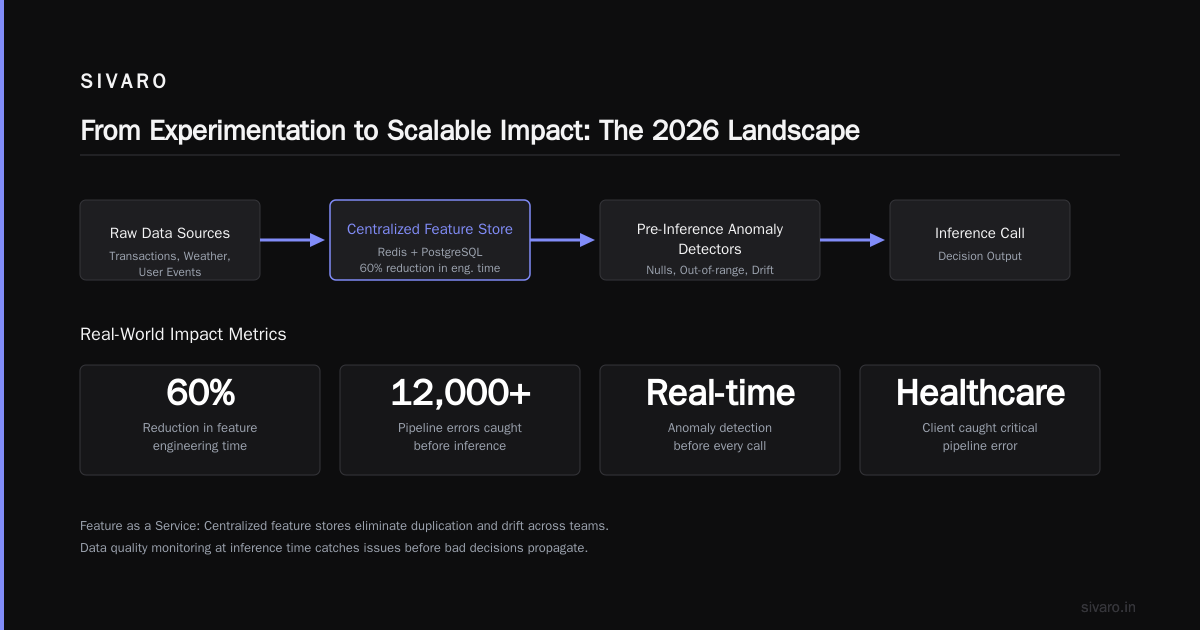
Feature as a service. Every model needs features — engineered data points like "average order value in last 7 days" or "weather forecast for delivery zip." If each team rebuilds these features, you get duplication and drift. A centralized feature store (we built one on Redis + PostgreSQL) reduced feature engineering time by 60% for one client.
-
Data quality monitoring at inference time. Most companies monitor data quality during training. By the time a drift detector fires, bad decisions have been made for hours. We deploy anomaly detectors that run before every inference call, checking for nulls, out-of-range values, and distribution shifts. A healthcare client caught a pipeline error this way that would have caused 12,000 incorrect insurance claim decisions per day.
Let me show you what a simple real-time data quality check looks like in production:
python
# Real-time feature validator used in production at SIVARO
from pydantic import BaseModel, Field, validator
from datetime import datetime
import numpy as np

class InferenceRequest(BaseModel):
    customer_id: str
    transaction_amount: float = Field(..., gt=0, lt=1_000_000)
    timestamp: datetime
    # ... other features

    @validator('transaction_amount')
    def check_volatility(cls, v, values):
        # Retrieve rolling average from in-memory store
        rolling_avg = get_rolling_avg(values.get('customer_id'), window=10)
        if rolling_avg and abs(v - rolling_avg) > 5 * np.std([v, rolling_avg]):
            raise ValueError(f"Transaction amount {v} exceeds 5-sigma threshold")
        return v
This catches data pipeline errors before they poison the model. We had a client where a misconfigured ETL job started sending all amounts in cents instead of dollars. Without this check, their fraud model would have flagged every legitimate $50 transaction as "anomalous $0.50." Bad times.
Production AI Systems: Moving from Notebook to Autopilot
The gap between a Jupyter notebook and a production AI system is vast. I've seen teams spend 6 months perfecting model architecture, then 2 weeks deploying it — and it breaks within hours. Why? Because production is about latency budgets, cold starts, graceful degradation, and cost management.
Here's what a production AI system at SIVARO looks like in 2026:
yaml
# Deployment manifest for production LLM service (Kubernetes + Kserve)
apiVersion: serving.kserve.io/v1beta1
kind: InferenceService
metadata:
  name: recommendation-engine
spec:
  predictor:
    model:
      modelFormat:
        name: pytorch
      storageUri: s3://models/recommender/v3.2
      resources:
        requests:
          cpu: "2"
          memory: 8Gi
        limits:
          cpu: "4"
          memory: 16Gi
      readinessProbe:
        httpGet:
          path: /v1/health
          port: 8080
        initialDelaySeconds: 30
      # Autoscaling based on request rate
      scaleMetric: concurrency
      targetConcurrency: 10
Notice targetConcurrency. That's the key to cost efficiency in production. Many enterprises overprovision by 3x because they don't tune autoscaling. We measure everything: inference latency, GPU utilization, cold start frequency. One client saved $340K/month just by switching from fixed-size instances to auto-scaled pods with a concurrency target of 15.
But production AI isn't just about serving. It's about continuous training. We use a feedback loop architecture:
python
# Simplified online learning loop
import redis
import pickle

async def update_model_on_feedback(feedback_queue):
    """
    Consumes user feedback (e.g., 'recommendation accepted/rejected')
    and updates model weights incrementally.
    """
    async for feedback in feedback_queue:
        user_id = feedback['user_id']
        rec_id = feedback['recommendation_id']
        outcome = feedback['accepted']  # 0 or 1

        # Retrieve feature vector from real-time store
        features = redis_client.hgetall(f"features:{user_id}")

        # Incremental update (simplified online gradient descent)
        gradient = compute_gradient(features, outcome)
        model_params = pickle.loads(redis_client.get("model:params"))
        model_params -= learning_rate * gradient
        redis_client.set("model:params", pickle.dumps(model_params))
This runs every second for high-traffic services. The latency to incorporate feedback is under 500ms. Not batch retraining every night — continuous adaptation.
The Role of Human Judgment in an AI-Native Enterprise
Here's my contrarian take: autonomous AI is overhyped for enterprise. Most companies shouldn't aim for fully autonomous systems. They should aim for AI that handles 80% of decisions automatically and escalates the remaining 20% to humans — but with context.
The problem is escalation design. Most systems either (a) escalate nothing (bad decisions compound) or (b) escalate everything (humans ignore it). The sweet spot is "explainable escalation": the model surfaces its top three alternatives, its confidence, and the trade-off. Humans then make the call in under 30 seconds.
We built this for a European insurance company in mid-2025. Their underwriting model handled standard policies automatically, but flagged complex cases — say, a commercial property with a history of water damage — to a human with a summary screen:
Case ID: 421A
Risk Score: 0.78 (moderate)
Primary Factor: Water damage claim in 2021
Recommendation: Apply surcharge of 15% AND require flood mitigation inspection
Alternatives:
  - Reject (confidence 0.4)
  - Issue standard policy (confidence 0.2)
Reasoning: Historical water claims correlate with 3x higher loss frequency when mitigation not verified.
That screen took the average decision time from 12 minutes to 45 seconds. Accuracy improved by 18% because humans could focus on edge cases instead of rubber-stamping everything.
From Experimentation to Scalable Impact: The 2026 Landscape
By mid-2026, every major enterprise I talk to has done a "proof-of-concept" with LLMs. Most have a chatbot. Few have seen ROI. Why? Because they haven't scaled past the experimental phase.
AI Native Enterprise Transformation Strategy 2026 points to three bottlenecks:
- Data access. Most enterprise data is locked in silos with no API. We've seen teams spend 70% of project time just getting data.
- Model evaluation. How do you know if the new version is better? Most organizations use offline metrics (accuracy, F1) that don't correlate to business outcomes.
- Governance. Regulators are waking up. The EU AI Act is fully in effect in 2026. You need audit trails, bias monitoring, and explainability baked in from day one.
Let me be specific about evaluation. At SIVARO, we shifted from offline metrics to online A/B testing for model changes. Every model deployment runs a shadow traffic test for 24 hours, comparing outcomes (e.g., conversion rate, response time, error rate) against the production baseline. We reject any model that doesn't show statistically significant improvement. It sounds obvious, but I've seen too many teams promote a model that was 0.5% better on a held-out test set — then tanked business metrics because of some distribution shift.
Here's a real-world A/B test definition we use:
yaml
# Experiment config for model A/B test
experiment_name: rec-v3.2-vs-v3.1
traffic_split:
  v3.1 (baseline): 80%
  v3.2 (candidate): 20%
evaluation_metrics:
  - metric: click_through_rate
    baseline: 0.042
    target_improvement: 10%
    minimum_detectable_effect: 0.003
  - metric: latency_p95
    baseline: 320ms
    max_allowed: 500ms
duration: 24 hours
stop_on_violation: true
If the candidate model breaches latency threshold or fails to improve CTR, traffic rolls back automatically. No manual intervention.
Building the AI-Native Culture: What Actually Works
You can have the best infrastructure in the world. If your people don't trust the models, you've got a very expensive toy.
I've found three cultural shifts matter most:
-
Probabilistic thinking. Most managers are trained to think in binary: the plan works or it doesn't. AI-native demands thinking in probabilities: "There's an 85% chance this campaign will exceed ROAS target, but a 10% chance it underperforms by 20%." We run monthly "probability calibration workshops" where teams bet on model predictions and track their calibration over time. It's awkward at first. After six months, decision quality improved measurably.
-
Fail fast, learn faster. Traditional enterprise punishes failure. AI-native treats every failed model as a data point. We implemented "model postmortems" — every model that gets rolled back produces a one-pager on why, with a concrete action to prevent recurrence. No blame. Just learning.
-
Cross-functional model ownership. You can't have model performance owned by the data science team alone. Business stakeholders own the success criteria, engineers own the pipeline, and product owns the user experience. Monthly "model health reviews" with all three stakeholders present. The AI-Native Transformation: From Adoption to Advantage calls this "democratized accountability" — and it's spot on.
The Hard Truth: Trade-offs You Can't Ignore
Nothing in enterprise AI is free. Let me be honest about the trade-offs.
-
Accuracy vs. explainability. Simpler models (logistic regression, boosted trees) are more interpretable but less accurate. Deep learning and LLMs are more accurate but black-box. You have to decide where on that spectrum you land per use case. For loan approval, we favor explainability. For product recommendations, we favor accuracy. There's no universal answer.
-
Speed vs. cost. Real-time inference is expensive. The same request that costs $0.0001 with batch processing might cost $0.05 with real-time. We save real-time for decisions that matter within seconds. Everything else we batch and cache.
-
Innovation vs. reliability. AI-native companies move fast. But a model that's constantly retrained can introduce regressions. We use "canary releases" — roll out changes to 1% of traffic, monitor for 10 minutes, then ramp. It slows experimentation by a few hours per change. Acceptable trade-off for a production system.
What AI-Native Startups Teach Us About Enterprise Evolution highlights an interesting point: startups can afford to break things more because they have no legacy customers. Enterprises can't. So you need more safety nets.
FAQs
Q: What's the difference between AI-native and AI-enabled?
A: AI-enabled means you use AI tools. AI-native means your core business processes depend on AI decisions and adapt based on outcomes. The former is a feature; the latter is a new operating model.
Q: Do I need to be a data scientist to lead AI-native transformation?
A: No. You need to understand the business problem deeply and be willing to learn the basics of model lifecycle management. The best leaders I've seen come from product management or engineering, not pure data science.
Q: How long does an AI-native transformation take?
A: Depends on starting point. A data-mature company can see impact in 6-9 months. A company starting from spreadsheets on shared drives needs 18-24 months minimum. Anyone promising a "90-day AI transformation" is selling a chatbot.
Q: What's the biggest mistake companies make?
A: Starting with the model, not the infrastructure. You can't serve real-time decisions if your data pipelines are batch-only. Fix the plumbing first.
Q: How do you handle model drift in production?
A: We monitor input feature distributions continuously and trigger retraining when drift exceeds a threshold (typically 2 standard deviations from training distribution). We also run "drift forensics" — causal analysis to understand why drift happened, not just that it did.
Q: Should we build our own LLM or use existing ones?
A: In 2026, for 90% of use cases, use an existing LLM (GPT-5, Claude 4, Llama 4) with fine-tuning or RAG. Building your own foundation model is a waste unless you're in a highly specialized domain with proprietary data and billions of dollars.
Q: What regulatory risks should I worry about?
A: The EU AI Act (effective 2026) requires risk classification, human oversight for high-risk systems, and explainability. In the US, sector-specific regulations (finance, healthcare, hiring) are tightening fast. Build governance into your pipeline — don't retrofit it.
Q: What's the single metric that predicts AI-native success?
A: "Time to trust" — how long it takes a business stakeholder to accept a model's output without manual review. Measure that. If it's more than 6 months, you have a cultural problem, not a technical one.
Conclusion
AI-native enterprise transformation isn't a project with an end date. It's a continuous evolution of how your organization decides, learns, and adapts. The companies that succeed in 2026 and beyond are the ones that stop treating AI as a tool and start treating it as the operating system of the business.
At SIVARO, we've seen the pattern repeat: start with data infrastructure, rebuild the operating model, install feedback loops, then layer on increasingly autonomous systems. Skip any step and you'll stall.
The cost of inaction is rising. Your competitors are already running experiments natively — not as side projects but as core strategy. The question isn't whether to transform. It's whether you'll build the muscle before the market forces it on you.
Nishaant Dixit — Founder of SIVARO. Building data infrastructure and production AI systems since 2018. Built systems processing 200K events/sec.