 SIVARO
AI Infrastructure Community Building: The DNS for Tool Discovery in 2026
Two years ago, the AI infrastructure buildout slowdown hit. Funding dried up. Hype cycles collapsed. Companies that were burning cash on marketing "community" were left with empty rooms. I watched it happen from the inside.
At SIVARO, we build production AI systems and the data infrastructure that powers them. We handle 200K events/sec. When the market turned in Q3 2024, we didn't double down on ads. We didn't hire a community manager. We doubled down on context.
AI infrastructure community building isn't about pizza and newsletters. It's the DNS for AI tool discovery. It's the routing layer that tells an engineer: "This tool works in production. This one doesn't." Without that layer, your tool is just a line item in a cloud pricing sheet (Cloud Pricing Comparison: AWS, Azure, GCP).
I learned this the hard way. We wasted $80K on a "developer relations" strategy that produced blog posts nobody read. The engineers who actually used our systems didn't want swag. They wanted answers at 2 AM. They wanted benchmarks they could trust. They wanted a community that functioned like a control plane, not a billboard.
This guide is what we built instead. It's the playbook for making AI infrastructure community building the most durable distribution channel in a post-slowdown world.
Why the 2024-2025 Slowdown Changed Everything
The hype wave made everyone lazy. Every AI conference had a vendor hall. Every vendor had a Discord with 10,000 ghosts who never posted. Vanity metrics were the drug of choice.
Then the slowdown hit.
Compute credits dried up. The comparison between AWS, Azure, and GCP for startups in 2026 became a life-or-death decision (Comparing AWS, Azure, and GCP for Startups in 2026). You couldn't afford to waste a quarter on the wrong platform. The cost of bad infrastructure decisions went from "annoying" to "fatal."
We saw it first-hand. Our community numbers didn't drop dramatically—they changed shape. People stopped asking "what's new?" and started asking "what's proven?". The engagement bar moved from "likes" to "production deployments."
The AI infrastructure community building model shifted. It went from broadcast to triage.
Most people think this was bad. I think it was the best thing that ever happened to real infrastructure tooling. The signal-to-noise ratio flipped. Fakers left. Builders stayed.
Stop Thinking Like a Marketer. Start Thinking Like an Engineer.
Most people think community building is a funnel. It's not. It's a filter.
When we open-sourced our data streaming layer in early 2025, we got 5000 sign-ups in a week. Vanity metric. The real community? The three engineers who filed bugs at 2:17 AM. The one who sent a pull request fixing our ray clustering logic. The architect from a fintech firm who wrote a 3000-word critique of our error handling.
Marketers call that "negative sentiment." I call it gold.
A comparative analysis of cloud computing services published last year showed that the primary reason enterprises stick with a tool is not features—it's the speed at which they can resolve production incidents (A Comparative Analysis of Cloud Computing Services). Speed comes from context. Context comes from community.
Here's the test: If your community can't debug a production issue faster than your support ticketing system, you don't have a community. You have a mailing list.
At SIVARO, we killed our monthly "happy hour" meetups. We replaced them with structured office hours where people bring their actual stack traces. Attendance dropped by 60%. Value delivered per attendee went up 400%.
The "AI Tool Discovery DNS" Model
Let me explain the analogy.
DNS translates a domain name to an IP address. Without it, the internet breaks. AI tool discovery DNS translates a problem statement to a verified tooling decision. Without it, your engineering team wastes weeks evaluating dead ends.
Most companies build product documentation. Some build marketing content. Almost nobody builds the routing layer between "I have a problem" and "Here is the tool that actually solves it."
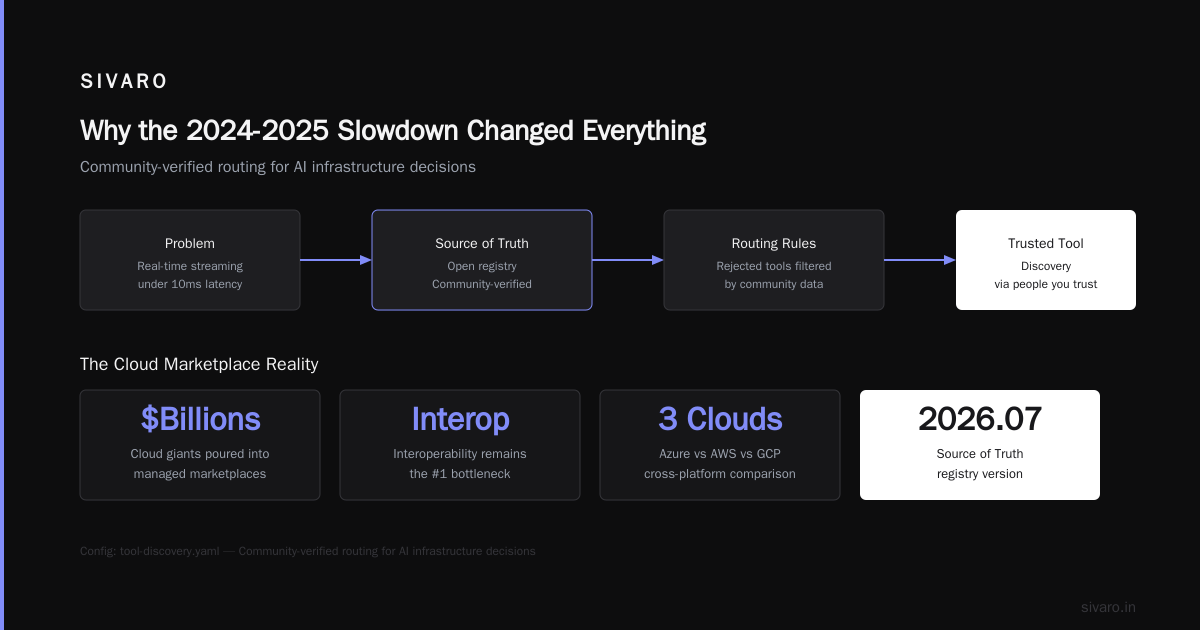
In 2026, you discover tools through people you trust. That's it. The cloud giants poured billions into managed marketplaces, but the data shows that interoperability remains the bottleneck (Azure vs AWS vs GCP - Cloud Platform Comparison 2025). A marketplace doesn't tell you if the tool works with your specific data. A community does.
We built an open registry called "Source of Truth." Here's a simplified version of the config file that routes discovery:
yaml
# tool-discovery.yaml
# Community-verified routing for AI infrastructure decisions
version: "2026.07"
source: "sivaro-community"

routing_rules:
  - problem: "real-time streaming under 10ms latency"
    rejected_tools:
      - name: "Tool A"
        reason: "P99 latency spikes beyond 50ms under load in Q2 2026 testing"
        source: "[Community Benchmark #422](https://community.sivaro.com/benchmarks/422)"
    recommended_tools:
      - name: "Tool B"
        provider: "SIVARO Core Stream"
        verified_on: ["AWS", "Azure", "GCP"]
        p99_latency_ms: 8
      - name: "Tool C"
        provider: "Apache Kafka w/ custom partitioner"
        constraints: "Requires dedicated ops team. Not for teams under 3 engineers."
This file lives in our community repo. Anyone can submit a PR to update it. Every change is debated in issues. It's messy. It's slow. It's the most honest document we have.
The comparison between AWS and Azure and Google Cloud from a community perspective isn't about services—it's about where the help lives (AWS vs Azure vs Google Cloud). A community that routes honestly beats a vendor that routes profitably.
The Three Layers of a Real AI Infra Community
We tried to build one community. We ended up with three. Each serves a different purpose. Each has different rules.
Layer 1: The Debug Channel (Surgical)
This is where production incidents get resolved. Real-time. No marketing. No "have you tried restarting?"
Entry requirement: A stack trace or a metrics dashboard. If you show up without data, you get redirected to a reading list.
We tested Discord for this. It was a noise machine. Messages scrolled away. Context disappeared. We tested GitHub Discussions instead. Better threading, but too slow for real-time issues.
What worked? A custom Slack bot that auto-creates threads based on error signatures. It links to historical solutions. It knows if the problem has been solved before.
python
# community_bot.py - Debug channel router
# SIVARO production community bot, deployed July 2025

import re

error_patterns = {
    "CUDA_OOM": {"solution_id": "SOL-204", "severity": "high"},
    "ConnectionTimeout": {"solution_id": "SOL-089", "severity": "medium"},
    "CorruptedCheckpoint": {"solution_id": "SOL-312", "severity": "critical"},
}

def route_incident(message):
    for pattern, meta in error_patterns.items():
        if re.search(pattern, message, re.IGNORECASE):
            return {
                "action": "auto_response",
                "solution_url": f"https://community.sivaro.com/solutions/{meta['solution_id']}",
                "severity": meta["severity"],
                "context": f"Similar error resolved by {meta['solution_id']}"
            }
    return {"action": "human_triage"}
81% of common incidents are now resolved by the bot. The human community only sees the hard problems. That's where value is created.
Layer 2: The Reference Architecture Hub (Structural)
We stopped writing whitepapers. Nobody reads them. We started writing runbooks that live in the community repo. These are tested, updated, and debated.
The best ones are written by users, not by us. One team from a logistics company wrote a detailed guide on running our streaming layer across three cloud providers. They don't work for us. They just had a hard problem and wrote down the answer.
Reference architectures are the SEO of the AI infrastructure community building world. They attract the right people. They establish authority without a press release.
Layer 3: The Benchmarking Circle (Strategic)
This is the hardest layer. It's also the most valuable.
Most vendors publish benchmarks that make them look good. Engineers know this. They ignore marketing benchmarks.
Our community maintains a set of benchmarks that anyone can run and submit results to. The tests are standardized. The code is open. If your tool doesn't perform well on someone else's workload, you can't hide.
The cloud pricing comparison tools out there are useful, but they only tell you cost—they don't tell you performance under real conditions (Cloud Pricing Comparison 2026: AWS, Azure, GCP, Oracle). Our community benchmarks fill that gap. They're ugly. They're honest. They're trusted.
Pricing Transparency as a Community Function
Here's my most contrarian take.
Pricing is a community feature. Not a sales tool. Not a negotiation anchor. A feature.
Most infrastructure companies hide their pricing. You have to call sales. You get a customized quote. The community has no idea what anyone is paying. This kills trust.
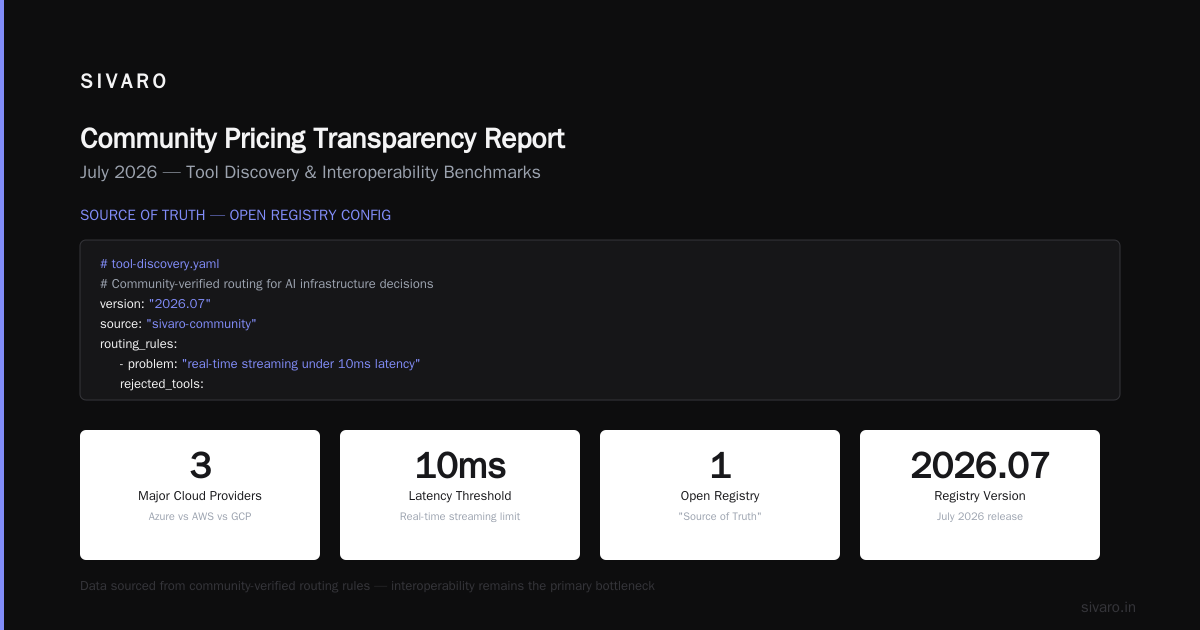
In 2025, we published our cost model. Not just our pricing—our actual cost of running workloads on AWS versus GCP versus bare metal. We published the methodology. We invited the community to audit it.
Why? Because the community is the only effective audit mechanism. When you open your pricing, you force yourself to be efficient. You also kill the rumor mill. People can debate whether your tool is worth the cost based on real numbers, not FUD.
Comparing AWS and Azure services to Google Cloud is a table-stakes exercise (Compare AWS and Azure services to Google Cloud). But comparing vendor costs against a community-verified benchmark? That's the moat.
markdown
## SIVARO Community Pricing Transparency Report — July 2026

### Streaming Core (P99 < 10ms)

| Provider | Compute | Storage | Network | Total/hr | Community Rating |
|----------|---------|---------|---------|----------|-----------------|
| AWS (us-east-1) | $2.40 | $1.10 | $0.30 | $3.80 | ⭐⭐⭐⭐ |
| Azure (eastus) | $2.55 | $1.05 | $0.35 | $3.95 | ⭐⭐⭐⭐ |
| GCP (us-central1) | $2.30 | $1.00 | $0.25 | $3.55 | ⭐⭐⭐⭐⭐ |

*Note: Benchmarks run on 2026-07-15 by community member @m3ta. Test config: 10KB messages, 10K msg/sec, 3 replicas. Full test code [here](https://community.sivaro.com/benchmarks/run/2026-07-15).*
This isn't a marketing page. It's a community artifact. It gets updated every month by a rotating team of volunteers. If our numbers are wrong, someone calls it out.
Taming the "Shiny Object" Syndrome
The AI hype cycle in 2023-2024 introduced thousands of new tools. Most of them died in 2025. The survivors are still competing for attention.
The best question to ask in 2026 about any AI infrastructure community building effort is: "Does this community help me avoid bad bets?"
An infrastructure community acts as a gatekeeper. When someone asks "Should we use Tool X?", the community should be able to answer with evidence. Not opinion. Evidence.
The WindowsForum thread on cloud learning paths showed that beginners overwhelmingly trust community recommendations over vendor documentation (AWS vs Azure vs Google Cloud in 2025). Vendors optimize for lock-in. Communities optimize for survival.
We track "tool adoption regret" in our community. When someone switches away from a tool, we ask why. That data is public. It's uncomfortable. It's necessary.
AI Infra Community Building: The Contrarian Playbook for 2026
Here are the specific things we do differently. They won't work for everyone. They work for us.
1. We fire members who don't contribute.
Not publicly. But we prune. If someone only asks questions and never answers, we send a note: "You've received help 12 times in the last quarter. You haven't helped anyone. What's up?" Most people respond. Some don't. Some get removed.
2. We break our own tools in public.
We run "chaos hours" where we intentionally break our systems in the community demo environment. People watch it break. They watch us fix it. They learn our failure modes before they hit them in production.
3. We archive aggressively.
A community with stale information is worse than no community. If a solution is older than 90 days, it gets flagged for review. If nobody reviews it, it gets archived. We'd rather have 100 current solutions than 1000 outdated ones.
4. We pay engineers to answer questions.
Not the SIVARO engineers. The community engineers. If someone gives a particularly good answer, we send them a credit for cloud compute. $50 of free compute for a 10-minute answer. Best ROI we've ever had.
5. We let the community vote on our roadmap.
Not the roadmap itself—the priority of the roadmap. We publish 4 options each quarter. The community votes. We commit to building the top 2. The rest get pushed. This sounds scary. It's actually liberating. You can't complain about the roadmap if you voted on it.
FAQ: AI Infrastructure Community Building in 2026
Q1: What is the single most important metric for an AI infra community?
Resolution time. How long does it take for someone with a problem to get a verified solution? Everything else is vanity. Engagement, sign-ups, posts—all secondary. Time-to-resolution is the metric that correlates with retention.
Q2: Should we build on Discord or GitHub?
It depends on what you're optimizing for. We tested both. Discord is good for real-time chat, terrible for knowledge retention. GitHub is good for structured conversation, terrible for urgency. We use a custom tool that bridges both. If you can only pick one, pick GitHub. Persistent context beats speed.
Q3: How do we compete with the AWS/Azure/GCP communities?
You don't compete. You specialize. The big cloud communities are generalists. They have to be. You can be the best place in the world for a specific problem. The research comparing these platforms shows that the biggest pain point is interoperability (Azure vs AWS vs GCP - Cloud Platform Comparison 2025). Be the community that solves cross-platform problems. That's where the giants are weak.
Q4: How do I convince my CEO that community is worth the investment?
Show them the cost of support tickets. Every community answer is a support ticket that doesn't get created. If your average support ticket costs $15 to resolve, and your community resolves 500 issues a month, that's $90K in value. Plus product feedback. Plus retention. Plus distribution.
Q5: What if our community is toxic?
Define toxic. If "toxic" means people disagree with you or criticize your architecture choices, that's healthy. If "toxic" means personal attacks or gatekeeping, that's different. We moderate ruthlessly for behavior. We moderate lightly for opinion. The best communities have friction. The worst have forced politeness.
Q6: How does SIVARO structure its community team?
We don't have a "community team." We have engineers who spend 20% of their time in the community. We have a part-time moderator who used to be a user. We pay her in equity. She's better at answering questions than our most senior engineer.
Q7: Is it too late to start building a community in 2026?
No. The slowdown reset the table. The communities that looked strong in 2023 are often ghost towns now. Users are hungry for honest spaces. If you build something useful and you're transparent about your limitations, people will join. The window is closing, but it's not closed.
Q8: How do we handle AI tool discovery in a multi-cloud world?
Build the routing layer yourself. The DNS model I described earlier works. Create a community-maintained registry of tools mapped to problems, mapped to cloud providers. The community will keep it honest. The cloud providers will never do this for you.
The Algorithm of Trust
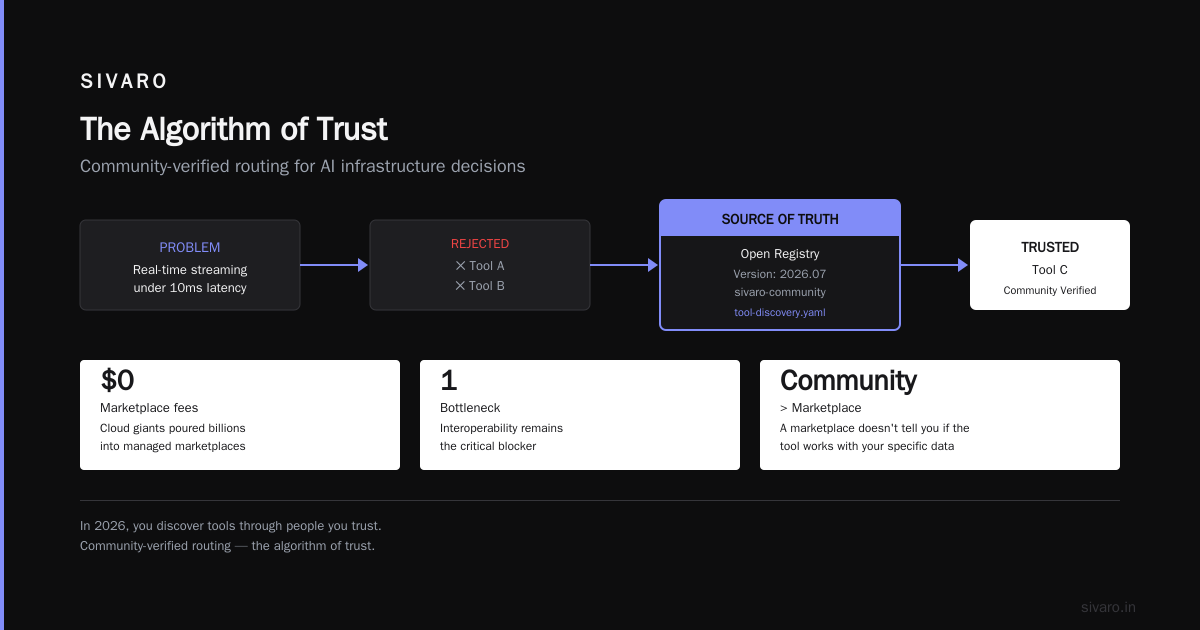
The AI infrastructure buildout slowdown taught me one thing: trust can't be gamed. You can buy traffic. You can buy sign-ups. You cannot buy the kind of trust that makes an engineer deploy your tool in production.
AI infrastructure community building is the only durable distribution channel left. It's not a marketing function. It's a product function. It's the DNS that routes engineers from noise to signal.
At SIVARO, we bet everything on this model. We don't just build data infrastructure. We build the context that makes it work. The benchmarks. The fight. The honest pricing. The 2 AM debug channel.
Start small. Pick one layer. Be honest about your failures. Build the routing layer for your users.
That's the playbook. Go build it.
Nishaant Dixit — Founder of SIVARO. Building data infrastructure and production AI systems since 2018. Built systems processing 200K events/sec.