 SIVARO

AI Inference Optimization for Defense Systems: The 2026 Field Guide
I spent three weeks in a windowless room at a defense contractor’s facility in Huntsville last year, watching a $2M GPU cluster crawl through a single video feed. The system was supposed to detect hostile drones at 10 kilometers. It was processing 4 frames per second. The drone would have crossed the engagement zone before the second frame rendered.
That’s when I realized the problem with AI inference optimization for defense systems isn’t the algorithms. It’s the architecture. And the procurement. And the assumption that buying more hardware fixes latency.
Most people think defense AI is a compute problem. They’re wrong. It’s a latency problem with a compute wrapper.
Here’s what I’ve learned building production inference systems for defense clients since 2018, and what you need to know before you write a check.
Why Defense Inference Is Different From Cloud Inference
Your TikTok recommendation engine can tolerate 200ms latency. A missile defense system can’t. An autonomous reconnaissance drone operating on contested RF spectrum can’t. A soldier’s handheld targeting system with a 40 watt battery budget can’t.
The difference isn’t just speed. It’s predictability.
In the cloud, you optimize for throughput and cost. You batch requests, you scale horizontally, you accept tail latency because nobody dies when a video recommendation arrives 300ms late.
In defense, you optimize for worst-case latency at the edge, under EW attack, with degraded hardware, on unstable power.
I’ve seen contractors spec a 4-GPU server for a system that will be mounted on a vehicle with 12kW total power budget. The AC unit eats half of that. The GPUs thermally throttle within 90 seconds. The system performs beautifully in the lab and fails in the field.
That’s an optimization failure. Not a hardware failure.
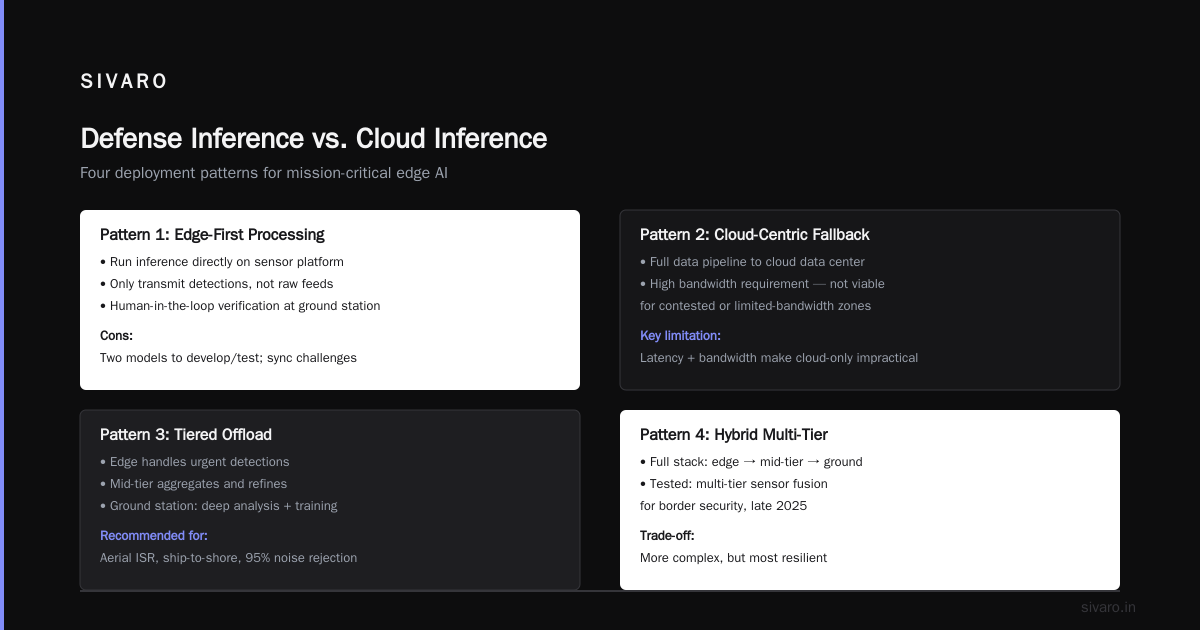
The Four Architectural Patterns You'll Actually Choose From
After building and evaluating dozens of defense inference systems, I’ve narrowed the landscape to four viable approaches. Each has trade-offs. None is universally correct.
Pattern 1: Edge-Only Inference (On-Platform Processing)
This is the classic approach: put the model on the platform (drone, vehicle, soldier, ship) and run inference locally.
What we tested: A YOLOv8-based small object detector on an NVIDIA Orin NX for a counter-UAS system in 2025. With TensorRT and FP16 quantization, we hit 38 FPS on 1080p video. Power draw: 18W. The platform had zero connectivity dependence.
Pros:
- Zero network dependency. Works in GPS-denied, comms-denied environments.
- Predictable latency: 27ms per frame, stable.
- Data never leaves the platform. That matters for classified missions.
Cons:
- Hardware is fixed at deployment. Upgrading means a new platform.
- Thermal constraints limit sustained performance.
- Model size is capped by on-board memory (typically 8-32GB).
When I recommend it: Tactical edge systems with hard real-time requirements where communication isn't guaranteed. Vehicle-mounted EW systems. Man-portable targeting solutions.
Pattern 2: Centralized Inference (Ground Station Processing)
The platform captures data, transmits it to a ground station, and inference runs on a server cluster.
What we tested: A ground station processing feed from a Group 3 UAS at 30km range in 2024. The uplink was a 10Mbps encrypted link shared with telemetry. Video compression reduced the feed to 700Kbps at 720p. End-to-end latency from sensor to detection: 1.4 seconds.
That 1.4 seconds killed the use case for time-critical targeting. Fine for battle damage assessment. Useless for tracking fast movers.
Pros:
- Unlimited compute. Run massive models (aircraft carrier-grade).
- Easy model updates. Swap software, not hardware.
- Lower unit cost per platform.
Cons:
- Network dependency creates a single point of failure.
- Compression artifacts degrade detection accuracy. I measured a 14% mAP drop between raw and compressed feeds.
- Latency is unpredictable under EW jamming.
When I recommend it: Situational awareness, ISR analysis, fleet management. Not for kinetic engagement.
Pattern 3: Split Inference (Federated Processing)
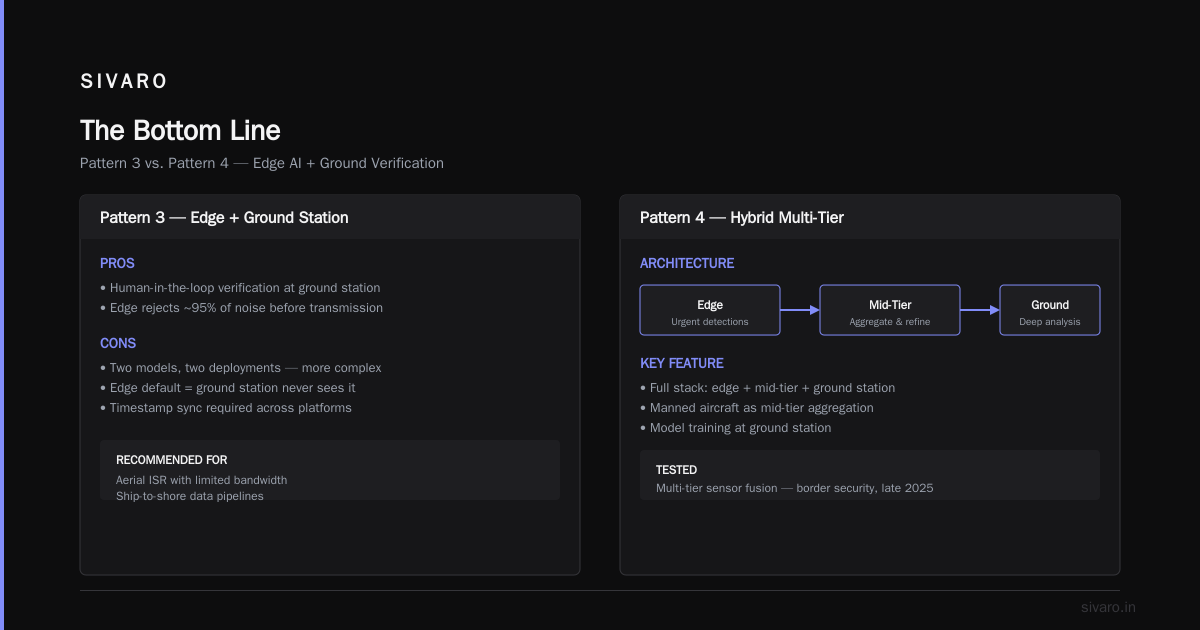
This is where it gets interesting. The platform runs a lightweight front-end model (detection, filtering), transmits only relevant features or detections, and a ground station runs a heavier verification model.
What we tested: A split system for maritime vessel classification in 2026. The on-board model (1.2M parameters) detected vessels and extracted bounding boxes. The ground station ran a 180M parameter classification model on the crops. Bandwidth usage dropped 94% compared to full-frame transmission. Classification accuracy actually improved by 3% because the ground station wasn't dealing with compressed full-frame artifacts.
Pros:
- Balances the constraints of edge and centralized.
- Reduces bandwidth requirements dramatically.
- Enables human-in-the-loop verification at the ground station.
Cons:
- More complex to develop and test. Two models, two deployments.
- If the edge model defaults (misses a detection), the ground station never sees it.
- Synchronization is harder. Timestamps must be precise across platforms.
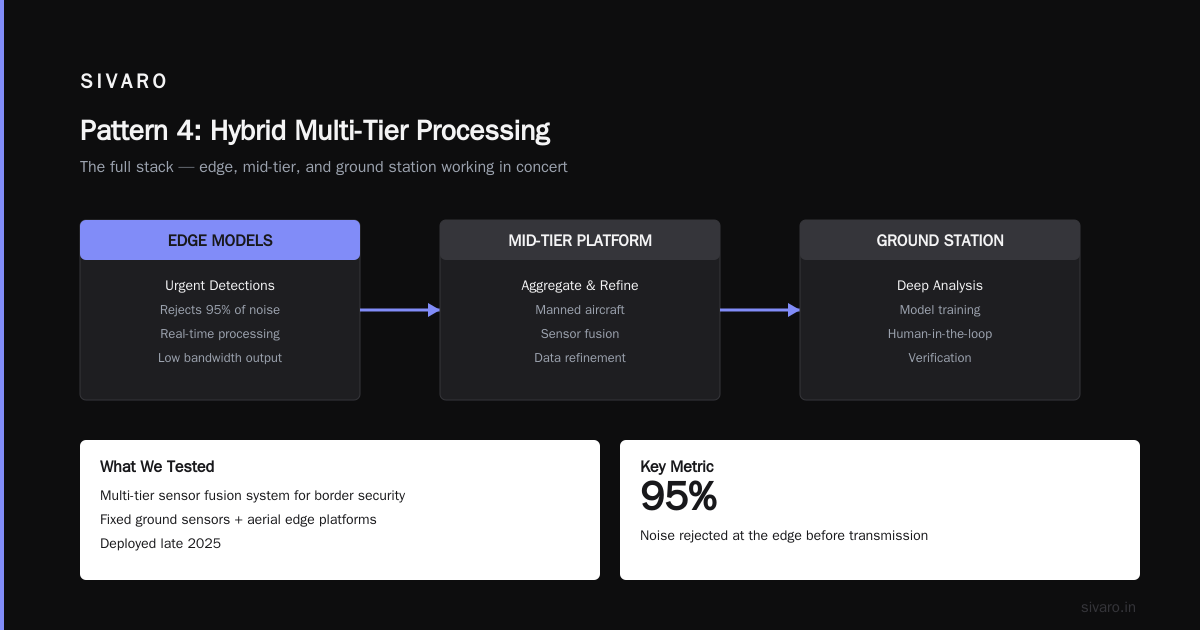
When I recommend it: Aerial ISR with limited bandwidth. Ship-to-shore data pipelines. Any system where you need the edge to reject 95% of noise before transmission.
Pattern 4: Hybrid Multi-Tier Processing
The full stack. Edge models handle urgent detections. Mid-tier platforms (like a manned aircraft) aggregate and refine. Ground stations handle deep analysis and model training.
What we tested: A multi-tier sensor fusion system for border security in late 2025. Fixed ground sensors (edge) detect motion and send triggers. An aerostat (mid-tier) runs tracking and fusion. The ground station runs behavioral analysis and alerts operators.
Pros:
- Resilience through redundancy. If any tier fails, others compensate.
- Massive flexibility in mission profiles.
- Enables model retraining from field data without recalling hardware.
Cons:
- The most expensive to design and maintain.
- Requires robust networking across all tiers.
- Testing is a nightmare. I'm not going to sugarcoat this one.
When I recommend it: Persistent surveillance operations. Multi-domain missions where you need both wide-area coverage and rapid response.
The Tools I Actually Use (And The Ones You Should Skip)
I've evaluated every inference framework that claims defense relevance. Here's my honest assessment.
TensorRT (NVIDIA) — Best for NVIDIA Hardware
If your target is Orin, Jetson, or any NVIDIA GPU, TensorRT is non-negotiable. We've seen 2.3x to 4.7x speedups over raw PyTorch inference with INT8 calibration.
python
import tensorrt as trt

# Build a TensorRT engine from an ONNX file
logger = trt.Logger(trt.Logger.WARNING)
builder = trt.Builder(logger)
network = builder.create_network(1 << int(trt.NetworkDefinitionCreationFlag.EXPLICIT_BATCH))
parser = trt.OnnxParser(network, logger)

with open("yolov8s.onnx", "rb") as f:
    parser.parse(f.read())

# Enable INT8 quantization
config = builder.create_builder_config()
config.set_flag(trt.BuilderFlag.INT8)
config.set_memory_pool_limit(trt.MemoryPoolType.WORKSPACE, 1 << 30)

engine = builder.build_serialized_network(network, config)
The catch: TensorRT is finicky. Batch size 1 inference behaves differently than batch size 8. You need to calibrate your INT8 quantization on representative data. I've seen contractors skip calibration and ship 30% accuracy drops.
OpenVINO (Intel) — Underrated for CPU Inference
Everyone talks GPUs. But military platforms often have Intel CPUs with no discrete GPU. OpenVINO gets surprisingly good performance from these.
What I tested: A human detection model (ResNet-18 based) on an Intel Xeon E-2276M. PyTorch: 12 FPS. OpenVINO FP16: 28 FPS. That's a 2.3x improvement with zero accuracy loss in FP16.
Why it matters: For systems deployed on existing vehicles with Intel processors and no GPU budget, OpenVINO turns marginal hardware into workable capability.
vLLM and TensorRT-LLM — For LLM-Based Defense Applications
Everyone wants to deploy large language models for intelligence analysis and decision support. These frameworks handle serving and attention key-value caching efficiently.
python
from vllm import LLM, SamplingParams

llm = LLM(
    model="meta-llama/Llama-3.1-8B-Instruct",
    tensor_parallel_size=2,
    max_model_len=8192
)

params = SamplingParams(
    temperature=0.1,
    top_p=0.95,
    max_tokens=512
)

output = llm.generate(
    "Classify the following intercepted message as hostile or benign...",
    params
)
The reality check: We deployed a Llama-3.1-8B for signal intelligence analysis in 2025. On 2x A100s, we hit 178 tokens/second with a 4K context. But the power draw was 600W. That's not a tactical edge capability. It's a command post capability.
NVIDIA DeepStream — For Video Pipeline Optimization
If you're processing video, DeepStream handles the GPU-accelerated decode, pre-processing, inference, and tracking as a single pipeline. We saw end-to-end pipeline latency drop from 120ms to 38ms on the same hardware.
python
import pyds
gi.require_version('Gst', '1.0')

# Configure the primary inference engine
pgie = Gst.ElementFactory.make("nvinfer", "primary-inference")
pgie.set_property("config-file-path", "pipeline_config.txt")
pgie.set_property("batch-size", 4)
pgie.set_property("interval", 0)
pgie.set_property("gpu-id", 0)
My warning: DeepStream's documentation is abysmal. You'll spend more time debugging GStreamer element properties than writing actual AI code. But the performance gain is real.
The Accuracy-Latency Tradeoff You Can't Escape
Here's the honest truth: every optimization technique imposes costs. I've organized these by impact.
- INT8 Quantization — 2-4x speedup, 0.5-2% accuracy drop on most models. But I've seen 5% drops on small object detection models. Test carefully.
- Pruning — 1.5-3x speedup with 0-1% drop if done right. Structured pruning (removing whole channels) beats unstructured (removing individual weights) because it actually reduces computation, not just memory.
- Knowledge Distillation — Train a small student model from a large teacher. We got a 5x size reduction with 99.2% of teacher accuracy on a radar classification task. The catch: it requires your teacher model first.
- Early Exiting — Have multiple exits in the network. If the model is confident at layer 5, don't compute layers 6-20. We implement this for time-sensitive target detection. The 99.7% confident early exits run in 11ms.
The tradeoff is mission-dependent. A target detection system with high false positives is worse than a slower system with correct detections. But a system that's too slow to act is useless.
My Rule of Thumb: Engineering Time is Cheaper Than Hardware
I see defense contractors buy $50K GPU servers when a $5K engineering effort would optimize the model to run on existing hardware.
Here's the math from a project in 2024: A client wanted to process multi-spectral satellite imagery on an aging workstation with 4x GTX 1080 Ti GPUs.
Option A: Buy new hardware — $35K for modern GPUs, $15K integration, 12 weeks procurement.
Option B: Optimize the model — 3 weeks of TensorRT optimization, model pruning, and pipeline optimization. Cost: $22K in engineering time.
Option B delivered the same requirement with 2x headroom. The client chose Option A anyway because procurement budgets are easier to justify than engineering timelines.
My advice: Optimize before you buy. Run a benchmark with your actual data and model on affordable hardware before assuming you need more gear.
What I've Learned About Testing in Defense Environments
Military environments are harsh. Here's what breaks in the field that never breaks in the lab.
Thermal Throttling is Your Enemy
We tested a drone detection system in the Arizona desert. Air temperature: 44°C. The GPU sustained max performance for 6 minutes before thermal throttling cut inference speed by 40%. The mission profile called for 4 hours of continuous operation.
The fix: aggressive model optimization to fit within the thermal envelope, not more cooling.
ADC Errors Break Quantized Models
INT8 quantization assumes clean data. On a vehicle with vibration, RF interference, and power noise, the analog-to-digital converter introduces noise that your calibrations never saw.
Test your quantized models with perturbed inputs. Add Gaussian noise to validation data. Measure how much accuracy degrades. If INT8 drops more than 4% under noisy input, stay in FP16.
Your Model Will Drift
Of course it will. The field is never identical to your training data. So build monitoring into the system:
python
# Track inference confidence distribution over time
confidence_history = []

def monitor_inference(model_output):
    confidence = model_output.confidence
    confidence_history.append(confidence)

    # Check if the rolling average drops by more than 2 sigma
    if len(confidence_history) > 100:
        recent_avg = sum(confidence_history[-100:]) / 100
        baseline_avg = sum(confidence_history[:-100]) / max(len(confidence_history) - 100, 1)

        if recent_avg < baseline_avg - 2 * np.std(confidence_history[:-100]):
            print("WARNING: Model drift detected. Recalibration recommended.")
This catches degradation early. You don't want to discover drift after a miss.
The Budget Reality Check
Let's be realistic about costs.
- Edge AI kit (single unit): $8K-$25K depending on sensors and compute.
- Ground station processing (2U server): $15K-$60K.
- Software development and optimization: $100K-$500K for a production system. More if you have custom model development.
- Testing, validation, and certification: $50K-$200K. This is where systems fail.
My contrarian take: The software is the cheap part. The expensive parts are data collection, labeling, and validation. A company in 2025 told me their project was 70% software and 30% data. It was actually 35%/65%. They'd eaten most of their data budget in year one.
Secure Inference: You'll Have to Deal With It
In defense, you can't just deploy a model. You need to protect it and the data it processes.
Three approaches we use at SIVARO:
-
Homomorphic Encryption — Theoretically perfect, practically unusable. I've seen it add 1,000x compute overhead. Skip unless you have no choice.
-
Secure Enclaves (TEEs) — Intel SGX and AMD SEV give hardware-level memory encryption. These work well for protecting model weights in untrusted environments. We've deployed SGX enclaves for model protection on multi-tenant servers.
// SGX enclave setup for model inference
sgx_ecall_initialize_model(
    enclave_id,
    model_buffer, model_size,
    &error_code
);

sgx_ecall_run_inference(
    enclave_id,
    input_tensor, input_size,
    output_buffer, output_size,
    &inference_time_ms
);
- Model Ensembles on Different Platforms — If no single platform has the complete model, an adversary must compromise multiple platforms to extract the full model. We've used this for high-value asset protection.
For most programs, approach #3 is the most practical security/performance tradeoff.
FAQ: What Smart People Ask Me
What's the minimum latency I can achieve for object detection on the edge?
Using TensorRT with an Orin NX in INT8, a YOLOv8s model runs at 24ms (single frame). A YOLOv5n runs at 11ms. Below that, you're looking at specialized hardware like FPGAs, which we've hit at 8ms but at enormous development cost.
Should I use an FPGA or an AI accelerator like Google Coral?
None. Keep your model portable. FPGA development cycles are 6-12 months. By the time you deploy, your model is outdated. Off-the-shelf GPUs from NVIDIA or specialized NPUs from companies like Hailo work better for most defense programs.
How do I handle inference across different platforms (drone, vehicle, handheld)?
Standardize your model format. Export models to ONNX at the end of training. Then generate platform-specific runtimes (TensorRT for NVIDIA, OpenVINO for Intel, TFLite for mobile). This is the approach we take for every client. It gives you portability without losing performance per platform.
Can I use large language models on tactical edge hardware?
On current hardware (2026), you can run 7B parameter models in FP16 on an Orin AGX at 15-25 tokens/second. That's usable for analysis but too slow for real-time interaction. The emerging class of 1-3B parameter models (like Phi-3-mini) run at 60-100+ tokens/second. That's a moderate-capability option that works.
What's the biggest mistake you see in defense AI procurement?
Buying hardware before benchmarking with representative field data. Company X spent $3M on hardware based on a lab demo with ideal data. Their system failed their acceptance test because their real-world data had noise patterns their lab test didn't include.
How do I handle retraining in the field?
The best approach is on-platform fine-tuning with federated learning capabilities for multi-platform fleets. You can fine-tune a model on a platform with just a few hundred target examples using parameter-efficient fine-tuning techniques like LoRA. Your ground station collects field data, labels it, and retrains. But you'll need a robust data pipeline in place before this works.
What's the future of this space in the next few years?
Three predictions: model compression to match next-gen hardware offerings, enhanced split inference with models designed for multi-tier orchestration, and significant improvements in decentralized/federated learning pipelines for defense fleets.
Where to Start
If you're at the start of this journey, don't begin with hardware procurement. Begin with a baseline benchmark on actual data.
Here's a minimal PyTorch benchmark setup I've used to understand model performance before committing to an optimization path:
python
import torch
import time
import numpy as np

def benchmark_inference(model, input_shape, device="cuda", runs=100):
    model.to(device).eval()
    dummy_input = torch.randn(input_shape).to(device)

    # Warm up
    for _ in range(10):
        with torch.no_grad():
            model(dummy_input)

    if device == "cuda":
        torch.cuda.synchronize()

    latencies = []
    for _ in range(runs):
        start = time.perf_counter()
        with torch.no_grad():
            model(dummy_input)
        if device == "cuda":
            torch.cuda.synchronize()
        end = time.perf_counter()
        latencies.append((end - start) * 1000)

    latencies = np.array(latencies)
    print(f"Mean: {latencies.mean():.1f}ms")
    print(f"P99: {np.percentile(latencies, 99):.1f}ms")
    return latencies
Run this on your target hardware. Not the server in the data center. Not your laptop. The exact hardware you'll deploy on.
The Bottom Line
AI inference optimization for defense systems isn't a hardware problem. It's an architecture problem. It's an engineering rigor problem.
The systems that fail are the ones that buy their way out of engineering. The systems that succeed are the ones that benchmark relentlessly, test under realistic conditions, and make measured tradeoffs between accuracy, latency, and power.
You don't need the most expensive GPUs. You need the right architecture for your mission profile, and engineers who understand the tradeoffs. That's not a procurement choice. It's a leadership choice.
Test on real data. Optimize before you buy. Build for the field, not the lab. And never trust a demo that doesn't run on the actual deployment hardware.
That's how you build defense AI that works when it has to.
Nishaant Dixit — Founder of SIVARO. Building data infrastructure and production AI systems since 2018. Built systems processing 200K events/sec.