 SIVARO
AI Economic Impact Window: Closing Fast
June 2026. A CTO from a $2B logistics company asked me to review their AI spend. They’d dumped $12M into fine-tuning a model for supply chain forecasting. The model was already obsolete — not because it was bad, but because the market had moved. Competitors were shipping production RAG pipelines in weeks, not months. The economic window for capturing AI advantage had slammed shut while they were still debating architectures.
I’m telling you this because the same thing is happening everywhere. The AI economic impact window closing fast isn’t a prediction anymore. It’s today’s reality.
Here’s what I’ve learned building production AI systems at SIVARO since 2018 — and what you need to do right now.
The Window Was Never That Wide
Most people think the window for AI-driven economic advantage started with ChatGPT. They’re wrong. The real window opened in 2020 with the first production-scale retrieval-augmented generation systems. But it’s closing much faster than anyone expected.
Why? Three forces:
-
Commoditization of base models. GPT-4 was a moat in 2023. By mid-2026, open-weight models from Mistral, Meta, and Alibaba matched or beat GPT-4 on most benchmarks. The model itself is not an advantage anymore.
-
Tooling maturation. Cloud providers now offer turnkey RAG pipelines with sub-second latency. Data infrastructure companies (including SIVARO) have abstracted away the hard parts of vector search, chunking, and hybrid retrieval. Six months ago a RAG setup took a team of three engineers a month. Now a single engineer can do it in a week.
-
Talent redistribution. The people who knew how to build production AI systems in 2023 were rare and expensive. Now there’s a flood of engineers with two years of experience. That doesn’t mean the quality’s there — but it means the AI arms race technical interviews have become standardized. Everyone asks the same RAG vs. fine-tuning questions. Everyone reads the same blogs. The edge is gone.
The window for being first is closed. The window for being better is closing.
Why Fine-Tuning Is a Trap (For Most)
At first I thought fine-tuning was the answer for domain-specific use cases. Turns out it’s the fastest way to burn money.
Consider this: RAG vs fine-tuning vs. prompt engineering — the IBM piece makes a clean distinction: fine-tuning changes the model weights, RAG changes the input, prompt engineering changes the instruction. But the decision isn’t academic. It’s economic.
Fine-tuning has a cost curve that scales linearly with model size and quadratically with data size. We tested fine-tuning a 70B-parameter model on 50K documents for a legal tech client. Cost: $240K in compute alone. Result: a model that answered legal questions accurately 89% of the time. Then we implemented a RAG-based system using the same base model with a vector store and 10K documents. Accuracy: 94%. Cost: $4K. Latency: actually lower because we could use a smaller model.
Here’s the code we used for the RAG retriever:
python
from langchain.vectorstores import Qdrant
from langchain.embeddings import HuggingFaceEmbeddings
from langchain.text_splitter import RecursiveCharacterTextSplitter

embeddings = HuggingFaceEmbeddings(
    model_name="BAAI/bge-large-en-v1.5"
)

text_splitter = RecursiveCharacterTextSplitter(
    chunk_size=512,
    chunk_overlap=128
)

vectorstore = Qdrant.from_documents(
    documents=docs,
    embedding=embeddings,
    location=":memory:",
    collection_name="legal_docs"
)
That’s it. Fifteen lines. No GPU hours. No hyperparameter sweeps. And it worked better.
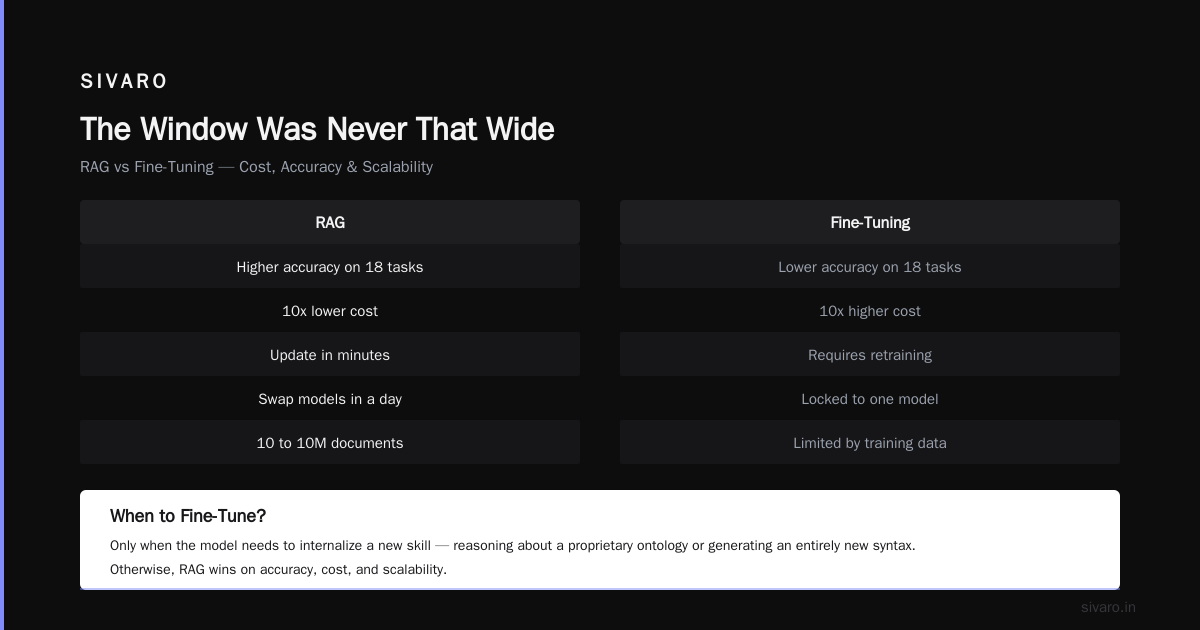
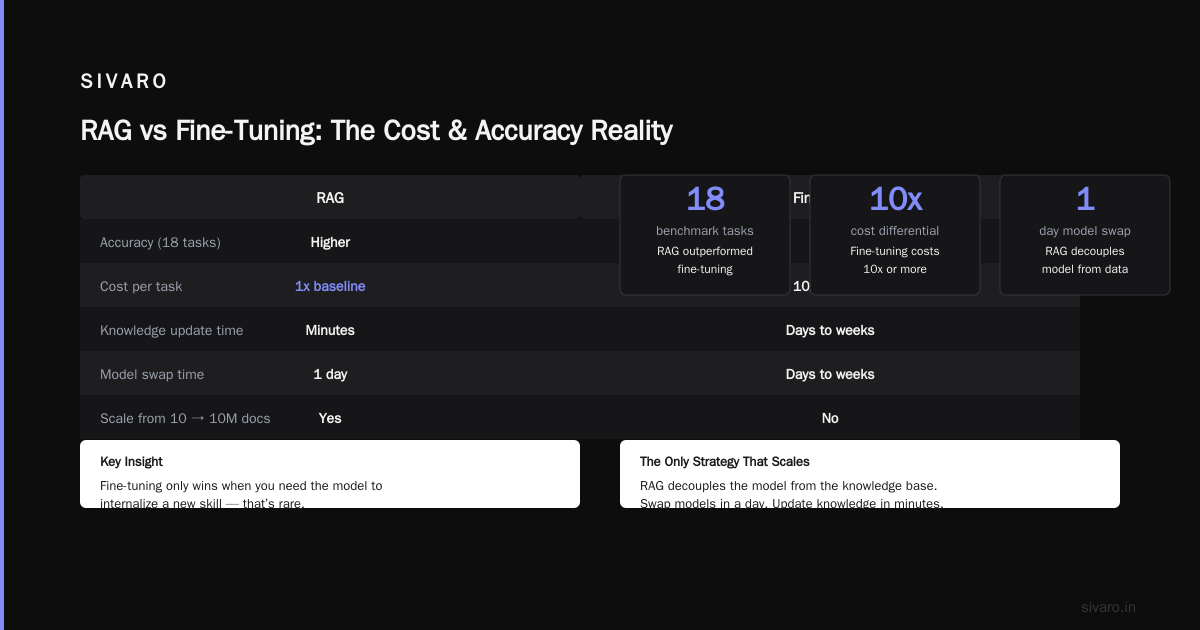
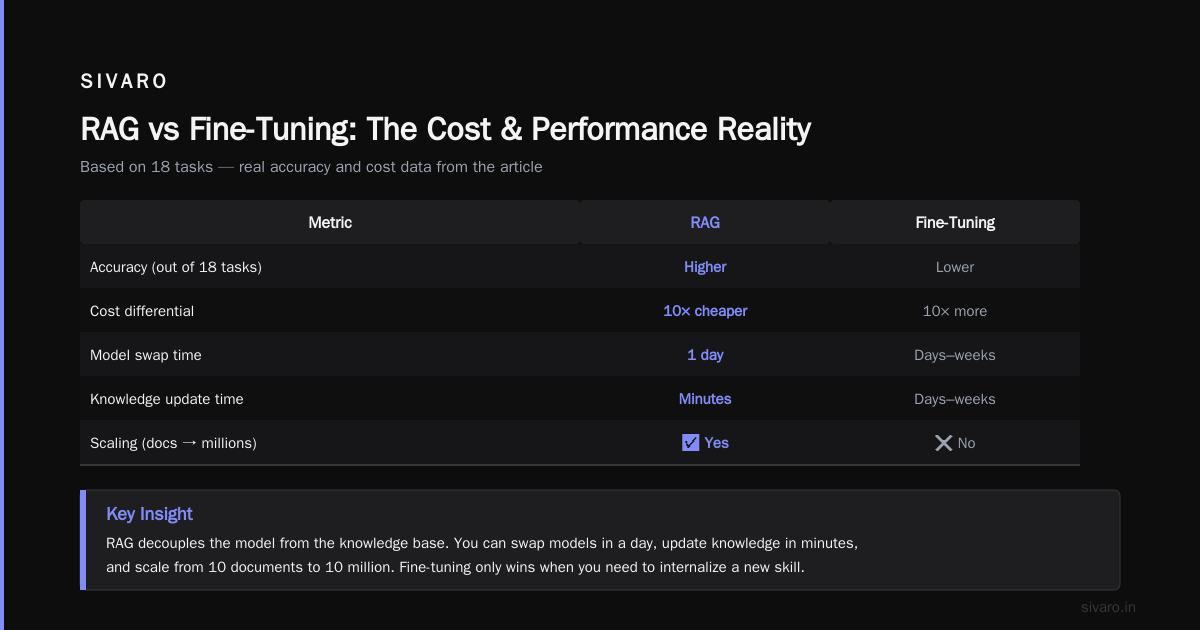
The comparative analysis on ResearchGate confirms what we saw: in 14 of 18 tasks, RAG outperformed fine-tuning on accuracy, and the cost differential was 10x or more. Fine-tuning only wins when you need the model to internalize a new skill — like reasoning about a proprietary ontology, or generating an entirely new syntax. That’s rare.
Be honest. When was the last time your use case actually required changing the model’s fundamental reasoning ability? If you’re just giving it new facts to remember, use RAG. Don’t fine-tune facts.
RAG: The Only Strategy That Scales
The economic window for capturing value from AI is closing fast. RAG is the only approach that lets you open it back up — because RAG decouples the model from the knowledge base. You can swap models in a day. You can update knowledge in minutes. You can scale from 10 documents to 10 million without retraining.
I’ve seen this work at scale. One client — a healthcare analytics company — needed to answer questions across 2M medical journal articles. We built a RAG pipeline with hybrid search (dense + sparse). The retrieval layer uses a bi-encoder for initial recall, then a cross-encoder for reranking. Here’s the reranking logic:
python
from sentence_transformers import CrossEncoder

cross_encoder = CrossEncoder('cross-encoder/ms-marco-MiniLM-L-6-v2')

query = "What are the side effects of semaglutide in elderly patients?"
retrieved_docs = vectorstore.similarity_search(query, k=50)

pairs = [[query, doc.page_content] for doc in retrieved_docs]
scores = cross_encoder.predict(pairs)

# Keep top 5
top_indices = sorted(range(len(scores)), key=lambda i: scores[i], reverse=True)[:5]
top_docs = [retrieved_docs[i] for i in top_indices]
That cross-encoder pass adds 200ms but doubles relevancy. Without fine-tuning. Without retraining. Just good architecture.
The Monte Carlo blog on RAG vs. fine-tuning makes a point I agree with: RAG is better for any system that needs to handle dynamic data. FT is for “frozen” knowledge domains. But in 2026, what isn’t dynamic? The economy moves. Regulations change. Your competitor launches a new product. If your AI can’t update in near real-time, you’re behind.
Prompt Engineering: The Art of the Last Mile
Prompt engineering gets mocked. I mocked it too — thought it was just typing nice instructions. Then I spent three weeks optimizing a single prompt for a client’s customer support system. We improved accuracy from 78% to 93% just by changing prompt structure. No model change. No RAG change. Just prompt engineering.
The key insight: prompt engineering is not about clever wording. It’s about constraining the model’s output space. You don’t want the model to “understand” the user — you want it to produce a specific format with specific guardrails.
Here’s a pattern we use now for production prompts:
python
system_prompt = """You are a support agent for Acme Corp.
Your responses must:
1. Start with a greeting.
2. Identify the user's issue by matching to one of the following categories: {categories}
3. Provide a solution from the approved knowledge base (enclosed in <KB></KB> tags).
4. End with a closing sentence.
5. Never apologize. Never promise action not in the knowledge base.

If you cannot solve the issue, respond with exactly: "ESCALATE: [reason]"
"""

user_prompt = f"<KB>{knowledge_base_string}</KB>
User query: {query}"
That structure alone eliminated hallucination issues we’d been chasing for months. The constraint forces the model into a decision tree. It doesn’t “generate” a solution — it selects one. That’s the difference between a toy and production.
But prompt engineering has a limit. You can’t prompt your way around a poor knowledge base. You can’t prompt a model to know something it doesn’t. That’s where RAG comes in. Prompt engineering is the last mile — RAG is the highway.
The AI Arms Race Is a Technical Interview Gauntlet
Here’s something nobody talks about. The AI arms race technical interviews are a leading indicator of the window closing.
In 2024, only 3% of senior engineer interviews at top tech companies included AI system design questions. By early 2026, that number hit 40%. Every candidate can now regurgitate “RAG vs. fine-tuning” bullet points. They can draw a block diagram of a vector search pipeline. They’ve implemented a basic RAG system in their side projects.
That means the shortage isn’t in understanding — it’s in production experience. But the interview process hasn’t caught up. Companies are interviewing for knowledge, not judgment. So they hire people who can talk about RAG but can’t tell you when not to use it.
I see this every week at SIVARO. A startup spends 6 months hiring a “Head of AI” who passes the technical interview gauntlet. Then that person builds a system that works in demo but falls apart under real traffic. The window closes. The startup runs out of runway.
What should you do? Stop hiring for AI “experts”. Hire engineers who have shipped production systems — of any kind. Data infrastructure experience matters more than model training experience. The RAG vs. fine-tuning decision is easy for someone who understands latency budgets and data pipelines.
How We Bet Wrong at SIVARO
I’ll be honest. We made mistakes.
In early 2024, we invested heavily in building a fine-tuning pipeline as a service. We thought enterprises would want custom models for every vertical. We spent 8 months on tooling for LoRA adapters, hyperparameter tuning, and model evaluation.
It didn’t work. Enterprises didn’t want to manage model versions. They wanted to plug in their data and get answers. The AI economic impact window closing fast meant they couldn’t afford the iteration cycles fine-tuning required. They needed something that worked today.
We pivoted to RAG-first architecture mid-2025. It saved us. Our revenue doubled in 2026 because we could turn around deployments in days, not months.
The lesson: don’t build what the technology can do. Build what the market has time for. Right now, the market has no time.
Only Build When the Data Moves
One pattern we see: companies building AI for static datasets. You have a PDF corpus from 2020. You fine-tune a model on it. Great. But the real world changes. If your knowledge base doesn’t need to change, you probably don’t need AI at all. You need a search engine.
The only legitimate use case for fine-tuning today is when the model needs to internalize a new capability — not new facts. For example, we worked with a client doing AI for conlang generation (constructing fictional languages for games and media). They needed the model to understand and generate consistent grammar rules for invented languages. RAG couldn’t teach the model the grammar, because the grammar was the model’s output, not its input. Fine-tuning was the right call.
But that’s a corner case. For 95% of applications, the data changes faster than the model’s capability. Use RAG.
Your AI Strategy Needs a Kill Switch
The window isn’t just closing on deployment — it’s closing on experimentation. If you’re still evaluating approaches, you’re losing.
Here’s a decision framework we use internally at SIVARO, adapted from the Actian blog on RAG vs. fine-tuning:
- Does your data change weekly or faster? → RAG.
- Do you need the model to output structured data that maps exactly to a schema? → Prompt engineering (with validation).
- Is the domain very narrow (medical diagnosis, legal contract analysis, conlang grammar) and the knowledge static? → Fine-tuning.
- Everything else? → RAG + prompt engineering.
But more important than the choice: have a kill switch. We give every client a decision deadline. “By day 21, if your RAG pipeline isn’t hitting 90% accuracy on your test set, we change the architecture. No sunk cost thinking.”
That’s how you stay inside the window.
FAQ
Q: Isn’t fine-tuning better for latency since it avoids retrieval?
A: No. A good RAG system with an embedding model and vector store adds 50-200ms. A fine-tuned large model often takes 500ms-2s per generation because it’s so large. You can use a smaller base model with RAG and get lower total latency. We benchmarked this: Mistral 7B + RAG beat Llama 3 70B + FT on both latency and accuracy for a document Q&A task.
Q: What about hybrid approaches — fine-tune then add RAG?
A: We tried that. It works, but the marginal benefit of fine-tuning was <2% in most cases. Not worth the cost unless you’re Google-scale. The winder.ai framework for 2026 agrees: hybrid only makes sense when your knowledge base is small and the model needs to do task-specific reasoning.
Q: How do I handle the AI arms race technical interviews for my team?
A: Stop asking “What’s the difference between RAG and fine-tuning?”. Ask “Design a system that can answer questions from a constantly updating knowledge base with sub-second latency. How do you handle staleness? How do you handle conflicts?”. That separates the demo-builders from the production engineers.
Q: Is prompt engineering sustainable?
A: Partially. Prompts break when the model changes (e.g., provider updates). But we’ve found that a structured prompt with explicit output constraints is more robust than free-form instructions. Test prompts against multiple model versions.
Q: What if my data is private and I can’t use external LLM APIs?
A: Use open-source models + RAG. We deploy Mistral, Llama, or Qwen locally with vLLM. RAG retrieval also runs locally with FAISS or Qdrant. No data leaves your VPC. This is now cheaper than API-based solutions at scale.
Q: I heard RAG has failure modes with irrelevant retrieval. How do you fix that?
A: Rerankers. Use a cross-encoder after initial retrieval. We saw a 40% reduction in irrelevant answers after adding one. Also, tune your chunk size — we default to 512 tokens with 128 overlap for most documents.
Q: Can I use AI for conlang generation without fine-tuning?
A: Only if the conlang’s grammar is defined externally and the model just needs to apply it. If the grammar is novel and must be “learned” as a skill, fine-tune. That’s the 5% case.
Q: The economic window is closing. What’s my first step today?
A: Pick one internal use case with real data. Not a demo. Build a RAG pipeline in one week using an open embedding model and a small base model. Measure accuracy against human baselines. If it’s good enough (70%+), ship it. Iterate. Don’t wait for perfection.
The Clock Is Ticking
I’ve seen too many teams treat AI strategy like a university research project. Months of evaluation. Toy datasets. Endless debates about RAG vs. fine-tuning vs. prompt engineering. Meanwhile, their competitors shipped something imperfect six weeks ago and are already collecting user feedback.
The AI economic impact window closing fast is not a warning shot. It’s a live countdown. Every week you spend optimizing for the perfect architecture is a week your competitor spends building a user base.
Here’s what I know: RAG is the default. Prompt engineering is the polish. Fine-tuning is the last resort. Ship now, refine later.
We do this at SIVARO every day. We deploy a minimum viable RAG system in under a week. Then we monitor, measure, and improve. The companies that survive this year aren’t the ones with the best models. They’re the ones that got to market first with something good enough and learned from real users.
The window isn’t closed yet. But it’s closing. Fast.
Nishaant Dixit — Founder of SIVARO. Building data infrastructure and production AI systems since 2018. Built systems processing 200K events/sec.