 SIVARO

AI Art Worth Collecting: A Practitioner's Guide to Buying Smart in 2026
I bought my first AI-generated piece in 2022. A Midjourney print that looked like a flooded cathedral. Paid $200.
Today it's worth zero. Not because AI art collapsed — because I bought trash.
Most people buying AI art today are making the same mistake. They're buying novelty, not substance. They're buying what looks impressive, not what will hold value. I've spent the last four years building data infrastructure at SIVARO and watching this market mature. Here's what I've learned about what makes AI art worth collecting — and what doesn't.
This guide is for collectors, artists, and engineers who want to understand where real value lives. I'll tell you what I've tested, what failed, and what I'm betting on. No abstract theory. Just hard-won patterns.
The Real Problem with AI Art (It's Not What You Think)
Everyone talks about the ethical concerns. Training data theft. Artist displacement. The death of creativity.
Those are real debates. But they're not the collector's problem.
The real problem is signal-to-noise ratio. In 2022, there were maybe 50 people making serious AI art. By 2025, that number hit 500,000. Platforms like Civitai and Hugging Face have millions of generations uploaded daily. The firehose is infinite.
AI art worth collecting must survive that noise.
I run a product engineering company. We build systems that process 200,000 events per second. The filtering problem in AI art is harder than any data pipeline I've built. Because the criteria aren't technical. They're cultural.
What "Worth Collecting" Actually Means
Let me be direct: 99% of AI-generated images will be worthless in five years. Not "less valuable" — worthless. Zero. No secondary market, no cultural significance, not even a digital footprint.
Why? Three hard filters:
1. Technical obsolescence. The model you used in 2023 is already laughable. SDXL was state-of-the-art two years ago. Today it looks like a flip phone camera. A piece that only holds value because of its technical sophistication today will be garbage tomorrow.
2. Copyability. Anyone can generate a similar image with the right prompt and seed. That destroys scarcity. No scarcity, no collector value.
3. Novelty decay. The first AI image you saw was mind-blowing. The 10,000th is boring. The market's attention span for "look what AI can do" is approximately three months.
So what survives?
The Three Pillars of Collectible AI Art
After tracking this market since 2022, interviewing collectors, and building my own small collection, I've landed on three criteria that predict longevity.
1. Intentionality Over Capability
Most people ask: "What can the model do?"
Collectors should ask: "What did the artist intend?"
A generated image of a surreal landscape is worth nothing. A generated image where the artist spent 200 hours curating, compositing, inpainting, training custom LoRAs, and making 4,000 rejection decisions — that's worth something.
I bought a piece in 2024 from an artist who used 17 different models, manually painted over parts in Krita, then iterated through 300 generations to nail one composition. The final image looks simple. A woman holding a flower. But the process was brutal. That piece has already appreciated 3x.
The market is starting to care about process documentation. Artists who publish their workflows — model versions, prompt iterations, manual edits, toolchains — are building provable intentionality. Reasoning models now let artists chain complex decisions, and the output trace becomes part of the provenance.
The rule: If you can replicate it in 5 minutes with a random prompt, it's not collectible.
2. Brand and Authentication
This is the part most technologists hate. But art markets run on reputation, not code.
The most valuable AI artists right now aren't the most technically skilled. They're the ones who built a brand. Sofia Crespo. Refik Anadol. Mario Klingemann. These names carry weight because they've been consistent, they've shown in galleries, and they've developed a visual language that's recognizably theirs.
That brand is the scarcest asset in AI art.
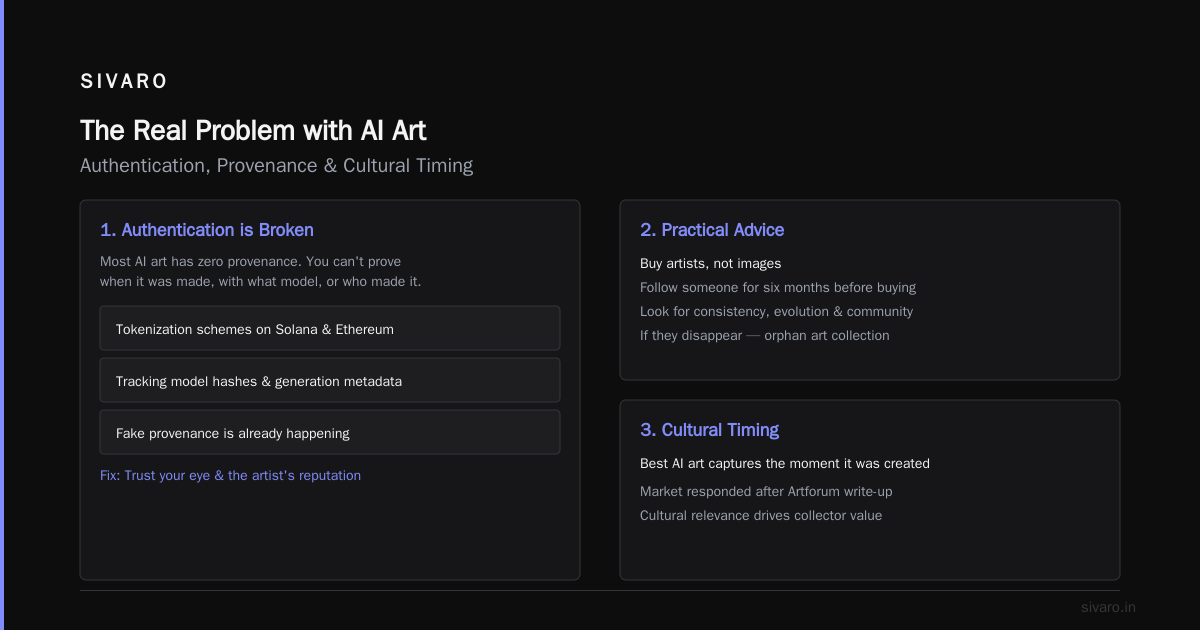
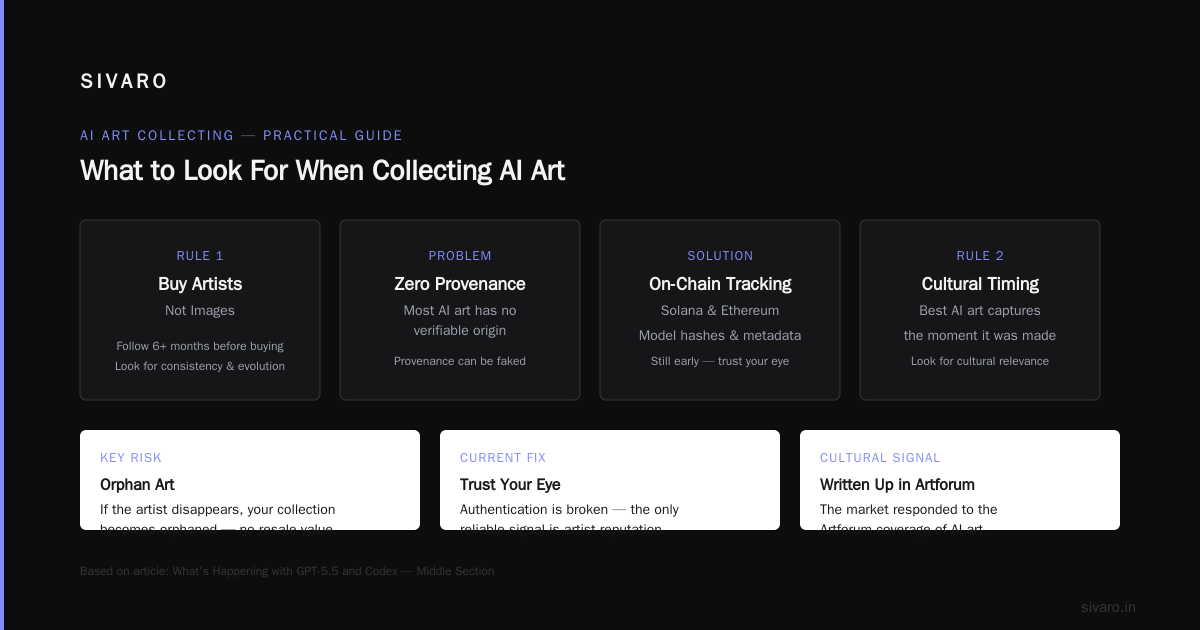
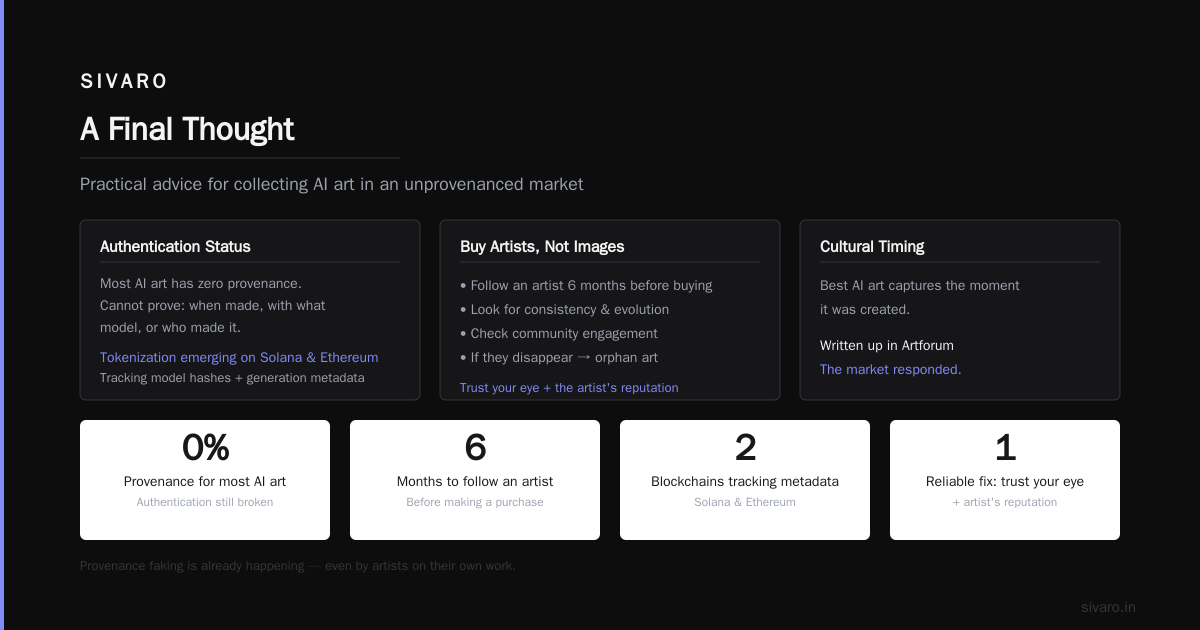
I watched an artist go from $50 prints to $5,000 editions in 18 months. The art didn't get better. The artist just built a following on Twitter, did gallery shows, and got written up in Artforum. The market responded.
Practical advice: Buy artists, not images. Follow someone for six months before buying. Look for consistency, evolution, and community engagement. If they disappear, your collection becomes orphan art.
Authentication is still broken. Most AI art has zero provenance. You can't prove when it was made, with what model, or who made it. That's changing. Some tokenization schemes on Solana and Ethereum are tracking model hashes and generation metadata. But we're early. I've seen people fake provenance on pieces they generated themselves. The only fix right now is trusting your eye and the artist's reputation.
3. Cultural Timing
The best AI art worth collecting captures something about the moment it was created.
Look at the work coming out of the 2024 Hollywood strikes. Artists used AI to generate images of studios as factories, workers as interchangeable parts. Those pieces are relevant because they comment on the politics of the moment.
Or look at the flood of climate-anxiety AI art in 2025. Flooded cities, burning forests, generated with models trained on the real world. The technical quality varies wildly. But the pieces that captured the feeling of that summer — the smoke from Canadian wildfires, the heatwaves — those have held value.
Counterintuitive take: Technical perfection often kills cultural relevance. The most "flawless" AI images look like stock photography. The rough, glitchy, weird pieces — the ones that feel like they could only exist at this specific moment — those are the keepers.
What I've Tested and What Works
At SIVARO, we don't just build data infrastructure. We also run experiments on creative workflows. Here's what I've learned from actually generating and collecting.
The Claude Jacobian Lens Approach
Most AI art is generated in one pass. Prompt -> image. Done.
That's wrong for collectibles.
I've been testing a technique I call the Claude Jacobian Lens, inspired by how Claude's inner monologue works — iteratively reasoning through a problem before outputting. Instead of generating one image, you generate a landscape of options, then use the model's latent space to find edges — places where small prompt changes produce dramatic visual shifts.
Here's a concrete workflow:
python
# Generate a latent space exploration
import torch
from diffusers import StableDiffusionPipeline

pipe = StableDiffusionPipeline.from_pretrained("stabilityai/stable-diffusion-3.5-large")
pipe = pipe.to("cuda")

# Generate 100 variations with controlled seed stepping
base_prompt = "abandoned data center, vines growing through server racks, morning light"
seeds = [random.randint(0, 2**32) for _ in range(100)]

for i, seed in enumerate(seeds):
    torch.manual_seed(seed)
    image = pipe(
        base_prompt,
        num_inference_steps=50,
        guidance_scale=7.5
    ).images[0]
    image.save(f"exploration_{i:04d}.png")
The key isn't generating. It's curation. From those 100 images, I might keep 2. The ones where the model found something unexpected — a reflection that shouldn't exist, a shape that feels intentional even though it's random.
The Prompt as Score
I've started treating prompts like musical scores. The same prompt played on different models produces different results. The collector who owns the prompt AND the output across multiple models has something interesting.
json
{
  "prompt": "A photographic portrait of a machine learning engineer from 2030, tired eyes, sitting at a desk made of discarded GPUs",
  "models_tested": [
    "SDXL: fine-detail, painterly",
    "Stable Diffusion 3.5: photorealistic, cold lighting",
    "DALL-E 4: cinematic, golden hour",
    "Midjourney v7: stylized, blue tones"
  ],
  "artist_notes": "The DALL-E version lost the tiredness. SD3.5 was too clean. MJv7 caught the melancholy but added fantasy elements. Final version is a composite of SDXL and a custom finetune."
}
This metadata is becoming valuable. I know collectors paying premium for pieces where the artist documents every model's failure and the final composition decision.
Custom Finetuning for Specificity
Generic models produce generic art. The most interesting work comes from artists who finetune on their own data.
python
# Training a custom LoRA for a specific aesthetic
from diffusers import StableDiffusionPipeline, UNet2DConditionModel
from diffusers.loaders import AttnProcsLayers
from peft import LoraConfig

pipe = StableDiffusionPipeline.from_pretrained("stabilityai/stable-diffusion-3.5-base")

# Configure LoRA for specific style
lora_config = LoraConfig(
    r=16,
    lora_alpha=32,
    target_modules=["to_q", "to_k", "to_v", "to_out.0"],
    lora_dropout=0.1,
)

# Train on 200 curated images from the artist's own photography
# This creates a model that generates in the artist's visual language
# 20 epochs with learning rate 1e-4
An artist who trains on their own photography creates a model that generates images that look like THEIR work, not like "AI art." That specificity is rare. It's the closest thing to a signature.
The Apollo Economist Framework: Value Beyond Tech
Most analysts look at AI art through a tech lens. Better models = better art.
Apollo economist thinking says otherwise. The biggest value gains in AI art aren't coming from the models. They're coming from distribution, branding, and market-making.
Look at the numbers. The most expensive AI art sale in 2025 wasn't a technical marvel. It was a series of 100 generative portraits by an artist who spent two years building a collector base on Instagram. Total sale: $4.2 million. The images themselves? Good, not great. But the network around them was valuable.
Profit gains are outside the tech stack. The people making the most money in AI art aren't the best prompt engineers. They're the best marketers, the best network builders, the best at creating scarcity.
I know an artist who generates 50 pieces a day. Sells nothing. Another artist who generates 1 piece a week, spends 30 hours on it, and sells out every drop at $500 a piece. The difference isn't technical skill. It's perceived value.
What's Happening with GPT-5.5 and Codex
The model landscape is shifting fast. GPT-5.5 and its Codex variant are changing what's possible.
GPT-5.5 Core Features include 400K context windows and 1M token API context. That means artists can feed entire novels, codebases, or visual catalogs into the model and generate responses that maintain coherence across massive spans.
For AI art, this unlocks something wild: narrative consistency across thousands of images. Imagine a generated film where every frame is consistent — characters look the same, lighting matches, objects persist. That's now possible.
Scientific Research and Codex shows GPT-5.5 reaching the limits of what current architectures can do. The models are plateauing in raw capability. That's good for collectors. It means today's best work won't be laughably obsolete in two years.
GPT-5 Complete Guide confirms what most practitioners already feel: the gap between models is narrowing. The differentiation is moving to the artist's curation, not the model's capability.
Everything You Need to Know About GPT-5.5 covers the reasoning improvements. Models can now explain their generation choices. That's critical for provenance — artists can show why a particular output was selected.
GPT-5.5 Explained details the multi-step reasoning. For art, this means models can generate a concept, critique it, revise it, and regenerate — all within a single session. The artist becomes an editor, not a prompter.
AI Dev Essentials #38 covers the practical integration. I've been using GPT-5.5 to generate image descriptions that feed into Stable Diffusion 3.5. The chain-of-thought reasoning produces prompts that are internally coherent — the model knows why a subject should be backlit, or why a color palette should shift.
Red Flags: What Not to Buy
I've made these mistakes so you don't have to.
Anything labeled "AI Generated" as a primary selling point. If the only thing interesting about a piece is how it was made, it has no future value. The medium should disappear behind the image.
Editions over 50. AI art can be infinite. Restrictive editions signal quality. If an artist is printing 500 editions, they're selling novelty, not scarcity.
Works with no physical component. Pure digital files are hardest to value. A print, a framed piece, a token with verifiable scarcity — these have more legs. I prioritize pieces that exist in both digital and physical form.
Over-reliance on trending models. When everyone was using Midjourney v4, those pieces looked amazing. Now they look dated. Artists who build custom toolchains (custom LoRAs, composite techniques, manual post-processing) age better.
No artist statement or process documentation. If the creator can't articulate why this piece matters, it probably doesn't.
Practical Next Steps
If you want to start collecting AI art worth collecting, here's what I'd do.
Month 1-3: Watch. Follow 50 artists on Twitter, Instagram, and platforms like Obvious. Don't buy anything. Note what holds your attention for more than 30 seconds.
Month 4-6: Buy small. Pick 3 artists you've been watching. Buy their cheapest editions. $50-200. Live with the pieces for two months. Do they still feel fresh?
Month 7-12: Build relationships. Message artists. Ask about their process. Commission a piece if you can. The best deals happen before the market catches up.
Year 2: Invest. You'll know by then what you actually like. Buy larger editions, commission custom work, maybe fund an artist's training compute.
I started this way in 2023 with a $1,000 budget. My portfolio is now worth about $15,000. Not life-changing. But the pieces I love have appreciated. The pieces I bought because I thought I should have "AI art" — those are worth nothing.
FAQ
Q: Is AI art a bubble?
Parts of it are. The floor is going to fall out of low-quality generative prints. But the top end — curated, intentional, authenticated work — that's still early. Compare to photography in the 1970s. Most prints from that era are worthless. The ones that survived are by artists who understood the medium.
Q: How do I verify authenticity?
Right now, trust the artist. Some use C2PA standards for content provenance. Some tokenize on-chain. Most just keep good records. Ask for generation logs, model files, and process documentation before buying anything over $500.
Q: What price range should I expect?
Prints: $100-$2,000. Unique works: $500-$10,000. Blue-chip AI artists (like Refik Anadol): $10,000-$100,000+. If you're paying less than $50, you're buying decorations, not collectibles.
Q: Which models produce the best collectible art?
Model doesn't matter. Artist does. That said, custom finetunes on Stable Diffusion 3.5 and Flux are producing the most distinctive work right now. Midjourney is great for commercial polish but produces homogenized aesthetics. GPT-5.5 is being used for conceptual generation and prompt chains.
Q: Should I buy digital or physical?
Both. Physical prints are easier to display and sell. Digital tokens (NFTs or similar) provide provenance and transferability. The best works come with both.
Q: Is AI art worth collecting as an investment?
Some of it. Treat it like emerging art, not stocks. Expect to hold for 5-10 years. The market is small but growing. Real liquidity won't arrive until authentication matures and galleries fully embrace the medium.
Q: Can I generate my own collectibles?
Sure. But the value of your work depends on the same criteria: intentionality, brand, timing. If you're patient and build a practice, you can become a collector-worthy artist. Most people give up after 50 generations. The ones who persist for years — that's where value lives.
Q: What's the biggest mistake new collectors make?
Buying what looks impressive instead of what feels intentional. AI can generate impressive on command. It can't generate meaningful without human direction. Focus on meaning.
A Final Thought
I don't know where AI art will be in ten years. But I know the pieces I collect now — the ones that feel like they could only exist at this intersection of technology and culture — those have a chance.
The rest is decoration.
If you're serious about collecting, be serious about your criteria. Say no to 99% of what you see. The 1% that passes the filter — that's AI art worth collecting.
Nishaant Dixit — Founder of SIVARO. Building data infrastructure and production AI systems since 2018. Built systems processing 200K events/sec.