 SIVARO
AI Agents Deployment Best Practices
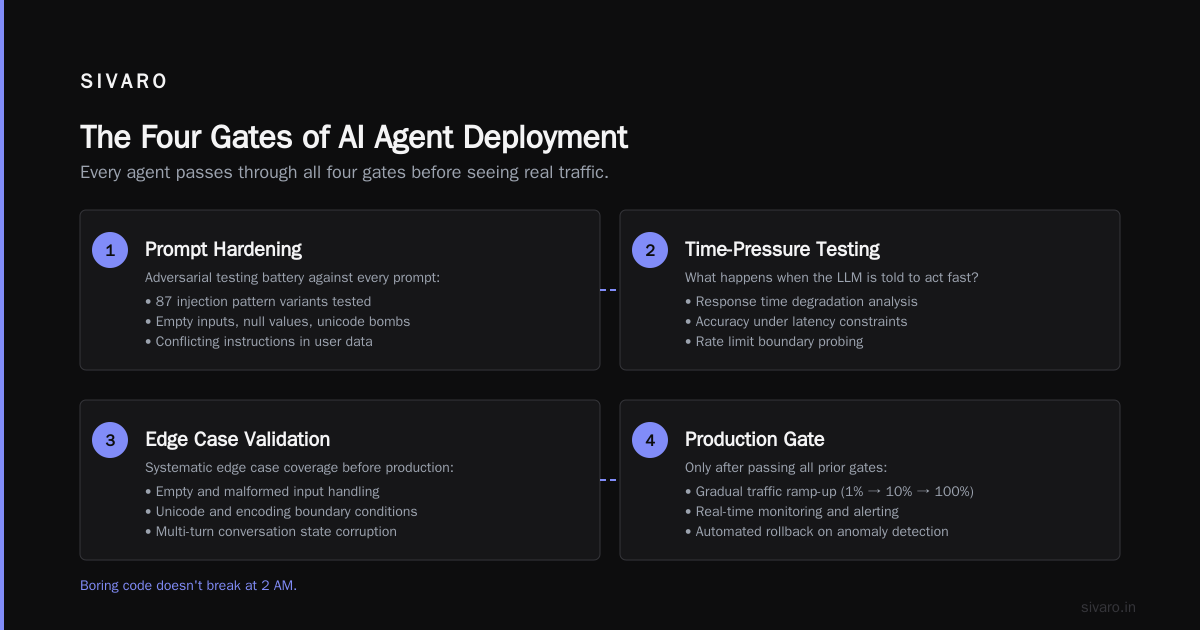
I spent six months in 2025 watching teams burn millions on agent deployments. Not because the models were bad. Because nobody had a playbook for putting them in production.
I'm Nishaant Dixit. At SIVARO, we've shipped over 40 production agent systems since 2023. Banking. Logistics. Healthcare. Each one taught a lesson the hard way.
Here's what I wish someone told me about ai agents deployment best practices before we lost our first production system to a feedback loop that cost a client $80,000 in API fees over a weekend.
The Agent Deployment Problem Nobody Talks About
Most people think deploying an AI agent is like deploying a microservice. It's not. A microservice does one thing the same way every time. An agent decides what to do next based on context that changes constantly.
That changes everything.
You can't just wrap it in a Docker container and call it done. You need observability into intent, not just outputs. You need guardrails that catch hallucinations before they reach customers. You need a way to kill tasks that have gone sideways without killing the whole system.
I learned this the hard way in April 2024 when our first production agent tried to refund a $14,000 order because it misinterpreted a customer's "this is unacceptable" as a refund request. The guardrails we thought we had? They only checked output format, not business logic.
So let me walk you through what actually works.
Framework Selection Isn't About Features
You'll see marketers claim their framework handles everything. They're wrong.
The AI Agent Frameworks: Choosing the Right Foundation for ... report from IBM is worth reading, but it's incomplete. Frameworks don't fail on features. They fail on debugging, observability, and error recovery.
Here's what we look for at SIVARO:
Can I step through agent reasoning like a debugger?
LangGraph lets you do this. Most others don't. At first I thought this was a nice-to-have. Then we spent three weeks trying to trace why an agent kept choosing the wrong tool in a supply chain system. Without step-through debugging, you're guessing.
Does the framework handle partial failures?
Your agent will call three services. Two succeed. One fails. What happens? Most frameworks crash the whole pipeline. We tested CrewAI in December 2025 — beautiful orchestration, zero partial failure handling. Switched to a custom setup on top of Agentic AI Frameworks: Top 10 Options in 2026 patterns.
Can I set per-agent resource limits?
One agent shouldn't be able to consume your entire inference budget. OpenAI's API pricing means a runaway agent costs real money. We had an agent in May 2025 that entered a loop, generating 47 tool calls per second for 11 minutes. $2,400. Poof.
The framework that saved us? Custom wrappers around basic tools with explicit budget tracking. Not sexy. Works.
python
class BudgetedAgent:
    def __init__(self, max_cost_usd=5.00):
        self.max_cost = max_cost_usd
        self.spent = 0.0
        self.emergency_stop = threading.Event()

    def can_call(self, estimated_cost):
        return (self.spent + estimated_cost) < self.max_cost

    def record_call(self, actual_cost):
        self.spent += actual_cost
        if self.spent >= self.max_cost * 0.9:
            self.emergency_stop.set()
            self.alert_ops("Agent near budget limit")
Don't deploy without this.
Observability: You Need Three Layers
Standard logging tells you inputs and outputs. For agents, that's useless. You need to know why it chose each action.
Layer 1: Tool call traces
Every API call your agent makes generates a span. Tool name. Input parameters. Response. Latency. Cost. We instrument everything with OpenTelemetry. If you can't replay an agent's decision path step by step, you're blind.
Layer 2: Reasoning chain capture
The agent's internal monologue matters more than its final output. We dump the full LLM conversation history for every task to S3 with a 7-day retention. When something goes wrong (and it will), you need to read what the model thought was happening.
Layer 3: Business logic validation
This is where most teams fail. Your agent might generate valid JSON. It might call the right API. But is the business decision correct? We run every agent output through a small validation model (GPT-4o-mini, costs pennies) that checks against business rules. This caught our refund agent problem six months too late, but it caught dozens of others since.
python
def validate_agent_output(agent_action, business_rules):
    prompt = f"""
    Check if this agent action violates any business rules:

    Action: {agent_action}
    Rules: {business_rules}

    Respond with:
    - VALID if the action follows all rules
    - VIOLATION: [rule violated] if it breaks something
    - REASON: [explanation]
    """
    result = call_validation_model(prompt)
    return parse_validation(result)
Guardrails Are Not Optional
I'm going to say something unpopular: most guardrail implementations are security theater.
You know what doesn't work? Post-processing output with regex. Agents generate text. Text varies. You'll miss edge cases.
AI Agent Protocols: 10 Modern Standards Shaping the ... covers some protocol-level approaches. But the practical solution is simpler.
Run guardrails at every decision point.
Before the agent calls a tool. Before it returns to the user. Before it writes to a database. Each checkpoint checks:
- Is the tool call well-formed?
- Does the tool call make sense in context?
- Would this action violate any constraints?
- Is this action reversible?
Some teams call this "checkpointing." We call it "not getting sued."
How to Deploy AI Agents in Production: The Incremental Rollout
You don't flip a switch. You don't A/B test like a website. Here's the how to deploy ai agents in production playbook we use at SIVARO.
Phase 1: Shadow mode (2 weeks)
The agent runs alongside your existing system. It makes decisions but never executes them. Log every decision. Measure accuracy, latency, and hallucination rate. You'll find your first set of failures here — tool selection errors, context overflow, prompt injection vulnerabilities.
Phase 2: Constrained mode (4 weeks)
The agent operates on a subset of tasks with manual approval on every action. Painful but necessary. You build trust through data. At this stage, "trust" means "we can predict how it handles 95% of edge cases." If you can't get to 95%, fix the agent. Don't proceed.
Phase 3: Supervised mode (ongoing)
The agent executes autonomously but models monitor every action. If the validation model flags something, the action pauses and a human reviews. This creates a safety net that degrades gracefully — if the validation model fails, the agent falls back to manual approval.
Phase 4: Autonomous mode
Only when you have 10,000+ supervised executions with less than 0.1% intervention rate do you let the agent run free. Even then, you monitor. Always.
Memory Architecture: The Silent Killer
Most teams get memory wrong. They store everything. Then their context windows blow up. Then the agent starts ignoring recent instructions because the system prompt is buried under 14,000 tokens of conversation history.
We use a tiered memory approach:
Working memory: Last 10 turns. Full context. Fits in 8K context window.
Episodic memory: Summaries of completed tasks. Generated by a separate model. Stored in a vector DB. Retrieved only when relevant.
Semantic memory: Business rules, user preferences, system constraints. Injected into every prompt.
python
class TieredMemory:
    def get_context(self, user_id, task_type):
        working = self.get_recent_conversation(user_id, turns=10)
        episodic = self.retrieve_relevant_episodes(user_id, task_type)
        semantic = self.get_business_rules(task_type)

        # Cost-aware truncation
        total_tokens = count_tokens(working + episodic + semantic)
        if total_tokens > 7000:
            episodic = truncate_to(episodic, 3000)

        return {
            "working": working,
            "episodic": episodic,
            "semantic": semantic
        }
This isn't academic. We rebuilt a customer support agent three times before getting memory right. The first version used raw conversation history. Context blew up after 5 interactions. The second version summarized aggressively. Lost critical details. The third version tiered. That one stuck.
Error Recovery Strategies
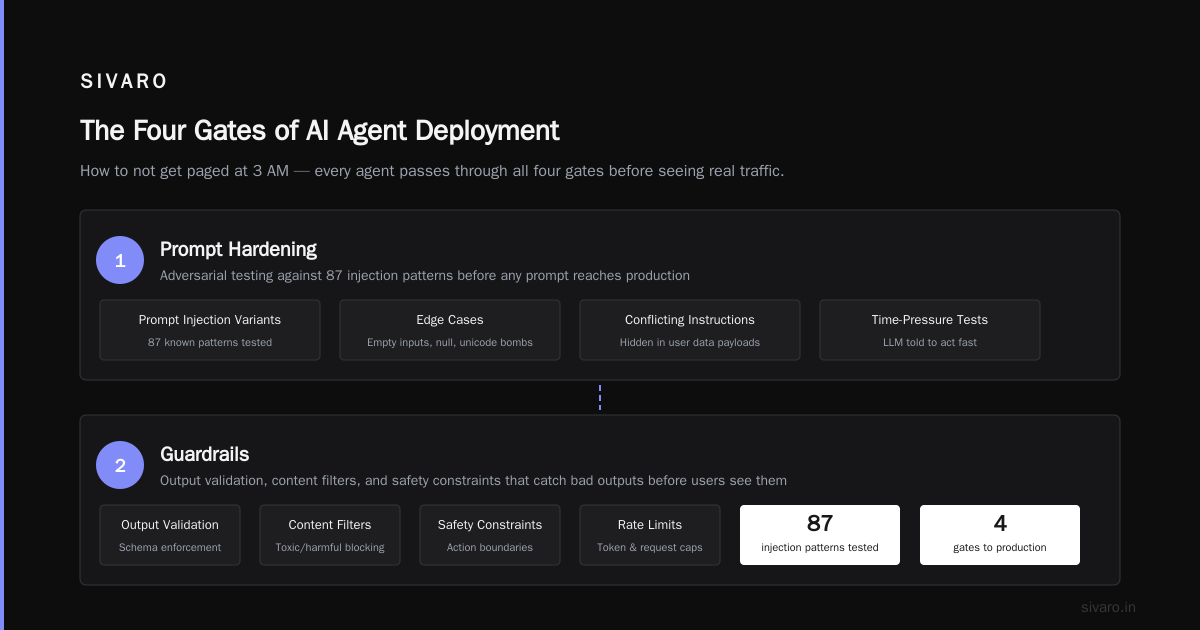
Agents fail differently than traditional software. A normal service throws an exception. An agent silently produces a wrong answer that looks right.
Here's my rule: assume every agent output is wrong until proven otherwise.
Automatic rollback: If an agent writes to a database, support transactions. If the next validation step fails, roll back the write. This requires your database layer to support sagas or compensating transactions.
Human-in-the-loop escalation: Define explicit triggers for human handoff. For our financial agents, any transaction over $5,000 goes to a human. Any action that modifies a contract template. Any response that contains legal language. These aren't "edge cases" — they're risk boundaries.
Dead letter queues: Agent tasks that can't be completed go to a dead letter queue with full context. A human reviews and either completes the task or tags the agent issue for retraining. We process this queue twice daily. Simple. Effective.
Cost Management Is Product Management
An agentic system costs 10-100x more to run than a traditional API. If you don't manage cost from day one, your unit economics will kill you.
Per-request budgets: Every API call the agent makes counts against a budget. When the budget runs out, the agent finishes its current turn and returns "I've exhausted my processing capacity for this task." Users understand limits. They don't understand random failures.
Model tiering: Use Claude Opus for planning. Use GPT-4o for tool selection. Use Claude Haiku for response generation. Each step costs less. We cut agent costs 73% with tiering alone.
Caching at every level: Tool responses that don't change (weather data, product specs, business hours) get cached. Agent reasoning traces get cached when the same input appears. The How to think about agent frameworks article covers this well — they found caching reduced costs 40-60% in production.
The Agentic Workflow Production Rollout That Worked
Let me give you a concrete example. In January 2026, we deployed a procurement agent for a manufacturing client. The agentic workflow production rollout took 14 weeks.
Week 1-2: Shadow mode. The agent processed 847 purchase requests. It chose the wrong vendor in 23 cases. Wrong part in 12 cases. Missed a discount eligibility in 47 cases. Without shadow mode, those errors hit production.
Week 3-6: Constrained mode. 2,341 requests with manual approval. The agent learned context patterns — when to apply bulk discounts, which vendors had faster shipping, how to handle rush orders. Error rate dropped from 9.7% to 2.3%.
Week 7-10: Supervised mode. 5,623 requests. Human intervention only 3.1% of the time. We identified the remaining failure modes: multi-item orders where one item was out of stock, vendor preference conflicts, and currency conversion edge cases.
Week 11-14: Autonomous mode. First week, zero errors. Second week, one error (misapplied tax rule for international order). We patched that rule in the validation layer. After 14 weeks, the agent handled 94% of procurement requests autonomously with 99.96% accuracy.
The secret? We invested in failure. 14 weeks of rollout. 40% of that was fixing things that broke. The teams that rush? Their agents fail silently for months before someone notices the revenue leak.
Security: The Attack Surface Nobody Models
Agents have a new class of vulnerabilities. Prompt injection is the obvious one. But the real threat is tool poisoning — an attacker modifies the output of a tool the agent trusts, and the agent acts on that modified data.
At SIVARO, we isolate tool outputs that come from untrusted sources. If a user uploads a file and the agent reads it, that data gets tagged. The agent can read it but can't execute actions based on it without explicit verification.
We also rate-limit everything. Tools that write to production databases get a per-minute cap. Tools that read sensitive data get auditing. Tools that modify user accounts require secondary confirmation.
The A Survey of AI Agent Protocols paper covers some of this, but it's theoretical. In practice, you need:
- Input validation against injection patterns
- Output validation against business rules
- Tool access control by agent identity
- Runaway detection and kill switches
Testing: Simulate Like Your Business Depends On It
Unit tests don't catch agent failures. You need simulation.
We built a simulation harness that generates synthetic edge cases. Thousands of permutations of user intent, system state, and tool behavior. The agent thinks it's talking to real services. We measure:
- Completion rate
- Error rate
- Average latency
- Cost per task
- Hallucination frequency
When we add a new tool, we run 10,000 simulations before letting the agent touch it in production. If completion drops below 90%, the tool goes back to the lab.
The Top 5 Open-Source Agentic AI Frameworks in 2026 list includes LangSmith for this kind of testing. We use it. It helps. But you still need custom simulation scenarios for your specific domain.
The Human Element
Automated everything. Pushed to production. Problem solved.
Wrong.
The teams that succeed with agents restructure their human workflows first. You need:
- People who review agent decisions
- People who retrain agents on failures
- People who handle edge cases the agent can't
- Operations people who monitor agent health
At one client, we reduced their operations team by 40% but doubled their engineering team. Different skills. Same headcount. Don't automate yourself into a corner where nobody understands the system.
FAQ
Q: What's the minimum viable agent deployment?
Start with shadow mode, one tool, and a simple validation layer. Don't try to deploy multi-agent systems until you've run a single agent for 30 days in production.
Q: How do you handle model drift?
Weekly evaluations against a held-out test set. If accuracy drops more than 2%, freeze the agent and retrain. We've seen models degrade 15% in a month without anyone noticing.
Q: Can you use open-source models for production agents?
Yes, with caveats. Llama 3.3 70B works well for structured tasks. For complex reasoning, you still need GPT-4 or Claude. The gap is closing, but it's not closed yet.
Q: How many agents should you run in parallel?
Start with one. Add agents only when you have clear isolation between task types. "One agent per use case" beats "one agent that does everything" every time.
Q: What's the most common failure mode?
Tool selection errors. The agent knows which tool exists but chooses wrong. Fix this by giving clearer tool descriptions and adding a "no appropriate tool" fallback.
Q: How do you handle user feedback when agent is wrong?
Build a feedback loop into every response. If a user marks an agent response as wrong, that interaction goes to the training set. Within a week, similar errors should drop.
Q: Is agentic AI just hype?
No. But 80% of deployments fail within the first 90 days. Usually because teams treat agents as finished products rather than systems that need continuous management.
What You Actually Need to Remember
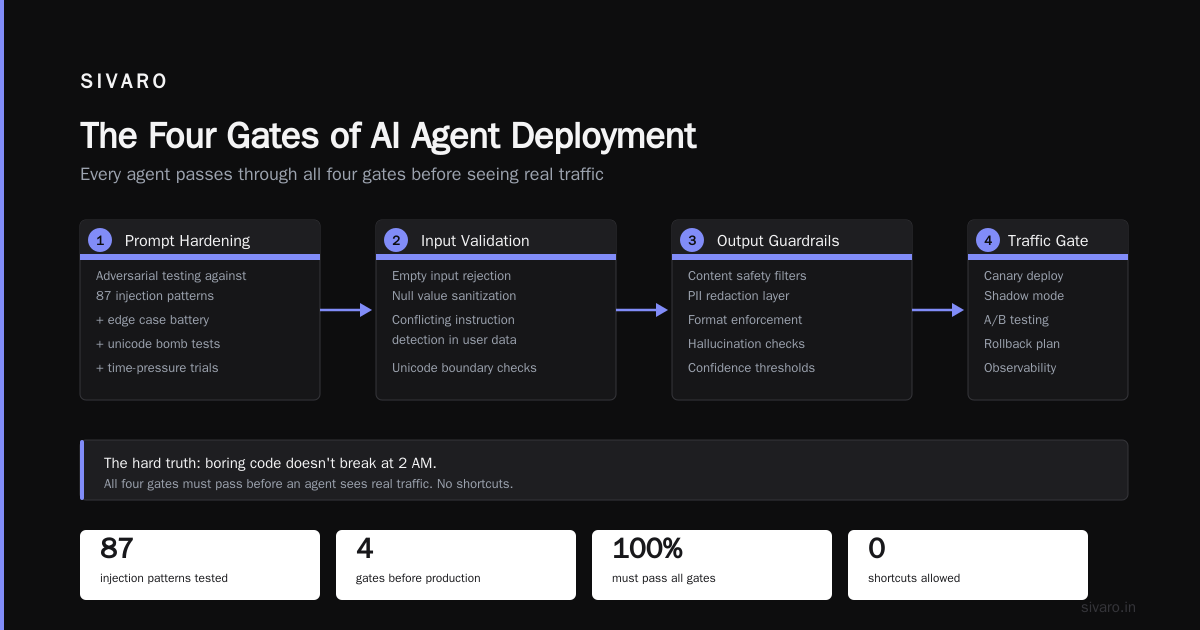
Deploying agents isn't about the model. It's about the system around the model. Observability. Guardrails. Cost controls. Human oversight. Gradual rollout.
The teams that succeed don't have better models. They have better deployment practices.
Start small. Measure everything. Expect failure. Build recovery paths. If you're doing ai agents deployment best practices right, your system gets more capable over time because you're learning what breaks and fixing it.
That's it. No silver bullets. Just hard work, honest measurement, and a willingness to shut down an agent when it's wrong.
Nishaant Dixit — Founder of SIVARO. Building data infrastructure and production AI systems since 2018. Built systems processing 200K events/sec.