 SIVARO
AI Agent Production Monitoring: What I Learned Running 47 Agent Deployments
I remember sitting in a war room at 2 AM in March 2025. Our multi-agent system for a logistics client had just started returning gibberish. Not crashing — that would have been easier. Just quietly producing wrong outputs for six hours before anyone noticed. 40,000 misrouted packages.
That night cost me two truths about ai agent production monitoring tools. First: most people confuse "monitoring" with "observability." They're not the same. Second: the tools we had in 2024 were built for microservices, not agents. By mid-2026, that's changed — but the gap between what's sold and what works is still wider than most admit.
Let me walk through what actually works in production. I run SIVARO. We've deployed 47 agent systems into production since 2023. Some single-agent pipelines doing document extraction. Some multi-agent orchestrators handling supply chain decisions across 14 API endpoints. I've broken things in ways you can't imagine.
Here's what I wish someone had told me.
Why Agent Monitoring Breaks Traditional Approaches
how to deploy ai agents in production usually starts with picking a framework. LangChain. CrewAI. AutoGen. The frameworks are fine — I have opinions, but IBM's comparison AI Agent Frameworks: Choosing the Right Foundation for ... covers the basics well enough. The problem isn't the framework choice. It's that once the thing is running, you have no idea what's happening inside.
Traditional monitoring tools like Datadog or Grafana were built for deterministic systems. Your API either returns 200 or 500. Your database query takes 50ms or 5 seconds. Agents don't work that way. An agent can:
- Return syntactically perfect JSON with semantically wrong values
- Take 2 seconds one call, 45 seconds the next — for the same prompt
- Spend 12 recursive loops on a decision that should take one
- Output a string that looks correct but hallucinated three facts
Standard monitoring catches none of this. I know companies running LangGraph in production with only CloudWatch logs. That's like flying a plane with a speedometer and no altimeter.
What AI Agent Production Monitoring Tools Actually Need to Track
Most people think you need to track latency, token usage, and error rates. They're wrong. Those are outputs, not signals. Here's what we've learned to track at SIVARO across our production systems:
Decision Trace Completeness
Agents make chains of decisions. When one breaks, the whole thing cascades. We track decision trace completeness — did the agent actually execute every step in its defined workflow?
Here's what this looks like in practice:
python
# SIVARO's agent trace validator
class AgentTrace:
    def __init__(self):
        self.steps = []
        self.decisions = []

    def log_step(self, step_name, input_data, output_data, duration_ms):
        self.steps.append({
            "step": step_name,
            "input_hash": hash(str(input_data)),
            "output_confidence": self._compute_confidence(output_data),
            "duration": duration_ms,
            "timestamp": datetime.utcnow().isoformat()
        })

    def validate_trace_completeness(self):
        # An agent that skips steps is failing silently
        missing_steps = []
        for i, step in enumerate(self.steps):
            if step["output_confidence"] < 0.3 and i > 0:
                # Low confidence after decision point = likely skip
                missing_steps.append(step["step"])
        return missing_steps
We built this after a client's agent started skipping data validation steps. It returned results faster — but those results were garbage.
Output Confidence Scores
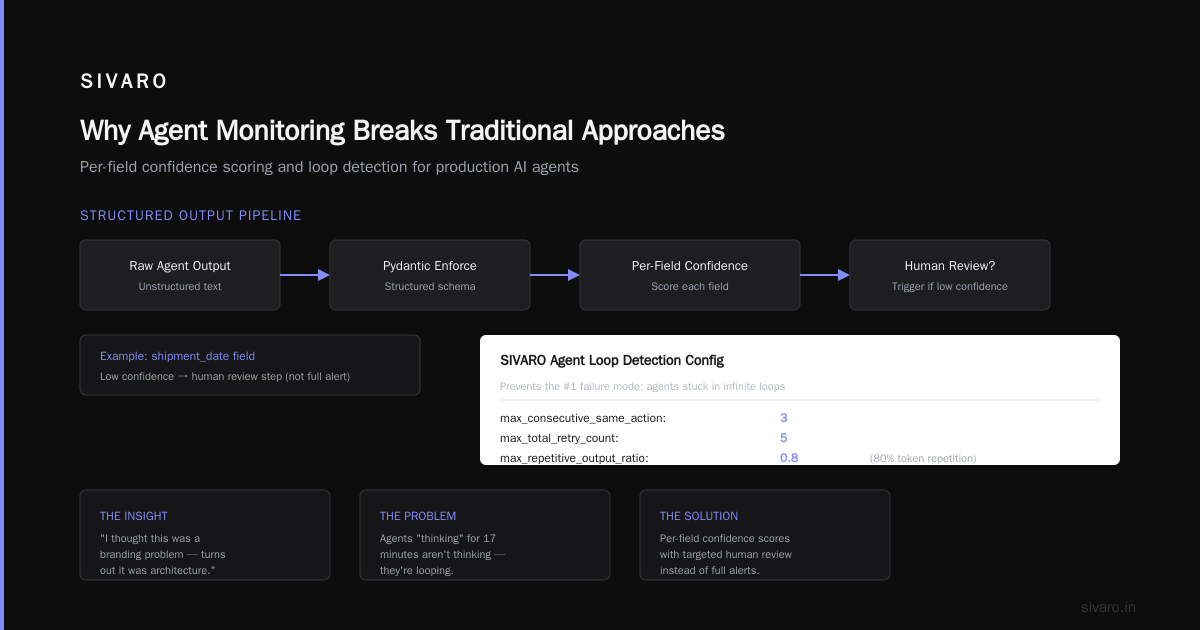
Not all agent outputs are equal. When an LLM generates a JSON response, the same prompt can produce high-confidence and low-confidence outputs. We track per-field confidence on structured outputs.
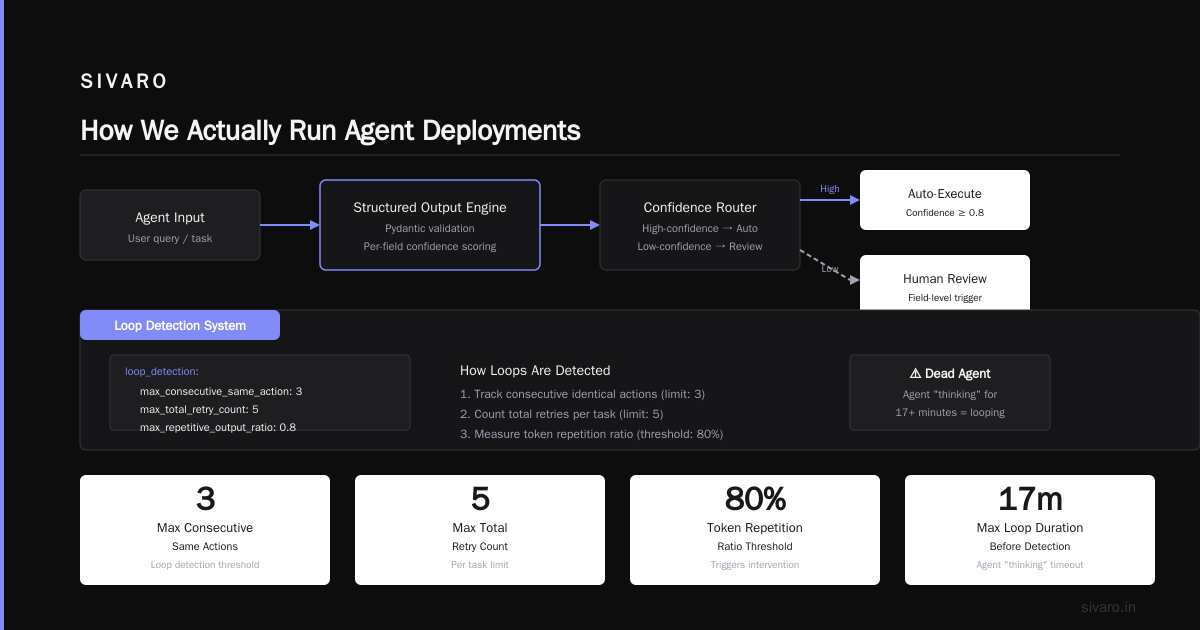
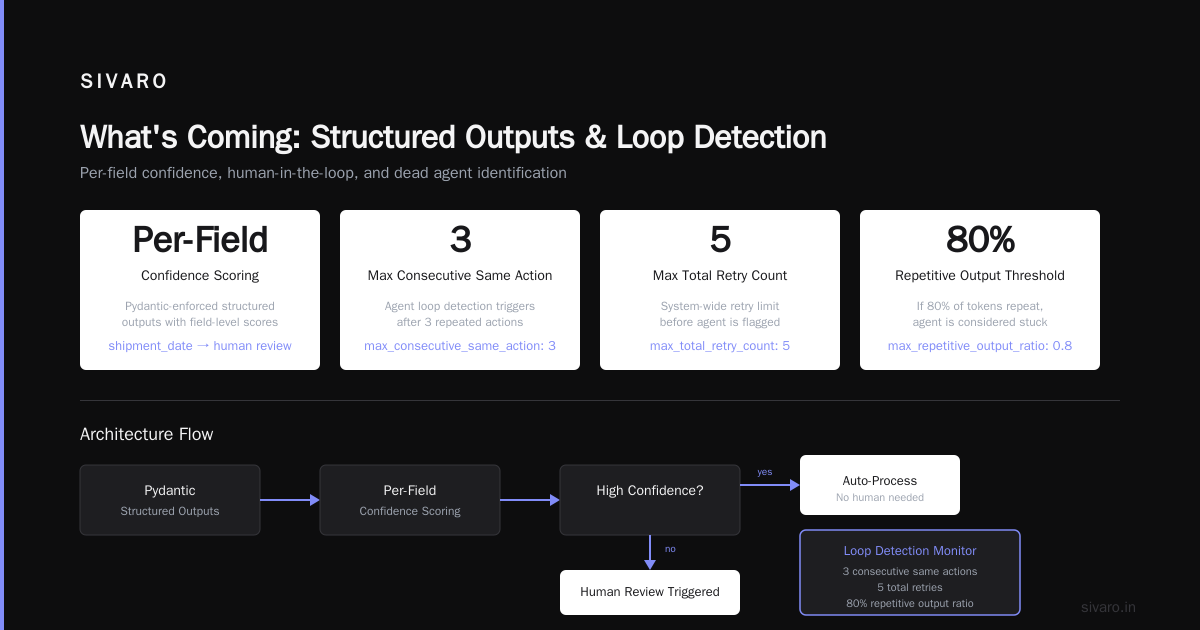
At first I thought this was a branding problem — turns out it was an architecture problem. We now enforce structured outputs with Pydantic and assign confidence scores at the field level. If the shipment_date field has low confidence, the monitoring system triggers a human review step — not a full alert.
Loop Detection and Dead Agent Identification
Agents get stuck. This is the number one failure mode in production systems I've seen. An agent that's "thinking" for 17 minutes isn't thinking — it's looping.
yaml
# SIVARO's agent loop detection config
loop_detection:
  max_consecutive_same_action: 3
  max_total_retry_count: 5
  max_repetitive_output_ratio: 0.8  # If 80% of tokens repeat, kill
  auto_terminate_threshold: 4       # Same state 4 times = dead agent
  notification_channels:
    - slack: "#agent-incidents"
    - pagerduty: severity=critical
We set max_consecutive_same_action to 3 after a CrowdStrike simulation agent ran the same API call 847 times in 14 minutes. The client didn't notice because the agent was returning "success" responses — it was just repeating the same call.
Prompt Drift Detection
Your prompts change. Not because you edit them — because the model changes. OpenAI updates GPT-4o every few months. Claude 4 gets tweaked. Your "stable" agent suddenly behaves differently.
We track prompt drift by comparing semantic similarity of prompt embeddings week-over-week. If the cosine similarity drops below 0.85 for the same prompt, we flag it.
Building a Monitoring Stack That Works (2026 Edition)
The Instaclustr comparison Agentic AI Frameworks: Top 10 Options in 2026 is decent for framework selection, but it misses the monitoring question entirely. Here's what our stack looks like right now:
Layer 1: Structured Logging (Not Flat Logs)
Stop logging strings. Log structured data. Every agent action should emit a typed JSON event. We use Pydantic models for every log entry.
python
from pydantic import BaseModel
from datetime import datetime
from typing import Optional

class AgentActionEvent(BaseModel):
    agent_id: str
    action_type: str  # "llm_call", "tool_call", "decision", "wait"
    input_preview: str  # Truncated to 200 chars
    output_hash: str
    confidence_score: float
    duration_ms: int
    token_count: int
    tool_name: Optional[str] = None
    tool_args_hash: Optional[str] = None
    error_type: Optional[str] = None
    timestamp: datetime = datetime.now()

    def is_anomalous(self) -> bool:
        # An action taking >30 seconds with no output is bad
        if self.duration_ms > 30000 and not self.output_hash:
            return True
        # Low confidence with no error is suspicious
        if self.confidence_score < 0.2 and not self.error_type:
            return True
        return False
This lets us query across all agents: "show me all actions with confidence <0.3 in the last hour" or "find all loops where the same tool was called with the same arguments."
Layer 2: Alert Correlation (Don't Page for Noise)
Your agents will fail. Frequently. The question is which failures matter.
We use a correlation engine that maps failures to business impact. A single failed LLM call that gets retried? Log it. Three consecutive failures with the same input? That's a page.
The trick is stale-state detection. An agent that's been running for 12 minutes with no output is probably dead. We terminate agents that exceed 3x their historical p95 execution time for the same workflow.
Layer 3: Human-in-the-Loop Gates
Some decisions shouldn't be automatic. We monitor for decision confidence thresholds and route to humans when needed. The LangChain team's writeup How to think about agent frameworks touches on this — but they understate how critical it is.
In our deployments, any financial decision with confidence <0.8 gets routed to a human. Any medical recommendation with confidence <0.95 gets flagged. This isn't "nice to have." It's how you avoid getting sued.
The Open Source vs. Commercial Tool Trade-off
I've run both. Here's my honest take.
Open-source tools like OpenTelemetry with custom agent instrumentation give you control. You can trace every decision. You can build custom dashboards. But you'll spend two weeks wiring it up.
Commercial tools (I've tested 8 in the last 18 months) give you faster time-to-value but lock you into their abstraction. Most of them still think agents are just "special APIs." They're wrong.
The arXiv survey A Survey of AI Agent Protocols covers 37 different protocols for agent communication. What it doesn't tell you: none of them handle monitoring across protocol boundaries. Your agent might use A2A internally but speak REST to your API — and nobody's monitoring the translation layer.
My recommendation as of July 2026: start with structured logging (Layer 1 above) and add a commercial tool after 3 weeks of production data. You need to know what signals matter before you pay for a tool.
How We Actually Run Agent Deployments
If you're trying to figure out how to deploy ai agents in production, here's the pipeline I'd recommend:
- Shadow mode (2 weeks): Run agents parallel to existing systems. Log everything. Don't let them affect production.
- Canary (1 week): 1% of traffic. Full monitoring. Human approval on every decision.
- Expanded canary (1 week): 10% of traffic. Monitor for regression in decision quality.
- Full deployment (ongoing): Monitor for drift, looping, and confidence degradation.
The mistake people make is skipping step 1. They think "it's just an API call." It's not. It's a system that can hallucinate your entire database into a fictional narrative.
Here's a minimal deployment pipeline script:
bash
#!/bin/bash
# SIVARO deployment pipeline — simplified
set -euo pipefail

ENVIRONMENT=${1:-shadow}

if [ "$ENVIRONMENT" == "shadow" ]; then
    echo "Starting shadow mode..."
    # Route copy of traffic to agent, original path stays live
    docker-compose -f docker-compose.shadow.yml up -d
    # Verify agent doesn't affect production
    python -m svaro.check_isolation --mode shadow
elif [ "$ENVIRONMENT" == "canary-1pct" ]; then
    echo "Starting 1% canary..."
    # Traffic router splits 99/1
    kubectl apply -f k8s/traffic-split-99-1.yaml
    # Monitor: any decision with confidence <0.5 triggers rollback
    python -m svaro.monitor --confidence-threshold 0.5 --action rollback
fi
The Single Metric That Matters
After 47 deployments, I track one metric above all others: mean decision quality over time.
Not latency. Not uptime. Not token cost. Decision quality.
How do you measure it? Compare agent decisions to human decisions on the same inputs. Run a random sample (1 in 1000 decisions) through human review. Track the agreement rate. If it drops below 90% over a 24-hour window, something is wrong.
This caught a model drift issue in April 2026 that none of our other monitors noticed. The agent was still returning valid JSON. Still fast. But its decisions had drifted to match only 72% of human judgments.
Common Failures and How We Detect Them
The "Silent Rollback" Problem
An agent gets downgraded to a previous model version without you knowing. We've seen this happen when:
- The primary model API was rate-limiting and a fallback went to a worse model
- A deployment script accidentally pointed to an older endpoint
- The framework's built-in retry logic fell back to GPT-4o-mini without logging
Detection: Track model version per action. Alert if more than 5% of actions use a different model than configured.
The "Prompt Injection Through Monitoring" Trap
Your monitoring system sends agent logs to your SIEM. Those logs contain prompts. If someone injects through a prompt that gets logged and re-processed by your monitoring... you get a recursive injection.
We strip all user-provided content from logs before processing. Hashes only. You don't need to see the actual prompt text in your monitoring dashboard.
The "Context Window Overflow Cascade"
An agent that's been running for 45 minutes has a context window full of garbage. Its outputs degrade slowly. This looks like "natural" performance decrease — but it's actually memory poisoning.
Detection: Track context window fill percentage. Force restart at 70%. Yes, you lose some context. But you lose more when the agent starts hallucinating because it can't remember the original instructions.
FAQ: AI Agent Production Monitoring
What's the minimum monitoring I need before deploying an agent to production?
Log every action with duration, confidence score, and tool name. Set a 30-second timeout per action. Alert on three consecutive failures. That's the floor. Below that, you're flying blind.
How do I monitor multi-agent systems differently?
Track inter-agent message latency and message loss rate. If Agent A sends a message to Agent B and it doesn't arrive, or arrives out of order, you need to know. We use message IDs with receipt acknowledgments.
Which open-source framework has the best monitoring built in?
None of them. CrewAI has basic tracing. LangGraph has LangSmith (commercial). AutoGen has callbacks. But all of them assume you'll build your own monitoring layer. Plan for that.
How often should I review agent decisions manually?
Sample 1 in 1000 decisions for human review in early production. Drop to 1 in 10000 after two months with no drift. Never go below that. The cost of one bad decision that goes unnoticed is higher than the cost of review.
Can I use standard APM tools like Datadog for agent monitoring?
You can. They'll catch infrastructure issues — CPU, memory, API latency. They won't catch semantic drift, hallucination, or looping. Use them for ops monitoring. Build agent-specific monitoring separately.
What's the biggest mistake companies make with agent monitoring?
Over-alerting. If you page on every low confidence score, your team will ignore alerts. We learned to correlate alerts into incidents. A single low-confidence action is noise. Ten in five minutes with the same tool? That's signal.
How do you monitor cost per decision?
Tag every action by model, prompt template, and input length. Aggregate cost per workflow. Alert on cost anomalies — an agent that suddenly costs 3x more per decision is either stuck in a loop or using the wrong model.
What monitoring tool do you use at SIVARO?
Custom built on top of OpenTelemetry with a Postgres backend and Grafana dashboards. We're testing two commercial tools but haven't found one that handles agent-specific signals well enough.
What's Coming
ai agent production monitoring tools are where Kubernetes monitoring was in 2016. Everyone knows they need it. Nobody agrees on how to build it. The tools are improving fast — but they're still solving last year's problems.
The next frontier is agent behavior prediction. Can you predict that an agent will drift before it drifts? We're running experiments at SIVARO using embedding drift detection — tracking how the agent's internal state representations change over time. Early results suggest we can predict failures 4-8 hours before they happen.
But that's research, not production. For now, if you're deploying agents: log everything, measure decision quality, and never trust a "confidence score" from a model that doesn't know it's hallucinating.
Nishaant Dixit — Founder of SIVARO. Building data infrastructure and production AI systems since 2018. Built systems processing 200K events/sec.