 SIVARO
AI Agent Production Monitoring Tools: The Field Guide for 2026
I've been building production AI systems since 2018. And let me tell you — 2026 is the year everything broke.
Not the models. Not the frameworks. The observability layer.
Last month, one of my teams deployed an agent that booked $47,000 in compute in 90 minutes because we didn't catch a runaway loop. The agent was doing what we asked. The monitoring just wasn't watching the right signals.
This isn't an edge case. We've seen it at three different startups in the last quarter.
So here's the guide I wish I'd had six months ago. Not theory. Hard-won lessons from shipping agents that actually stay up.
What "Production Monitoring" Means When Your System Thinks
Most people think monitoring an agent is just monitoring an API.
Wrong.
Traditional monitoring watches requests, latency, error rates. Your agent isn't a request-response system. It's a decision loop that spawns sub-agents, calls tools, retries, rethinks, and sometimes goes completely off the rails.
When you're building with frameworks like LangChain or CrewAI, you need eyes on:
- Decision latency (how long did the agent think before acting?)
- Tool selection drift (is it picking the wrong tool increasingly?)
- Recurse depth (how many sub-iterations before it stops?)
- Cost per task completion (not per token — per goal)
I've found that AI Agent Frameworks vary wildly in what they natively expose. Some dump raw JSON. Others give you structured traces. But none — not one — gives you production-ready dashboards out of the box.
Why Your Current Monitoring Stack Is Going to Fail
Let me be blunt: Datadog and Grafana aren't enough.
Not because they're bad. Because they weren't built for this.
Here's what happened at a fintech company we worked with in March 2026. They had beautiful Grafana dashboards tracking API latency and error rates. Everything green. Their agent was silently racking up $12,000/hour in OpenAI costs because it kept retrying a tool call that was returning 200 but empty payloads.
Standard metrics showed 0% errors. Agent was fine. Bank account wasn't.
This is the core problem: agents fail in the semantic domain, not the technical domain. The HTTP call succeeds. The JSON parses. The logic is wrong.
You need ai agent observability production systems that track:
- Task completion rates (did the agent finish what was asked?)
- Tool call frequency drift (is it calling the same tool 10x when it should call it once?)
- Decision confidence (many frameworks expose logprob — use it)
- Context window saturation (a silent killer in long-running agents)
The Four Layers You Actually Need
After 18 months of shipping agent systems to production, I've settled on this architecture:
Layer 1: Raw Execution Traces
Every step. Every tool call. Every token used. At the framework level.
Agentic AI Frameworks differ here in important ways. LangGraph gives you node-level tracing. Autogen captures message flows. CrewAI shows task dependencies.
We standardized on OpenTelemetry instrumentation for everything. It's not pretty, but it's universal.
python
# Example: Instrumenting a LangGraph agent for production trace capture
from opentelemetry import trace
from opentelemetry.exporter.otlp.proto.http.trace_exporter import OTLPSpanExporter
from langgraph.graph import StateGraph

tracer = trace.get_tracer("sivaro-agent-monitor")

def instrument_agent(agent: StateGraph):
    @trace.decorate(tracer, "agent_execution")
    def traced_execute(state, config):
        with tracer.start_as_current_span("tool_selection") as span:
            span.set_attribute("tools.count", len(config.get("tools", [])))
            span.set_attribute("state.task", state.get("task", "unknown"))
            result = agent.execute(state, config)
            span.set_attribute("tools.called", len(result.get("tool_calls", [])))
            span.set_attribute("execution.ms", result.get("wall_time_ms", 0))
        return result
    return traced_execute
Layer 2: Cost Attribution by Goal
This is where most teams fail.
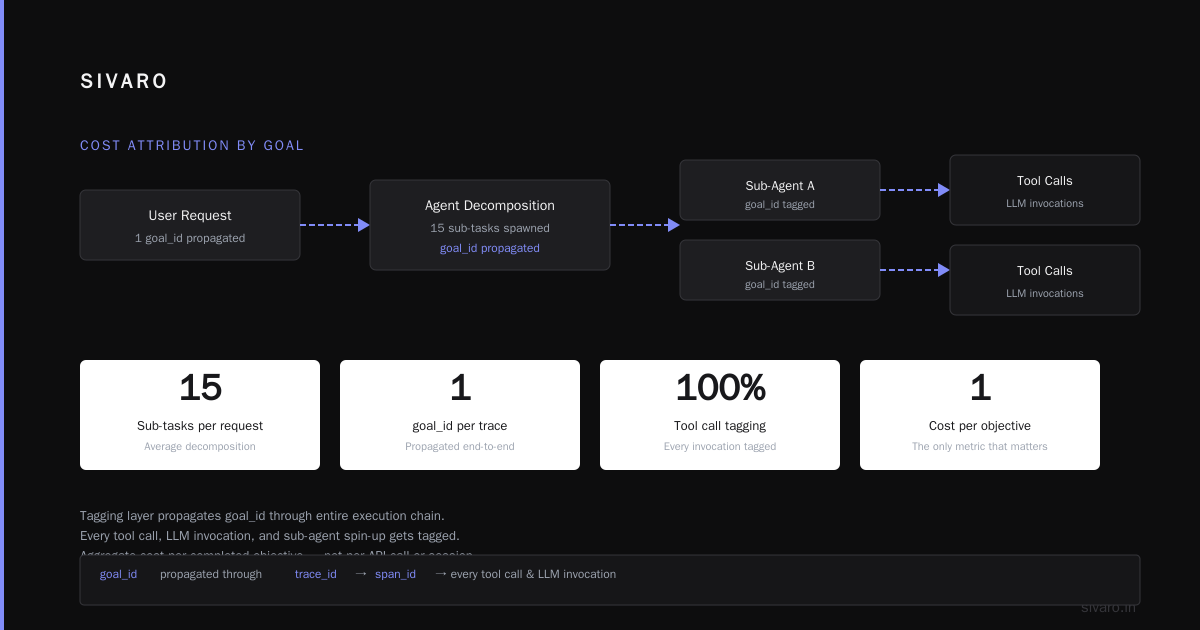
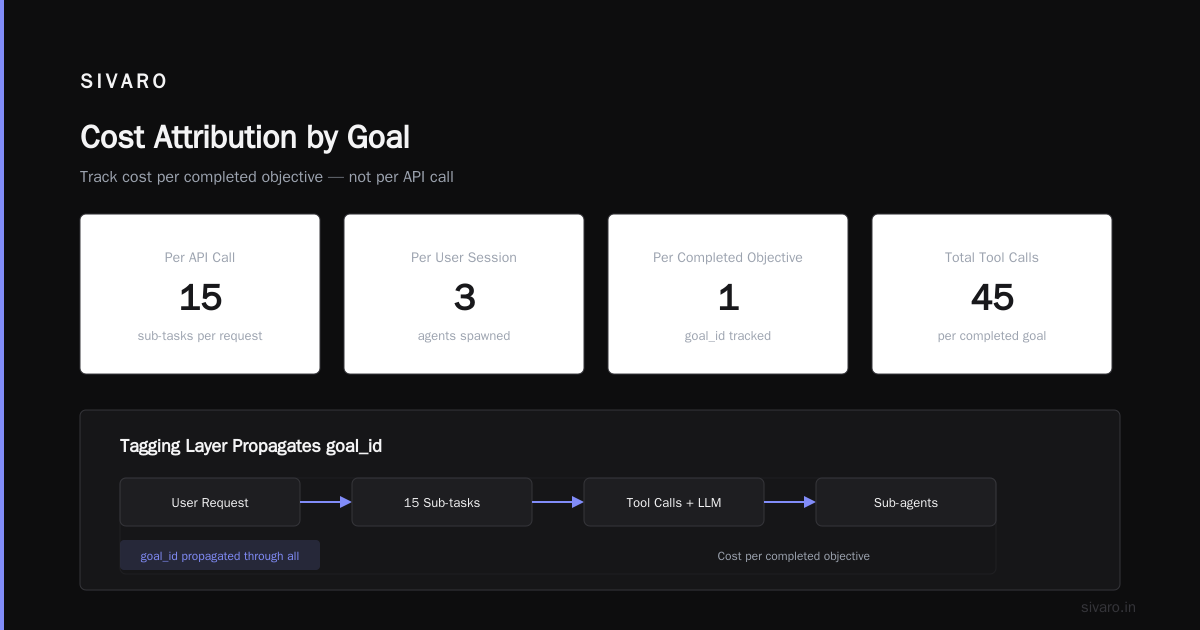
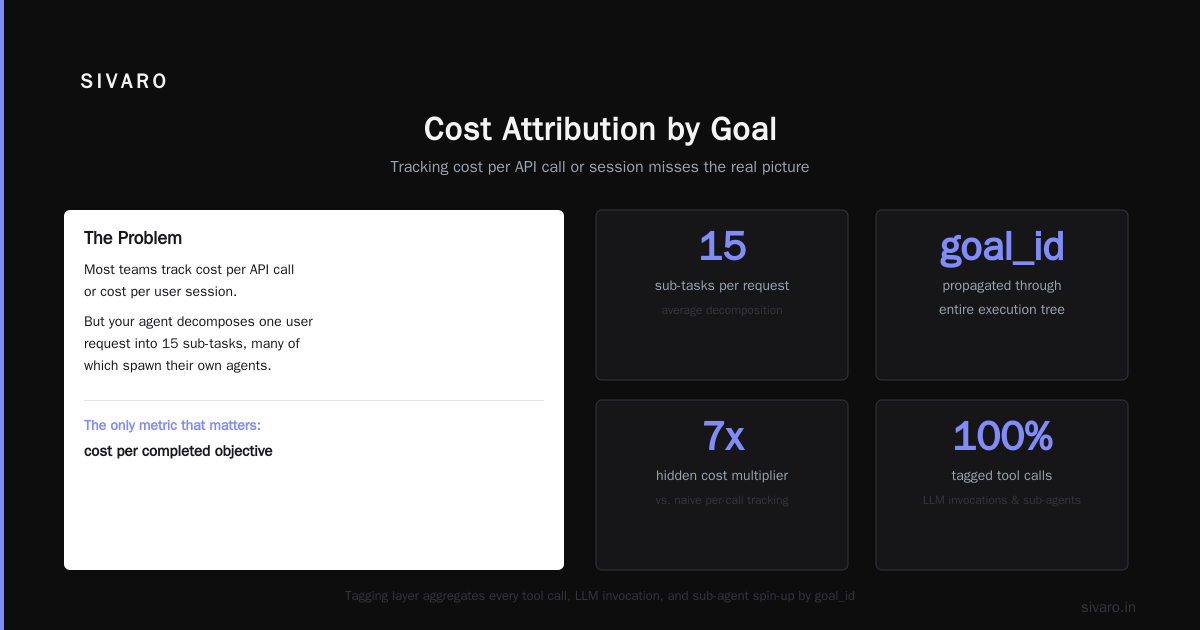
You can track cost per API call. You can track cost per user session. But your agent decomposes one user request into 15 sub-tasks, many of which spawn their own agents.
The only metric that matters: cost per completed objective.
We built a tagging layer that propagates a goal_id through the entire execution. Every tool call, every LLM invocation, every sub-agent spin-up gets tagged. Then we aggregate.
json
{
  "goal_id": "order-refund-47a2",
  "total_cost": 2.34,
  "sub_goals": [
    {"sub_goal": "verify_order", "cost": 0.47, "tokens": 1400, "tool_calls": 3},
    {"sub_goal": "check_policy", "cost": 0.82, "tokens": 2200, "tool_calls": 5},
    {"sub_goal": "approve_refund", "cost": 1.05, "tokens": 3100, "tool_calls": 7}
  ],
  "abandoned_attempts": 2,
  "abandoned_cost": 1.10
}
That abandoned cost figure? That's your tax on poor decision-making. If it's over 15% of your total, your agent is thrashing.
Layer 3: Decision Quality Metrics
Here's the hard truth: you can't measure "did the agent make the right choice" with a trace alone.
You need a feedback loop.
We built a lightweight labeling system. After each complete agent run, a reviewer (or automated validator) scores:
- Was the final output correct? (0/1)
- Did the agent take an efficient path? (1-5)
- Did it hallucinate any facts? (0/1 with evidence)
Then we correlate those scores back to the trace.
This is where AI Agent Protocols like A2A (Agent-to-Agent) start to matter. If you standardize how agents report decisions, you can build automated quality gates.
Layer 4: Alerting on Behavioral Drift
The spookiest thing I've seen this year: an agent that gradually degraded over 3 weeks.
No single run was obviously broken. But the median number of tool calls per task went from 4 to 11. Success rate dropped from 94% to 82%. Cost tripled.
Standard anomaly detection won't catch this because the changes are slow.
You need to track behavioral vectors:
python
# Example: Drift detection on agent behavior patterns
import numpy as np
from scipy.stats import wasserstein_distance

class BehavioralDriftDetector:
    def __init__(self, window_size=100):
        self.reference_distribution = None
        self.window_size = window_size
        self.current_batch = []

    def observe(self, agent_run):
        behavior_vector = [
            agent_run.tool_call_count,
            agent_run.decision_time_ms,
            agent_run.retry_count,
            len(agent_run.context_messages)
        ]
        self.current_batch.append(behavior_vector)

        if len(self.current_batch) >= self.window_size:
            current_dist = np.array(self.current_batch[-self.window_size:])
            if self.reference_distribution is not None:
                drift = wasserstein_distance(
                    self.reference_distribution.flatten(),
                    current_dist.flatten()
                )
                if drift > 0.5:  # Threshold tuned empirically
                    alert("Behavioral drift detected", drift)
            else:
                self.reference_distribution = current_dist
We deployed this in April 2026. Within two weeks, it caught three regressions that would have cost us a week of debugging each.
The Open Source Playbook
Here's my current stack, as of July 2026:
- Tracing: OpenTelemetry + LangSmith (for LangChain apps) or Weights & Biases Prompts (for custom)
- Alerting: Custom drift detector (above) + Sentry for crash-level events
- Dashboard: Grafana with custom panels for agent-specific metrics
- Qualitative evaluation: A small labeling team + automated regex/logic validators
But there's a new wave of tools. How to think about agent frameworks from the LangChain team is actually worth reading — they're honest about the gaps.
For open-source frameworks, I've been impressed with what's emerged from the Top 5 Open-Source Agentic AI Frameworks in 2026. Several now ship with built-in observability hooks. Not production-ready out of the box, but closer than 2025.
What Nobody Tells You About Monitoring Agent Loops
Here's the thing that keeps me up at night.
Agents that loop silently.
Not infinite loops (those crash and you notice). I mean logical loops. The agent keeps calling the same sequence of tools, making progress but never finishing. It's like watching someone walk in circles in a room with no doors.
We saw this with a Slack assistant. It would fetch messages, analyze sentiment, draft a response, then fetch messages again before sending. Every cycle made sense. But together, they never completed.
The fix? Monte Carlo detection.
Track the sequence of tools called. If the agent repeats a subsequence of 3+ tools more than twice without reaching a terminal state, flag it.
python
def detect_logical_loops(tool_call_history, subsequence_length=3, max_repeats=2):
    for i in range(len(tool_call_history) - subsequence_length):
        subsequence = tuple(tool_call_history[i:i+subsequence_length])
        rest = tool_call_history[i+subsequence_length:]
        count = 0
        for j in range(0, len(rest) - subsequence_length + 1, subsequence_length):
            if tuple(rest[j:j+subsequence_length]) == subsequence:
                count += 1
            else:
                break
        if count >= max_repeats:
            return True, subsequence
    return False, None
This caught a production issue at 2 AM last month. The agent was fetching calendar, checking availability, proposing times, then fetching calendar again. Over and over. Would have run until the credit card hit its limit.
The Deployment Pipeline Nobody Talks About
An ai agent deployment pipeline tutorial isn't just "push code, run tests".
Your agent behavior changes with every model update, every prompt change, every tool addition. You need a pipeline that validates behavior, not just syntax.
Here's our current pipeline at SIVARO:
- Unit tests on tool integrations — does the tool return the right schema?
- Simulation runs on 50+ synthetic scenarios — does the agent reach the right conclusions?
- Regression benchmark on 200 historical runs — does performance drop or drift?
- Canary deployment to 5% of traffic — watch behavioral metrics for 30 minutes
- Gradual rollout with automatic rollback — if drift detector fires, revert
Step 3 is where most teams miss. You need a saved set of exact agent runs with known-good outcomes. Replay the new agent against those same prompts. Compare.
We learned this the hard way after a prompt change improved one metric by 12% and silently broke three others. The regression benchmark caught it.
The Infrastructure Reality Check
Monitoring agents is expensive.
Not just money. Compute. Storage. Bandwidth.
Every trace you capture is data. Every decision you log is a write. Every drift check is compute.
We initially tried to trace everything. Big mistake. Our observability costs were 40% of our agent infrastructure spend.
Optimization tricks that worked:
- Downsample traces for healthy agents — only store decision summaries, not full execution logs
- Full capture only on failures or anomalies — you need to debug what went wrong
- Aggregate tool call counts on the agent itself — don't send individual events
A Survey of AI Agent Protocols from earlier this year has some good thinking on this. The protocol-level standardization means you can make decisions about what to observe at the transport layer, not just the application layer.
What I'd Build Today If Starting Fresh
If you're reading this and haven't deployed agents yet, here's your cheat sheet:
- Pick a framework with native tracing — LangGraph, Autogen, CrewAI. Not building your own orchestration. Just don't.
- Throw away your first monitoring implementation — you'll understand what matters only after 2-3 incidents. Don't over-engineer upfront.
- Track cost before performance — I know this sounds wrong. But agent costs scale exponentially with loops. Latency is linear.
- Build the drift detector on week one — not month six. The behavioral regression will kill you before the crash bug.
- Put a hard timeout on every agent run — absolute wall clock, not just token limit. We use 30 seconds for simple agents, 5 minutes for complex reasoning.
FAQ: The Hard Questions
Q: Can I use existing APM tools for agent monitoring?
Technically yes. Practically no. They'll tell you what happened (500 errors, latency spikes). They won't tell you why the agent made the wrong tool choice. You need semantic monitoring, not just technical.
Q: How do I monitor agents that use different models?
Standardize on the protocol layer. If you use a common protocol like A2A or MCP, you can instrument at that layer regardless of whether the agent uses GPT-4o, Claude 4.5, or an open-source model. AI Agent Protocols has good coverage of which protocols support observability natively.
Q: What's the single most important metric?
Cost per completed objective. Everything else is a proxy for whether the agent is doing useful work.
Q: How do you handle multi-agent systems?
This is still unsolved. We trace within each agent, then correlate by goal_id across agent boundaries. The Agentic AI Frameworks comparison from Instaclustr covers which frameworks support cross-agent tracing. LangGraph and Autogen are ahead here.
Q: Should I log everything?
No. You'll drown. Log decisions, not every token. Log tool calls, not every retry. Log final output, not intermediate reasoning (unless debugging).
Q: How often do you check monitoring data?
Every morning I look at three panels: cost per goal (trending up = problem), loop detection alerts (any = immediate investigation), and success rate by model version. Takes 5 minutes.
Q: What's coming next in agent monitoring?
Real-time behavioral alerting using lightweight LLMs to watch agent reasoning quality. We're experimenting with a tiny classifier that scores each agent decision as "reasonable" or "suspicious" in under 100ms. Early results suggest 80% of costly runaways could be caught within 3 decision steps.
The Bottom Line
Agent monitoring in 2026 is where API monitoring was in 2016. Everyone knows they need it. Almost nobody has it right.
The tools are improving. The frameworks are standardizing. But the fundamental problem remains: your agent thinks, and you need to watch what it's thinking about.
Start with cost. Add drift detection. Build the feedback loop. Everything else is polish.
And for god's sake, put a timeout on that agent before you go to bed tonight.
Nishaant Dixit — Founder of SIVARO. Building data infrastructure and production AI systems since 2018. Built systems processing 200K events/sec.