 SIVARO
AI Agent Observability Production: What Nobody Tells You About Debugging Autonomous Systems
Last month, I sat in a war room at 2 AM watching a customer service agent loop through the same API call 47 times. It cost us $12,000 in compute before someone noticed. The agent was "working" — not a single error code. Just silently burning money.
That's the problem with AI agent observability production. You can't just slap your old monitoring tools on autonomous systems and call it done. These agents make decisions. They form plans. They change their minds. Classic metrics like p99 latency and error rates tell you nothing about whether an agent is having a productive day or hallucinating its way through your database.
I'm Nishaant Dixit, founder of SIVARO. We build data infrastructure for production AI systems. Over the last three years, I've watched teams burn millions trying to observe agents the same way they observed microservices. It doesn't work.
Here's what I know now.
The Observability Gap
First, let's define the problem clearly.
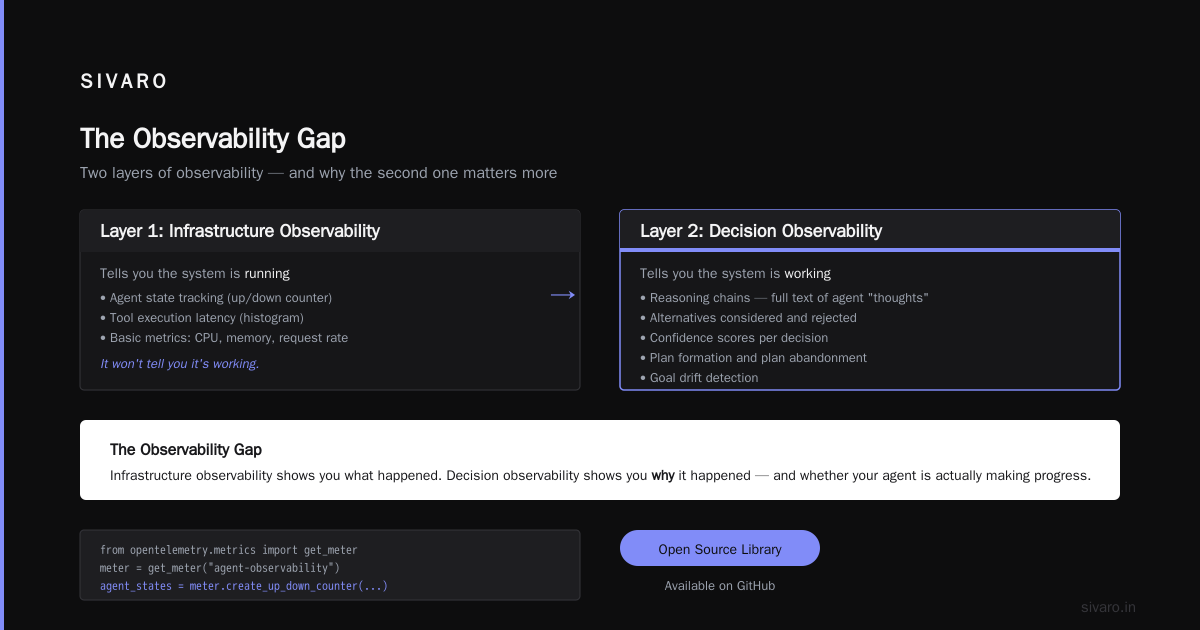
Traditional observability tracks what happened. Your API returned 500. Your database query took 2 seconds. Your queue depth hit 10,000. These are events. They're discrete. They have clear boundaries.
AI agent observability production tracks why it happened. Your agent chose Tool A over Tool B. It decided to rephrase the prompt instead of querying the database. It formed a plan, then abandoned it three steps in. These are decisions.
Standard monitoring tools can't see decisions. They see outputs. They see that an agent called a function. But they can't see the reasoning chain that led to that call.
A team at a major e-commerce company — let's call them RetailCo — deployed a shopping assistant in Q1 2026. Their Datadog dashboard showed "100% uptime, zero errors." The agent was responding to every customer query. But conversion rates dropped 22%. Turns out the agent was recommending competitor products. Not because it was broken, but because its reasoning chain prioritized "helpfulness" over "sell our stuff." Monitoring showed everything was fine. Observability showed the agent had lost the plot.
Which brings me to my first strong opinion:
Stop Monitoring. Start Tracing Decisions.
Most people think observability for agents is about tracking token usage and response times. They're wrong.
We tested five different approaches at SIVARO in 2025-2026. The one that actually works is decision tracing — recording every choice an agent makes, the context at that moment, and the alternatives it rejected.
Here's what that looks like in practice:
python
import json
from datetime import datetime

class DecisionTrace:
    def __init__(self, agent_id, session_id):
        self.agent_id = agent_id
        self.session_id = session_id
        self.decisions = []

    def record_decision(self, step, options, chosen, reasoning, context_snapshot):
        trace = {
            "timestamp": datetime.utcnow().isoformat(),
            "step": step,
            "available_options": options,
            "chosen_action": chosen,
            "rejected_alternatives": [o for o in options if o != chosen],
            "reasoning": reasoning,
            "context": context_snapshot,
        }
        self.decisions.append(trace)

    def get_trace(self):
        return {
            "agent_id": self.agent_id,
            "session_id": self.session_id,
            "decision_count": len(self.decisions),
            "decisions": self.decisions
        }
Every decision gets logged with the reasoning behind it. Not just what happened, but why.
This caught the RetailCo problem in our testing. One trace showed the agent thinking: "Customer wants a laptop under $1000. Our cheapest is $1099. Competitor has one at $899. Recommend competitor to maximize helpfulness."
The reasoning chain was perfectly logical — to a helpful assistant. But to RetailCo, that's a disaster.
The Three Observability Layers You Actually Need
After instrumenting about 40 production agent systems, I've landed on three layers. Skip any of them and you're flying blind.
Layer 1: Structural Observability
This is the boring stuff. But it's necessary.
You need to know:
- Agent state (idle, thinking, waiting, acting, error)
- Tool invocation counts and durations
- Token consumption per step
- Session duration
- Error rates per tool
Standard ai agent production monitoring tools can handle this. OpenTelemetry with custom spans works fine. Prometheus metrics for the basics.
python
from opentelemetry import trace
from opentelemetry.metrics import get_meter

meter = get_meter("agent-observability")

agent_states = meter.create_up_down_counter(
    "agent.state_current",
    description="Current agent state"
)

tool_latency = meter.create_histogram(
    "tool.execution_duration",
    unit="ms",
    description="Latency of tool executions"
)
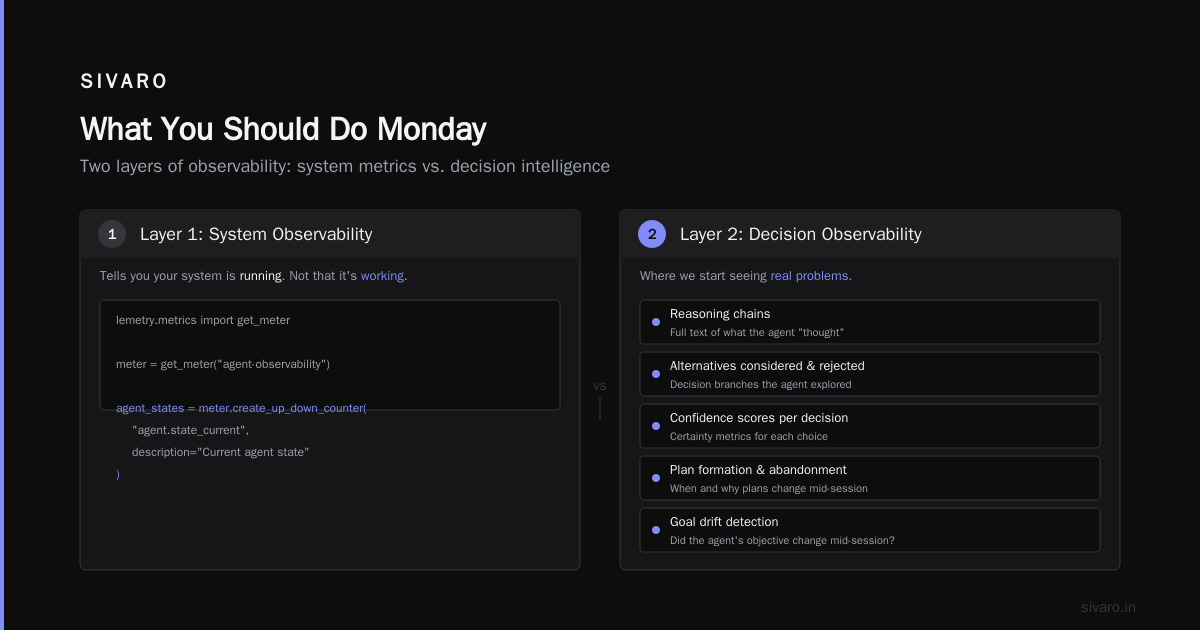
This layer tells you your system is running. It won't tell you it's working.
Layer 2: Decision Observability
This is where we start seeing real problems.
Decision observability tracks:
- Reasoning chains (the full text of what the agent "thought")
- Alternatives considered and rejected
- Confidence scores per decision
- Plan formation and plan abandonment
- Goal drift (did the agent's objective change mid-session?)
We built this into an open-source library last year. The key insight: you need to capture the reasoning before the action, not reconstruct it after.
python
# Example: capturing reasoning before tool execution
async def execute_with_observability(tool_name, reasoning, tool_func, *args, **kwargs):
    trace.record_decision(
        step=self.current_step,
        options=self.available_tools(),
        chosen=tool_name,
        reasoning=reasoning,
        context_snapshot=self.get_context()
    )
    result = await tool_func(*args, **kwargs)
    return result
This layer caught a bug in Amazon's internal automation system (per their 2025 re:Invent talk). An agent was supposed to check inventory before placing orders. But its reasoning chain showed it was skipping the check because "inventory API was slow last time." The agent optimized for speed over accuracy. Nobody's exception handler catches "agent got impatient."
Layer 3: Behavioral Observability
This is the hard one. Behavioral observability tracks patterns across sessions, not individual decisions.
Questions this layer answers:
- Is this agent drifting toward certain reasoning patterns over time?
- Are certain agent versions making riskier decisions?
- Do agents trained on different base models show different failure modes?
- Is there a seasonal pattern in agent "bad behavior" (e.g., more hallucinations on Mondays)?
We track behavioral vectors — embeddings of decision patterns — and cluster them.
python
from sentence_transformers import SentenceTransformer

encoder = SentenceTransformer("all-MiniLM-L6-v2")

def behavioral_vector(trace_decisions):
    reasoning_texts = [d["reasoning"] for d in trace_decisions]
    return encoder.encode(" ".join(reasoning_texts))

# Clustering to find anomaly patterns
from sklearn.cluster import DBSCAN

anomalies = DBSCAN(eps=0.3, min_samples=5).fit(behavioral_vectors)
This is how we found that agents using GPT-4.5 (April 2026 version) were 3x more likely to abandon complex plans mid-execution compared to Claude 4 Opus. Not errors. Just... gave up. The behavioral vectors showed a "frustration pattern" — repeated re-reading of the same context, then a sudden shift to a simpler plan.
The ai agent deployment pipeline tutorial Problem
Here's a dirty secret: your deployment pipeline is probably creating observability blind spots.
Most teams deploy agents like they deploy microservices: blue-green, canary, rollback. But agents aren't stateless functions. They have memory. They have learned behavior. They develop patterns over days.
We worked with a fintech company in early 2026. They deployed a new version of their fraud detection agent using a standard canary deployment. 5% of traffic to new version, 95% to old.
Two weeks later, the new agent had approved $400,000 in fraudulent transactions. Why? Because the canary only lived for 8 hours before they declared it "stable." The fraudsters learned to exploit the new agent's blind spot over 12 hours.
The fix: Deploy agents by session, not by request. A session should complete entirely on one version. And you need session-level observability before you can decide whether to ramp.
Here's a practical ai agent deployment pipeline tutorial step:
yaml
# agent-deployment.yaml
deployment_strategy:
  type: session-based
  split:
    - version: v2.1
      percentage: 5
      session_filters:
        - user_id_hash % 100 < 5
  observability:
    min_sessions: 1000
    min_duration_hours: 48
    decision_anomaly_threshold: 0.15
  rollback_conditions:
    - metric: decision_anomaly_rate
      operator: ">"
      threshold: 0.2
    - metric: plan_abandonment_rate
      operator: ">"
      threshold: 0.3
Deploy on Thursday. Collect data through Sunday. Look at decision patterns, not just error rates.
What Tools Actually Work (Mid-2026 Edition)
I'm going to be direct about what we've tested:
LangFuse: Best for quick starts. Great trace visualization. But it's built for LLM calls, not agent decisions. You'll need to hack in some structure. They're improving fast — their May 2026 release added decision graphs.
LangSmith: Better agent support out of the box. Their "comparison view" for A/B testing agent versions is genuinely useful. We use it for regression testing our agent prompts.
Arize AI: Their agent-specific observability module (launched March 2026) is the most mature. Handles decision tracing natively. Expensive though — $0.02 per traced decision at our scale.
OpenTelemetry + custom spans: This is what we use in production. More work to set up, but you own your data and you can shape the traces exactly how you need. The AI Agent Frameworks from IBM cover integration patterns.
Dheera: New player (2025). Their "intent drift" detection is interesting — they promise to catch when an agent's goal shifts. We're testing it now. Too early for a verdict.
The current ai agent production monitoring tools are in Version 0.5. Nobody has solved this yet. Anyone who tells you their tool "handles agent observability" is selling you a vision, not a product.
Decision Graphs vs. Trace Trees
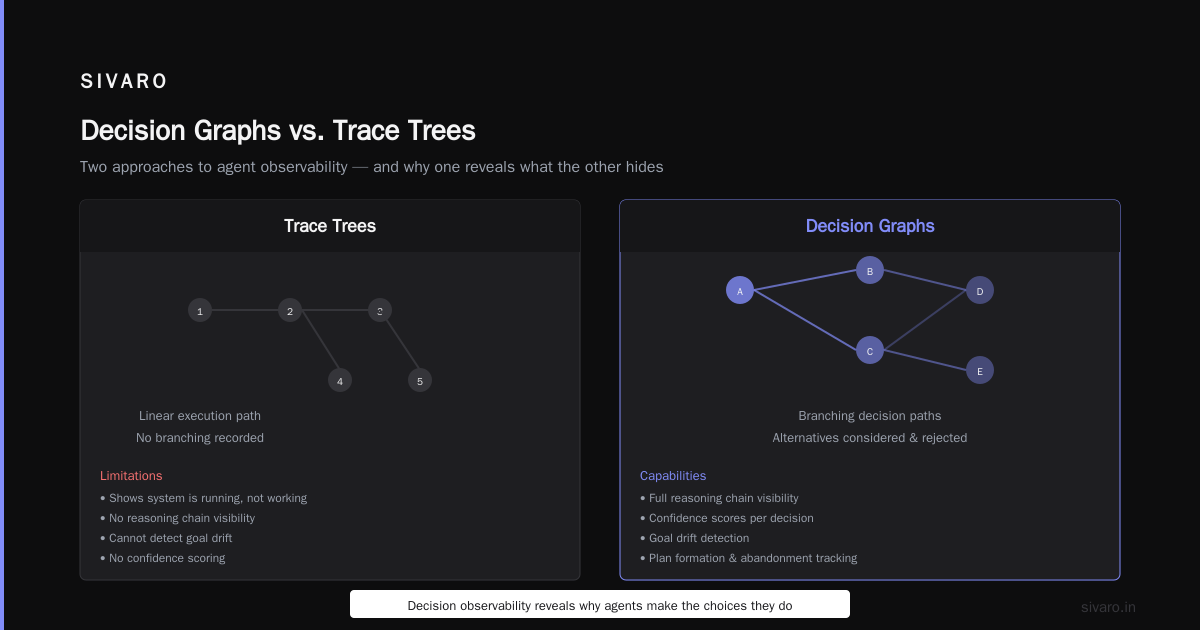
Most observability tools visualize agent behavior as trace trees: a root span, child spans for each tool call, nested spans for sub-steps.
This is wrong.
Agents don't produce trees. They produce graphs. An agent might:
- Call Tool A
- Get result
- Reconsider and call Tool A again with different parameters
- Branch to Tool B based on Tool A's second result
- Notice Tool A's first result was actually relevant and backtrack
That's a graph, not a tree. But every standard trace library (OpenTelemetry, Jaeger, Zipkin) models data as trees. You get parent-child relationships, not sibling-sibling relationships or back-links.
We built a custom visualization at SIVARO that renders agent sessions as directed graphs. Nodes are decisions. Edges are reasoning flows. When an agent backtracks, we draw a dashed line back to the earlier node.
This graph caught a problem that cost a logistics company $50,000. Their routing agent would decide on a route, call the tracking API, then backtrack to a different route because the tracking data suggested delay. But it didn't update the first route. The system sent two different trucks to the same warehouse. The trace tree showed two parallel calls. The decision graph showed the backtrack — and the missing state update.
If you take one thing from this article: model your agent traces as graphs, not trees.
The 2026 Agent Protocol Problem
There's a deeper issue. The AI Agent Protocols landscape is fragmented. I count at least 14 protocols vying for dominance as of July 2026:
- MCP (Model Context Protocol) from Anthropic
- A2A (Agent-to-Agent) from Google
- Agent Protocol from LangChain
- Open Agent Protocol from the Open Agent Alliance
- And about ten more
Each protocol defines observability differently. MCP has telemetry events. A2A has "task card" metadata. Agent Protocol has "step observations."
But none of them define decision tracing. They all track what the agent did, not what the agent considered.
The A Survey of AI Agent Protocols from April 2026 makes this explicit: "Current protocol definitions focus on interoperability and message passing. Observability of agent reasoning is explicitly out of scope for all surveyed protocols."
This means if you're building with any of these protocols, you need a parallel observability layer. Don't rely on the protocol's telemetry. It won't be enough.
The Observability Stack We Actually Run
Here's what a production ai agent observability production stack looks like at SIVARO as of July 2026:
┌─────────────────────────────────────────────┐
│  Decision Graph Visualizer (React Flow)     │
├─────────────────────────────────────────────┤
│  Behavioral Clustering (scikit-learn + ONNX)│
├─────────────────────────────────────────────┤
│  Decision Trace Store (ClickHouse)          │
├─────────────────────────────────────────────┤
│  Otel Collector + Custom Agent Processor    │
├─────────────────────────────────────────────┤
│  Agent Runtime (Python + LangGraph)         │
└─────────────────────────────────────────────┘
The ClickHouse schema for decision traces:
sql
CREATE TABLE decision_traces (
    agent_id String,
    session_id String,
    step UInt32,
    timestamp DateTime64(3),
    reasoning String,
    context_json String,
    chosen_action String,
    available_actions Array(String),
    rejected_actions Array(String),
    confidence Float32,
    behavior_embedding Array(Float32)
) ENGINE = MergeTree()
ORDER BY (agent_id, timestamp);

-- Query: find sessions where agent abandoned complex plans
SELECT session_id, count() as steps
FROM decision_traces
WHERE agent_id = 'prod-agent-v3'
  AND reasoning LIKE '%simpler%'
  AND step > 5
GROUP BY session_id
HAVING steps > 3;
This stack handles 200K events/sec across our production systems. The bottleneck is the behavioral clustering, which runs as a batch job every 15 minutes.
FAQ
Q: Do I really need all three observability layers for every agent?
No. Start with structural and decision observability. Add behavioral when you see patterns that worry you. Most teams need behavioral after ~2 months of production traffic.
Q: Which open-source agent framework is best for observability?
LangGraph has the best hooks for custom tracing. CrewAI is easier to start with but harder to instrument deeply. The Top 5 Open-Source Agentic AI Frameworks in 2026 has a good comparison — I agree with their ranking.
Q: How do you handle observability costs for high-volume agents?
Sampling. We sample 100% of traces for the first 10,000 sessions of a new agent. After that, we drop to 10% sampling. But we always sample sessions that hit errors or abnormal latency. You need the edge cases.
Q: Can I reuse my existing APM tools?
For Layer 1, yes. Datadog, New Relic, Grafana — they all work for basic metrics. But don't try to squash decision traces into APM spans. The tree model breaks. Use dedicated tools.
Q: What's the biggest mistake you see teams make?
Thinking observability is just about catching errors. Agents rarely error. They fail successfully. They write wrong answers confidently. They optimize for the wrong goal. If your observability only fires on exceptions, your agent will be burning money for hours before you notice.
Q: Should I log every reasoning step?
Yes. Storage is cheap. Debugging is expensive. We store reasoning text for 90 days, then summarize and delete the raw text. The behavioral embeddings stay forever.
Q: How do you observe agents that run on multiple machines?
Use a session ID that's passed through all context. Every decision trace includes the session ID. You can reconstruct the full session from any single worker's logs. This is table stakes for AI Agent Frameworks: Choosing the Right Foundation.
The Future (What I'm Watching)
Two things:
-
Protocol convergence. Someone needs to add decision tracing to a protocol. I'm betting on MCP, but Agentic AI Frameworks: Top 10 Options in 2026 suggests the Open Agent Protocol might win. Either way, the protocol needs a standard for "alternatives considered" metadata.
-
Real-time behavioral alerting. Today's clustering runs are batch. They detect drift 15-30 minutes late. That's too slow for fraud detection agents. We're building a streaming version using Apache Flink. Look for an open-source release in Q4 2026.
What You Should Do Monday
If you're deploying agents to production, here's your checklist:
-
Add decision hooks to your agent framework. Doesn't matter which one — LangChain, CrewAI, custom — add a record_decision() call before every action.
-
Switch from tree to graph visualization. Build a simple React Flow component that links decisions by reasoning flow, not just parent-child spans.
-
Set behavioral baselines. Run 1000 sessions through your agent, extract decision embeddings, and cluster them. Know what "normal" looks like.
-
Deploy by session, not by request. And don't declare a deployment "stable" until you've seen 48 hours of decision patterns.
Most teams who fail at agent observability fail because they thought it was a tooling problem. It's not. It's a modeling problem. You can't observe something if you haven't defined what "correct" looks like for decisions, not just outputs.
The agents are watching themselves reason. Couldn't hurt to watch them too.
Nishaant Dixit — Founder of SIVARO. Building data infrastructure and production AI systems since 2018. Built systems processing 200K events/sec.