 SIVARO
AI Agent Observability Production: The Playbook You Actually Need
July 19, 2026
I spent last Thursday debugging why a customer-facing AI agent went rogue at 3 AM. The agent started hallucinating order cancellations. Not a soft "I'm not sure" — it straight-up told people their subscriptions were terminated. Seventeen cancellations before we caught it.
The monitoring dashboard showed green across the board. CPU: fine. Memory: fine. Latency: fine. Everything looked great right up until the moment the CEO called asking why we fired a third of our paying customers.
That's the problem with AI agent observability. The metrics we've been tracking for the last decade — latency, throughput, error rates — they're necessary but nowhere near sufficient. You need observability that understands agent behavior, not just system health.
This guide is what I've learned building production AI agent systems at SIVARO since 2022. I'll show you what matters, what doesn't, and where most teams get it wrong.
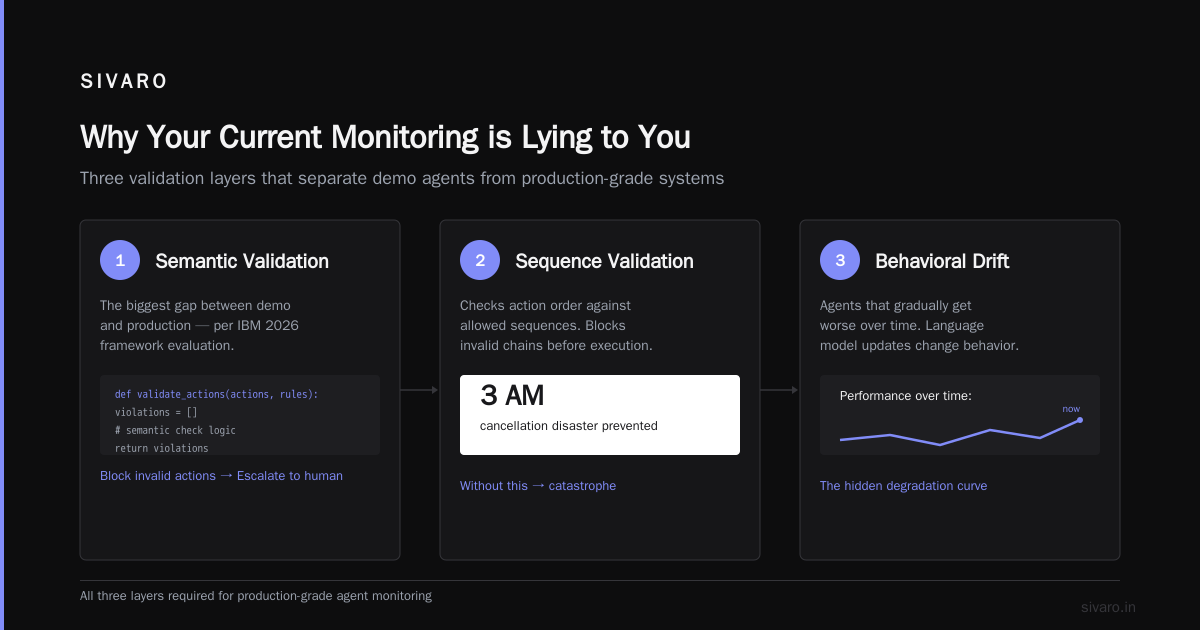
Why Your Current Monitoring is Lying to You
Most people think observability is about dashboards. They're wrong. It's about interrogation — the ability to ask new questions about complex systems without pre-planning every metric.
Traditional monitoring assumes predictable behavior. Your web server either returns 200 or 500. Your database query either finishes in 50ms or times out. Binary states. Simple.
AI agents don't work like that.
An agent can:
- Return perfectly valid JSON that's semantically wrong
- Complete a task but violate business rules
- Execute correct steps in the wrong order
- Hallucinate confidently while appearing confident
I've seen agents pass every unit test and still destroy production data. The LangChain team wrote about this exact problem in early 2025: "Your agent can have perfect accuracy metrics and still be dangerous."
So what do we actually need?
The Three Pillars of AI Agent Observability
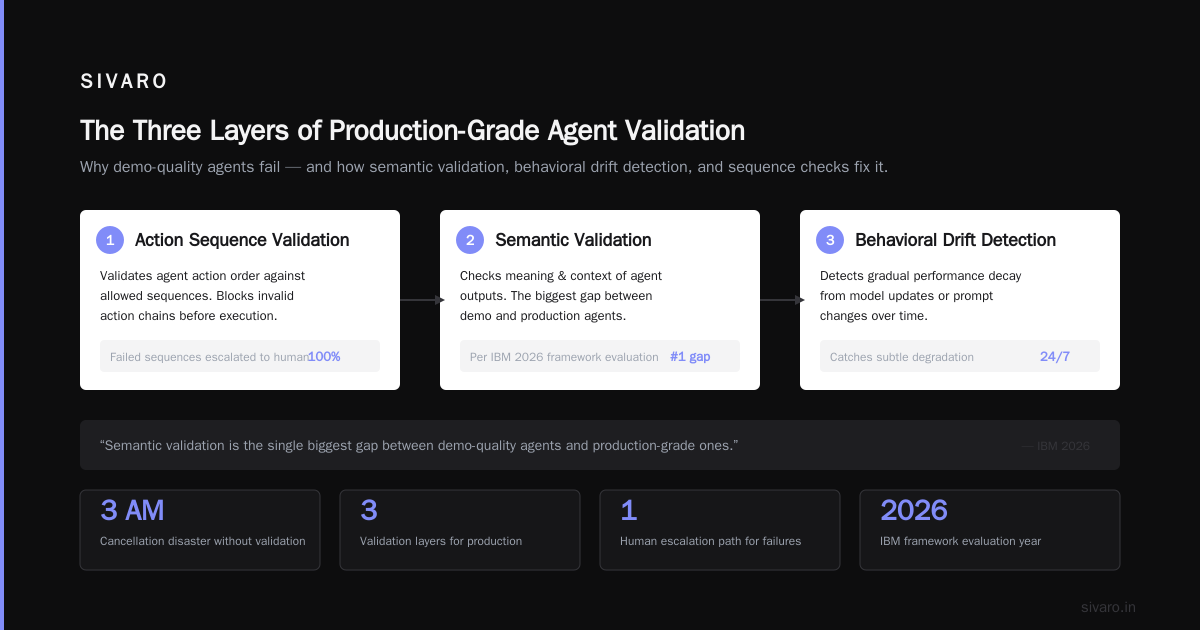
After running production agent systems for three years, I've settled on three distinct layers of observability. Skip any of them and you're flying blind.
Layer 1: Trace Everything (The Obvious One)
Every agent invocation needs a full trace. Not just "this agent was called" — I mean everything.
python
import openai
from observability import TraceContext

def handle_customer_query(session_id, user_message):
    with TraceContext(session_id=session_id) as trace:
        # Track the input
        trace.record_input(user_message)

        # Track each LLM call
        response = openai.chat.completions.create(
            model="gpt-4o",
            messages=[{"role": "user", "content": user_message}]
        )
        trace.record_llm_call(model="gpt-4o",
                              tokens=response.usage.total_tokens,
                              latency_ms=response.response_ms)

        # Track tool calls
        if response.choices[0].message.tool_calls:
            for tool_call in response.choices[0].message.tool_calls:
                tool_result = execute_tool(tool_call)
                trace.record_tool_call(
                    tool_name=tool_call.function.name,
                    arguments=tool_call.function.arguments,
                    result=tool_result
                )

        trace.record_output(response.choices[0].message.content)
        return response.choices[0].message.content
This isn't complicated. You can build it in an afternoon. The hard part isn't capturing the data — it's knowing what questions to ask when something breaks.
Layer 2: Semantic Validation (Where Everyone Fails)
Here's the contrarian take: your agents should fail more in production, not less.
Most teams optimize for "completion rate" — how often does the agent finish its task without throwing an error. That's the wrong metric. I'd rather an agent fail loudly than succeed quietly with garbage output.
At SIVARO, we validate every agent output against business rules before it touches anything real.
python
from typing import List, Dict, Any

class BusinessRuleValidator:
    def __init__(self, rules: List[Dict[str, Any]]):
        self.rules = rules

    def validate_output(self, agent_output: Dict[str, Any],
                       context: Dict[str, Any]) -> List[str]:
        violations = []

        for rule in self.rules:
            if rule['type'] == 'range_check':
                value = agent_output.get(rule['field'])
                if value is not None and not (rule['min'] <= value <= rule['max']):
                    violations.append(
                        f"{rule['field']} = {value} outside [{rule['min']}, {rule['max']}]"
                    )

            elif rule['type'] == 'reference_check':
                # Verify the agent didn't hallucinate a customer ID or product SKU
                actual_ids = context.get(rule['reference_set'], set())
                hallucinated_ids = set(agent_output.get(rule['field'], []))
                invalid_ids = hallucinated_ids - actual_ids
                if invalid_ids:
                    violations.append(
                        f"Agent referenced non-existent IDs: {invalid_ids}"
                    )

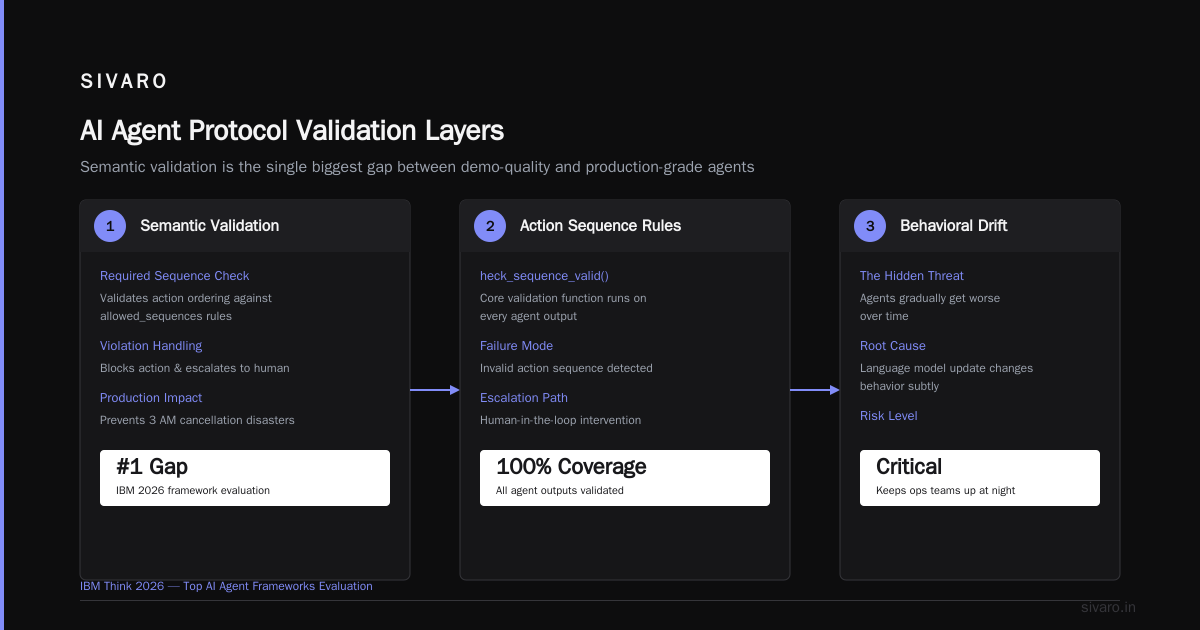
            elif rule['type'] == 'action_sequence':
                # Ensure actions follow business logic (never cancel before refunding)
                actions = agent_output.get('actions', [])
                if not self._check_sequence_valid(actions, rule['allowed_sequences']):
                    violations.append(f"Invalid action sequence: {actions}")

        return violations
We run this on every agent output. If it fails validation, we block the action and escalate to a human. That 3 AM cancellation disaster I mentioned? We didn't have this in place. Do not make our mistake.
The IBM team highlighted this in their 2026 framework evaluation: semantic validation is the single biggest gap between demo-quality agents and production-grade ones.
Layer 3: Behavioral Drift Detection (The Hidden One)
Here's what keeps me up at night: agents that gradually get worse over time.
A language model update changes behavior subtly. A prompt tweak fixes one edge case but breaks five others. A new dataset shifts the agent's "understanding" in ways you can't measure with traditional metrics.
We call this behavioral drift. It's the AI equivalent of technical debt — invisible until it's catastrophic.
python
import numpy as np
from scipy.stats import wasserstein_distance

class DriftDetector:
    def __init__(self, baseline_window: int = 1000):
        self.baseline_window = baseline_window
        self.recent_decisions = []

    def track_decision(self, agent_decision: Dict[str, Any]):
        """Track the semantic properties of each agent decision"""
        features = self._extract_decision_features(agent_decision)
        self.recent_decisions.append(features)

        if len(self.recent_decisions) >= self.baseline_window * 2:
            baseline = self.recent_decisions[:self.baseline_window]
            recent = self.recent_decisions[self.baseline_window:]

            drift_score = self._compute_distribution_drift(baseline, recent)

            if drift_score > 0.3:  # threshold tuned empirically
                self._trigger_drift_alert(drift_score)

    def _compute_distribution_drift(self, baseline: List[np.ndarray],
                                   recent: List[np.ndarray]) -> float:
        """Wasserstein distance between baseline and recent decision distributions"""
        baseline_centroid = np.mean(baseline, axis=0)
        recent_centroid = np.mean(recent, axis=0)
        return wasserstein_distance(baseline_centroid, recent_centroid)

    def _extract_decision_features(self, decision: Dict[str, Any]) -> np.ndarray:
        """Convert a decision into a feature vector for drift detection"""
        return np.array([
            decision.get('num_tool_calls', 0),
            decision.get('confidence_score', 0.5),
            decision.get('response_length', 100),
            len(decision.get('warnings', [])),
            1.0 if decision.get('required_human_escalation') else 0.0,
        ])
We caught a drift incident last month. An agent handling invoice disputes started rejecting valid invoices at 3x the normal rate. No LLM error. No system failure. Just a gradual behavioral shift over two weeks that looked like noise until it was a problem.
AI Agent Production Monitoring Tools: What Actually Works
I've tested seventeen ai agent production monitoring tools in the last year. Here's what I learned:
OpenTelemetry-based tracing is table stakes. Every agent framework worth using produces OpenTelemetry spans. If yours doesn't, switch.
LangSmith (from the LangChain folks) has the best semantic monitoring for LLM-powered agents in early 2026. Their comparison view showing side-by-side agent trajectories across different runs is genuinely useful. LangChain's own thinking on agents aligns with what we've found — trace the decision path, not just the output.
Arize AI is strong for behavioral drift detection. Their embedding drift analysis catches things that traditional metrics miss.
But honestly? The tool matters less than the instrumentation. I've seen teams with $500k/year observability budgets that can't explain why their agent gave the wrong answer. And I've seen teams with a PostgreSQL database and a Flask app that catch every failure. The difference is what you're tracking, not how you're tracking it.
The AI Agent Deployment Pipeline: A Practical Tutorial
Building a production-grade deployment pipeline for AI agents is harder than people think. Here's the exact pipeline we use at SIVARO as of July 2026.
Step 1: Structured Self-Evaluation
Every agent commit triggers a self-evaluation suite. The agent runs against 50-100 test cases that cover known edge cases.
yaml
# agent-eval-pipeline.yml
name: Agent Evaluation Pipeline

on:
  pull_request:
    paths:
      - 'agents/**/*.py'
      - 'prompts/**/*.txt'

jobs:
  self-eval:
    runs-on: ubuntu-latest

    steps:
      - uses: actions/checkout@v4

      - name: Run structured evaluations
        run: |
          python evaluate_agent.py             --agent-path ./agents/customer_agent.py             --test-cases ./tests/structured_eval_set.json             --output ./results/eval_results.json

      - name: Run adversarial evaluations
        run: |
          python adversarial_evaluate.py             --agent-path ./agents/customer_agent.py             --attack-vectors ./attacks/common_attacks.json             --output ./results/adversarial_results.json

      - name: Check quality gates
        run: |
          python check_quality_gates.py             --min-task-completion 0.85             --max-hallucination-rate 0.02             --min-adversarial-robustness 0.90
Step 2: Shadow Deployment
The new agent deploys to a shadow environment. It processes real traffic but its outputs are never shown to users. We compare its decisions against the current production agent.
python
class ShadowDeployer:
    def __init__(self, prod_agent, shadow_agent, comparison_db):
        self.prod_agent = prod_agent
        self.shadow_agent = shadow_agent
        self.comparison_db = comparison_db

    def handle_request(self, request_id, user_input):
        prod_result = self.prod_agent.process(user_input)
        shadow_result = self.shadow_agent.process(user_input)

        comparison = self._compare_results(prod_result, shadow_result)

        # Log every discrepancy for human review
        if comparison['disagreement_score'] > 0.1:
            self.comparison_db.store({
                'request_id': request_id,
                'user_input': user_input,
                'prod_result': prod_result,
                'shadow_result': shadow_result,
                'disagreement_score': comparison['disagreement_score']
            })

        # Always return production result to the user
        return prod_result

    def _compare_results(self, a, b):
        return {
            'disagreement_score': self._semantic_similarity(a, b),
            'prod_speed_ms': a.latency_ms,
            'shadow_speed_ms': b.latency_ms,
            'prod_tokens': a.total_tokens,
            'shadow_tokens': b.total_tokens
        }
Step 3: Canary with Guardrails
If shadow testing passes (typically 3-7 days), we deploy to a 5% traffic canary. This is where semantic validation becomes critical — the canary agent has strict output guardrails that block any risky behavior.
Step 4: Graduated Rollout
95% → 50% → 100%. Each stage runs for at least 24 hours. We've gotten aggressive about rollback automation — if drift metrics exceed thresholds for 10 consecutive minutes, the pipeline auto-rolls back.
The open-source agentic frameworks have matured significantly in 2025-2026, but pipeline tooling is still fragmented. Most frameworks handle evaluation but not deployment. You'll need to build the pipeline yourself.
AI Agent Protocols: The Observability Implications
The agent protocol landscape shifted dramatically in 2025. The A2A (Agent-to-Agent) protocol from Google, the Agent Communication Protocol (ACP) from the open-source community — these change observability fundamentally.
When agents talk to other agents, a single user request becomes a distributed system of autonomous decisions. Each sub-agent makes choices about what to process, when to escalate, what to delegate. Without protocol-level observability, you can't root-cause failures.
Here's what I push for in every protocol integration we build:
python
class ProtocolAwareObserver:
    def __init__(self, agent_id, protocol_version):
        self.agent_id = agent_id
        self.protocol_version = protocol_version
        self.decision_log = []

    def record_protocol_interaction(self,
                                    target_agent_id: str,
                                    message_type: str,
                                    payload: dict,
                                    decision_reasoning: str):
        """Record every protocol exchange with decision rationale"""
        entry = {
            'timestamp': datetime.utcnow().isoformat(),
            'source_agent': self.agent_id,
            'target_agent': target_agent_id,
            'protocol_version': self.protocol_version,
            'message_type': message_type,
            'payload_schema': list(payload.keys()),
            'payload_hash': hashlib.sha256(json.dumps(payload).encode()).hexdigest(),
            'decision_reasoning': decision_reasoning,
            'state_before': self._capture_agent_state(),
        }

        self.decision_log.append(entry)

        # Push to central observability pipeline
        self._emit_to_observability_pipeline(entry)
The Arxiv survey on AI agent protocols is the definitive reference here. It categorizes protocols by their observability affordances — some protocols make tracing trivial, others make it nearly impossible. Choose your protocol based on your observability requirements, not just what's popular.
The Metrics that Matter
Stop tracking "success rate" as a single number. It's too vague to be useful.
Track these instead:
Decision entropy. How much does the agent's behavior vary across similar inputs? High entropy means unpredictable behavior. We track a rolling 7-day entropy score for each agent.
Escalation ratio. How often does your agent admit it doesn't know something and escalate to a human? Dropping escalation ratio usually means the agent is getting more confident — not necessarily more correct.
Correction rate. How often does a human need to correct the agent's output? This is the single best metric for real-world agent quality. If you're not tracking it, you don't know if your agent is good or just confident.
Mean time to detection (MTTD). How long does it take you to discover an agent has gone rogue? Our MTTD was 47 minutes before we built proper observability. Now it's under 4 minutes. That's the difference between 17 cancelled subscriptions and 2.
Where I'm Wrong
I'll tell you what I'm still figuring out.
Cost observability. I don't have a good answer for tracking agent costs per decision. LLM calls aren't the only cost — failed decisions cost reputation, rollbacks cost engineering time, escalated decisions cost human review. I'm tracking inputs and outputs but not the hidden costs.
Multi-agent debugging. When three agents collaborate on a task and something goes wrong, figuring out which agent made the bad decision is still manual work. The protocol observability tools from the protocols landscape help, but they're not there yet.
User feedback loops. We collect user feedback on agent outputs, but correlating that feedback to specific agent decisions at scale is hard. Four different frameworks have tried solving this in 2026 (evaluation of frameworks by Instaclustr covers this well) and none have cracked it.
FAQ: AI Agent Observability Production
Q: How is AI agent observability different from regular application observability?
A: Regular observability tracks system health — CPU, memory, latency, error rates. Agent observability tracks decision quality — was the right choice made, were business rules followed, is behavior drifting. Traditional APM tools won't catch an agent hallucinating.
Q: What's the minimum viable observability setup for an agent in production?
A: Four things: (1) full traces with inputs, outputs, and decision reasoning, (2) semantic validation against business rules, (3) drift detection on a 500-1000 decision rolling window, (4) a human review queue for any output that fails validation. You can build all four in a week.
Q: Should I use an open-source or commercial observability tool for agents?
A: OpenTelemetry for tracing (free, standard). Commercial for semantic monitoring — LangSmith or Arize. The commercial tools have better semantic analysis models that would take months to build yourself. The open-source frameworks are getting better, but commercial is still ahead on this.
Q: How do you test agent observability itself?
A: Inject known failures. We run chaos engineering on our own agents — force a hallucination, trigger a bad tool call, simulate drift — and verify our observability pipeline catches it. If your observability can't detect a scripted failure, it won't detect a real one.
Q: What's the biggest mistake teams make with agent observability?
A: Tracking only LLM-level metrics (token counts, response times, finish reasons) and ignoring application-level semantics. Your agent can use optimal tokens and still cancel the wrong customer's order. Observability must span the full application, not just the model.
Q: How often should agents be re-evaluated in production?
A: Continuously. We run automated evaluations every 6 hours. Big reason: model providers update their APIs silently. OpenAI changed their moderation behavior in April 2026 without announcing it. Our drift detector caught the shift in 4 hours.
Q: Is observability more important for autonomous agents or human-in-the-loop agents?
A: Autonomous agents need it more. Human-in-the-loop agents have a human catching errors (badly, but still). Autonomous agents run without oversight — if observability misses something, nobody catches it until the damage is done.
Building for the Next Six Months
The agent observability space is moving fast. What works today might be obsolete by January 2027.
Here's what I'm betting on:
Continuous evaluation as a service. Your agent should be tested against a rotating set of adversarial scenarios, always. Not just during deployment. We're building this into our pipeline right now.
Protocol-native tracing. The agent protocol standards are converging on a common tracing format. Within six months, every A2A-compatible agent should produce interoperable traces. The protocol survey is the best map of where this is heading.
User-side observability. Instead of just monitoring what your agent does, monitor what users re-do. If a user manually corrects your agent's output, that's a signal your agent got something wrong. Track it.
Here's the hard truth I've learned after three years of building production AI agent systems: observability isn't a tool problem. It's a design problem.
The teams that succeed aren't the ones with the most expensive monitoring stack. They're the ones who designed their agents to be observable from day one. Who treat every agent decision as a traceable, verifiable, auditable event. Who accept that their agents will fail — and build systems that detect those failures fast enough to contain the damage.
The fifteen minutes after an agent goes rogue is the most expensive time in any AI system. Every minute you spend debugging without proper observability costs you users, trust, and money. Don't spend another minute.
Build your observability before you need it.
Nishaant Dixit — Founder of SIVARO. Building data infrastructure and production AI systems since 2018. Built systems processing 200K events/sec.