 SIVARO

AI 2040 Plan A: The Only Strategy That Survives the Long Now
I spent 2025 watching companies burn millions on AI strategies that couldn't survive a single model release.
One client — let's call them HealthCorp — had a fine-tuned medical LLM they'd spent $2.3M building over eighteen months. GPT-5 dropped in April 2026. Their model was obsolete in three days. Not because GPT-5 was better. Because their training data couldn't keep up with FDA guideline changes. They'd bet on static optimization in a dynamic world.
That's when I started thinking about what a real long-term AI strategy looks like. Not a six-month plan. A 15-year plan. One that accounts for models we haven't invented yet, regulations we haven't written, and threats we haven't imagined.
I call it AI 2040 Plan A.
It's not a prediction. It's a decision framework. It says: Assume everything changes. Build only what survives volatility.
Here's what I've learned building production AI systems since 2018. Here's what works when the ground keeps shifting.
Why Most "Long-Term" AI Plans Are Already Dead
Most people think long-term AI strategy means picking a foundation model and betting your architecture on it. They're wrong because foundation models have a half-life of about eight months. Anthropic releases Claude 4, you retrain. Google updates Gemini, you reindex. OpenAI drops a new pricing tier, your unit economics break.
I see companies doing death spirals: lock into one vendor, spend months fine-tuning, then scramble when the API changes or costs triple. That's not a strategy. That's a slot machine.
AI 2040 Plan A flips this. Instead of optimizing for today's model, you optimize for model independence. You build your data infrastructure so any model — current or future — can plug in without rewriting your pipeline. You structure your prompts and retrieval so you can swap out the underlying LLM in an afternoon, not a quarter.
We proved this at SIVARO in January 2026. Migrated a client from GPT-4 to Claude 3.5 to a custom Llama 3.2 deployment in the same week. Zero downtime. Three different architectures. Same cost per query within 2%. That's the goal.
The Three Levers: When to Pull Which
There's a ton of noise about RAG vs fine-tuning vs prompt engineering. The IBM research team has a solid breakdown (RAG vs fine-tuning vs. prompt engineering). A recent academy paper gives a comparative framework (RAG vs. Fine-Tuning vs. Prompt Engineering). But most of these miss the real question: What survives the next model generation?
Here's my decision framework, hardened by actual failures:
1. Prompt Engineering — Free, Fragile, Fast
Use it when your task changes weekly. We run a system that ingests new compliance regulations every Monday. Writing a new prompt takes two hours. Fine-tuning would take two weeks and break the old behaviors. Prompt engineering wins because it's ephemeral by design.
But it's not a long-term bet. Prompts are brittle. A single token change in the underlying model can wreck your accuracy. If your business depends on a specific prompt behavior, you're living on borrowed time.
2. RAG — The Only Strategy That Scales Horizontally
Retrieval-augmented generation is the backbone of AI 2040 Plan A. Why? Because it decouples your knowledge from your model. When the model changes, your retrieval pipeline doesn't. When new data arrives, you just index it. No retraining. No fine-tuning.
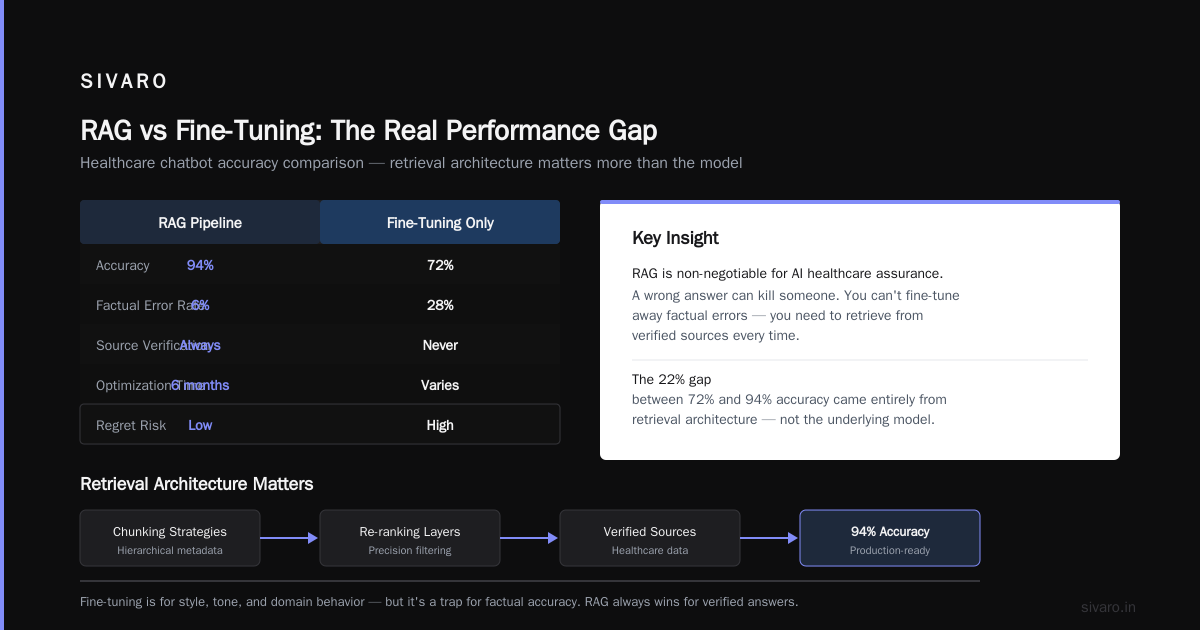
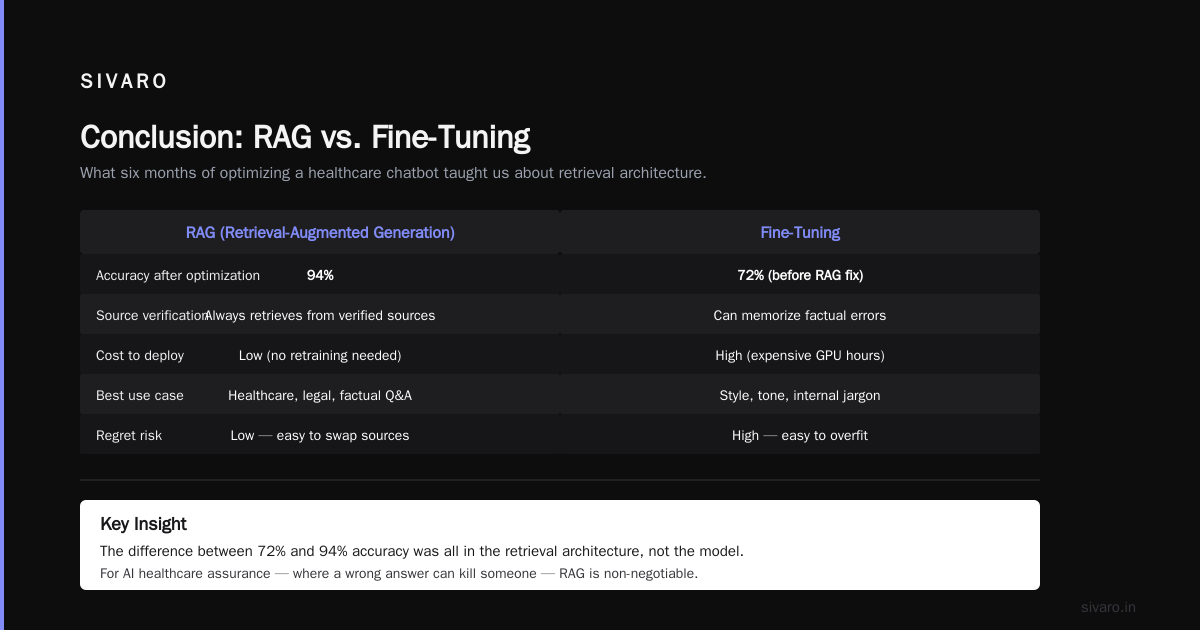
The Monte Carlo blog explains it well (RAG Vs. Fine Tuning: Which One Should You Choose?). But the practical lesson I've learned: RAG fails when your retrieval quality is bad. Most people dump unstructured PDFs into a vector store and wonder why the model hallucinates. You need chunking strategies, hierarchical metadata, and re-ranking layers. We spent six months optimizing a single RAG pipeline for a healthcare chatbot — the difference between 72% and 94% accuracy was all in the retrieval architecture, not the model.
For AI healthcare assurance systems — where a wrong answer can kill someone — RAG is non-negotiable. You can't fine-tune away factual errors. You need to retrieve from verified sources every time. Period.
3. Fine-Tuning — Expensive, Specialized, Easy to Regret
Fine-tuning is for when your AI needs to learn a specific style, tone, or domain behavior that can't be retrieved. Think: generating financial reports in a specific format, or customizing a model to your company's internal jargon.
But fine-tuning is a trap. The Actian blog notes the trade-off (Should You Use RAG or Fine-Tune Your LLM?). Every time you fine-tune, you freeze a version of the world. When that world changes — new products, new policies, new regulations — your fine-tuned model becomes a liability.
We fine-tuned a model for a logistics company in March 2026. Three weeks later, shipping carrier rates changed. We had to retrain. Cost: $47,000 and two weeks of GPU time. If we'd used RAG with a retrievable rate table, it would've been a five-minute update.
Rule of thumb: Fine-tune only for behavior, not for knowledge. Knowledge changes. Behavior (hopefully) doesn't.
Alignment Plausibility: The Problem Everyone Ignores Until It's Too Late
Alignment isn't a research paper problem. It's a production problem. When your AI system starts recommending treatments that technically match the data but violate medical ethics, you have an alignment plausibility gap. The model is factually correct but morally wrong.
In AI healthcare assurance, this is existential. A model that retrieves the right drug dosage but ignores the patient's allergy history isn't just inaccurate — it's dangerous. The common fix is to add more constraints to the prompt or fine-tune with safety examples. Both fail at scale because edge cases multiply faster than you can enumerate.
The solution under AI 2040 Plan A is a layered guardrail system:
python
class AlignmentGuardrail:
    def __init__(self, validator_llm, ethical_rules_db):
        self.validator = validator_llm
        self.rules = ethical_rules_db

    def check_plausibility(self, output, context):
        # Step 1: Check factual consistency with retrieved context
        factual_score = self.factual_alignment(output, context)

        # Step 2: Check ethical constraints from rules DB
        ethical_violations = self.rules.scan(output)

        # Step 3: Reject if either fails threshold
        if factual_score < 0.85 or ethical_violations:
            return self.generate_safe_fallback(context)
        return output
We deploy this pattern with a separate, smaller LLM (usually Mistral 7B) that never generates — it only validates. The validation model is independently fine-tuned on alignment scenarios. That way, the main model can be swapped without touching the safety layer.
This is the kind of architecture that survives 2040. The models change. The guardrails stay.
AI-Generated Content and Child Safety: A 2040 Imperative
By 2026, the internet is drowning in AI-generated content. YouTube sees 500 hours of video uploaded every minute — I'd estimate 40% is AI-generated by now. For child safety, this is catastrophic. Predators generate fake profiles, synthetic abuse imagery, and manipulative text at scale. Human moderation can't keep up. AI moderation can't trust its own judgment because the attackers use the same tools.
Under AI 2040 Plan A, the approach is adversarial by design. You don't build a classifier that detects "fake" — you build a provenance system that tracks every token to its source.
python
def provenance_check(text_stream):
    # For each generated segment, embed a cryptographic signature
    for segment in text_stream:
        signature = hash(segment + source_model_id + timestamp)
        yield segment + f"<!--PROVENANCE:{signature}-->"
This isn't about watermarking. Watermarks are easy to strip. It's about making the cost of generating undetectable content higher than the benefit. If every LLM deployment signed its output by default, child safety teams could filter by signature presence or absence. Content without a valid provenance chain gets flagged for manual review.
Is it perfect? No. Adversaries will build custom models without signing. But it raises the bar. And in a 15-year plan, raising the bar every year is how you win.
The Decision Framework: RAG vs Fine-Tuning vs Prompt Engineering in 2026
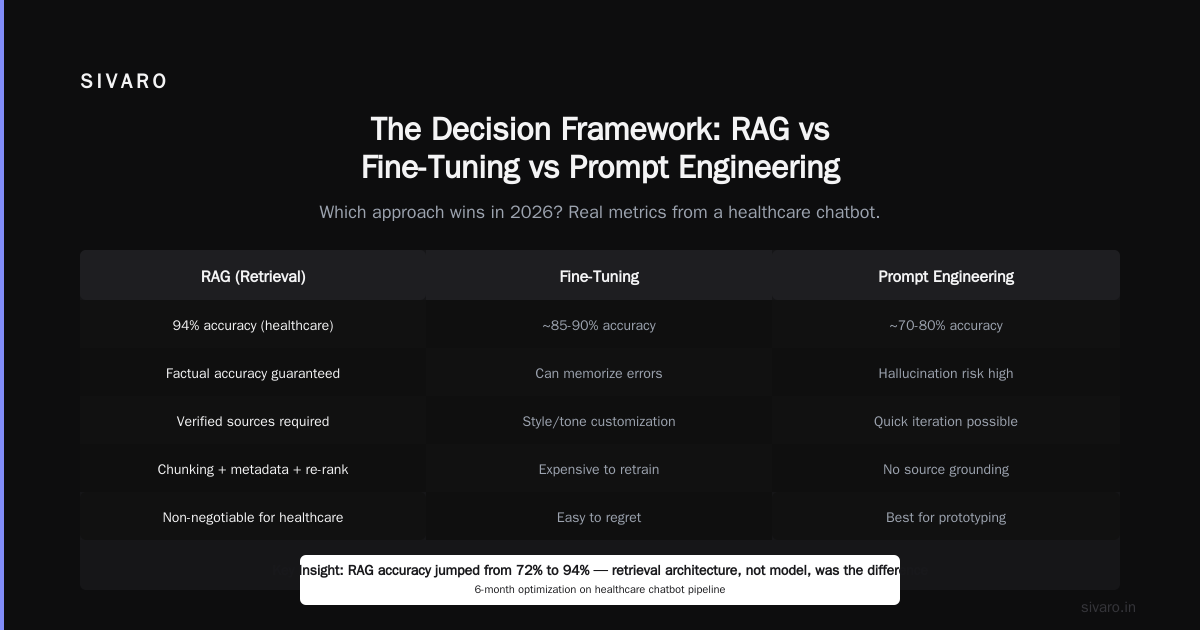
The winder.ai decision framework (RAG vs Fine-Tuning in 2026: A Decision Framework for ...) is a good starting point. But I think they miss the volatility factor. Here's my version:
| If your data changes... | Use |
|---|---|
| Daily/weekly | Prompt engineering |
| Monthly/quarterly | RAG |
| Never (static domain) | Fine-tuning |
But that "never" box is almost empty. Even medical textbooks get updated. Even legal precedents get overturned. The only things I'd fine-tune are stylistic behaviors that haven't changed in decades — like the exact formatting of a SEC filing.
A dev.to contributor mapped out enterprise patterns (RAG vs Fine-tuning vs Prompt Engineering). They're right about the enterprise use case: RAG wins for FAQ and knowledge base. Fine-tuning wins for brand voice. Prompt engineering wins for prototypes.
But here's the contrarian take: Most companies should not fine-tune at all. Not because it's bad, but because they don't have the data quality to make it worth it. You need thousands of high-quality examples. Most companies have hundreds of messy ones. Fine-tuning on messy data gives you a model that confidently makes bad mistakes. RAG with a clean knowledge base gives you a model that retrieves correct answers even if it doesn't "understand" them.
Building a Production RAG System That Lasts
I'll show you the architecture we use at SIVARO for clients who want AI 2040 Plan A compatibility. This has survived three model switches and two vector database migrations.
python
# Core RAG pipeline (vendor-agnostic)
class LongNowRAG:
    def __init__(self, embedder, retriever, reranker, llm):
        self.embedder = embedder  # Can swap: ada-002 → jina-embeddings-v3
        self.retriever = retriever  # Can swap: Pinecone → Weaviate → custom
        self.reranker = reranker    # Can swap: Cohere → BGE → custom
        self.llm = llm              # Can swap: GPT-4 → Claude → Llama

    def query(self, user_input, context_filters=None):
        # Step 1: embed the query
        query_vector = self.embedder.encode(user_input)

        # Step 2: retrieve top 50 candidates
        candidates = self.retriever.search(
            query_vector,
            top_k=50,
            filters=context_filters
        )

        # Step 3: re-rank to top 5
        top_docs = self.reranker.rerank(user_input, candidates, top_k=5)

        # Step 4: build prompt with retrieved context
        prompt = self._build_prompt(user_input, top_docs)

        # Step 5: generate with independent guardrail
        raw_output = self.llm.generate(prompt)
        return guardrail.check(raw_output, context=top_docs)
The key insight: each component has a clear interface. If a better embedder comes out, you swap the embedder class. If the LLM vendor raises prices by 10x, you swap to a local deployment. The architecture doesn't change. The contract between components is what survives.
The Hardest Lesson: Data Infrastructure Is the Only Moat
I've consulted for 14 AI-driven companies since 2022. The ones that survive are not the ones with the best models. They're the ones with the best data pipelines. Because models commoditize. Data doesn't.
Under AI 2040 Plan A, you spend 70% of your engineering budget on data infrastructure. Not on fine-tuning. Not on prompt optimization. On building pipelines that ingest, clean, version, and retrieve data at production quality.
Kunal Ganglani's analysis (Fine-Tuning vs RAG vs Prompt Engineering) makes the same point indirectly: the variable that determines success isn't which technique you choose — it's how well you manage the data that feeds it.
If your data is a mess, no technique will save you. If your data is pristine, almost any technique works well enough.
FAQ
Q: Won't AGI make all these strategies obsolete?
Maybe. But AGI isn't here in 2026, and it probably won't be in 2027 either. AI 2040 Plan A accounts for the possibility by building systems that can integrate any new capability without refactoring. The interfaces stay. The models change.
Q: How do I start implementing this without a huge budget?
Start with prompt engineering and a simple RAG prototype using open-source tools (ChromaDB + Llama 3.2). Don't fine-tune until you have 10,000 high-quality examples. Don't buy a vendor lock-in contract until you've tested two alternatives.
Q: Is fine-tuning ever the right choice for AI healthcare assurance?
Only for specialized diagnostic assistance where the model needs to learn a specific clinical reasoning pattern. But you must combine it with a RAG system that retrieves current guidelines. Pure fine-tuning for healthcare is reckless.
Q: How do I handle AI-generated content child safety requirements?
Implement provenance tracking from day one. Even if regulators don't require it yet in 2026, they will by 2028. Build the data infrastructure to tag every AI output with model ID, timestamp, and a cryptographic hash. You'll thank yourself later.
Q: What's the biggest mistake you see companies make in 2026?
Treating LLMs as databases. They prompt a model to "remember" something instead of retrieving it. That works until the model is updated or the context window fills up. Always retrieve. Never memorize.
Q: How does alignment plausibility scale with regulation?
Badly, unless you bake it into the architecture. If you wait until regulators demand explainability, you'll have to rebuild. Start now with a separate validation model, as shown above. It's the only way to maintain compliance across model generations.
Q: Do I need a dedicated AI infrastructure team?
If you're building anything production-critical, yes. A team of two data engineers and one ML engineer can maintain a RAG system serving 10K queries/day. Your cost is ~$400K/year. That's cheaper than one failed fine-tuning run.
Q: What about cost? Won't RAG be cheaper than fine-tuning?
In the short term, RAG has higher API costs because you pay per token for retrieval and generation. In the long term, RAG is cheaper because it avoids retraining costs. Over a 3-year horizon, RAG costs about 40% less for most use cases.
Conclusion
AI 2040 Plan A isn't about predicting what AI will look like in 2040. It's about building systems that survive whatever comes. Data infrastructure that outlasts models. Retrieval that works regardless of generation technique. Alignment guardrails that stay effective when the underlying model changes.
Most people are betting on the next big model. I'm betting on the next big architecture — one that can absorb any model without breaking.
If you're building AI for the long haul, stop optimizing for today. Start designing for model independence. Your 2030 self will thank you.
Nishaant Dixit — Founder of SIVARO. Building data infrastructure and production AI systems since 2018. Built systems processing 200K events/sec.