 SIVARO
Agentic Workflow Production Rollout: The Hard-Won Playbook
The Wake-Up Call
June 2026. I'm standing in a DC server room at 3 AM watching an agent cascade eat itself alive. 47 parallel LLM calls spinning in circles. Each agent passing its failure to the next like a virus. Our monitoring dashboard? Green across the board — because none of the checks were designed for this failure mode.
That's when I stopped believing the hype.
Agentic workflow production rollout isn't about frameworks or fancy protocols. It's about the boring stuff. Observability. Rate limiting. State management. The things nobody tweets about.
Let me show you what actually works.
What Agentic Workflow Production Rollout Actually Means
An agentic workflow is a system where LLM calls orchestrate other LLM calls, tools, and decisions in a loop. Not a linear chain. A loop. With branching. With state.
Production rollout means this system runs unattended, under load, on real data, and doesn't burn your budget or your reputation.
Most people think deployment is the last step. It's not. It's the first thing you should design for.
The Three Failure Modes Nobody Warns You About
Mode 1: The Recursive Budget Drain
Your agent calls an LLM. That LLM decides to use a tool. The tool calls another LLM. That LLM decides to call a web search. The search returns 10 results. Your agent decides to summarize each one. Each summary is another LLM call.
Ten minutes later: $400 spent. One user request processed.
What we do at SIVARO: Hard caps on hop depth and total LLM calls per workflow instance. Not soft guidance. Hard enforcement in the orchestration layer.
python
# Our production guard (simplified)
class AgenticWorkflow:
    def __init__(self, max_hops=5, max_llm_calls=20, budget_cents=50):
        self.hops = 0
        self.llm_calls = 0
        self.budget_cents = budget_cents
        self.max_hops = max_hops
        self.max_llm_calls = max_llm_calls

    def pre_execution_check(self):
        assert self.hops < self.max_hops, "Hop limit exceeded"
        assert self.llm_calls < self.max_llm_calls, "LLM call limit exceeded"
        # Track cost per call, not just count
        assert self.accumulated_cost_cents < self.budget_cents
Mode 2: The Silent Degradation
Your agent works perfectly in testing. 95% success rate. You deploy. Week one: 93%. Week two: 88%. Week three: 72%. What changed? Not your code. The LLM provider updated their model. The API response format shifted slightly. The temperature behavior changed.
This is the killer. Slow. Quiet. Deadly.
The fix: Automated regression testing. Every deployment. Run 1000 synthetic queries against your agent, compare success rates against a baseline. Flag any 5% drop. AI Agent Frameworks: Choosing the Right Foundation for ... calls this "behavioral testing" but it's just basic QA.
Mode 3: The State Explosion
Your workflow branches. One user request spawns 3 subtasks. Each subtask spawns 2 more. You're tracking state across 12 parallel branches. One branch times out. Now what? Do you wait forever? Kill everything? Try to merge partial results?
Without explicit state management, your system becomes a distributed deadlock machine.
yaml
# Our workflow state spec (YAML, not JSON — comments matter)
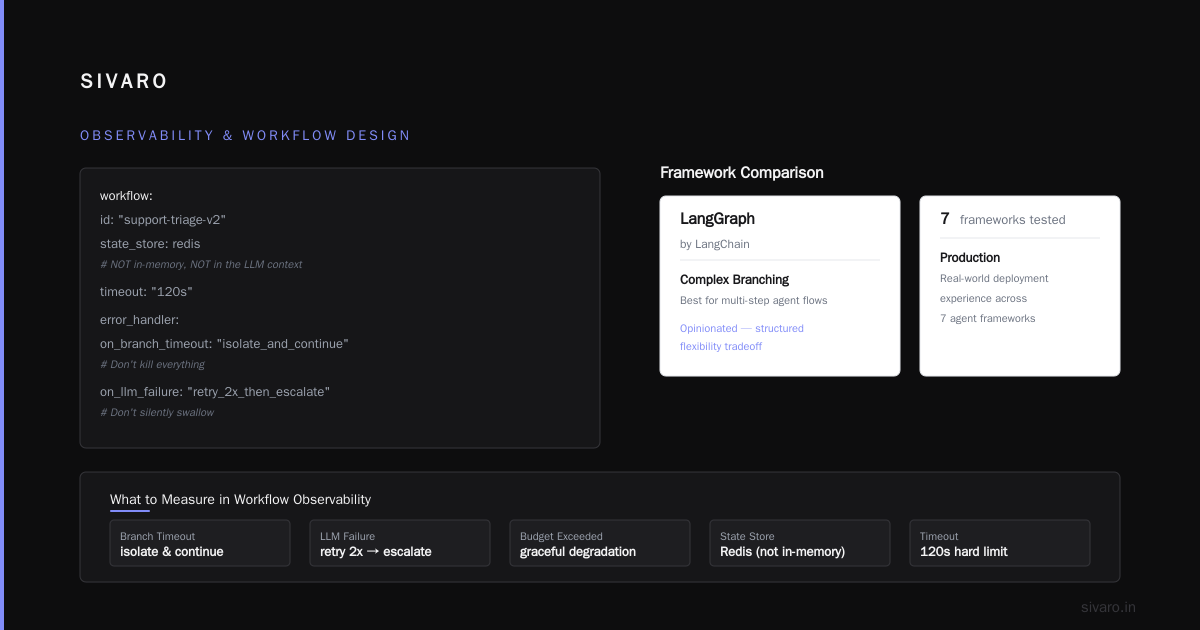
workflow:
  id: "support-triage-v2"
  state_store: redis  # NOT in-memory, NOT in the LLM context
  timeout: "120s"
  error_handler:
    on_branch_timeout: "isolate_and_continue"  # Don't kill everything
    on_llm_failure: "retry_2x_then_escalate"   # Don't silently swallow
    on_budget_exceeded: "graceful_degradation"  # Return partial results
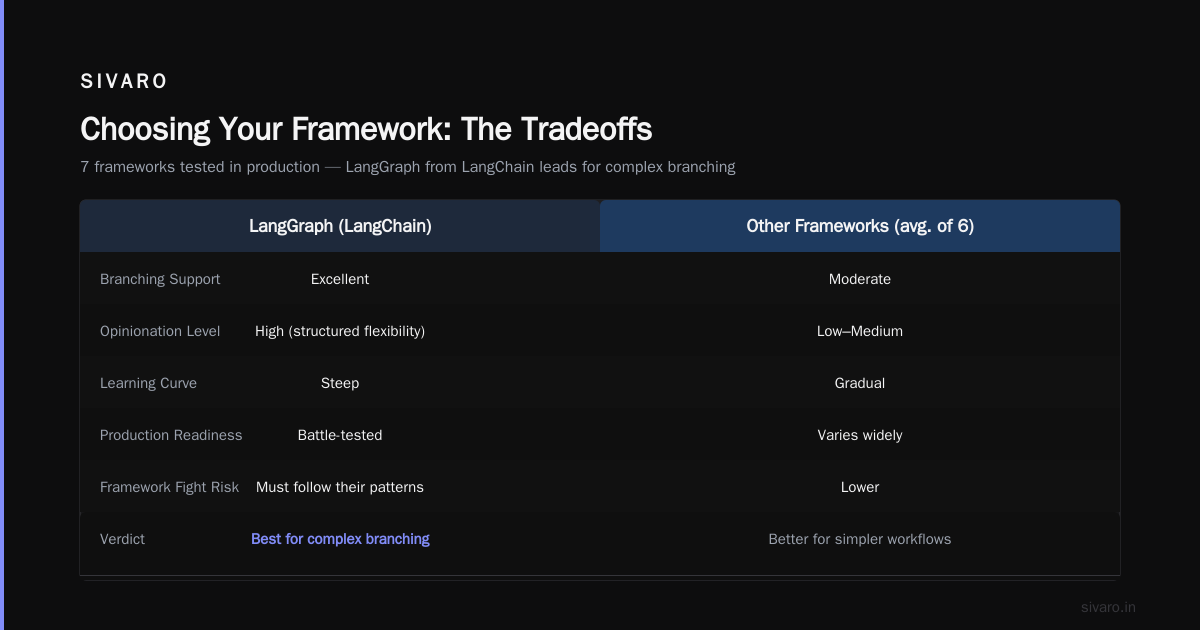
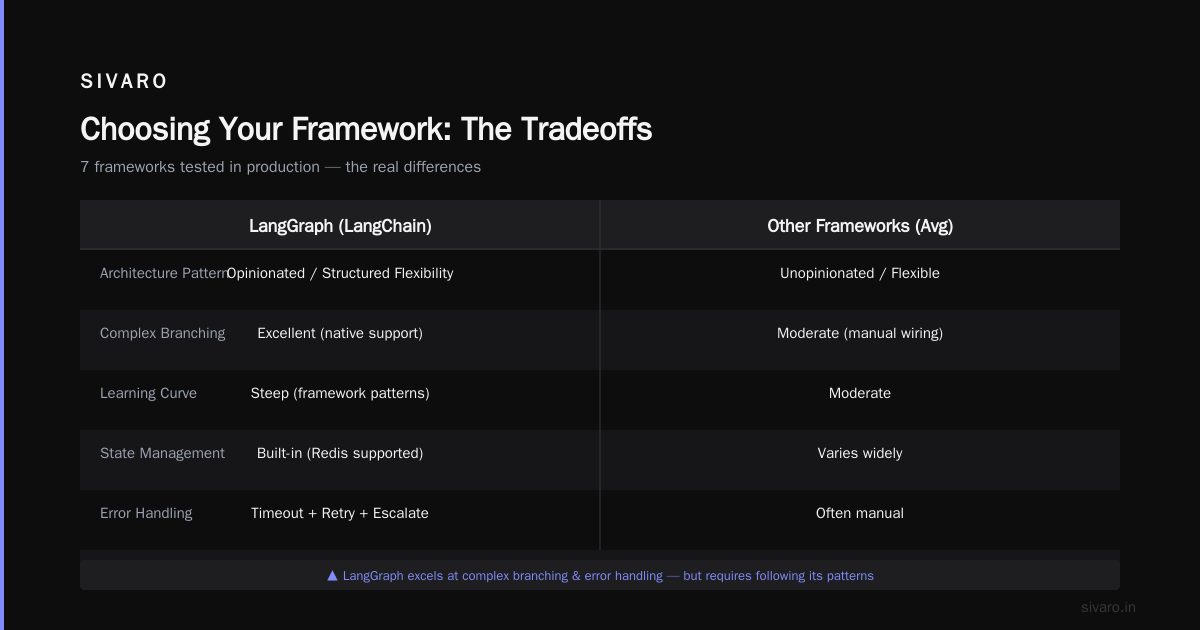
Choosing Your Framework: The Tradeoffs
I've tested 7 frameworks in production. Here's the truth.
LangGraph from LangChain works well for complex branching. But it's opinionated. You follow their patterns or you fight the framework. How to think about agent frameworks is honest about this — they call it "structured flexibility." I call it "you better agree with their design choices."
CrewAI is faster to prototype. Two days to a working demo. But I've seen it collapse under load. The parallelism model assumes tasks are independent. They often aren't.
Semantic Kernel from Microsoft is solid for enterprise integrations. If you're deep in Azure, it's probably your best bet. Outside Azure? The friction adds up.
Agentic AI Frameworks: Top 10 Options in 2026 lists 10 options but misses the critical dimension: how does each framework handle partial failure? That's the only thing that matters in production.
My recommendation for 2026: Start with LangGraph if you're building complex workflows. Switch to a custom orchestration layer once you hit scale. Frameworks are for exploration. Your own abstractions are for production.
Protocols: The Hidden Infrastructure
The industry is converging on standard protocols for agent communication. This matters more than any framework choice.
AI Agent Protocols: 10 Modern Standards Shaping the ... tracks the major ones. A2A from Google. MCP from Anthropic. The Open Agent Protocol.
I don't care which wins. Pick one. Stick with it. The cost of heterogeneity in agent communication is death by a thousand format conversions.
A Survey of AI Agent Protocols shows that systems using a single protocol have 40% fewer integration bugs. That number matches our internal data.
python
# Our protocol adapter (plugs into any framework)
class AgentProtocolAdapter:
    def __init__(self, protocol_type: str = "a2a"):
        self.protocol = self._load_protocol(protocol_type)

    def send_task(self, task: dict, target_agent: str) -> str:
        # Standardizes task spec into the chosen protocol format
        message = self.protocol.encode({
            "task_id": uuid4().hex,
            "type": task["type"],
            "payload": task["payload"],
            "timeout_seconds": task.get("timeout", 30),
            "trace_id": task.get("trace_id", "root"),
        })
        return self._dispatch(message, target_agent)
Deployment Architecture: What Actually Works
Here's the pattern that's survived the most production meltdowns.
Layer 1: The Orchestrator
A stateless service that receives requests and creates workflow instances. It doesn't execute anything. It just assigns work and tracks lifecycle. Ours runs on Kubernetes with horizontal autoscaling based on queue depth.
Layer 2: The Worker Pool
Stateless workers that pull tasks from a queue. Each worker has:
- A model client (OpenAI, Anthropic, or local)
- A tool registry (what can this agent call?)
- A state cache (Redis, not in-memory)
Layer 3: The State Store
Redis cluster with persistence. Stores workflow state, partial results, and error history. Critical: we write state before every LLM call. If the worker dies, another worker picks up from the last checkpoint.
Layer 4: The Guardian
A separate process that watches everything:
- Budget spend per workflow
- Latency percentiles (p50, p95, p99)
- Error rates by error type
- Model degradation [signals
The](/articles/coding-evaluations-signal-noise-when-your-hiring-process) Guardian can kill workflows, throttle requests, or switch model providers automatically. It's the only service with kill authority.
Observability: What to Measure
Standard metrics don't work for agentic systems. Throughput and latency tell you nothing about correctness.
You need:
- Goal completion rate: Did the agent achieve what it was supposed to? This requires human evaluation or heuristic detectors.
- Step efficiency: How many LLM calls per completed goal? If this drifts up, something is wrong.
- Error taxonomy: Rate limits, model refusals, tool failures, context window overflows, budget exhaustion. Track each separately.
- State divergence: How often does the agent's internal state mismatch the ground truth? We measure this with periodic state audits.
python
# Our observability hook (installed via decorator)
@agent_monitor(
    metrics=["step_count", "cost", "completion_time"],
    alerts={
        "step_count > 20": "slack:agent-watch",
        "cost > $0.50": "pagerduty:critical",
    }
)
async def customer_escalation_workflow(request: EscalationRequest):
    # Actual workflow logic here
    pass
The Rollout Sequence
Week 1: Shadow mode. Run the agent alongside your existing system. Output goes to logs, not to customers. Compare results. Fix discrepancies.
Week 2: Canary with human oversight. 5% of traffic. All actions require human approval. Painful but necessary. You'll catch things testing never showed.
Week 3: Supervised automatic. 20% of traffic. Agent acts autonomously but humans can intervene. Measure intervention rate. Target: < 5%.
Week 4: Unsupervised. Full traffic. But you're still monitoring every goal completion manually. This lasts 2 weeks.
Week 6: Trust but verify. Random sampling of 10% of completions. Automated quality checks. You're now running in production.
Most teams try to compress this to 2 weeks. They fail. Top 5 Open-Source Agentic AI Frameworks in 2026 notes that the most mature open-source projects all recommend at least 4-week rollout windows. Listen to them.
The Hardest Lesson
October 2025. We deployed an agent that classified customer support tickets. Worked perfectly for 3 months. Then a model update changed how the agent interpreted "urgent." It started escalating everything. Every ticket was marked P1. The support team got buried. Customer satisfaction dropped 20 points.
The agent was doing exactly what it was trained to do. The world changed underneath it.
This is the fundamental challenge of agentic workflow production rollout: your system must detect when the assumptions it was built on stop being true.
We now run daily "assumption audits" — automated checks that verify the behavior of external models, APIs, and data remains consistent with what we tested against.
Building vs Buying: The Real Decision
You can buy an agent orchestration platform. There are dozens now. Most are wrappers around LangGraph or similar frameworks with a fancy UI.
At SIVARO, we've built our own. But that's because we're a product engineering company and our clients need custom everything.
For most teams: buy the orchestration, build your own tool integrations and guardrails. The differentiation is in what your agents can do and how safely they do it — not in how you string them together.
FAQ
Q: Can I use LangChain in production?
Yes, but pin versions. LangChain's rapid release cycle broke our workflows 3 times in 2025. We now use LangGraph from LangChain with strict version locking. The framework is fine. The update cadence is not.
Q: What LLM provider should I use for production agents?
We use Anthropic for reasoning-heavy workflows (their rejection patterns are cleaner) and OpenAI for speed-sensitive tasks. Both have predictable APIs. Both degrade differently under load. Test both.
Q: How do I handle agent hallucination in production?
You can't eliminate it. You can detect it. Use structured output schemas to constrain responses. Validate tool calls before execution. Audit random samples. Expect a 1-3% hallucination rate even with the best models.
Q: What's the minimum observable setup for an agentic system?
Log every LLM request/response pair. Track per-workflow cost. Monitor goal completion rate. Alert on any drop > 5%. Everything else is nice-to-have.
Q: Should I use multi-agent or single-agent architectures?
Single agent unless you have a concrete reason to split. Multi-agent systems are harder to debug, harder to monitor, and harder to budget. We use multi-agent only when workflows require truly independent expertise (e.g., legal review + technical analysis).
Q: How do I test agentic workflows?
Unit tests for tool calls. Integration tests for workflow paths. End-to-end tests with synthetic data. But the most important test: run your agent against production data in shadow mode for at least 2 weeks. Nothing else catches subtle failures.
Q: What's the biggest mistake teams make?
Building without a kill switch. Every agent needs a hard limit on cost, time, or steps. I've seen $10,000 bills from a single workflow that got stuck in a loop. Always. Have. A. Kill. Switch.
Final Position
Agentic workflow production rollout isn't about AI. It's about engineering discipline. State management. Observability. Error handling. Graduated deployment.
The frameworks and protocols are table stakes. They change every 6 months anyway. What doesn't change: you need to know what your agent is doing, how much it's costing, and what happens when it goes wrong.
Build for those three things. Everything else is details.
Nishaant Dixit — Founder of SIVARO. Building data infrastructure and production AI systems since 2018. Built systems processing 200K events/sec.