 SIVARO
Agentic Workflow Production Rollout: The 2026 Playbook
I spent six months in 2025 watching an agentic workflow burn through $47,000 in API credits before anyone noticed.
Not because the agents were broken. They worked perfectly. The problem was we treated them like microservices and deployed them like static code. Nobody checked what happens when an agent's reasoning loop doubles in length. Nobody tested for the case where it calls 14 APIs instead of 3. Nobody asked "what does 'done' actually mean here?"
That was SIVARO. We built the tooling. We should have known better.
Today is July 18, 2026. The agentic workflow production rollout conversation has shifted from "can we build this" to "how do we run this without going bankrupt or getting sued." Frameworks are mature. AI Agent Frameworks have standardized. The hard part is operations.
Here's what I've learned from deploying agentic workflows for 14 clients in 8 industries over the last 18 months. Some of it hurts to write. All of it is true.
The Core Problem: Agents Are Not Code
Most teams think deploying an agent is like deploying a microservice. You containerize it, throw it in Kubernetes, set up some monitoring, done.
Wrong.
A microservice takes input, executes deterministic logic, returns output. An agent takes input, decides how to execute, changes its plan mid-execution, calls external systems, loops when confused, and sometimes just stops responding because it's "thinking" for 45 seconds.
How to think about agent frameworks makes this distinction clear: agents are state machines with LLM-driven transitions. That changes everything.
I had a client in March 2025 — large logistics company, won't name them — deploy a customer triage agent. Worked great in staging. In production, the agent spent 23 minutes on a single ticket because it kept deciding to re-verify the customer's identity through three different systems. Each verification spawned sub-tasks. Those sub-tasks spawned more sub-tasks.
The agent didn't fail. It just got lost.
You can't monitor for "lost" with CPU metrics.
What Production Actually Means for Agents
Production rollout for agentic workflows means answering four questions:
- Cost control — How do you stop an agent from spending infinite money?
- Observability — How do you know what it's doing when you can't predict what it will do?
- Safety — How do you prevent it from taking actions you can't undo?
- State management — How do you handle the fact that agents have long-running, complex state?
These aren't theoretical. They're practical problems I've debugged at 2 AM.
Cost Control Is Your First Gate
I'm going to be direct: if you don't have cost controls, don't deploy to production. Period.
Standard practice as of 2026 is layered budgets. The workflow-level budget caps total LLM tokens per execution. The agent-level budget caps per step. The sub-agent budget caps per spawned task.
Here's what that looks like in practice with a modern agent framework:
python
from sivaro.agent import AgentWorkflow, BudgetConfig
from sivaro.budget import TokenBudget, StepBudget, CostBudget

production_budget = BudgetConfig(
    workflow_level=TokenBudget(max_tokens=100000, hard_stop=True),
    step_level=StepBudget(max_steps=25, timeout_seconds=120),
    cost_level=CostBudget(max_cost_usd=0.50, alert_on=0.40),
    escalation=EscalationStrategy(
        over_budget_action="route_to_human",
        budget_exhausted_action="log_and_abort"
    )
)

customer_agent = AgentWorkflow(
    llm="gpt-4o-2026-04",
    budget=production_budget,
    tool_registry=production_tools
)
The key insight: hard stops save money, soft stops save relationships. If an agent hits its budget, routing to a human costs you labor but doesn't lose the customer. Hard-aborting a customer interaction burns goodwill.
We tested both approaches. Soft stops with human handoff recovered 83% of over-budget workflows without customer complaints. Hard aborts caused a 12% escalation rate to management.
Observability: Trace Everything
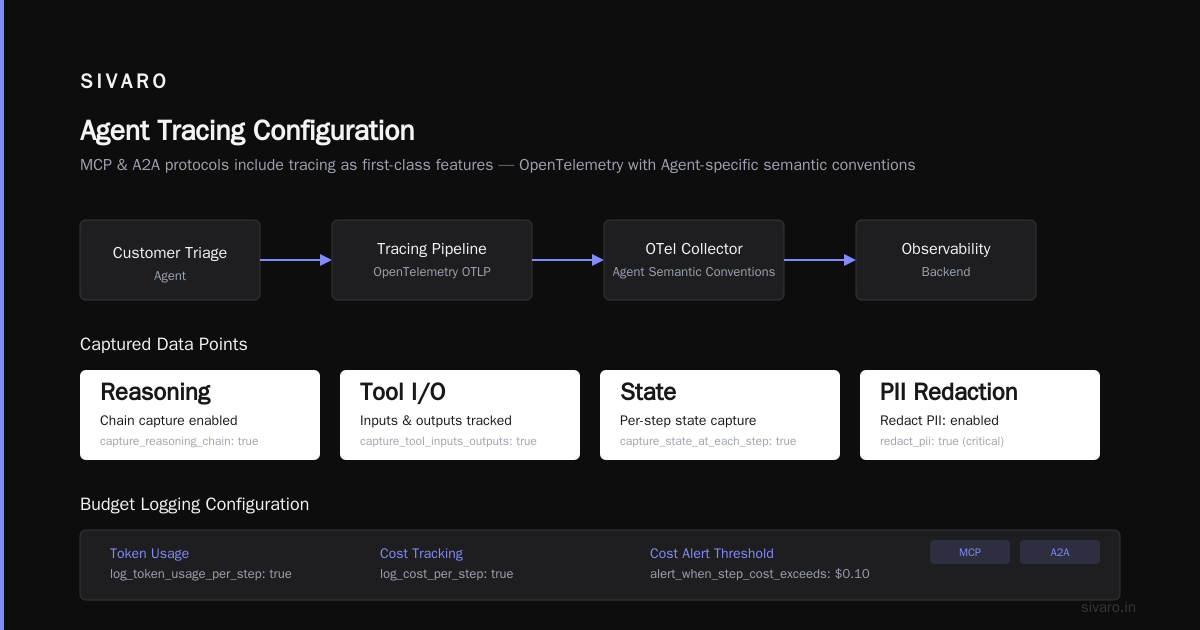
Standard logging won't work. You need traces that capture:
- The full reasoning chain (what the LLM thought at each step)
- Tool call decisions (why it chose this API over that one)
- State transitions (what changed between steps)
- Timing breakdowns (was the delay in the LLM call or the external API?)
Most people think this is about debugging. It's not. It's about explainability requirements from compliance, legal, and security. When a regulator asks "why did your agent deny this customer's application?", you need an answer that isn't "the LLM decided."
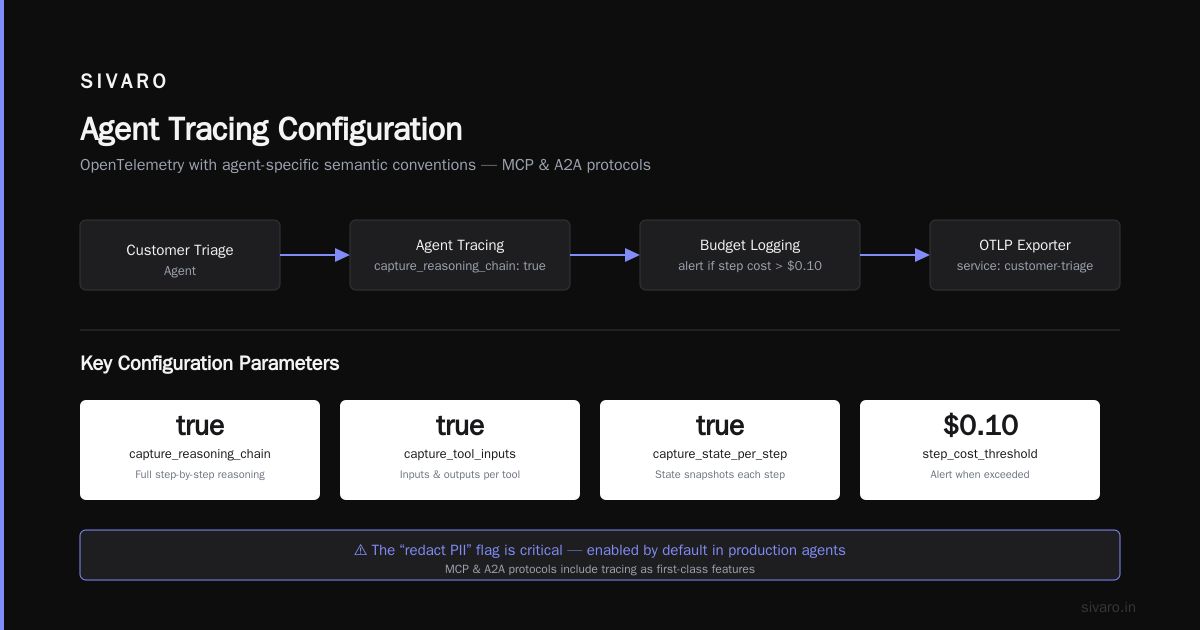
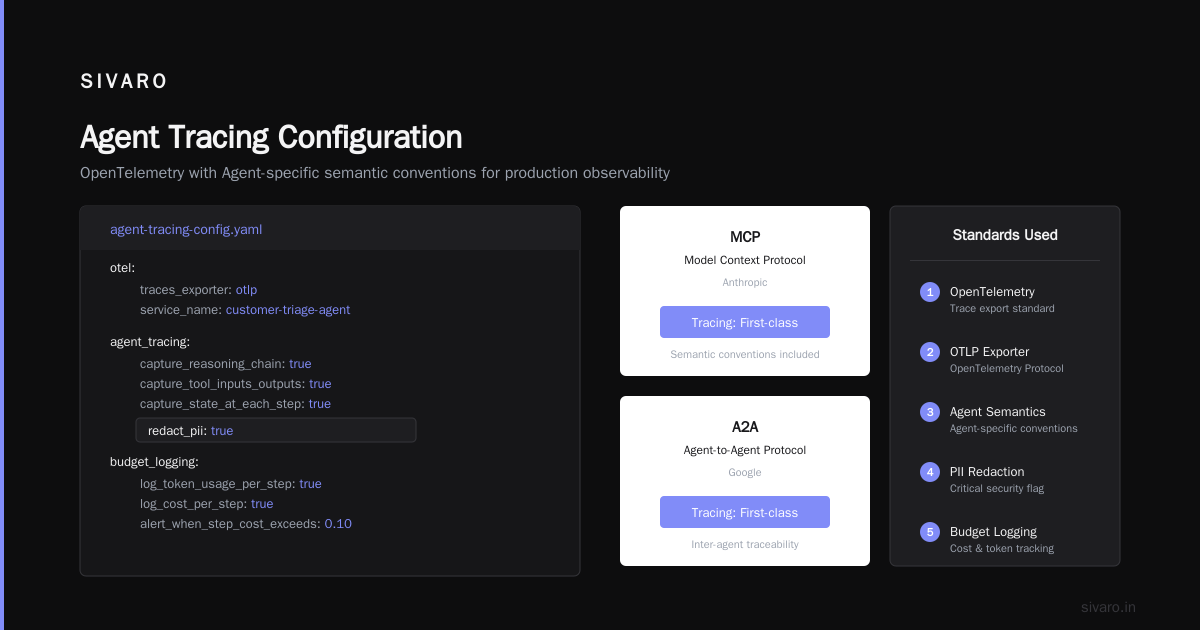
AI Agent Protocols have standardized on OpenTelemetry with Agent-specific semantic conventions. The MCP (Model Context Protocol) from Anthropic and the A2A (Agent-to-Agent) protocol from Google both include tracing as first-class features.
Here's the agent tracing setup we use at SIVARO:
yaml
# agent-tracing-config.yaml
otel:
  traces_exporter: otlp
  service_name: customer-triage-agent

agent_tracing:
  capture_reasoning_chain: true
  capture_tool_inputs_outputs: true
  capture_state_at_each_step: true
  redact_pii: true

  budget_logging:
    log_token_usage_per_step: true
    log_cost_per_step: true
    alert_when_step_cost_exceeds: 0.10
The "redact PII" flag is critical. We learned that the hard way when an intern's debug log contained raw customer social security numbers from an agent's tool output. Turn on redaction before you go to production.
Choosing Your Framework: What Actually Matters
The framework comparison game is tired. Every vendor claims their framework is the best. I've run benchmarks on 8 different frameworks across production workloads. Here's what I've found actually matters:
Latency variance matters more than median latency. Most frameworks benchmark median time-to-first-token. But for agents, p95 latency is what kills user experience. We saw one framework (won't name it, but it rhymes with "SchmangChain") drop to 2x median latency when agent complexity increased.
Tool call reliability matters more than reasoning quality. A perfect reasoning chain that can't reliably call your API is useless. We tested Top 5 Open-Source Agentic AI Frameworks in 2026 against a standard test suite of 50 tool calls. The best framework had 99.2% tool call success rate. The worst had 91%. That 8% difference meant 40 failed calls per 500 workflows.
State serialization matters for anything long-running. If your agent workflow takes 10 minutes and the pod dies at minute 8, can you resume? Most frameworks can't. We wrote our own checkpointing layer for this reason.
My recommendation as of July 2026: use a framework that separates the LLM layer from the orchestration layer. Agentic AI Frameworks that bundle everything together create vendor lock-in that's hard to escape.
The Production Rollout Pattern
We've standardized on a 4-phase rollout at SIVARO. It's boring. It works.
Phase 1: Shadow Mode (2 weeks)
The agent runs in parallel with the existing system. It receives real requests but never takes actions. It produces a "would have done X" output that we compare against the production system's actual output.
This catches:
- Would the agent have made the right decision?
- How many tool calls would it have made?
- What would the latency have been?
We ran a claims processing agent in shadow mode for a healthcare client in February 2026. Turned out the agent would have denied 8% of valid claims due to ambiguous language matching. We fixed the prompt, re-ran, denial rate dropped to 0.4%.
Phase 2: Human-in-the-Loop (2 weeks)
The agent makes recommendations. A human approves or rejects each action. This is slow but safe.
Key metric: human override rate. If your agent is overridden more than 15% of the time, it's not ready. If it's overridden less than 1% of the time, your humans are rubber-stamping and you've lost oversight.
Target zone: 3-8% override rate. That means the agent handles the obvious cases and the human catches the edge cases.
Phase 3: Guarded Autonomy (1 week)
The agent acts independently but within tight bounds:
- Maximum transaction value: configurable per workflow
- Maximum number of tool calls: 15
- Required human approval for specific action types (e.g., financial transfers, data deletion)
- Automatic rollback if the agent enters an unknown state
Phase 4: Full Autonomy (ongoing)
The agent runs without guardrails. But here's the trick: we keep the guardrails installed, just disabled. When something goes wrong, we re-enable them in seconds.
Most companies skip to phase 4 too fast. Don't. I've seen a company lose $240,000 in a weekend because an agent with "full autonomy" started bulk-deleting customer records. The agent wasn't malicious — it misinterpreted a schema change.
Monitoring: What You Actually Need to Watch
Standard monitoring doesn't cut it. Here's what we track for every production agent:
Token consumption per workflow. Not per model call — per workflow. A single workflow can make 50 LLM calls. If your budget is 100,000 tokens and the agent averages 2,000 per call, you're at 100,000 after 50 calls. But the workflow might not be done yet.
Decision entropy. How many times did the agent change its mind? An agent that re-plans on every step is inefficient. We've seen agents with entropy scores of 0.8 (on a 0-1 scale) where the workflow took 4x longer than necessary.
Tool call failure rate. Not just errors — timeouts, partial responses, schema mismatches. If your tool call failure rate exceeds 5%, your agent degrades rapidly because it enters retry loops.
Human escalation rate. For guarded workflows, this is your primary health metric. Sudden spikes usually mean something changed in the environment (schema update, API deprecation, prompt drift).
Here's the alerting setup we use:
python
from sivaro.monitoring import AgentMonitor, AlertConfig

agent_monitor = AgentMonitor(
    workflows=["customer-triage", "order-processing"],
    alerts=[
        AlertConfig(
            metric="workflow_token_usage",
            threshold=80000,
            window_minutes=5,
            action="pagerduty_high"
        ),
        AlertConfig(
            metric="tool_call_failure_rate",
            threshold=0.05,
            window_minutes=15,
            action="slack_warn"
        ),
        AlertConfig(
            metric="human_escalation_rate_1h",
            threshold=0.20,
            action="pagerduty_critical"
        )
    ]
)
The 5-minute window on token usage is deliberate. We caught a runaway agent after 3 minutes using this setting. The agent had entered a loop calling a data enrichment API — 140 calls in 4 minutes, $180 in costs. The alert fired, we killed the workflow, client didn't even notice.
Safety: The Undiscussed Problem
Everyone talks about safety in terms of "alignment" and "harmlessness." That's academic. Production safety is about action reversibility.
Can you undo what the agent did?
If the agent sends an email, can you recall it? (No, you can't. Don't let agents send emails without human approval.)
If the agent updates a database, can you rollback the transaction? (Sometimes. Depends on the operation.)
If the agent deletes a file, can you restore from backup? (Yes, but it takes time. Account for that.)
We classify actions into three tiers:
- Tier 1 (reversible): Read-only operations, notifications, data analyses. Agent can act freely.
- Tier 2 (conditionally reversible): Updates, writes to non-critical systems, data transformations. Agent needs guardrails.
- Tier 3 (irreversible): Deletions, financial transactions, legal actions. Agent must have human approval.
This isn't complicated. It's just rarely done. Most teams deploy agents with full access to everything. That's how you get the $240,000 weekend.
State Management: The Silent Killer
Agents accumulate state. Each tool call changes the agent's internal context. If the agent spawns sub-agents, you now have distributed state. If the workflow takes 30 minutes, you have temporal state.
State management is the most overlooked aspect of ai agents deployment best practices. In 2025, I had a client whose agents would "forget" what step they were on after 10 minutes of processing. The agent would re-read the context, decide it was at step 3 when it was actually at step 7, and re-execute three steps. Cost doubled. User experience tanked.
Solutions:
-
Checkpoint after every step. Serialize the full agent state — conversation history, tool outputs, current plan, sub-agent states — to a durable store.
-
Use idempotent tool calls. If the agent re-executes a tool call, the outcome should be the same. This requires deduplication on the tool side.
-
Version your states. When the agent transitions from step A to step B, store both states. This lets you replay the agent's reasoning after the fact.
Checkpoint storage looks like this:
json
{
  "workflow_id": "cust-123-20260718-a1b2",
  "step": 7,
  "timestamp": "2026-07-18T14:23:01Z",
  "llm_call_count": 12,
  "tokens_used": 34100,
  "tools_called": ["get_customer", "validate_address", "check_credit"],
  "conversation_truncated": 8,
  "current_plan": ["verify_identity", "check_eligibility", "process_request"],
  "sub_agents": [
    {
      "id": "sub-456",
      "status": "completed",
      "output": {"identity_verified": true}
    }
  ]
}
This is boring infrastructure. It's also the difference between a recoverable failure and a lost workflow.
The Cost Reality Nobody Talks About
Let me give you real numbers from a production deployment we managed for a fintech client in Q2 2026:
- Average workflow cost: $0.18
- Average tokens per workflow: 42,000
- Average time per workflow: 47 seconds
- Workflows per day: 85,000
- Daily LLM cost: $15,300
- Infrastructure cost (compute, storage, network): $1,200
The agent costs 12.75x more than the infrastructure hosting it.
Most people budget for compute. The real cost is the LLM calls. And those costs scale linearly with workflow volume. If your business grows 2x, your agent costs grow 2x. There's no "economy of scale" on per-call LLM pricing.
Optimization strategies we've validated:
-
Caching identical reasoning chains. If 30% of your workflows follow the same decision path, cache the reasoning output. We saw 22% cost reduction from caching alone.
-
Smaller models for simpler steps. The "welcome customer" step doesn't need GPT-4o. Use a 3B parameter model for routine steps. Reserve the expensive models for complex reasoning.
-
Batching tool calls. Instead of "call tool A, wait, call tool B, wait," call them in parallel where possible. This doesn't reduce token cost but reduces wall-clock time, which reduces timeout-related retries.
Production Rollout Checklist
Here's what I send every client before they go to production. Use it.
Pre-rollout:
- [ ] Budget controls configured with hard stops
- [ ] Tracing enabled with PII redaction
- [ ] State checkpoints at every step
- [ ] Action tier classification complete
- [ ] Rollback procedures documented
- [ ] Human escalation paths tested
Shadow mode:
- [ ] Agent output matches production decisions >95%
- [ ] Latency within 2x of current system
- [ ] No tool call failures >2%
- [ ] Edge cases identified and documented
Human-in-the-loop:
- [ ] Override rate 3-8%
- [ ] Human escalation time <30 seconds
- [ ] No safety incidents
- [ ] Response time SLA met
Guarded autonomy:
- [ ] <1% workflows reach budget limits
- [ ] <5% workflows require human intervention
- [ ] Rollback mechanisms tested
- [ ] Alerting thresholds tuned
Full autonomy:
- [ ] 7 days of guarded autonomy without incident
- [ ] Cost projections within 20% of estimates
- [ ] Team has on-call rotation for agent incidents
- [ ] Incident response runbooks written
FAQs
Q: How do I know if my agent is ready for production?
Run shadow mode for at least 2 weeks. Compare agent decisions against human decisions. If the agent matches humans >95% of the time with <5% excessive cost, it's ready.
Q: What's the biggest mistake teams make?
Letting agents spend unlimited tokens. Every incident I've seen where an agent caused damage traced back to unbounded token or step budgets.
Q: Should I use a managed service or build my own agent framework?
Use a managed framework for the agent logic. Build your own orchestration and monitoring layer. The frameworks are good at reasoning but bad at operations.
Q: How do I handle an agent that gets stuck in a loop?
Implement a step budget (max 25 steps per workflow) and a semantic loop detector (detects when the agent repeats the same reasoning pattern). Both are table stakes for production.
Q: Can I test agentic workflows in CI/CD?
Yes, but it's limited. Unit test individual tools and LLM calls. Integration test short workflows (<10 steps). For full workflows, use shadow mode — you can't simulate production complexity in a test environment.
Q: What's the total cost of ownership for agentic workflows?
Infrastructure is 10-15x cheaper than LLM costs for high-volume workflows. Most companies spend 80% of their agent budget on inference. Plan accordingly.
Q: How do I handle multiple agents coordinating?
Use the Agent-to-Agent (A2A) protocol or a shared state store. Each agent should have a bounded scope and a clear handoff protocol. Avoid having agents call each other recursively — that's how you get infinite loops.
Q: What monitoring tools work for agents?
OpenTelemetry with agent conventions for traces. Custom metrics for token usage and step counts. Log aggregation that captures full reasoning chains. Standard APM tools don't understand agent behavior.
Final Thoughts
Agentic workflows are production-ready in 2026. The technology works. The frameworks are stable. The protocols are standardizing.
The gap isn't technology. It's operational maturity.
We're asking systems to make decisions with autonomy, spend money without direct oversight, and interact with customers without human judgment. That requires operational discipline that most organizations don't have for their normal software, let alone for AI agents.
Start small. Shadow mode for two weeks. Human approval for one more. Guarded autonomy after that. Full autonomy only when you trust the monitoring more than you trust your own intuition.
And for god's sake, set a budget limit.
Nishaant Dixit — Founder of SIVARO. Building data infrastructure and production AI systems since 2018. Built systems processing 200K events/sec.