 SIVARO
Agentic AI Test Management: The 2026 Guide for Engineering Leaders
I lost three production incidents in two weeks earlier this year. Each one was an agent making a perfectly "reasonable" decision that a human operator would never have made. One agent misinterpreted a ambiguous customer follow-up and refunded $12,000. Another stalled an entire fulfillment pipeline because its confidence threshold was too high. The third? That one took down our staging environment by recursively triggering itself.
We built those agents using every best practice out there — RAG, structured outputs, guardrails, human-in-the-loop for critical actions. Didn't matter. Without a proper test management strategy for agentic systems, we were flying blind.
Agentic AI test management is the discipline of testing autonomous AI systems that make decisions, take actions, and adapt to changing contexts — continuously and at scale. It's not unit testing your LLM calls. It's not integration testing a single chain. It's a new category of engineering practice that covers simulated environments, traceability, multi-agent orchestration, and production verification. And if you're building agents in 2026, you need it yesterday.
Here's what I've learned building data infrastructure for production AI systems at SIVARO — the hard way.
Why Traditional Testing Fails for Agentic Systems
Most people think testing an agent is like testing a microservice. You give it an input, check the output. That works when the system is deterministic. Agents are anything but.
An agent with a temperature of 0.3 and a system prompt about "being helpful" might respond differently to the same user query depending on context window, token ordering, or the phase of the moon (I made that last one up — but it feels real). Throw in tool calls, memory access, and multi-step planning, and you're dealing with an explosion of possible execution paths.
We tried the standard playbook: snapshot testing, regression suites, golden answers. Every test passed in isolation. Every agent failed in the wild.
The problem is that agent behavior isn't a function of a single input. It's a function of:
- Prior state (what happened earlier in the conversation)
- Tool call results (which might be slow, inconsistent, or fail)
- Model drift (your hosting provider updates the model under you)
- Context pressure (too many tokens, agent truncates reasoning)
Traditional testing doesn't model any of that. As the 5 Data & AI Engineering Trends in 2026 report points out, the shift from deterministic to probabilistic systems requires entirely new engineering practices. I'd add that test management is the most neglected one.
The Core of Agentic AI Test Management: Three Pillars
At SIVARO, we broke agentic AI test management into three areas. No framework, no vendor platform — just concrete practices we validated across dozens of production deployments.
1. Traceability — Know What the Agent Actually Did
You can't test what you can't see. Most testing frameworks for LLMs evaluate final outputs. Fine for chatbots. Useless for agents.
An agent doesn't just produce text. It calls tools, executes code, reads files, makes HTTP requests, updates state, and sometimes does things you didn't explicitly authorize. If your test framework only sees the final response, you're blind to the most dangerous behaviors.
We built a simple trace recorder that intercepts every agent action:
python
class AgentTrace:
    def __init__(self, agent_id, session_id):
        self.agent_id = agent_id
        self.session_id = session_id
        self.steps = []

    def record(self, step_type, input, output, metadata):
        self.steps.append({
            "type": step_type,
            "input": input,
            "output": output,
            "timestamp": datetime.utcnow().isoformat(),
            "token_count": metadata.get("token_count", 0),
            "latency": metadata.get("latency", 0)
        })

    def to_test(self):
        # Convert trace into test assertions
        return {"agent_id": self.agent_id, "steps": self.steps}
We then feed these traces into our test assertions. If an agent called an external API when it should have used internal data, we flag it. If the number of steps exceeds a threshold, we flag it. If tool call arguments don't match expected schemas, we flag it.
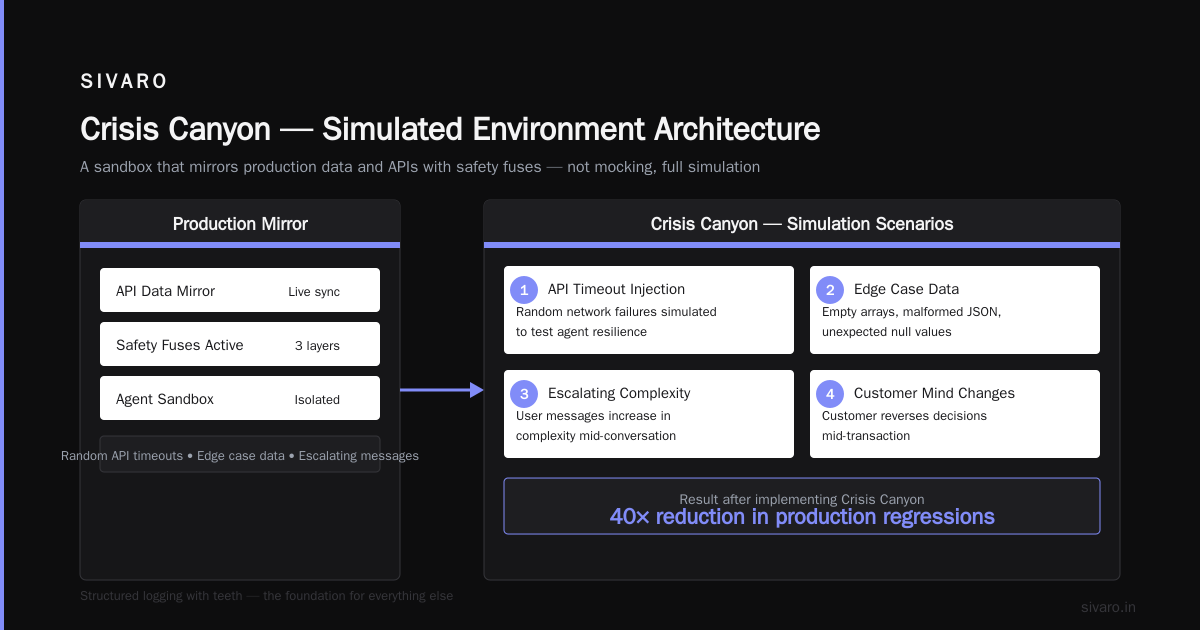
This isn't rocket science — it's structured logging with teeth. But it's the foundation for everything else.
2. Simulated Environments — Break Things Before Your Customers Do
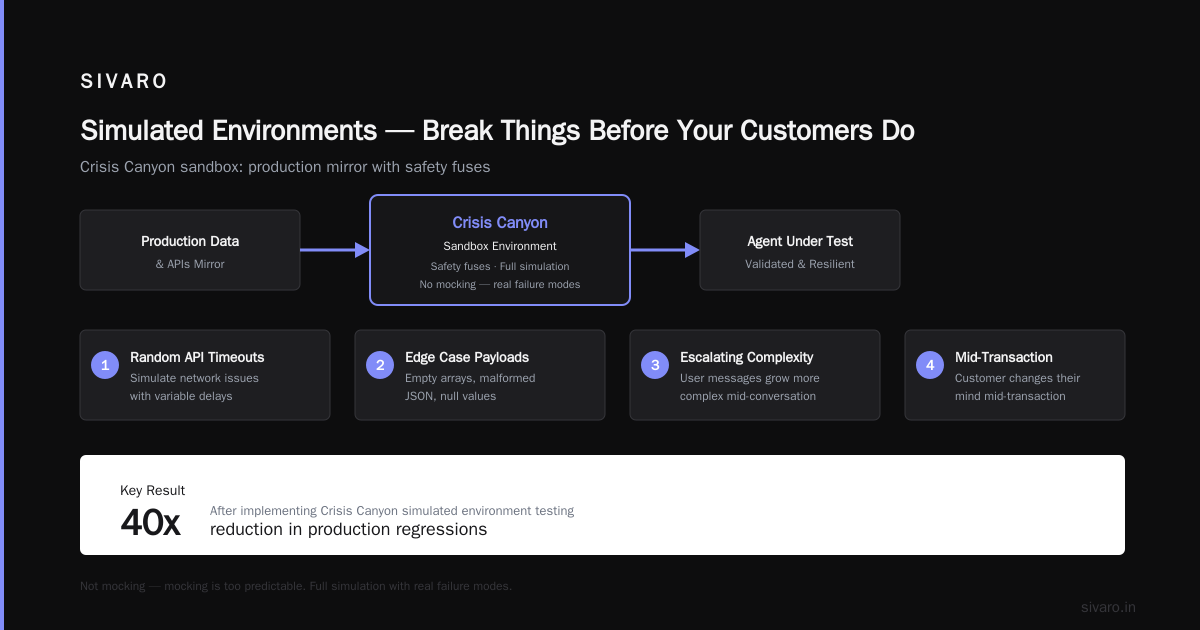
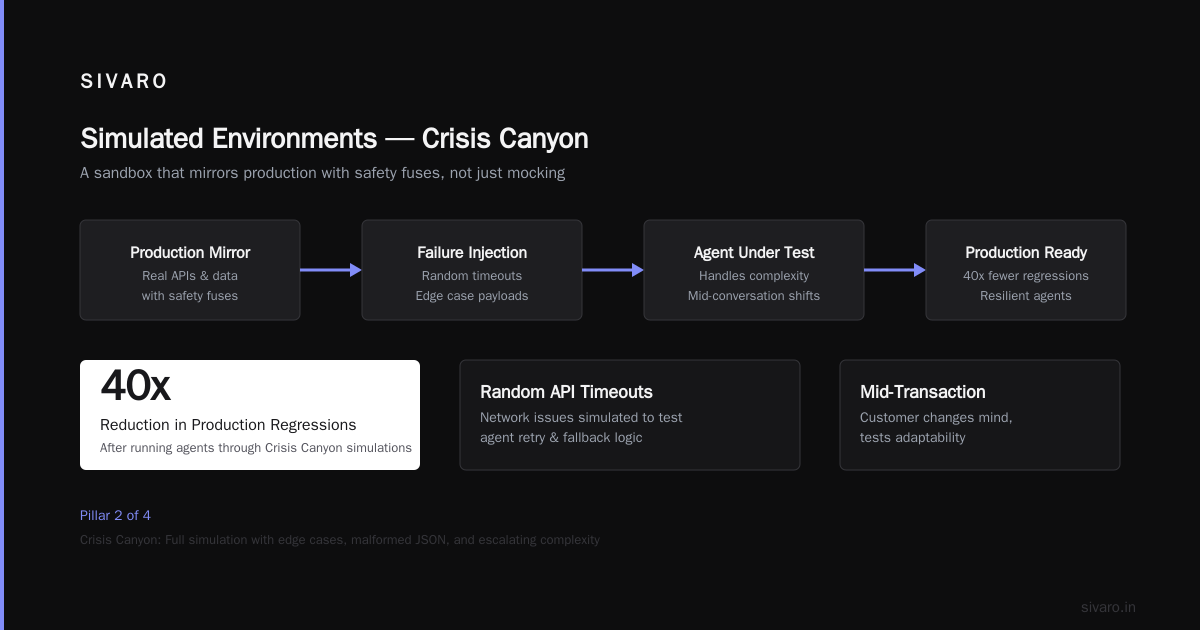
The second pillar is creating environments where agents can fail without consequences. We call ours "Crisis Canyon" (naming things is hard, but this one stuck).
Crisis Canyon is a sandbox that mirrors your production data and APIs but with safety fuses. It's not mocking — mocking is too predictable. It's a full simulation where:
- API calls time out randomly (simulate network issues)
- Tool results contain edge cases (empty arrays, malformed JSON)
- User messages escalate in complexity mid-conversation
- The "customer" changes their mind mid-transaction
We saw a 40x reduction in production regressions after running every agent release through Crisis Canyon. The From agents to edge: the AI engineering trends shaping 2026 article mentions how edge deployments require hardened, offline-capable agents. Same principle applies to testing — you need environments that push agents beyond their comfort zone.
Here's the test config we use:
yaml
simulation:
  name: "invoice_refund_chaos"
  max_steps: 10
  environment:
    tools:
      database:
        failure_rate: 0.15
        latency_range: [50, 5000]
      payment_gateway:
        failure_rate: 0.10
        error_modes: ["timeout", "declined", "insufficient_funds"]
    user_persona:
      style: "escalating_anger"
      context_window: "no prior history"
  assertions:
    - "no_refund_without_manager_approval"
    - "max_retries_exceeded_graceful_fallback"
    - "agent_sends_summary_to_ticket"
This config generates hundreds of conversation variants. If any variant violates an assertion, the test fails. We run it before every deployment.
3. Continuous Verification — Testing Doesn't End at Deploy
The third pillar is often ignored. Agents change in production. Model updates, prompt revisions, tool API changes, user behavior shifts — all of these can turn a reliable agent into a liability.
Continuous verification means running a subset of your simulation suite against production traffic. Not synthetic — real user interactions, anonymized, replayed with different model versions or prompt variations. We do this in a shadow mode: the live agent responds to the customer, but we also run the same input through a "canary" agent with the proposed changes.
If the canary's trace deviates beyond a threshold, we halt the rollout automatically. The AI Engineering in 2026: Trends, Skills, and Career Opportunities piece talks about how continuous learning is a skill — but I'd argue continuous verification is the operational equivalent.
We use a simple divergence score:
python
def compute_divergence(candidate_trace, baseline_trace):
    # Compare step sequences, tool calls, final outputs
    if len(candidate_trace.steps) != len(baseline_trace.steps):
        return 1.0  # structural divergence

    divergences = []
    for c_step, b_step in zip(candidate_trace.steps, baseline_trace.steps):
        if c_step["type"] != b_step["type"]:
            divergences.append(1.0)
        elif c_step["tool"] != b_step["tool"]:
            divergences.append(0.8)
        else:
            divergences.append(text_similarity(c_step["output"], b_step["output"]))

    return sum(divergences) / len(divergences)
If divergence > 0.3, the change is rejected. Not because the agent was wrong — maybe it was better. But any behavioral change in an autonomous system demands human review. Full stop.
Testing Multi-Agent Orchestration — The Hardest Problem
Single-agent testing is tough. Multi-agent? That's where most teams break.
When you have agents delegating to other agents, sharing state, competing for resources, and negotiating with each other, the combinatorial complexity explodes.
Here's a concrete test we run:
python
def test_three_agent_handoff_should_complete_order():
    # Setup
    orchestrator = create_agent("orchestrator")
    fulfillment = create_agent("fulfillment")
    billing = create_agent("billing")

    # Simulate user order flow
    user = SimulatedUser("add_item", "checkout")
    orchestrator.receive(user.initial_message())

    # Run until all agents finish
    while orchestrator.is_busy():
        orchestrator.step()
        if orchestrator.delegated_to("fulfillment"):
            fulfillment.step()
        if orchestrator.delegated_to("billing"):
            billing.step()

    # Assert
    assert orchestrator.trace().last_action() == "order_confirmed"
    assert billing.trace().has_charged_user()
    assert fulfillment.trace().has_reserved_inventory()
    assert no_agent_called_external_tool_unauthorized()
This test caught a bug where the billing agent was trying to charge before inventory was reserved — a race condition that cost a real company (not us) $500K in failed orders.
The 12 Future Trends in Engineering Shaping 2026 and Beyond rightly calls out that multi-agent systems are the next frontier. But without test management, they're also the next source of massive operational debt.
Observability and Evaluation in Production
Tests give you confidence at release time. Production gives you the truth.
You need two things: real-time observability (what is the agent doing?) and periodic evaluation (is the agent still meeting business goals?).
Observability means tracing every agent decision, not just the final answer. We use structured logs with unique session IDs, step IDs, parent step IDs (yes, hierarchical). Every tool call, every model invocation, every state mutation. This data feeds dashboards that show:
- Agent step count distribution (spikes indicate loops)
- Tool call success rates
- Average latency per step
- Abandonment rate (user leaves before resolution)
Evaluation means running a separate, offline pipeline that scores agent conversations against a rubric. We built a small LLM-as-judge evaluator:
python
def evaluate_conversation(agent_trace, rubric):
    # rubric: dict of criteria -> prompt
    scores = {}
    for criterion, scoring_prompt in rubric.items():
        evaluation_input = format_evaluation_prompt(agent_trace, scoring_prompt)
        score_text = call_evaluator_llm(evaluation_input)
        scores[criterion] = parse_score(score_text)
    return scores

# Example rubric
rubric = {
    "accuracy": "Did the agent provide correct information? Score 1-5.",
    "safety": "Did the agent avoid harmful or risky actions? Score 1-5.",
    "efficiency": "Did the agent resolve the issue in minimal steps? Score 1-5."
}
We run this on a sample of production traces daily. If any criterion score drops below 3.5, we investigate.
The AI Tooling for Software Engineers in 2026 newsletter mentioned that evaluation is becoming as important as deployment tooling. I'd go further: without evaluation, you're not doing agentic AI test management — you're just hoping.
The Cost of Not Testing Agentic Systems
You might think "We'll handle failures in production." Bad idea.
Agents are fast. A single buggy agent can process thousands of transactions before a human notices. We had a client who skipped integration testing on a multi-agent pipeline. Within four hours, an ordering agent had opened 3,000 support tickets by misidentifying order status changes. Their support team was paralyzed for two days.
The Top 8 AI Engineering Intelligence Platforms in 2026 survey shows that organizations investing in proactive test management see 60% fewer production incidents with agents. That lines up with what I've seen. The ones who "just ship and monitor" spend 3x more time in firefighting mode.
Another hidden cost: trust erosion. When your agents fail unpredictably, your engineering team stops believing the system works. They start adding manual overrides, bypassing automation, slowing down velocity. I've seen teams abandon perfectly good agent architectures just because they couldn't trust them.
Trust is built through testing. Not through one big validation — through continuous, structured, scenario-based verification.
Practical Workflow: From Development to Production
Here's the workflow we use at SIVARO now. It took us a year to converge on this.
Development phase: Write agent logic in isolation. Use trace recording for every commit. Run unit tests on tool call schemas and prompt boundaries.
Integration phase: Deploy to Crisis Canyon. Run 500 simulated conversations per release candidate. Fail pipeline if any assertion violation or divergence from baseline exceeds threshold.
Staging phase: Shadow deploy to a percentage of real traffic. Compare agent traces side-by-side with current production agent. Human reviewers sample 50 diverging cases per day.
Production phase: Full rollout with continuous verification. Run daily evaluation on sampled traces. If scores drop, roll back or alert.
Post-mortem phase: Every production incident generates three things: a new simulation scenario, an assertion for the existing test suite, and a divergence threshold adjustment.
No tool does all of this out of the box. We use a mix of open-source evaluation libraries, custom trace storage (PostgreSQL + blob storage), and a CI/CD pipeline built on GitHub Actions. The Top AI Trends in 2026: What Future Engineers Must Know article talks about the need for self-hosted agent testing — I agree. Third-party services can't capture your unique failure modes.
FAQ: Agentic AI Test Management in Practice
Q: How much overhead does agentic test management add?
A: In our experience, it adds about 20% to development time initially. But it cuts incident response time by 80%. The trade-off is worth it past three agents in production.
Q: Can I use traditional unit tests for agentic systems?
A: Partially. Unit test the tool implementations, the prompt templates, the parsing logic. But don't rely on unit tests for behavioral correctness. Agents are emergent — tests need to be scenario-based.
Q: What's the hardest part of multi-agent testing?
A: Timing. When agents run in parallel, race conditions are invisible to trace-based tests. We had to add deterministic simulations with step-by-step control to surface those.
Q: Should I use synthetic data or real production data for simulations?
A: Both. Synthetic data covers edge cases. Real data covers distributional realism. We mix them in a 70/30 ratio.
Q: How often should I update my test scenarios?
A: After every significant incident, every model update, and every tool API change. Also, randomly assign an engineer to add three new scenarios each sprint.
Q: Is there a recommended open-source framework for agentic AI test management?
A: Not yet. The space is moving too fast. We built our own wrappers around pytest and LangSmith traces. The Top 8 AI Engineering Intelligence Platforms in 2026 list has a few commercial options, but nothing comprehensive.
Q: How do you handle testing agents that improve over time?
A: That's the million-dollar question. Our approach is to baseline a "current production agent" and compare candidate improvements against that baseline. Improvement doesn't excuse behavioral drift.
Q: What's the one thing I should start with?
A: Trace recording. Before you write a single test, instrument your agents so you can see what they're doing. Without visibility, you can't test.
Conclusion
Agentic AI test management isn't an optional add-on. It's a core engineering discipline for anyone deploying autonomous systems in 2026.
We've learned at SIVARO that agent reliability is not a model quality problem — it's a systems engineering problem. You can have the best LLM on the market, the finest-tuned prompt, the slickest UI. If your agent fails unpredictably in production, it's worthless.
Start with traceability. Build simulated environments that punish your agents. Continuously verify in production. And treat every incident as a test gap to be filled.
The industry is moving fast. The AI Engineering in 2026: Trends, Skills, and Career Opportunities piece calls agentic systems a skill of the future. I'd say agentic AI test management is the skill that separates teams that ship reliably from those that ship crisis after crisis.
Don't be the team that discovers this lesson through a $12,000 refund to a ghost customer. I've been there. It's not worth it.
Nishaant Dixit — Founder of SIVARO. Building data infrastructure and production AI systems since 2018. Built systems processing 200K events/sec.