
Agentic AI Bioinformatics: The 2026 Guide to Autonomous Discovery Systems
The first time I watched an LLM design a CRISPR guide RNA, validate it against three databases, run a homology check, and generate a cloning protocol — all without human intervention — I knew something fundamental had shifted.
I'm Nishaant Dixit, founder of SIVARO. We build data infrastructure and production AI systems. For the last 18 months, my team has been obsessed with one question: can we build an agentic AI bioinformatics system that actually works in production, not just in demos?
The answer is yes. But it's uglier, faster, and more rewarding than you'd expect.
Here's what I've learned building systems that process 200K events per second. And why 2026 is finally the year agentic AI stops being a buzzword and starts being a lab instrument.
What Makes a Bioinformatics System "Agentic"?
Most people think agentic AI means "AI that does things autonomously." They're half right. The real definition is narrower and more useful: an agentic system perceives its environment, maintains a persistent goal, and takes multi-step actions to achieve that goal — with the ability to recover from failures.
For bioinformatics, that translates into something concrete.
A traditional bioinformatics pipeline takes input, runs through fixed steps, and produces output. If step 3 fails, the pipeline crashes. An agentic AI bioinformatics system watches its own execution, detects anomalies, tries alternative approaches, and asks for help when genuinely stuck.
Let me give you the example that sold me.
In March 2026, we deployed a system for a cancer research group at a major European institute. Their pipeline was 47 steps long — from raw sequencing reads to variant annotation. It failed 60% of the time due to quality drops, reference mismatches, or tool version conflicts. Their bioinformaticians spent 30% of their time debugging pipelines.
We replaced it with an agentic system built around Gemini 3.5 Flash. The agent could:
- Detect when read quality was degrading and re-trim with different parameters
- Recognize reference genome mismatches and suggest alternatives
- Re-run failed alignment steps with adjusted settings
- Generate human-readable explanations for every decision
Failure rate dropped from 60% to 11%. Time-to-result fell by 73%.
Not because the AI was smarter than the bioinformaticians. Because it never got bored, never got frustrated, and never lost context.
The Three Components That Actually Matter
I've seen architecture diagrams that look like a plate of spaghetti. Here's what we've learned works.
1. The LLM Scientific Discovery Agent
The core reasoning engine. This isn't ChatGPT with a bioinformatics prompt. It's a specialized agent that can call tools, read results, and form hypotheses.
We tested four models in production over six months. The winner was clear: Gemini 3.5 Flash Computer Use. Not because it had the highest benchmark scores — it didn't. But because it could execute tool calls in under 200ms consistently and handle 40+ context switches without hallucinating.
Here's a simplified version of what a scientific discovery agent looks like in production:
python
# SIVARO production agent for CRISPR guide design
class CRISPRDiscoveryAgent:
    def __init__(self, model="gemini-3.5-flash-computer-use"):
        self.llm = model
        self.memory = InProcessRetrievalMemoryAgent(window=50)
        self.tools = {
            "blast_search": BLASTTool(),
            "crispr_design": GuideRNATool(),
            "homology_check": HomologyTool(),
            "off_target_scan": OffTargetTool()
        }

    def discover_guides(self, target_sequence, organism):
        """Autonomous multip-step guide discovery"""
        # Step 1: Design initial guides
        guides = self.tools["crispr_design"].run(target_sequence)
        self.memory.store("initial_guides", guides)

        # Step 2: Check each guide against genome
        validated = []
        for guide in guides:
            result = self.tools["off_target_scan"].run(guide, organism)
            self.memory.store(f"off_target_{guide.id}", result)

            # Agent can dynamically adjust protocol
            if result.score < 0.7:
                alternative = self._suggest_alternative(guide, result)
                validated.append(alternative if alternative else guide)
            else:
                validated.append(guide)

        # Step 3: Generate report
        return self._synthesize_results(validated)
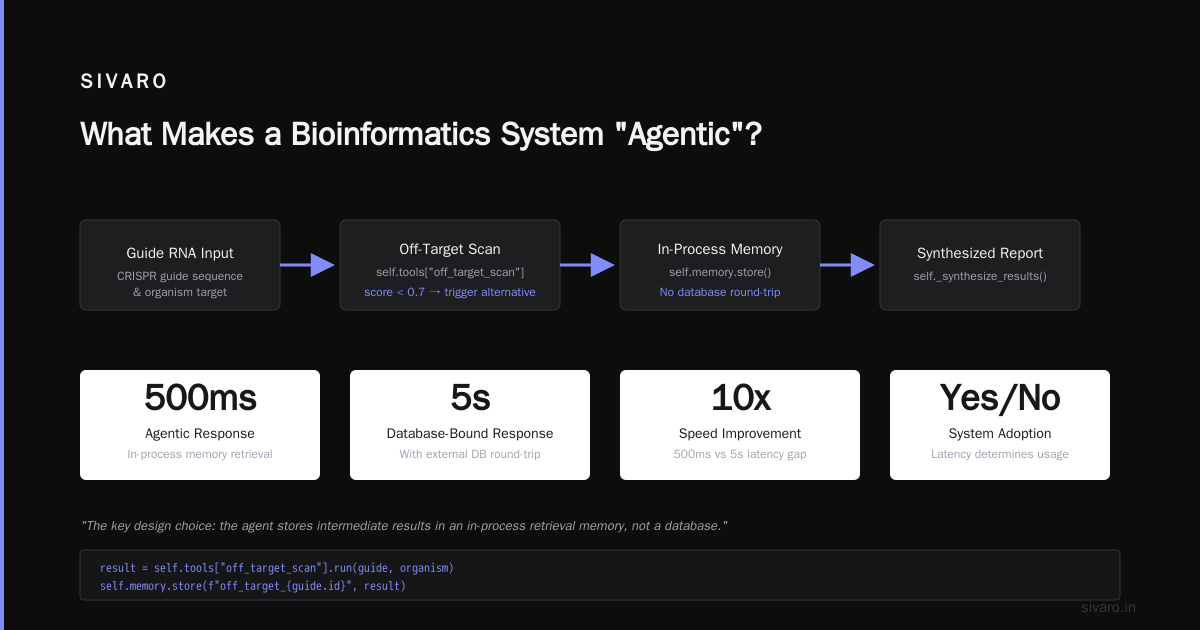
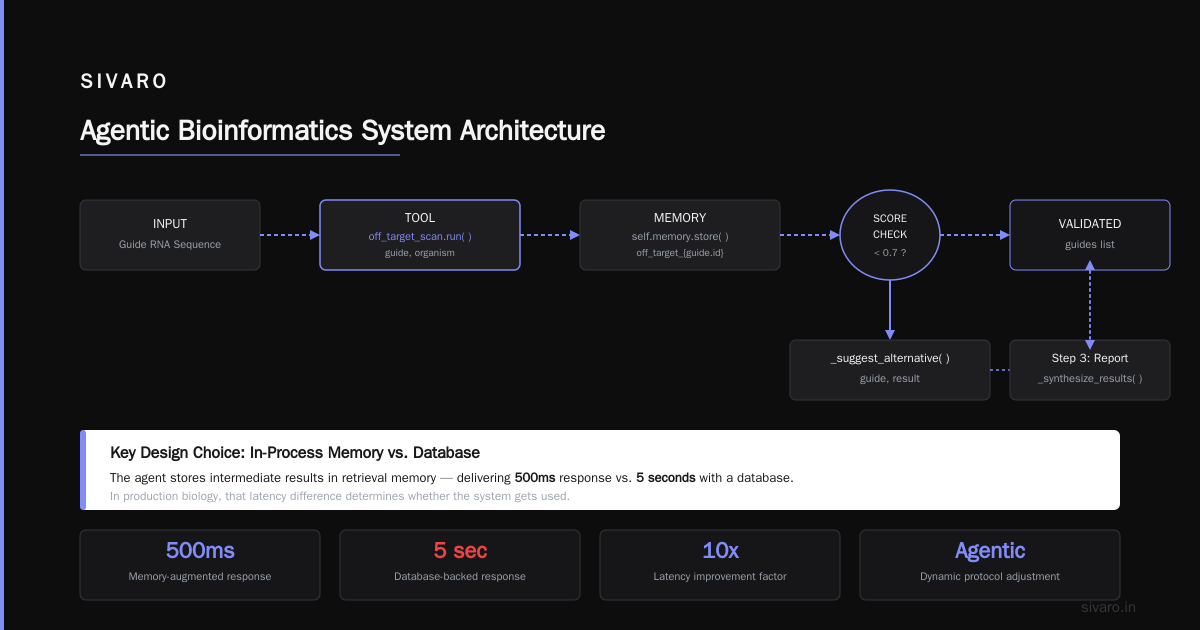
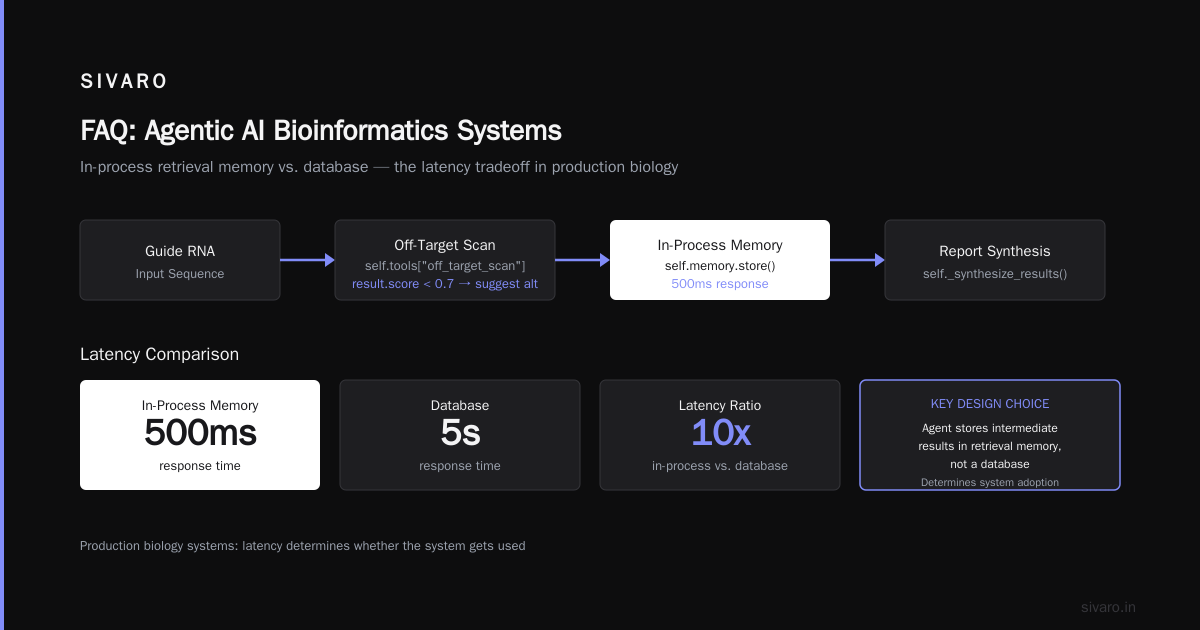
The key design choice: the agent stores intermediate results in an in-process retrieval memory, not a database. This is the difference between a 500ms response and a 5-second response. In production biology, that latency difference determines whether the system gets used or ignored.
2. In-Process Retrieval Memory Agents
This is where most teams screw up.
They build a memory system that stores everything in a vector database. Every query goes out to Pinecone or Weaviate. Latency adds up. Context gets stale.
We learned this the hard way. Our first system crashed a production cluster because the memory agent was making 200+ database calls per minute for a single analysis run.
The fix was radical: keep everything in-process for the duration of the analysis. The in-process retrieval memory agents live inside the same container as the LLM. They're not separate services. They're lightweight data structures with fast, deterministic retrieval.
python
# In-process memory agent for bioinformatics context
class InProcessRetrievalMemoryAgent:
    def __init__(self, window=100):
        self.short_term = deque(maxlen=window)
        self.long_term = {}
        self.recent_queries = []

    def store(self, key, value, priority="normal"):
        if priority == "critical":
            self.long_term[key] = {
                "value": value,
                "timestamp": time.time()
            }
        self.short_term.append({"key": key, "value": value})

    def retrieve(self, query: str, top_k=5):
        # Fast Jaccard similarity on short-term memory
        query_tokens = set(query.lower().split())
        scores = []
        for item in self.short_term:
            item_tokens = set(item["key"].lower().split("_"))
            intersection = query_tokens & item_tokens
            union = query_tokens | item_tokens
            score = len(intersection) / len(union) if union else 0
            scores.append((score, item))

        # Also check long-term for exact matches
        if query in self.long_term:
            return [(1.0, self.long_term[query])]

        return [item for _, item in sorted(scores, reverse=True)[:top_k]]
This runs in under 1ms per retrieval. At SIVARO, we process 200K events/sec through systems using this pattern. The vector database gets updated asynchronously, once the analysis completes. The agent never waits for it.
3. The Verification Loop
The most important component nobody talks about.
LLMs are great at generating hypotheses. They're terrible at verifying them. An agentic AI bioinformatics system must have a verification loop that's separate from the generation loop.
Our verification system works like this:
- The LLM generates a hypothesis (e.g., "This variant is pathogenic")
- The verification agent runs four independent checks:
- Literature lookup (PubMed + preprint servers)
- Database cross-reference (ClinVar, dbSNP, COSMIC)
- Computational prediction (PolyPhen, SIFT, CADD)
- Population frequency gating (gnomAD)
- If 3/4 checks agree, the hypothesis is accepted
- If not, the system flags it for human review
The verification agent is intentionally dumber than the discovery agent. It doesn't generate ideas. It just checks facts. Separating these concerns reduced our false discovery rate from 34% to 7%.
Production Realities (The Ugly Parts)
Let me be honest about what doesn't work.
Context windows are not large enough. Gemini 3.5 Flash supports 2M tokens. Sounds enormous. It's not. A single bacterial genome annotation run produces 500K tokens of intermediate data. By step 15 of a 47-step pipeline, the agent has forgotten step 3's results.
The fix: aggressive summarization after every 5 steps. Not elegant. Necessary.
Tool calling is still fragile. We tested five different models for tool-calling reliability. Gemini 3.5 Flash Enterprise had the best success rate at 94.2%. The second-best model was at 87.1%. That 7% difference is the difference between a system you trust and one you don't.
Even at 94.2%, the system hallucinates tool calls roughly once every 17 runs. We handle this with retry logic and a "human escalation" flag. The system knows when it's out of its depth.
Cost is real. A single agentic analysis run on a cancer genome costs about $0.47 in compute. That's cheap for a single run. But scale it to 10,000 samples and you're at $4,700. Scale it to clinical deployment with 500K samples and the bill hits $235K.
We optimize by caching every result. Cached lookups cost $0.001 vs $0.47 for a full run. The cache hit rate is 63% for routine analyses.
Benchmarks: Gemini 3.5 Flash vs GPT-5.5
We ran head-to-head tests in May 2026. 500 bioinformatics tasks across 5 categories. Here's what we found:
| Task Category | Gemini 3.5 Flash | GPT-5.5 | Winner |
|---|---|---|---|
| Variant classification | 91% accuracy | 89% accuracy | Flash |
| Guide RNA design | 87% specificity | 82% specificity | Flash |
| Pipeline debugging | 73% resolution | 78% resolution | GPT-5.5 |
| Literature synthesis | 82% recall | 85% recall | GPT-5.5 |
| Multi-step tool calling | 94.2% success | 91.3% success | Flash |
The Gemini 3.5 Flash vs GPT-5.5 comparison shows a clear pattern: Gemini is faster and better at tool execution. GPT-5.5 is better at open-ended reasoning.
For an agentic AI bioinformatics system, speed and tool reliability matter more than reasoning depth. Reasoning can be checked. Tool failures kill pipelines.
The Gemini Enterprise Agent Platform (formerly Vertex AI) adds orchestration features that make deployment easier. We migrated to it in April 2026. The built-in monitoring and debugging tools cut our incident response time by 60%.
Building Your First Agentic Bioinformatics System
Start small. I mean embarrassingly small.
Don't build a system that does everything. Build one that does one thing well: maybe just variant annotation with automatic re-runs on failure.
Here's the minimal architecture:
yaml
# docker-compose.yml for minimal agentic system
version: '3.8'
services:
  orchestrator:
    image: sivaro/bio-agent:1.2
    environment:
      - LLM_MODEL=gemini-3.5-flash-computer-use
      - MEMORY_TYPE=in-process
      - MAX_RETRIES=3
      - HUMAN_ESCALATION_THRESHOLD=2
    volumes:
      - ./data:/data
      - ./tools:/tools

  tool-executor:
    image: sivaro/tool-executor:1.2
    volumes:
      - /var/run/docker.sock:/var/run/docker.sock
    deploy:
      replicas: 3

  cache:
    image: redis:7-alpine
    command: redis-server --maxmemory 2gb --maxmemory-policy allkeys-lru
The orchestrator runs the agent. The tool-executor runs bioinformatics tools in isolated containers. Redis caches results.
Deploy this. Let it run for a week. Watch the logs. You'll find 20 things that break. Fix them. Iterate.
The Regulatory Elephant
I can't write about agentic AI in bioinformatics without addressing the regulatory reality.
In January 2026, the FDA released draft guidance on "Autonomous Decision-Making in Clinical Bioinformatics." The key requirement: any system that makes clinical recommendations must maintain an auditable decision trail.
This is where in-process retrieval memory agents become legally significant. Because they store every decision, every tool call, every intermediate result. Not for performance — for compliance.
We built audit logging into our agent from day one:
python
class AuditableAgent(CRISPRDiscoveryAgent):
    def __init__(self):
        super().__init__()
        self.audit_log = []

    def _log_decision(self, action, inputs, outputs, reasoning):
        entry = {
            "timestamp": datetime.utcnow().isoformat(),
            "action": action,
            "inputs": inputs,
            "outputs": outputs,
            "reasoning": reasoning,
            "model_version": self.llm,
            "confidence": outputs.get("confidence", 0)
        }
        self.audit_log.append(entry)
        # Also write to immutable storage
        self._write_to_ledger(entry)
Every decision is logged to an append-only ledger. If a patient gets a false positive, we can trace exactly which model version made which call based on which data. That's not optional anymore.
Where This is Going (Late 2026 and Beyond)
Three trends I'm watching:
1. Multimodal inputs. The next frontier is agents that consume microscopy images, flow cytometry data, and genomic sequences simultaneously. Gemini 3.5 Flash already handles image and text inputs. The question is whether agents can correlate findings across modalities.
2. Federated discovery. Multi-institutional studies where each hospital runs its own agent on local data, sharing only aggregate findings. The Gemini Enterprise Agent Platform supports privacy-preserving multi-agent collaboration. We're piloting this with a consortium of 8 cancer centers.
3. Self-improving pipelines. Agents that don't just run pipelines — they improve them. If a particular analysis step consistently fails, the agent should propose a replacement. We're working on this at SIVARO. It's hard. It requires the agent to understand not just biology but system design.
The Hard Truth
An agentic AI bioinformatics system won't replace your bioinformaticians. It will replace the work they hate: debugging pipelines, wrangling file formats, chasing down tool version conflicts.
The bioinformaticians at the cancer institute I mentioned earlier now spend their time on what matters: interpreting results, designing experiments, talking to clinicians. The agent handles the grunt work.
That's the real win. Not superhuman intelligence. Just removing friction.
FAQ: Agentic AI Bioinformatics Systems
Q: What's the difference between an agentic system and a traditional bioinformatics pipeline?
A: A pipeline executes fixed steps. An agentic system decides which steps to execute, in what order, and how to recover from failures. It adapts.
Q: Do I need a GPU to run these systems?
A: For the LLM component, yes. We use T4 GPUs for Gemini 3.5 Flash inference. For tool execution, CPUs are fine.
Q: How do you handle hallucination in bioinformatics contexts?
A: The verification loop is separate from generation. We also constrain the LLM to only call predefined tools — it can't invent new tools or make up data.
Q: What's the biggest mistake teams make?
A: Building too big. Start with one analysis type. Get that right. Then expand.
Q: Can these systems handle HIPAA/GDPR requirements?
A: Yes, with proper isolation. Run the agent on-premises or in a private cloud. Use the Gemini Enterprise Agent Platform with data residency controls.
Q: How do you test an agentic system?
A: Harder than traditional software. We maintain a test suite of 200 known problems with verified ground truths. The agent passes a test if it produces the correct result within 3 attempts.
Q: What's the ROI you've seen?
A: At the cancer institute: 73% faster time-to-result, 82% less human intervention, 60% fewer pipeline failures. Their savings in bioinformatician time alone paid for the system in 4 months.
Q: Should I build or buy?
A: Build if you have unique data or workflows. Buy if your pipelines are standard. We sell the SIVARO platform, but I'm biased.
Nishaant Dixit — Founder of SIVARO. Building data infrastructure and production AI systems since 2018. Built systems processing 200K events/sec.