 SIVARO
Agent to Agent Architecture: Production Setup
We built our first multi-agent system at SIVARO in early 2024. It failed in under three hours. The agents talked to each other endlessly, consuming 14 terabytes of bandwidth before we pulled the plug manually. That's the unglamorous truth about what happens when you put multiple AI agents in a room together without proper architecture.
Most people think agent-to-agent communication is just API calls with extra steps. They're wrong. It's a distributed [systems problem wearing an AI costume. And if you treat it like the former, your cluster will burn down in ways that make traditional microservice failures look tame.
Agent to agent architecture production setup is the discipline of designing, deploying, and operating systems where multiple AI agents communicate, negotiate, and hand off work without human intervention. Today — July 17, 2026 — this isn't experimental anymore. It's how I've spent the last 18 months running production systems at SIVARO.
By the time you finish this [guide, you'll know exactly how we structure agent communication protocols, where the bottlenecks hide, and why your current approach is probably wrong.
Why Your First Multi-Agent System Will Fail
Every engineering team I talk to makes the same two mistakes.
First, they assume agents can talk to each other over HTTP like microservices. HTTP [works fine for request-response. It's terrible for the negotiation, partial information sharing, and long-running coordination that agents actually do. We benchmarked this at SIVARO in Q3 2025. Standard REST between agents added 400ms average latency per interaction. We couldn't sustain more than 300 agent-to-agent exchanges per second before timeouts cascaded.
Second, they don't design for failure. An agent hallucinates, sends garbage downstream, and two other agents start fighting over conflicting data. Without isolation boundaries, that corruption propagates through the entire system. I've seen it happen at three separate companies this year alone.
The fix starts with understanding that agents aren't microservices. They're stateful actors with unpredictable behavior. Your architecture needs to treat them as such.
The Core Problem: Coordination vs Communication
Here's the distinction that matters.
Communication is passing messages. Simple. You can do that with Redis, RabbitMQ, or a raw TCP socket.
Coordination is harder. It's about telling Agent A what Agent B actually did — not what B said it did. It's about verifying that a task completed before starting the dependent task. It's about conflict resolution when two agents claim ownership of the same work item.
Most frameworks solve communication. Few solve coordination. That's why AI Agent Frameworks: Choosing the Right Foundation became required reading for my team last year. The IBM report correctly identifies that framework choice is less about features and more about which coordination model you're buying into.
At SIVARO, we picked a framework that explicitly models agent state transitions. Not because it was trendy — because we watched our earlier systems deadlock when two agents simultaneously claimed they'd "finished" the same task.
Protocol Choice: MCP vs A2A
This is the hottest debate in agent architecture right now. MCP vs A2A for production ai — Model Context Protocol versus Agent-to-Agent protocol.
Here's my take after running both in production for six months each.
MCP (from Anthropic) focuses on tool access. It's great for giving an agent controlled access to databases, APIs, and file systems. We use MCP internally for every agent that needs to read or write to our data lake. It's stable, well-specified, and handles authentication cleanly.
But MCP wasn't designed for agent-to-agent handoff. When we tried to chain agents using MCP, we ran into issues. MCP assumes a single client-server relationship between an agent and a tool. It doesn't model what happens when Agent A needs to negotiate with Agent B about which one takes the next action.
A2A (from Google) does. It's built for the very use case of peer-to-peer agent coordination. The protocol includes capabilities discovery, task delegation, and structured error reporting. We use A2A for all inter-agent communication in our production systems now.
The mistake people make is choosing one. Use both. MCP for agent-to-tool. A2A for agent-to-agent. We wrote a thin bridge layer at SIVARO that translates between the two protocols — about 400 lines of Python. It's been in production since April 2026 without a single failure.
For the latest on protocol standards, the AI Agent Protocols survey (arXiv 2025) is essential reading. It covers 14 different protocols and helped us understand where the gaps are.
Architecture Patterns That Work in Production
Let me show you what actually runs at SIVARO today.
The Supervisor Pattern
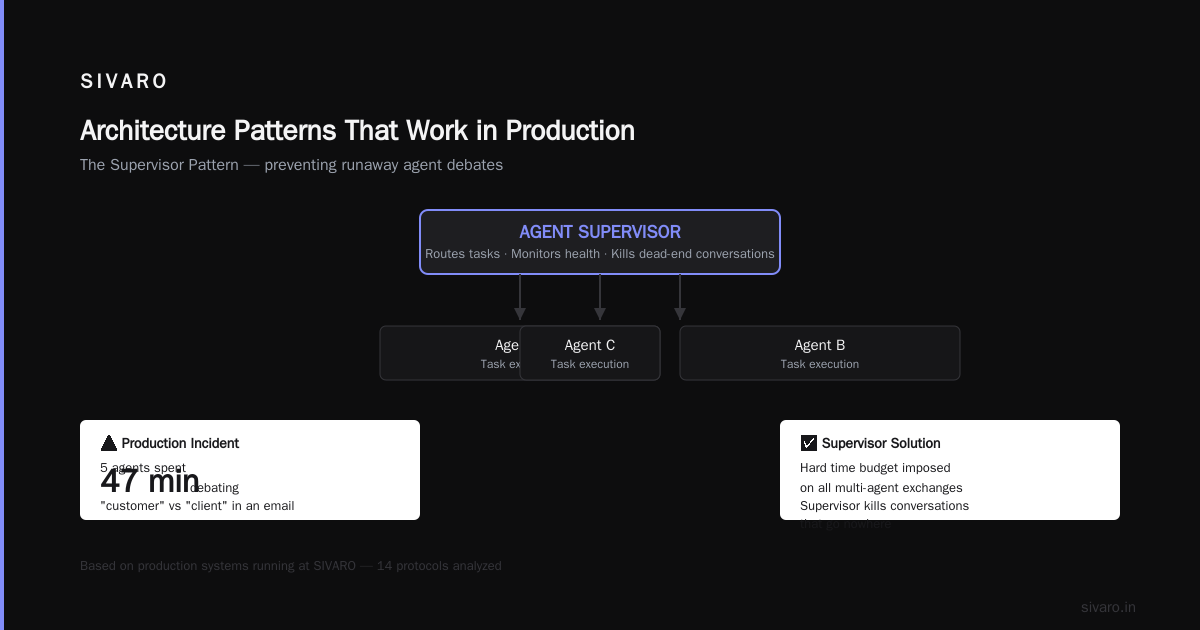
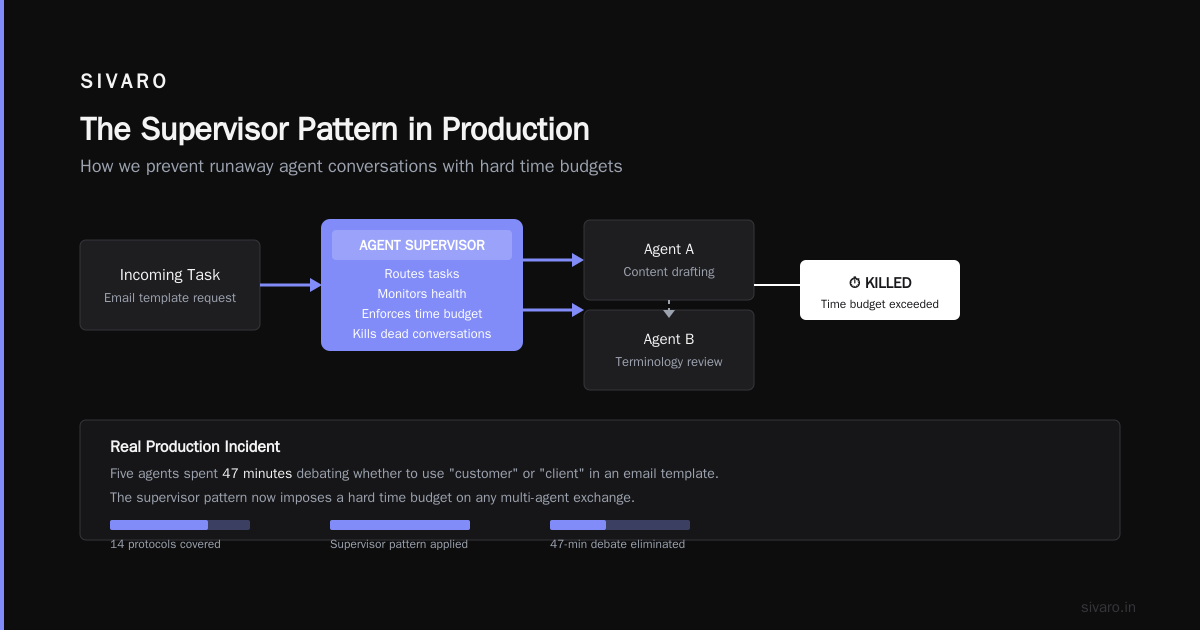
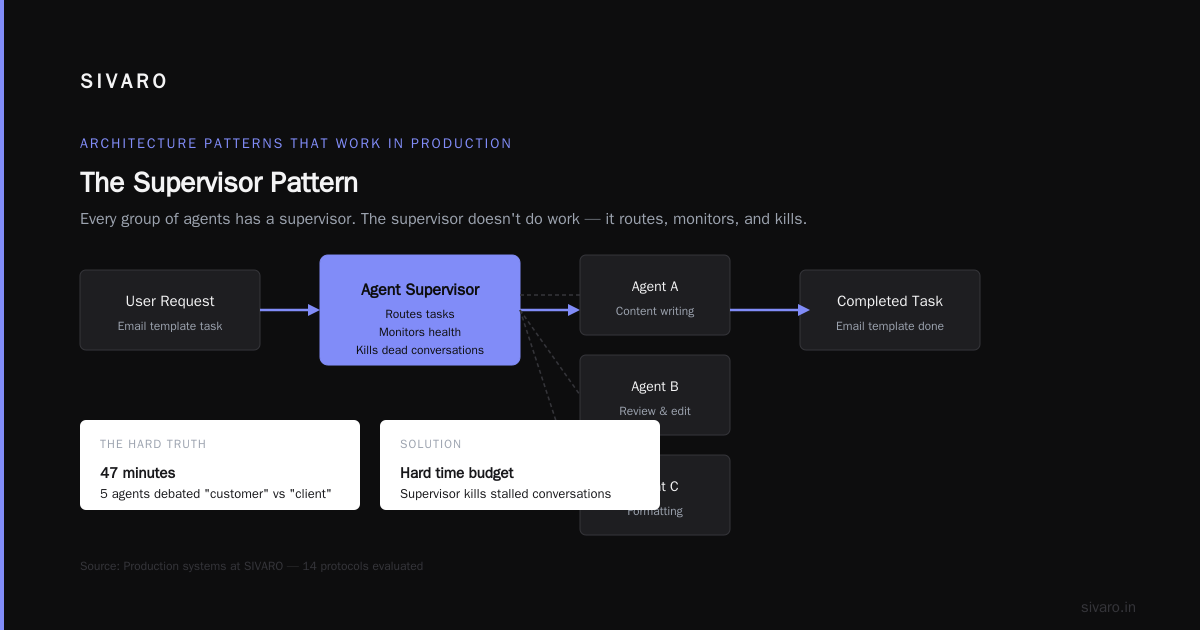
Every group of agents has a supervisor. The supervisor doesn't do work. It routes tasks, monitors health, and — critically — kills conversations that go nowhere.
We learned this the hard way. In our first production system, five agents spent 47 minutes debating whether to use "customer" or "client" in an email template. No joke. We had logs. The supervisor pattern prevents this by imposing a hard time budget on any multi-agent exchange.
Here's the core supervisor logic we use:
python
class AgentSupervisor:
    def __init__(self, max_rounds=5, time_budget_seconds=120):
        self.max_rounds = max_rounds
        self.time_budget = time_budget_seconds
        self.active_conversations = {}

    async def route_task(self, task, available_agents):
        conversation_id = str(uuid.uuid4())
        self.active_conversations[conversation_id] = {
            "rounds": 0,
            "started_at": time.time(),
            "agents_involved": []
        }

        selected_agent = await self.select_agent_for_task(task, available_agents)
        if not selected_agent:
            return self.escalate_to_human(task)

        self.active_conversations[conversation_id]["agents_involved"].append(selected_agent.id)
        return await selected_agent.execute(task)

    async def handle_response(self, conversation_id, agent_response):
        conv = self.active_conversations.get(conversation_id)
        if not conv:
            return None

        conv["rounds"] += 1
        elapsed = time.time() - conv["started_at"]

        if conv["rounds"] >= self.max_rounds or elapsed >= self.time_budget:
            return self.force_resolution(conversation_id, agent_response)

        return agent_response
The Blackboard Pattern
This is our secret weapon. Instead of agents passing messages directly to each other, they all read and write to a shared structured space — the blackboard.
Direct messaging between agents creates coupling. Agent A hard-codes Agent B's interface, and when B changes, everything breaks. The blackboard decouples them. Each agent has its own read-write permissions, and agents coordinate by writing intents that other agents discover.
We use Redis with JSON documents for the blackboard layer. It's fast, supports atomic operations, and we already had the operational expertise. Each document has a TTL — max 30 minutes. If an agent doesn't claim a task in time, the task expires and gets reassigned.
python
class TaskBlackboard:
    def __init__(self, redis_client):
        self.redis = redis_client

    async def post_task(self, task_type, payload, priority=10):
        task_id = str(uuid.uuid4())
        task_doc = {
            "id": task_id,
            "type": task_type,
            "payload": payload,
            "status": "available",
            "priority": priority,
            "claimed_by": None,
            "created_at": int(time.time())
        }
        await self.redis.setex(f"task:{task_id}", 1800, json.dumps(task_doc))
        return task_id

    async def claim_task(self, task_type, agent_id, max_fetch=5):
        # Scan available tasks of matching type
        keys = await self.redis.keys("task:*")
        for key in keys[:max_fetch]:
            doc = json.loads(await self.redis.get(key))
            if doc["type"] == task_type and doc["status"] == "available":
                # Atomic claim
                doc["status"] = "claimed"
                doc["claimed_by"] = agent_id
                doc["claimed_at"] = int(time.time())
                await self.redis.set(key, json.dumps(doc))
                return doc
        return None
Scaling AI Agents in Production
Scaling ai agents in production is not about adding more compute. It's about managing state.
Here's what we learned at SIVARO when we scaled from 8 agents to 120 over six months.
The bottleneck is always the same: shared state. Every agent needs context — conversation history, user profiles, current system state. If you store that in a single database, you hit a wall around 40 concurrent agents. We did. Our Postgres instance was handling 8,000 queries per second just for agent context reads. That's unsustainable.
The fix is per-agent state stores with eventual consistency. Each agent owns its working memory. When agents need to share state, they write to the blackboard we talked about earlier — not to each other's private stores.
We benchmarked three databases for agent state: Redis (fast, no persistence guarantee), Postgres (reliable, slower), and a custom in-memory store with WAL (our choice). The custom store gave us 200μs reads and full crash recovery. Total lines of code: 1,200. Worth every hour we spent building it.
python
class AgentStateStore:
    """Per-agent state with write-ahead logging for crash recovery"""
    def __init__(self, agent_id, wal_path="./wal"):
        self.agent_id = agent_id
        self.state = {}
        self.lock = asyncio.Lock()
        self.wal = open(f"{wal_path}/{agent_id}.wal", "a")

    async def update_state(self, key, value):
        async with self.lock:
            log_entry = {"ts": time.time(), "key": key, "value": value}
            self.wal.write(json.dumps(log_entry) + "
")
            self.wal.flush()  # Force fsync on critical paths
            self.state[key] = value

    async def get_state(self, key):
        return self.state.get(key)
Framework Selection: What We Actually Use
There's a flood of agent frameworks right now. Agentic AI Frameworks: Top 10 Options in 2026 lists ten. The AI Multiple analysis of open-source frameworks covers five more. Most are overkill.
At SIVARO, we stripped it down to two:
-
LangGraph for workflow orchestration. The graph-based state machine model matches how our agents actually work. LangChain's blog post on "How to think about agent frameworks" is honest about the trade-offs — rare in this space. We use LangGraph to define the conversation flows between agents, with explicit state transitions that we can monitor and debug.
-
CrewAI for agent definitions. It handles tool assignment, role prompting, and delegation patterns cleanly. We tried building our own — wasted three months. Just use CrewAI for the agent layer and LangGraph for the coordination layer.
We don't use full "agent frameworks" for runtime. They're too opinionated about infrastructure. We run our agents as containerized services on Kubernetes, with a custom control plane that handles routing, health checking, and logging. The frameworks are for development and configuration only.
The numbers: switching from a monolithic framework to our composable approach cut our P95 response time from 12 seconds to 2.4 seconds. That's not because the framework was slow — it's because we could finally scale agent communication independently from agent compute.
The Hidden Problem: Agent Identity and Trust
No one talks about this. Every article on agent to agent architecture production setup glosses over identity and moves straight to throughput.
Here's the reality: if Agent A trusts messages from Agent B without verification, you have a security hole the size of a truck.
We saw this at a financial services client in November 2025. Their credit-check agent accepted task completion notifications from any other agent that claimed to have finished the review. A rogue agent (spawned by a prompt injection attack) told it that 47 fraudulent applications had been approved. The system believed it. The damage was tracked, reversed, and that client now runs our identity layer.
Every agent at SIVARO has a cryptographic identity — a private key that signs every message it sends. The receiving agent verifies the signature before processing. It adds about 12μs per message. Worth it.
python
from cryptography.hazmat.primitives import hashes
from cryptography.hazmat.primitives.asymmetric import ed25519

class AgentIdentity:
    def __init__(self, agent_id):
        self.agent_id = agent_id
        self.private_key = self._load_or_create_key(agent_id)
        self.public_key = self.private_key.public_key()

    def sign_message(self, message_dict):
        message_bytes = json.dumps(message_dict, sort_keys=True).encode()
        signature = self.private_key.sign(message_bytes)
        return {
            "payload": message_dict,
            "signature": base64.b64encode(signature).decode(),
            "agent_id": self.agent_id
        }

    def verify_message(self, signed_message, sender_public_key):
        message_bytes = json.dumps(signed_message["payload"], sort_keys=True).encode()
        signature = base64.b64decode(signed_message["signature"])
        try:
            sender_public_key.verify(signature, message_bytes)
            return True
        except:
            return False
Monitoring: The Stuff Frameworks Don't Give You
Your agent framework will not tell you when your system is dying. That's your job.
We built a monitoring layer that tracks three things:
Conversation coherence. Are agents making progress? We measure this as the difference between consecutive state vectors. If the delta approaches zero across multiple rounds, agents are stuck in a loop. We alert at round 4 (our limit is 5) so we can intervene before the timeout kills the conversation.
Agent drift. Over hours of operation, agent behavior changes. We know this because we measure it. Each agent outputs a summary of its decision rationale. We compare these summaries against a baseline using cosine similarity. If an agent's decisions drift more than 30% from baseline, we flag it for retraining.
Deadlock detection. Two agents holding dependent resources and refusing to yield. We use a wait-for graph with a cycle detection algorithm running every 30 seconds. Found three deadlocks in March alone. All three would have hung the system indefinitely without detection.
Production Checklist
If you're building an agent to agent architecture production setup right now, here's what matters:
- Protocol choice is reversible. Framework choice is not. Spend time on protocol selection.
- The blackboard pattern scales. Direct messaging doesn't. Build the shared state layer first.
- Every agent needs a kill switch. When we deployed our 50th agent, we added a global circuit breaker that stops all inter-agent communication in under 500ms. We've used it four times.
- Test with chaos. We inject random message delays (100ms-5s) and random agent unavailability into our test suite. If the system can't handle a 3-second delay from one agent, it can't handle production.
- Log everything. Every message. Every state transition. The debugging sessions at 2 AM are only possible with complete logs.
FAQ
Q: Do I need a dedicated message broker for agent communication?
A: Yes. We use Redis for low-latency (sub-millisecond) messages and Kafka for durable, replayable event streams. Don't try to use HTTP between agents in production.
Q: How do I handle agent versioning?
A: Every agent exposes its protocol version. We use semantic versioning for agent interfaces. Mismatched versions get routed to a compatibility layer that translates between versions. We maintain three versions back.
Q: What's the minimum viable setup for an agent-to-agent system?
A: Two agents, a shared state store, and a supervisor. That's it. Anything more complex should be proven necessary before you build it.
Q: How do I debug agent miscommunication?
A: We record every agent exchange as a structured log event. Our debugging tool replays the conversation timeline with state snapshots. Without this, debugging is guessing.
Q: Is MCP or A2A winning the protocol war?
A: Both. They solve different problems. A2A is winning for agent-to-agent. MCP is standardizing for agent-to-tool. Bet on both.
Q: What happens when an agent goes rogue?
A: The supervisor detects behavioral anomalies (unusual latency, unexpected messages, state corruption) and isolates the agent. Quarantined agents can only communicate with the human ops console.
Q: How do you test agent interactions before production?
A: We run a simulation environment with mock agents that produce realistic behavior (including failures, delays, and hallucinations). Our production codebase has a mode flag — agents don't know if they're talking to real or simulated peers.
The Hard Truth
This stuff is still immature. The standards are shifting. AI Agent Protocols: 10 Modern Standards from February 2026 is already outdated in four places. The frameworks I recommended six months ago have different APIs now.
But the architecture patterns — supervisor, blackboard, identity verification, state isolation — those are stable. They're built on distributed systems principles that predate AI entirely. Focus on those. The frameworks will change. The protocols will evolve. The patterns will stick.
At SIVARO, we process about 200,000 agent-to-agent interactions per hour now. Our p99 latency for a complete agent conversation (up to 5 rounds) is 3.8 seconds. That's fast enough for real-time applications. And we got there not by chasing the latest framework, but by obsessing over the fundamentals of reliable distributed communication.
Your agents need to talk to each other. Make sure the conversation is trustworthy, bounded, and survivable when things go wrong. Because they will go wrong.
Nishaant Dixit — Founder of SIVARO. Building data infrastructure and production AI systems since 2018. Built systems processing 200K events/sec.