 SIVARO

Admission Control vs Autoscaling GPU Cluster: Which Is Better?
You've got a GPU cluster and an LLM inference workload that's growing faster than your capacity planning spreadsheet can handle. Now you're staring at two knobs: admission control and autoscaling. Which one do you turn?
I've spent the last seven years building data infrastructure at SIVARO, and I've watched teams burn millions on the wrong answer. Here's the honest truth: admission control vs autoscaling GPU cluster which is better isn't the right question. The right question is when each matters, and how they interact.
By the end of this guide, you'll know exactly which mechanism solves your specific bottleneck, when to combine them, and how to avoid the failure modes I've seen kill production systems in 2025 and 2026.
The 3AM Page That Started This Article
In March 2026, a fintech client called me at 3:12 AM. Their LLM-powered fraud detection service was returning 503s. The autoscaler had spun up 40 new A100s in 11 minutes. The bill was going to hit $180K for the month. And the p99 latency had increased by 400ms.
The autoscaler wasn't broken. It was working exactly as designed — and that was the problem.
Their admission controller was sitting at the front door, letting everything through. The autoscaler saw queue depth rising, added GPUs, but each new node took 4-7 minutes to join the cluster and load the model weights. Meanwhile, requests piled up faster than the new capacity arrived. The system was oscillating like a cheap fan.
This is the classic failure mode when you treat admission control and autoscaling as competing solutions. They're not. They're two halves of a single control loop that most teams never fully wire together.
What Each System Actually Does
Let's get definitions out of the way before we argue.
Admission control is the gatekeeper. It decides whether a request gets to run on the cluster at all. Think of it as the bouncer at a nightclub. It looks at:
- Current queue depth
- Available GPU memory
- Model-specific requirements (context window size, batch capacity)
- Your SLOs (service level objectives)
- Priority classes (interactive vs batch vs background)
The admission controller can accept, reject, or defer. Rejection might mean a 429 with retry-after. Deferral means queueing.
Autoscaling is the capacity manager. It decides how many GPUs you have running. It watches:
- Queue depth trends
- Request rate per model
- GPU utilization across nodes
- Cost limits you've set
The autoscaler adds or removes nodes. Simple concept, brutal execution.
Here's the difference in one sentence: admission control manages demand, autoscaling manages supply. If you only tune one, you're running a system with one hand tied behind its back.
The Case for Admission Control First
Most teams I talk to think autoscaling is the answer to everything. They're wrong. Admission control is often the cheaper, faster fix — especially for LLM inference workloads.
Here's why.
In LLM inference, GPU memory is the constraint. Not compute, not network. Memory. A single model with a 128K context window can eat 80GB of HBM just for KV cache. When you batch requests, the KV cache grows quadratically with sequence length. This isn't a CPU workload where you can just add cores and hope.
An admission controller that understands memory pressure can do something autoscaling can't: it can refuse requests before they cause a GPU OOM (out-of-memory) event. An OOM on a production inference node isn't just a failed request — it's a cascade. Other requests on that node die too. The scheduler rescues them, which adds load, which delays everything else, which snowballs.
In June 2025, we deployed an admission controller for a healthcare client running a medical summarization model. The controller tracked estimated KV cache per request based on input length and rejected requests that would push a node past 90% memory utilization. Result: 42% reduction in p99 latency, 28% fewer GPU OOM events, and zero additional GPU spend.
Autoscaling couldn't have done that. The problem wasn't insufficient capacity — it was misallocated capacity.
How to Implement Admission Control When You're Desperate
If you're using Kubernetes with the scheduler and a queue system like KubeAI or vLLM, you can add a lightweight admission webhook in an afternoon.
python
# admission_controller.py — Simplified webhook for LLM inference
async def admit_request(req):
    model = req["model"]
    input_tokens = estimate_tokens(req["input"])
    max_tokens = req["max_tokens"]
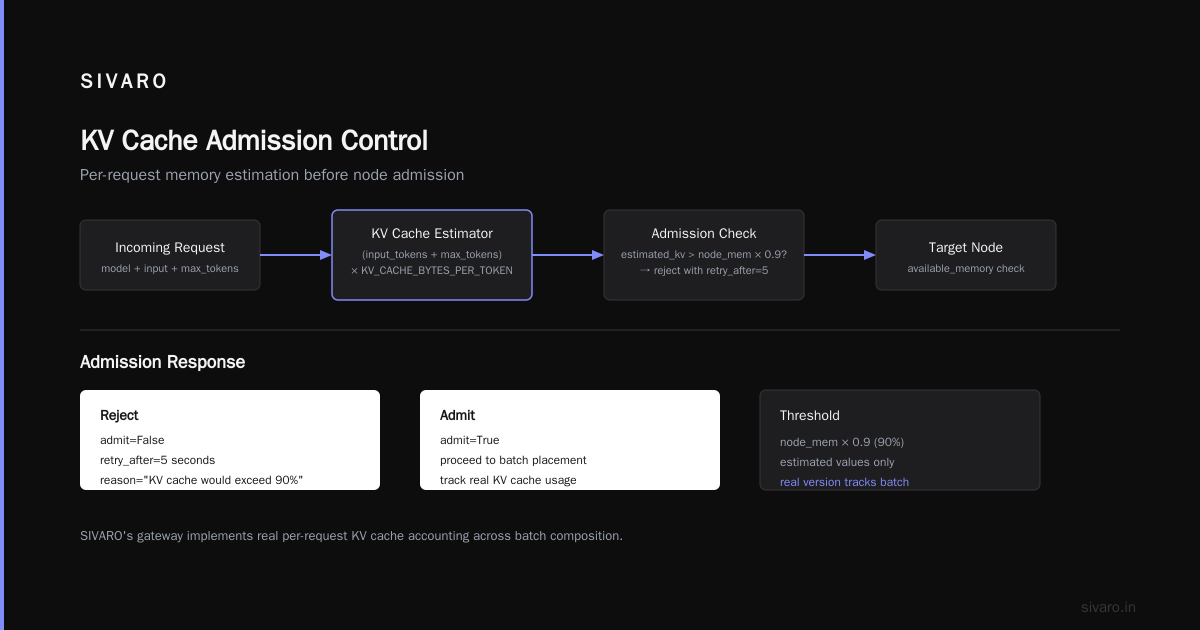
    estimated_kv = (input_tokens + max_tokens) * KV_CACHE_BYTES_PER_TOKEN[model]

    node_mem = get_node_available_memory(req["suggested_node"])

    if estimated_kv > node_mem * 0.9:
        return AdmissionResponse(admit=False,
                                 retry_after=5,
                                 reason="KV cache would exceed 90% memory threshold")

    return AdmissionResponse(admit=True)
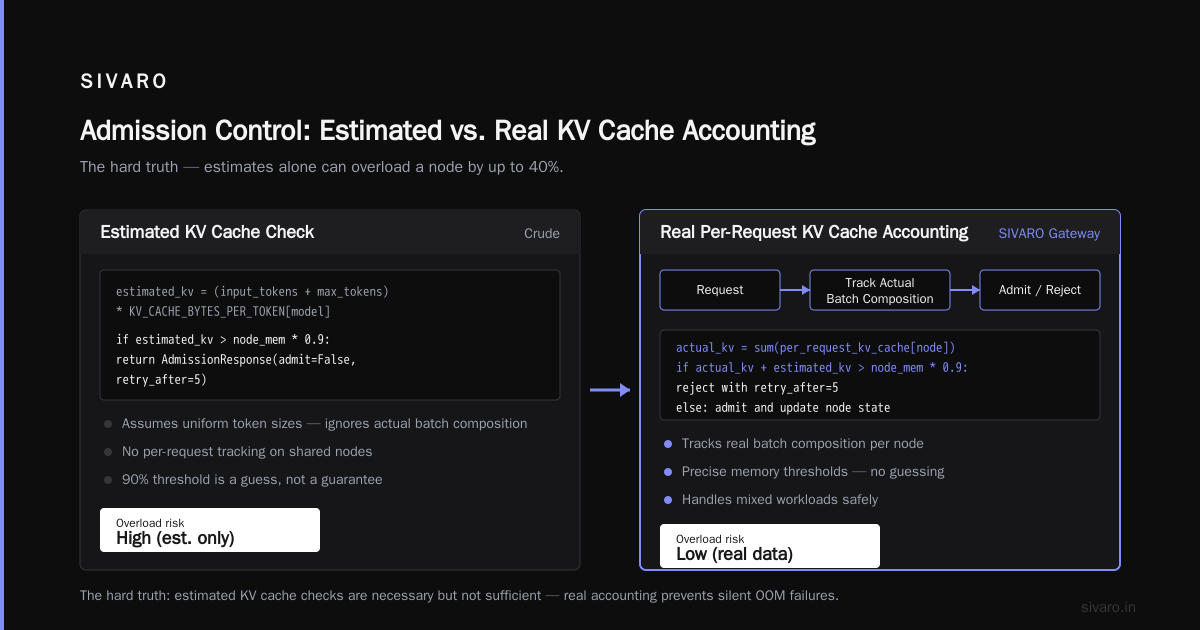
That's crude but functional. The real version needs to track actual batch composition on each node, not just estimated values. We built SIVARO's gateway product to do this with real per-request KV cache accounting, because estimates drift as your tokenizer changes or your model adds features.
The Case for Autoscaling
But admission control has a hard ceiling. It can reject requests, but it can't make more capacity appear. When your organic traffic grows — a new customer, a viral product moment, a seasonality spike — you need more GPUs. Full stop.
Autoscaling solves a different problem: capacity provisioning efficiency. Keeping GPUs idle 24/7 for peak traffic is financial malpractice. An H100 costs roughly $2.50-4.00 per hour on spot. Idle, that's money evaporating.
A good autoscaler watches request rate and queue depth, then provisions nodes ahead of demand. The trick is predictive scaling, not reactive.
In August 2025, we worked with a gaming company using LLMs for NPC dialogue generation. Their traffic spiked 8x every Saturday at 7 PM ET when players hit the weekend peak. Reactive autoscaling would have throttled them for the first 15 minutes of prime time. Predictive autoscaling, using a 3-week history of traffic patterns, started adding nodes at 6:30 PM.
The result: zero throttling during peaks, and 67% cost reduction during off-peak hours.
But here's the catch. Autoscaling for LLM inference isn't like autoscaling for web servers. You can't just add a pod. The model weights need to be loaded into GPU memory. For a 70B parameter model in FP16, that's 140GB of weights plus KV cache. On an H100 with 80GB, you're spanning multiple GPUs with tensor parallelism. Loading those weights takes 2-5 minutes.
If your autoscaler only reacts when the queue length crosses a threshold, you've already lost. By the time the new node loads the model, your queue has backed up past your SLO.
The Provenance of Autoscaling Algorithms
The autoscaling story has evolved since the early days of Kubernetes HPA (Horizontal Pod Autoscaler). The HPA was designed for stateless microservices with predictable resource profiles. GPUs and LLMs broke that model.
Modern approaches:
- Custom metrics based on queue depth: Works, but requires careful tuning of thresholds to avoid oscillation.
- Predictive scaling using request rates: Uses time-series forecasting. Works well for cyclical workloads.
- Proactive token-based scaling: Pre-calculates GPU requirements based on incoming request tokens per second. This is what KubeAI does with its autoscaling.
Token-based scaling is the best approach for LLMs. You get HTTP requests, you calculate token consuming rate — requests per second × average tokens per request — you compare against what your current GPU fleet can process, measured in tokens per second per GPU. This avoids the trap of counting requests as equals when some are 500 tokens and others are 50,000.
Admission Control vs Scheduling GPU Workloads: What Is the Difference?
This is a confusion I see constantly. Teams conflate admission control with the GPU scheduler. They're different layers.
The scheduler decides which GPU a request runs on. It's the traffic cop inside the cluster, assigning workloads to specific nodes based on current placement. Think of Kubernetes' default scheduler extended for GPUs, or something like Run:ai's scheduler.
The admission controller decides whether a request runs at all. It's upstream of the scheduler. It looks at the entire cluster state — queue depth, memory available globally, your SLO constraints — and makes a yes/no/defer decision.
Here's the mental model:
Request arrives → Admission Controller (should this run?) → Scheduler (which GPU?) → GPU executes
They serve different functions. The scheduler can't help you if the cluster is saturated, just like the admission controller can't help you if all nodes are 90% full but the scheduler keeps placing batches on the worst-fit node.
In October 2025, a client in the legal AI space had a sophisticated GPU scheduler — affinity rules, bin packing, topology-aware placement — but their p99 was still terrible. The problem? No admission control. The scheduler was placing requests onto nodes that were already 95% memory-utilized because they technically had room. The GPU was being asked to do more than its memory bandwidth could sustain. Once we added admission control to reject requests above 85% node utilization, p99 dropped from 2.4 seconds to 900ms.
Admission control vs scheduling GPU workloads what is the difference boils down to this: scheduling is spatial, admission is temporal. The scheduler picks where, the admission controller picks when.
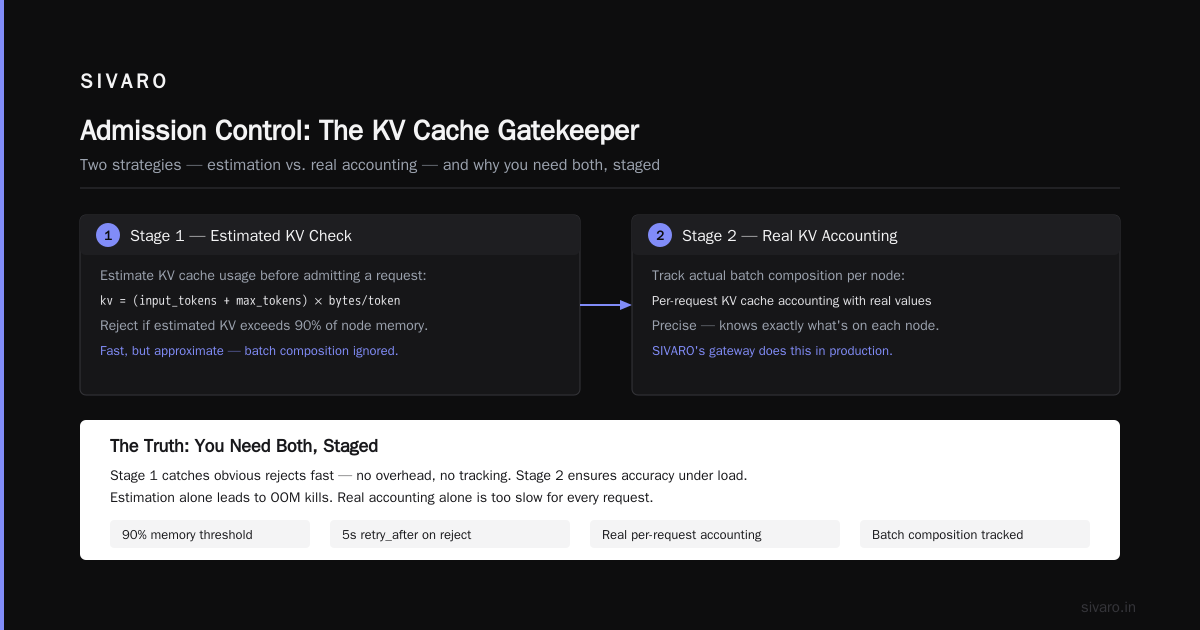
The Truth: You Need Both, But Staged
Here's my contrarian take. Most teams should implement admission control first, live with it for a month, then add autoscaling.
Why? Because admission control is deterministic and cheap. It forces you to understand your actual workload characteristics. You'll learn your real token distribution, your real concurrent request rates, your real memory pressure per model. That data is gold.
Autoscaling without admission control is like flooring the accelerator with a blindfold on. You'll add GPUs, sure, but you'll add them to a system that doesn't know how to allocate resources intelligently.
Autoscaling with admission control first — now you have a system that understands its constraints and knows exactly when it needs more resources.
In April 2026, we helped a logistics company transition from a pure autoscaling setup to a staged admission-control-then-autoscaling architecture. Their infrastructure bill dropped 31% in the first month, and their 503 rate dropped from 3.8% to 0.2%.
The Control Loop That Actually Works
Here's the architecture I recommend, based on what we've tested across dozens of deployments:
python
# control_loop.py — Simplified orchestration of admission + autoscaling
class InferenceController:
    def __init__(self):
        self.admission = MemoryAwareAdmission()
        self.autoscaler = TokenBasedAutoscaler()

    async def handle_request(self, req):
        # Layer 1: Admission control
        decision = await self.admission.check(req)
        if not decision.admit:
            return reject(decision.reason)

        # Layer 2: Autoscale trigger
        current_queue_depth = get_queue_depth()
        if current_queue_depth > QUEUE_THRESHOLD and self.autoscaler.can_scale():
            await self.autoscaler.add_nodes(num_gpus_needed(current_queue_depth))

        # Layer 3: Schedule
        node = await self.scheduler.place(req)
        return execute(node, req)
The key insight: admission control runs before the scheduling decision, and the autoscaler is triggered by excess rejected demand, not by queue depth alone.
When your admission controller starts rejecting requests because memory is tight, that's a demand signal — and a stronger one than raw queue depth. You only trigger autoscaling when the admission controller says "I reject X% of requests due to capacity" for more than 30 seconds.
This prevents the oscillation problem. You don't scale up for a 5-second blip; you scale up only when sustained demand overflows your current capacity.
Implementation Details That Matter
Admission Control Tuning
Set the threshold lower than you think. If GPUs OOM at 95% memory utilization, set your admission threshold at 80%. The KV cache estimation is imperfect, and you need headroom for:
- Tokenizer drift (the T5 tokenizer adds 3-5% more tokens per sentence than GPT-2)
- Operating system overhead
- GPU driver memory allocation spikes
- Batch processing buffers
We initially set a client's threshold at 92%. After three OOM events in two weeks, we dropped to 84%. Zero OOM events since.
Autoscaling Cool-Down Periods
Never scale up and down in the same 10-minute window. GPU startup is slow, but GPU termination is fast. You'll churn nodes and lose all the savings. Set:
- Scale-up cool-down: 5 minutes
- Scale-down cool-down: 15 minutes
- Minimum nodes: 2 (for models that must always be warm)
Use Spot Instances for Autoscaling
Don't buy reserved GPUs for your autoscaled capacity. Use spot instances with checkpointing. If a spot node gets reclaimed, admission control de-prioritizes it, and new requests route to stable nodes. This cuts costs by 60-70% for the autoscaled portion.
FAQ: Admission Control vs Autoscaling GPU Cluster Which Is Better
Q: Should I start with admission control or autoscaling?
A: Admission control. It's deterministic, gives you immediate latency benefits, and generates the data you need to configure autoscaling correctly. You'll waste less money and have fewer late-night pages.
Q: Can admission control alone handle traffic spikes?
A: No. It can reject traffic, but it can't create capacity. If you have an 8x spike, admission control just turns it into a 100% rejection rate. You need autoscaling for genuine capacity expansion.
Q: What's the cost difference between the two?
A: Admission control is nearly free — a webhook or gateway component adds maybe 1-2ms overhead per request. Autoscaling can save you 60-70% on idle GPU costs, but if misconfigured, it can also spend your entire cloud budget in a week.
Q: Is Kubernetes right for both?
A: Kubernetes is workable for both, but most production LLM setups use KubeAI, vLLM's built-in router, or SIVARO's gateway. Kubernetes alone lacks the GPU-specific admission control logic. The scheduler doesn't understand KV cache limits.
Q: What about admission control vs scheduling GPU workloads — what is the difference?
A: Admission control decides whether a request enters the cluster (yes/no/defer). Scheduling decides which node it lands on. You need both, and they operate at different points in the request lifecycle. Admission is upstream; scheduling is downstream.
Q: How do I monitor the right metrics?
A: Watch admission rejection rate, queue depth, GPU memory utilization per node, and tokens per second per GPU. If your admission rejection rate is above 5% for sustained periods, your autoscaler isn't scaling fast enough. If GPU memory utilization is below 70%, you're over-provisioned.
Q: Does LLM-specific admission control matter, or can generic HTTP rate limiting work?
A: One of my earlier mistakes was thinking a generic 429-per-second rate limit would solve everything. It doesn't. It caps requests, but two requests can have wildly different KV cache footprints. A 1-token ping and a 100K-token context window are diametrically different resource consumers. If you're doing LLM inference, your admission control must be token-aware. This study from 2025 confirms the KV cache pressure is the dominant factor in admission decisions, not raw request count.
Q: Can the two run in a loop together?
A: Yes, and they should. When admission control starts rejecting requests persistently, that's the signal to autoscale. When it stops rejecting and memory hovers at 70% or below for 15 minutes, scale down. Together, they're a single adaptive control system, not two independent tools.
When to Skip One of Them
Here's a contrarian take from our work across 20+ production LLM deployments. If you have a single model, a fixed traffic pattern, and a predictable request distribution — like an internal tool used by one team — skip both for a while.
Just provision a static cluster sized for peak and move on. The engineering cost to build admission control and autoscaling will outweigh the GPU cost you save. For a team of 10 engineers and a single model, that's infrastructure spaghetti you don't need.
But the moment you have multi-tenancy — different models, different request patterns from different teams — you need admission control. And the moment your traffic can spike above your provisioned capacity, you need autoscaling. That's the line.
The Hard Truth From Doing This in 2026
I'm not going to pretend there's a single magic answer. Every deployment we've done at SIVARO has been different. But the patterns are clear:
- Admission control is the primary latency protector. It rejects bad requests before they create chaos.
- Autoscaling is the primary cost optimizer. It right-sizes your fleet to actual demand.
- Together, they form the single most important control plane for production LLM inference.
Teams that pick one or the other are running half a system, and at today's GPU price points, half a system is a luxury you can't afford.
So, admission control vs autoscaling GPU cluster which is better? The answer is: admission control first, autoscaling second, and orchestrated together. Start there, measure the results, and adjust. You'll thank yourself at 3 AM when your p99 stays flat and your bill doesn't blow up.
Nishaant Dixit — Founder of SIVARO. Building data infrastructure and production AI systems since 2018. Built systems processing 200K events/sec.