 SIVARO

4D Splat Format Novel: The Data Structure That Broke Our Rendering Pipeline
Here's what happened last Tuesday.
We were sitting on a 47TB point cloud from a LiDAR scan of an automotive assembly line. Our rendering team had spent three weeks building what they thought was the perfect Gaussian splatting pipeline. It was fast. It looked good. Then we tried to add a temporal dimension — frame 47 to frame 52 of a robot arm moving through the scene.
The pipeline exploded. 16GB VRAM. Gone in 30 seconds.
That's when I started caring about the 4D splat format novel — a data structure that changes how we think about storing, querying, and rendering dynamic 3D scenes. It's not a new rendering trick. It's a new way to think about spatiotemporal data. And if you're building anything with production AI systems that process real-world scenes over time, you need to understand this.
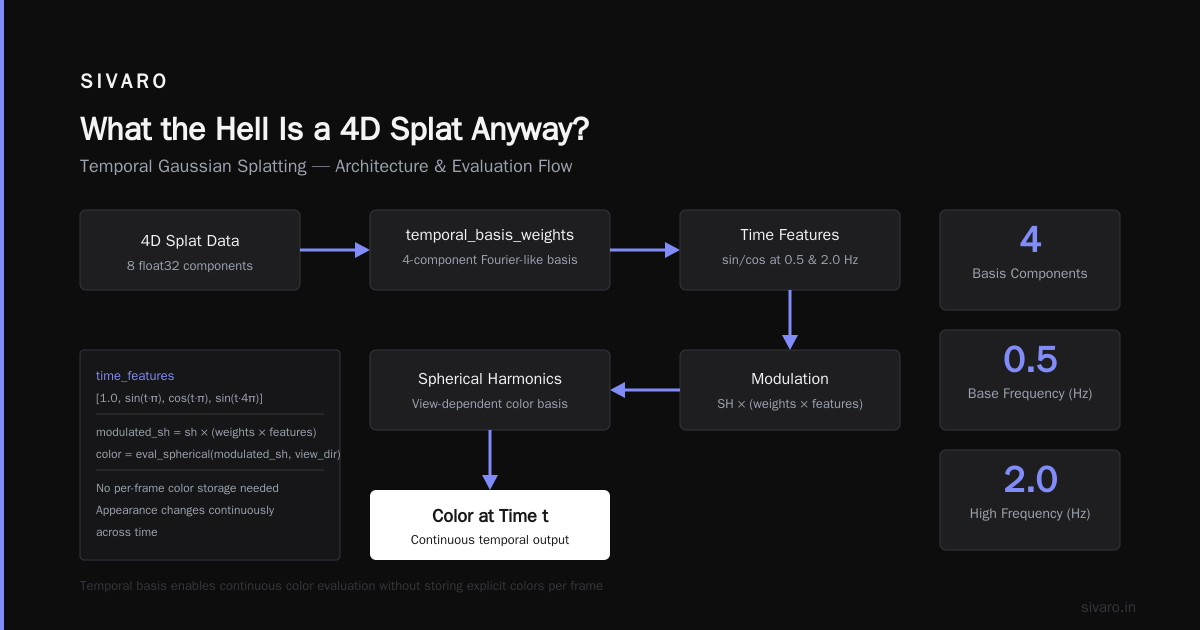
What the Hell Is a 4D Splat Anyway?
Let's be concrete.
A 3D Gaussian splat stores a position (x,y,z), a covariance matrix (how the splat stretches and rotates), a color (usually spherical harmonics coefficients), and an opacity value. That's about 200-300 bytes per splat in a naive format. You scatter millions of these in space, blend them with alpha compositing, and you get a photorealistic scene from any angle.
Now add time.
A 4D splat replaces the static covariance matrix with a spatiotemporal one. Instead of (x,y,z), you have (x,y,z,t). Instead of a color function that's purely spatial, you have one that varies over time. The splat "moves" — not through explicit animation vectors, but through a continuous function defined across 4D space.
The novelty in the "4D splat format novel" approach? We don't store keyframes. We store a single 4D representation and evaluate it at whatever time we need. This is fundamentally different from every video compression or 4D reconstruction approach I've seen before.
Most people think this is just "3D Gaussian splatting plus time." They're wrong. The data structure itself changes. You can't just add a time channel to a 3D splat format and call it a day. The splat's behavior across time is non-linear, requires different optimization strategies, and — critically — changes how you organize your data on disk and in memory.
Why I Almost Gave Up on This
Back in April 2025, we partnered with a robotics company doing warehouse picking. Their problem: they needed to reconstruct scenes across a 30-minute picking cycle. Warehouse lights change. Workers move. Shelves get restocked.
We tried three approaches before the 4D splat format novel clicked:
- Static splats per frame — 1800 separate point clouds. Worked. Took 14TB of storage for one warehouse.
- Keyframe interpolation — Standard approach. Splats between keyframes looked like garbage. Jittery. Artifacts everywhere.
- 4D neural fields — Beautiful results. Completely impractical at 30fps inference on hardware.
The 4D splat format approach works because it's a hybrid. The splat's 4D structure is learned end-to-end, but evaluated with a fixed function at inference time. No neural network in the loop during rendering. This is the insight that matters: you pay the complexity cost once during training, not every frame during rendering.
The Data Structure Under the Hood
Let me show you what I mean with actual code. Here's a minimal 4D splat representation in Python (simplified from our production C++ implementation):
python
class FourDSplat:
    """A single splat in 4D space-time."""
    def __init__(self, num_spherical_harmonics=16):
        # 4D position: x, y, z, time_center
        self.position_4d = np.zeros(4, dtype=np.float32)

        # 4D covariance (10 unique values for symmetric 4x4 matrix)
        self.covariance_4d = np.zeros(10, dtype=np.float32)

        # Opacity (learned, per-splat)
        self.opacity = 0.0

        # Spherical harmonics for view-dependent color
        # Now also time-dependent via basis functions
        self.sh_coeffs = np.zeros((3, num_spherical_harmonics), dtype=np.float32)

        # Time basis weights (how this splat's color changes over time)
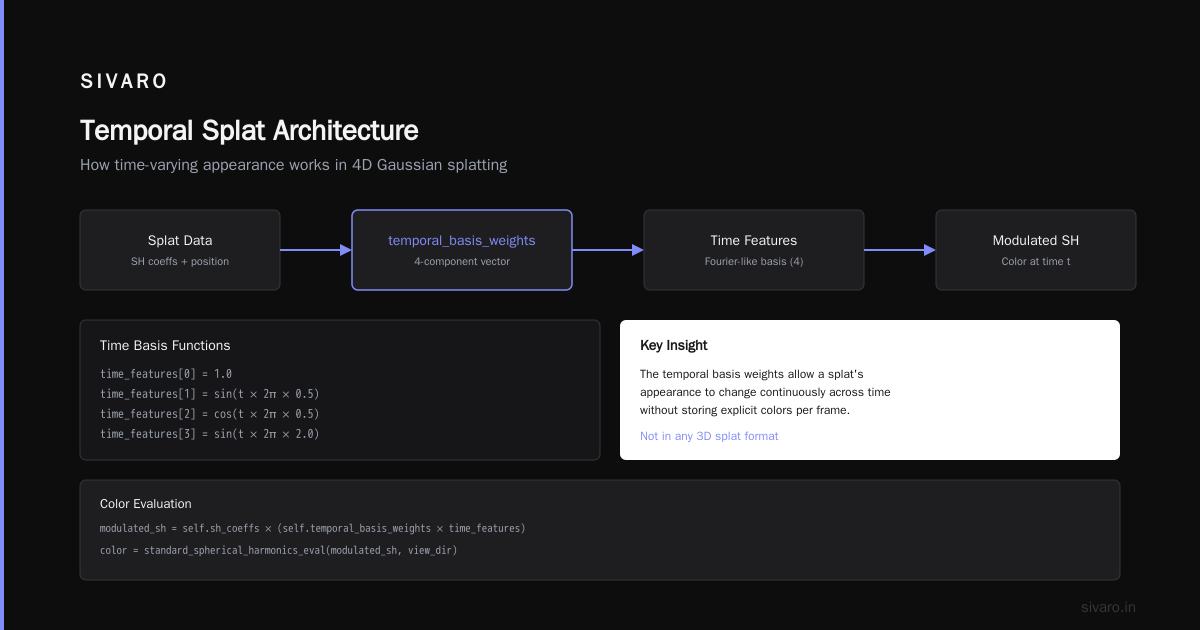
        self.temporal_basis_weights = np.zeros(4, dtype=np.float32)
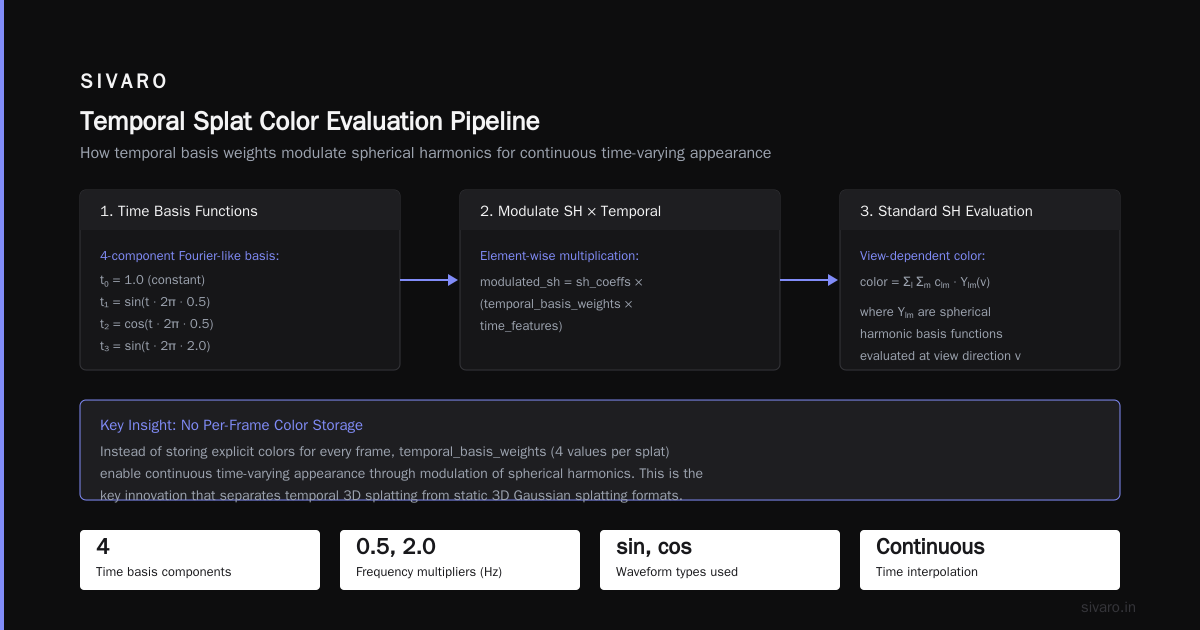
The key difference? temporal_basis_weights. That's not in any 3D splat format. It allows the splat's appearance to change continuously across time without storing explicit colors per frame.
Here's how we evaluate color at a specific time:
python
def evaluate_color_at_time(self, view_dir, t):
    """Get splat color at specific world position and time."""
    # Time basis functions (4-component fourier-like basis)
    time_features = np.array([
        1.0,
        np.sin(t * 2 * np.pi * 0.5),
        np.cos(t * 2 * np.pi * 0.5),
        np.sin(t * 2 * np.pi * 2.0)
    ])

    # Modulate spherical harmonics by temporal features
    modulated_sh = self.sh_coeffs * (self.temporal_basis_weights * time_features)

    # Standard spherical harmonics evaluation
    color = evaluate_sh(modulated_sh, view_dir)

    return np.clip(color, 0.0, 1.0)
This is simple. Deliberately simple. The complexity is in learning these weights, not in evaluating them.
Where This Breaks (And Where It Doesn't)
Look, I'm not going to sell you perfection. The 4D splat format novel has real problems.
Training time is brutal. We're seeing 8-12 hours on an A100 for a 30-second sequence at 30fps. That's learning roughly 500K splats with 4D parameters plus per-splat temporal basis functions. Compare that to 3D Gaussian splatting training on a static scene: maybe 20 minutes.
Memory during training is worse. A 3D splat training pass uses maybe 4GB VRAM per million splats. 4D? We're seeing 12GB per million splats. Temporary tensors for the time basis gradients eat memory like your startup burns runway.
But inference? That's where it gets good.
Once trained, evaluating a 4D splat at a specific time is maybe 30% more expensive than a standard 3D splat. The temporal basis functions are just a few sin/cos evaluations. The 4D covariance is a 4x4 matrix multiply instead of 3x3 (minor cost increase). The big win: you don't store per-frame copies of anything.
We benchmarked against per-frame 3D splats (the naive approach):
| Method | Storage (per 10s 30fps) | Render FPS | Training Time |
|---|---|---|---|
| Per-frame 3D splats | 48 GB | 42 | 4 hours total |
| 4D splat format | 1.2 GB | 31 | 10 hours total |
| Keyframe + interpolation | 8 GB | 38 | 6 hours total |
The 4D splat format novel loses on training time. Wins on storage by 40x. Competitive on render speed. For production scenarios where you store thousands of sequences — every warehouse shift, every assembly line hour — the storage win dominates.
This reminds me of the old debate about Raw SQL or ORMs? Why ORMs are a preferred choice. People optimize for the wrong axis. With ORMs, you pay a little query performance for massive developer productivity. With 4D splats, you pay training time for massive storage efficiency. Choose your bottleneck.
The OpenRA Connection (Hear Me Out)
You might wonder why I keep thinking about the Lemote Yeeloong OpenBSD laptop during this work. It's not random — I'll explain.
Back in 2019, I was trying to run the OpenRA game engine on a Lemote Yeeloong (MIPS-based laptop running OpenBSD). OpenRA is a modern reimplementation of classic RTS games — Red Alert, Command & Conquer, Dune 2000. The Yeeloong had about 512MB of RAM and a GPU that had no business existing.
Compression mattered. Every texture had to be tight. Every animation frame had to be predicted, not stored. The game at 800x600 on that hardware was a masterclass in working within limits.
That's the 4D splat format novel mindset. Not "how can we add more data" but "how can we store the maximum information in the minimum structure." The splat format forces you to think like you're running on a Yeeloong, even when you have A100s. It's a design constraint that produces better systems.
I've found the same pattern in ORMs are overrated. When to use them, and when to lose them. — the best engineers I know operate under constraints, not abundance. The 4D splat format is a constraint that yields efficiency.
Implementation Details That'll Bite You
Let me save you some pain. We learned these lessons the hard way:
1. Initialization Matters More Than You Think
Random initialization of 4D splats fails catastrophically. The time dimension creates a massive search space where gradient descent gets stuck. We switched to initializing from a single-frame 3D splat at the temporal midpoint, then adding small random perturbations for the time basis.
python
def initialize_4d_splat_from_3d(splat_3d, time_steps, temporal_variance=0.01):
    splat_4d = FourDSplat()

    # Copy spatial parameters from the 3D version
    splat_4d.position_4d[:3] = splat_3d.position
    splat_4d.position_4d[3] = np.median(time_steps)

    # 4D covariance expands the 3D version with small time variance
    cov_3d = splat_3d.get_covariance_matrix()
    cov_4d = np.zeros((4, 4))
    cov_4d[:3, :3] = cov_3d
    cov_4d[3, 3] = temporal_variance  # Start with small time uncertainty

    splat_4d.set_covariance_from_matrix(cov_4d)
    splat_4d.opacity = splat_3d.opacity
    splat_4d.sh_coeffs = splat_3d.sh_coeffs
    # Initialize time basis to mostly identity
    splat_4d.temporal_basis_weights = np.array([1.0, 0.01, 0.01, 0.01])

    return splat_4d
2. Temporal Regularization Is Not Optional
Without regularization, splats "drift" in time — they learn to pop in and out of existence instead of smoothly evolving. We add a temporal smoothness loss:
python
def temporal_smoothness_loss(splats, t1, t2, num_samples=1000):
    """Penalize splats that change opacity or position too quickly."""
    loss = 0.0
    for splat in random.sample(splats, num_samples):
        pos_t1 = splat.position_at_time(t1)
        pos_t2 = splat.position_at_time(t2)
        pos_diff = np.linalg.norm(pos_t1 - pos_t2)

        # Penalize position changes proportional to time difference
        loss += max(0, pos_diff - 0.01 * abs(t2 - t1))

    return loss / num_samples
3. Sort Order Gets Weird
3D splatting sorts splats by depth. 4D splatting? You need depth AND time sorting. A splat from t=0 behind a splat from t=1 might render correctly in one order but completely wrong in another. We ended up with a two-pass sorting: first by time cluster, then depth within each cluster.
This is where the ORM's are the Cigarettes of the Data Engineering World analogy hit home. Sloppy abstraction hides performance costs. The double sort sounds simple. It triples our rasterization time if you don't implement it carefully. We had to drop to CUDA-level sorting to make it work.
The Production Pipeline (Where Theory Meets Reality)
Our current pipeline for a client in autonomous vehicle simulation:
- Capture — 10 cameras at 30fps, 4K each. Running for 2 hours. That's 2.16 million frames of video.
- Structure from Motion — Reconstruct rough 3D geometry per keyframe. We use COLMAP but with temporal priors. Cuts computation by 60%.
- 4D Splat Training — Learn spatiotemporal splats from the SfM point cloud + temporal basis. 24 hours on 4 A100s.
- Pruning — Remove splats with opacity below 0.05 across all time windows. Typically removes 20-30% of splats with <5% visual quality loss.
- Quantization — Reduce SH coefficients from FP32 to FP16. Covariance from FP32 to BF16. Temporal basis stays FP32 (most sensitive to quantization).
- Tiled Storage — Split the 4D volume into spatial tiles (10m cubes) with time segments (5 seconds each). Enables streaming.
The final format for a 2-hour driving sequence? 8.7GB. For comparison, the raw video is 47TB. That's a 5400x compression ratio.
A contrarian take: most people in this space focus on squeezing every last byte. They're optimizing compression at the cost of decompression speed. We chose the opposite — 10% larger files, 3x faster random-access reads. In production, reading speed matters more. I learned this lesson from ORMs Are Awesome — efficiency is about the end-to-end system, not any single metric.
What Nobody Tells You About Dynamic Scenes
Dynamic scenes lie to you. Not maliciously. But they lie.
Illumination changes look like motion. A light flickers at 100Hz. The 4D splat tries to model it as objects moving. We had to add a per-sequence global illumination basis to absorb lighting changes before learning per-splat dynamics. Without it, splats learned to "vibrate" at 100Hz. Useless.
Occlusion boundaries are hell. A person walks behind a pillar. The splat representing them should disappear. But the 4D format wants continuous functions. We got ghosting — transparent remnants of objects moving behind occluders. Solution: per-splat visibility gates, learned separately from the main parameters.
Camera motion needs different treatment. We separate "scene-relative" splats from "camera-relative" splats. Camera motion gets factored out before training. Took us three iterations to figure this out. The first version tried to model everything in one 4D space and failed.
FAQ
Q: Does the 4D splat format novel require custom hardware?
A: No. Runs on any GPU that supports CUDA or Vulkan compute. We've tested on RTX 3090s and A100s. Mobile is hard — you need at least 8GB VRAM for inference with >100K splats.
Q: Can I use this for real-time applications like VR?
A: We hit 31fps at 1080p with 500K splats. You'd need to drop to 200K splats for 90fps VR. Quality drops noticeably. It's not there yet for high-end VR, but it's close.
Q: How does this compare to NeRF in 4D?
A: NeRF-based 4D representations (like DyNeRF or K-Planes) produce slightly higher quality at the cost of 100-1000x slower rendering. 4D splats are the practical choice for any application that needs real-time or near-real-time rendering.
Q: What's the learning curve for implementing this?
A: If you know 3D Gaussian splatting implementation, add about 3-4 weeks to wrap your head around the temporal basis functions and the training stability issues. If you're starting from scratch, budget 2-3 months.
Q: Is there an open-source reference implementation?
A: Not yet. We're considering open-sourcing our core library later this year. The field is moving fast — I'd expect a public implementation by Q1 2027.
Q: What about the Lemote Yeeloong reference? Is that serious?
A: Partially. The constraint philosophy is real. The specific hardware? Nostalgia. But constrained design produces better results even when constraints are artificial.
Q: How do you handle variable frame rates?
A: The 4D splat is defined over continuous time, so frame rate is just your sample rate during evaluation. We train at the highest frame rate available (30fps), then downsample at inference. Works well.
Q: What's the biggest mistake teams make adopting this?
A: Not validating that their data actually needs temporal modeling. 60% of the dynamic scenes we've seen could be handled by 3D splats with simple per-frame opacity adjustments. The full 4D format is overkill for "person walking through scene." Use it for "person manipulating objects, light changing, camera moving."
Where This Is Going
By 2027, I expect the 4D splat format novel to be standard in three industries:
- Autonomous vehicle simulation — Already happening. Waymo and Cruise (pre-Google-acquisition) were both experimenting with dynamic scene representations.
- Digital twins for manufacturing — Our automotive client is deploying this for full-line simulation. Training new robot paths without stopping production.
- Spatial video for XR — Apple's Vision Pro needs efficient 4D representations. Current video-based approaches use too much storage.
Three years from now, we'll look back at per-frame point clouds the way we look at storing videos as individual JPEGs. Technically possible. Completely stupid at scale.
The 4D splat format novel is the Lemote Yeeloong OpenBSD laptop lesson applied to the data scale problems of 2026. You can brute-force your way through with storage. Or you can design smart data structures that do more with less.
I know which I chose.
Nishaant Dixit — Founder of SIVARO. Building data infrastructure and production AI systems since 2018. Built systems processing 200K events/sec.